

If you arrived wondering whether the Kamasutra is sacred wisdom, an embarrassing relic, or simply a book of sexual positions, begin by refusing all three shortcuts. Each takes one visible feature and mistakes it for the whole intellectual project.
You will get a clearer reading by placing kama beside the other aims of life, separating classification from social history, testing several interpretive lenses, and noticing the modern interests that keep reducing the work to a slogan. This approach requires neither defensive embarrassment nor uncritical celebration.
Put kama back beside the other human aims

Popular memory has compressed the Kamasutra into sexual positions and an easy assumption of promiscuity. That compression changes the category of the work. It turns an inquiry into kama, sensory life, pleasure, conduct, and human relationships into a detachable bedroom manual.
Within the familiar fourfold Dharmic account of human aims, kama stands beside dharma, artha, and moksha. These terms address different dimensions of life: right order and obligation, material well-being and practical agency, desire and enjoyment, and liberation. Naming all four does not mean that every desire is automatically righteous. It means that desire is important enough to examine instead of being denied, romanticised, or left intellectually ungoverned.
This is why the apparent tension between the Kamasutra and the Manusmriti needs more care than either defenders or detractors usually give it. One inherited body of thought can preserve injunctions concerning self-control alongside systematic reflection on kama. Different works may address different questions, audiences, situations, and human aims. Their coexistence is not proof that they say the same thing, but neither is it proof that the tradition is incoherent.
When someone claims that the Kamasutra proves what Hindu civilisation either approved or rejected, ask three questions. Which human aim is under discussion? Is the passage prescribing conduct, classifying possibilities, or analysing experience? What other obligations would bear on the conduct being described? Those questions prevent kama from being treated as either a synonym for dharma or an enemy of it.
Use rival interpretive lenses as tools, not verdicts

A major dispute concerns the kind of knowledge being organised. Michel Foucault used the category of ars erotica for traditions in which knowledge is drawn from cultivated experience of pleasure, including its quality, intensity, duration, and effects on body and mind. This lens directs attention toward discrimination and practice rather than a simple list of permitted and forbidden acts.
Yet that label cannot settle the matter. Doniger and Kakar have argued that features associated with both erotic art and sexual science appear in the Kamasutra. Its classifications can look analytical, while its concern with experienced pleasure can look practical and aesthetic. A rigid choice between the two may reveal more about a modern scheme than about the Sanskrit categories being interpreted.
| Interpretive lens | What it helps you notice | What it can distort | Question to ask |
|---|---|---|---|
| Literal social history | The forms of conduct the system is able to name | A catalogue of possibilities becomes a census of ordinary life | What independent evidence shows how common this conduct was? |
| Erotic art | Attention to cultivated experience, pleasure, and sensory discrimination | A European contrast may be imposed as though it were an Indian self-description | Does this passage teach experiential discernment, or are we adding that purpose? |
| Sexual science | Taxonomy, method, comparison, and systematic instruction | Vatsyayana is turned into a premature version of a modern psychologist | What counts as knowledge here, and is it actually the same as modern scientific evidence? |
| Logical exercise | The intellectual discipline involved in constructing distinctions and combinations | The human and ethical setting can disappear behind formal categories | Is the classification reporting frequency, mapping possibilities, or training reasoning? |
Use these lenses passage by passage rather than selecting one label for the entire work. A section that multiplies categories may be doing logical work. A section concerned with qualities of pleasure may reward the erotic-art lens. A rule-like statement may invite comparison with normative literature. The most responsible interpretation is often the one that can explain why the mode changes.
This also shows why calling Vatsyayana an ancient Freud is too easy. Before claiming equivalence, you would need to establish that both thinkers ask the same questions, use comparable methods, and mean the same thing by knowledge of sexuality. Chronological resemblance or a shared interest in desire is not enough.
Treat classification as a map of possibilities, not a census
An especially useful warning treats some of the Kamasutra’s elaborate distinctions as exercises in logic rather than transparent descriptions of everyday behaviour. This does not make them meaningless. It changes what they can prove.
A grammar can identify possible constructions without telling you how frequently speakers use each one. A work of statecraft can catalogue stratagems without proving that every ruler used all of them. In the same way, an exhaustive classification of erotic or social possibilities does not establish that ancient Indians regularly enacted every classified possibility.
- Identify the claim being made. Is it about what was imaginable, permissible, recommended, prestigious, possible, or common?
- Locate the evidence. A category proves that its compiler could formulate a distinction; it does not by itself prove social prevalence.
- Check the function of the catalogue. It may organise practice, display completeness, sharpen reasoning, or address an exceptional case.
- Separate internal coherence from external history. A system can be intellectually coherent even when you lack evidence that society followed it closely.
- Reduce the conclusion to what the evidence supports. Say that a possibility was classified when classification is all you can establish.
This discipline corrects two equal and opposite mistakes. One reader feels compelled to apologise for every described act because it supposedly records normal Hindu life. Another treats every description as proof that ancient India already embodied a preferred modern sexual politics. Both turn a constructed representation of life into an unverified photograph of society.
The safer formulation is also the more informative one: the Kamasutra shows that certain desires, relationships, distinctions, and strategies could be made objects of systematic thought. Claims about their historical frequency require corroboration beyond the classification itself.
Notice the colonial, defensive, and commercial filters
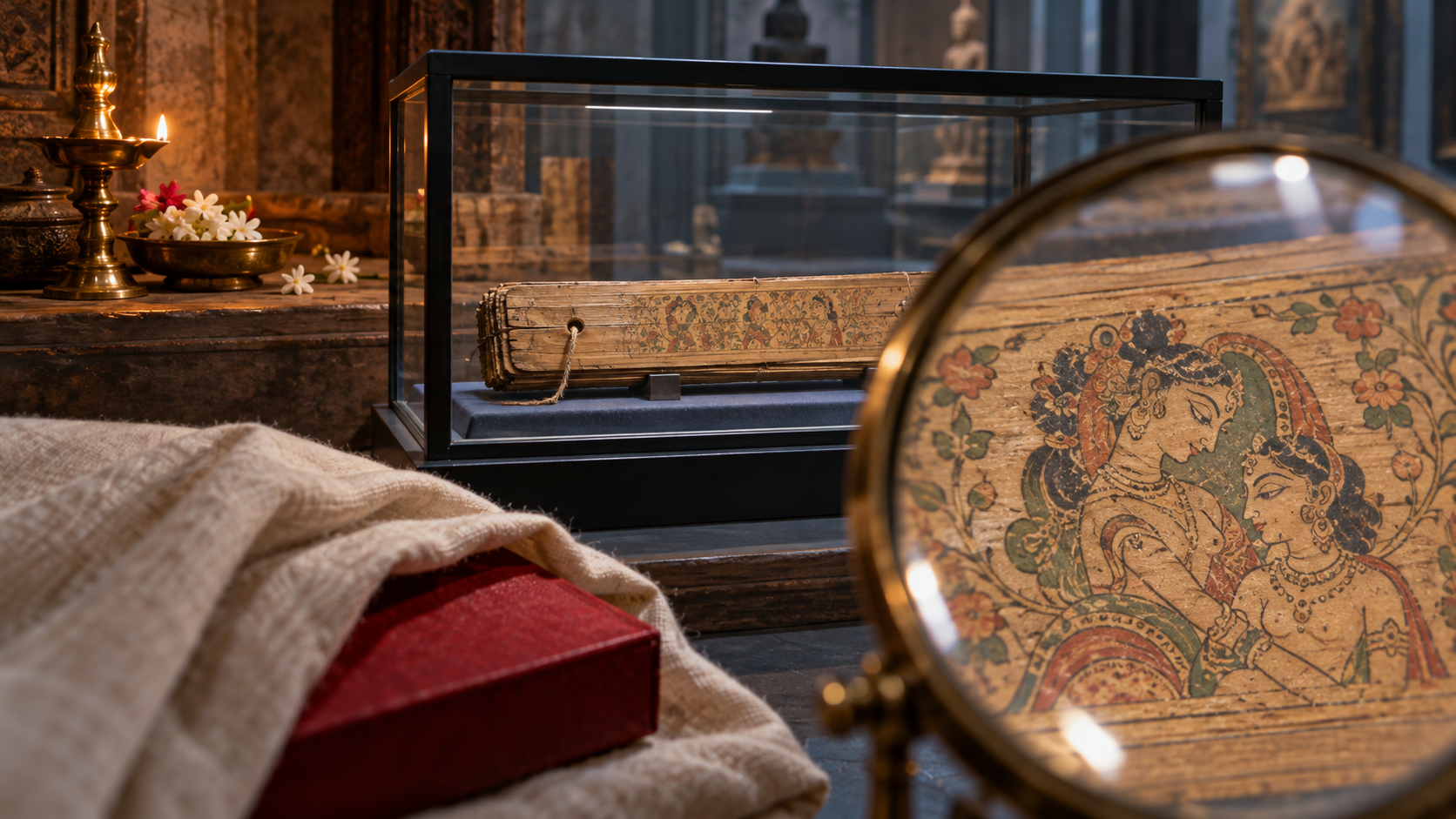
Modern reception did not develop in an empty room. The colonial-era recovery of the Kamasutra and other Indian cultural remains occurred amid British judgments about Indian morality. For interpreters already inclined to regard India as immoral, the work could be treated as confirmation of an existing civilisational prejudice. The stereotype was not created by neutral reading alone.
A defensive response can reproduce the same distortion from the other direction. Under pressure to prove that Hindu civilisation meets an imported standard of respectability, readers may accent self-restraint and push kama to the edge of the tradition. The result is a selective inheritance: one part is presented as authentic, while another is treated as an awkward exception.
Commercial culture performs a third reduction. The Kamasutra name was used in condom advertising because it offered wide recognisability, an erotic signal, and borrowed cultural legitimacy. That is effective branding, but it is not the recovery of Vatsyayana’s intellectual world. A marketable fragment has been detached from its larger setting and returned to the public as the meaning of the whole.
- Colonial filter: selects whatever can serve as evidence of Indian excess or inferiority.
- Defensive filter: suppresses kama to demonstrate moral respectability.
- Commercial filter: turns civilisational memory into a portable erotic trademark.
You can detect these filters by looking at what has vanished. If an interpretation retains sexual novelty but loses dharma, artha, moksha, reasoning, and social context, it is probably a caricature. If it retains restraint but cannot admit that kama received serious analysis, it is also incomplete. If it uses antiquity only to authenticate a modern product or ideology, treat the claim as positioning before treating it as history.
Follow a disciplined six-step reading practice

You do not need to resolve every scholarly dispute before reading responsibly. You do need a procedure that prevents a striking passage from carrying more historical or moral weight than it can bear.
- Write down the question you are actually asking. Historical practice, Sanskrit intellectual method, moral authority, and contemporary sexual ethics are different questions. Do not let an answer to one silently become an answer to all four.
- Record the edition and translation. Interpretive language can enter through translation. Do not compare English phrases from different versions as if their wording were automatically Vatsyayana’s own.
- Place the passage within the domain of kama. Then ask how dharma, artha, and moksha would complicate any attempt to turn it into a complete rule for life.
- Identify what the passage is doing. Classification, instruction, idealisation, observation, and logical enumeration make different kinds of claims.
- Test more than one lens. Read once for cultivated experience, once for systematic analysis, and once for formal classification. Keep the interpretation that explains the most details while importing the fewest assumptions.
- State your contemporary judgment openly. Cultural importance does not make every premodern prescription binding. If you are drawing a present-day ethical conclusion, name present-day requirements such as consent, reciprocity, dignity, and freedom from coercion rather than pretending that antiquity alone has settled the question.
Key takeaways
- Kama is a recognised field of human concern within a larger Dharmic account of life; it is not the whole of that account.
- A classification proves that a distinction was formulated, not that the corresponding conduct was universal or common.
- Erotic art, sexual science, social history, and logical training are interpretive lenses. None should become an automatic verdict on every passage.
- Colonial judgment, defensive nationalism, and commercial branding can all preserve the same narrow image for different reasons.
- Respecting a civilisational work does not require treating every statement as timeless instruction or modern social policy.
The next time someone invokes the Kamasutra as proof that ancient India was either depraved, prudish, liberated, or secretly modern, ask them to show the passage, identify the kind of claim it makes, name the lens being used, and supply evidence for its historical reach. That small discipline turns a cultural slogan back into a serious encounter with Indian thought.
References

Leave a Reply
You must be logged in to post a comment.