
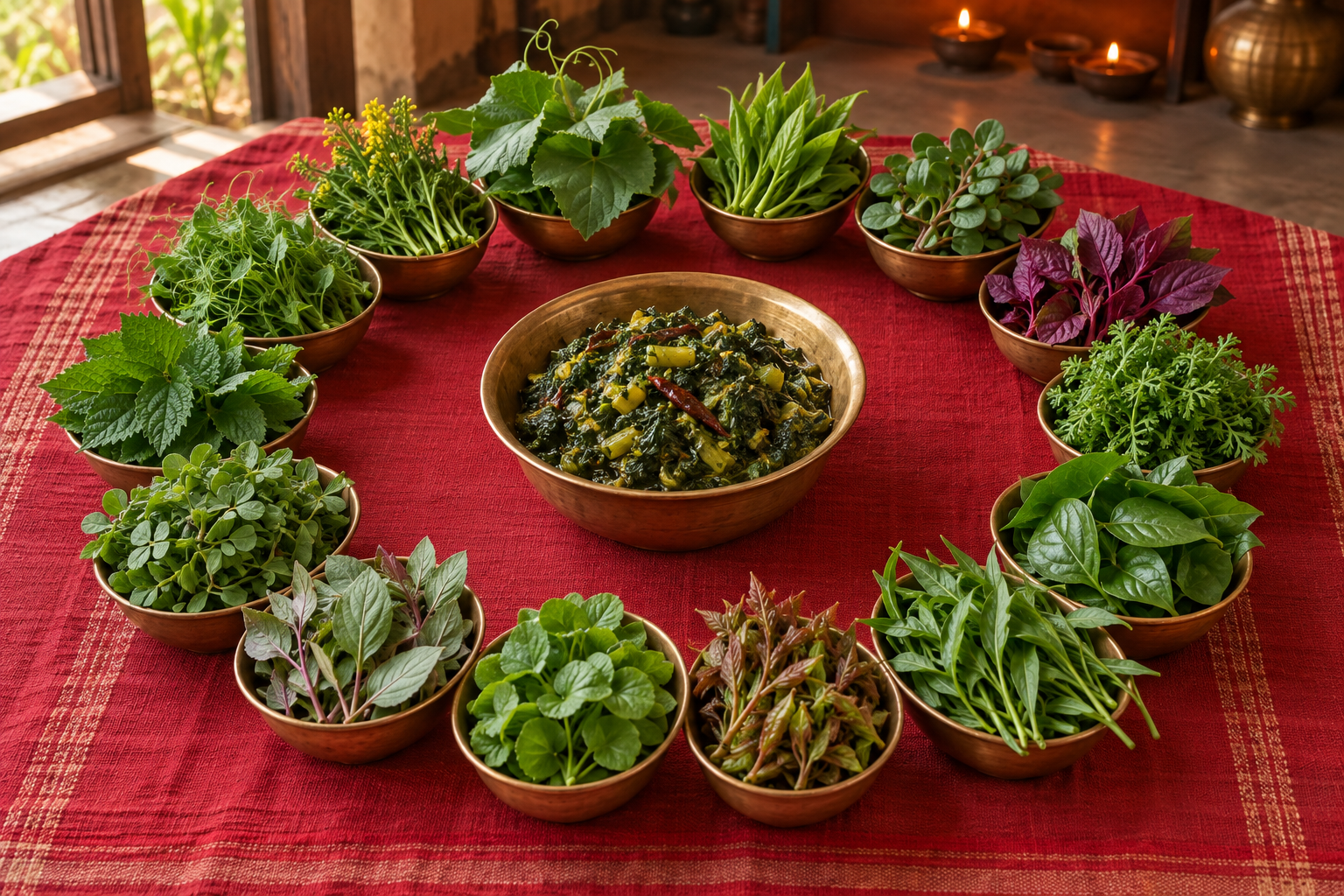
You are preparing for Bhoot Chaturdashi, but the greens named by your family do not perfectly match the list you found elsewhere. That does not necessarily mean anyone has forgotten the custom. Bengal’s plant names, market supplies, and household practices are local, so the selection can change while the ritual number remains fourteen.
The essential practice is to eat fourteen different kinds of shaak on Bhoot Chaturdashi, immediately before Kali Puja. If you want to observe it faithfully, first identify the version inherited by your family or locality. Use the list below as a practical starting point, not as a reason to dismiss a genuine regional variation.
The fourteen names to take to the market
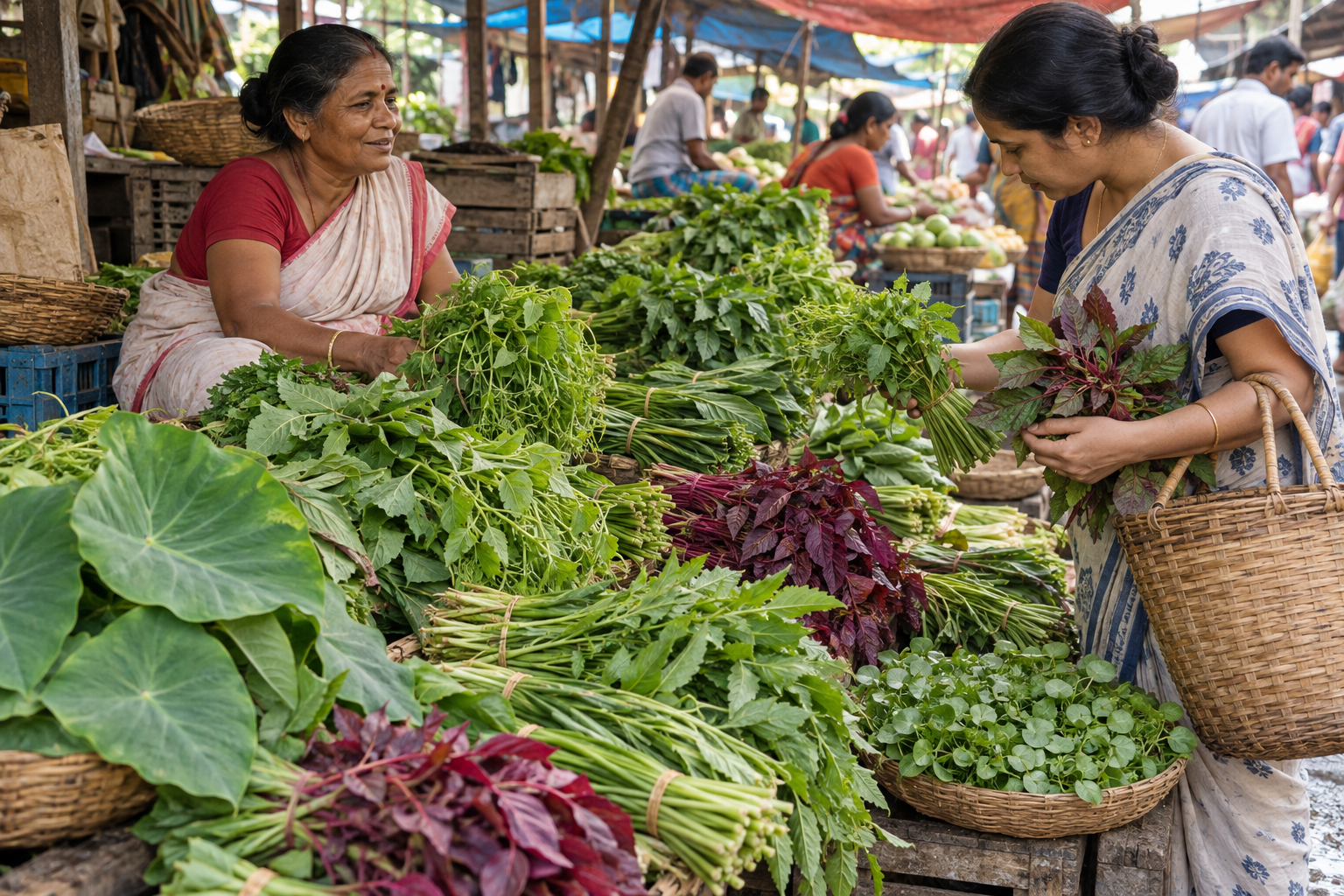
A commonly recorded Bhoot Chaturdashi list contains the following fourteen greens. Keep the Bengali script beside the Roman spelling when you shop; pronunciation and transliteration can vary, while the Bengali name gives a knowledgeable relative or vendor more information to work with.
- Ol (ওল)
- Keu (কেউ)
- Beto (বেতো)
- Kalka-shunde (কালকাসুন্দে)
- Neem leaves (নিমপাতা)
- Joyonti (জয়ন্তী)
- Sorshe (সর্ষে)
- Sancha (সাঞ্চে)
- Hilencha (হিলঞ্চা)
- Polta (পলতা)
- Shulka (শুল্কা)
- Guloncho (গুলঞ্চ)
- Ghentu (ঘেঁটু)
- Shushuni (শুষনি)
These are traditional market and household names, not a complete botanical identification guide. Do not select an unfamiliar plant merely because its seller uses a name that sounds similar. Confirm it with someone who knows the edible greens of your area.
Decide which fourteen belong to your family
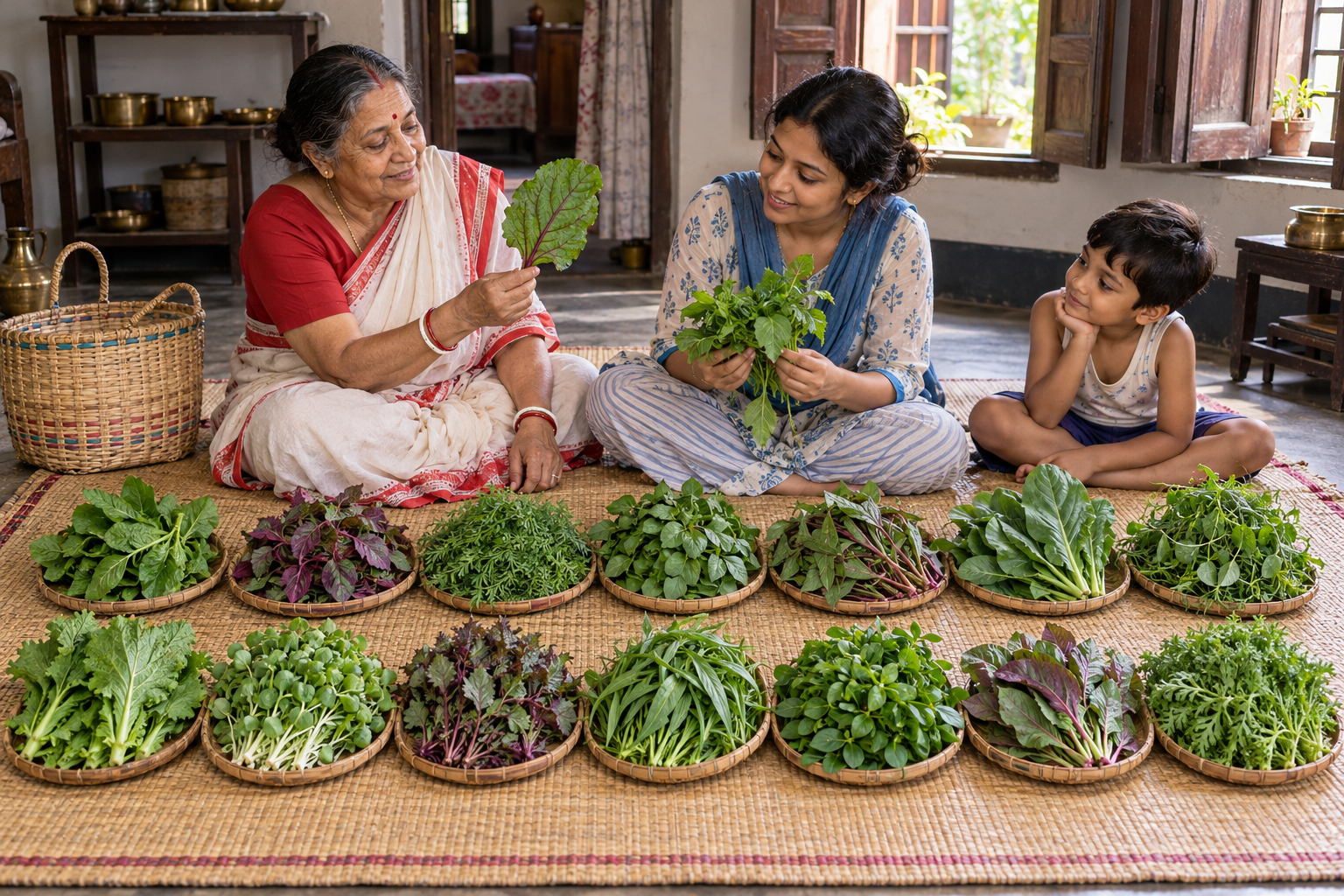
The custom has a stable structure and a variable local expression. Fourteen different types are required, but the exact types may differ by region. That distinction helps you avoid two opposite mistakes: treating one published list as the only legitimate Bengali tradition, or treating the number fourteen as optional because lists differ.
- Begin with household memory. Ask the person who has prepared the meal in your family which names were actually used. Request the Bengali names as well as any local pronunciations.
- Check those names locally. Show the written list to a trusted vegetable seller or another person familiar with regional shaak. A spoken Roman spelling alone may not be enough for a reliable identification.
- Mark every variation. If your family uses another green in place of one on the working list, write down both names. Do not quietly rename a substitute as though the lists were identical.
- Count distinct types, not portions. Dividing one familiar green into fourteen portions does not reproduce a custom that calls for fourteen different kinds of shaak.
- Save the final list. Record the Bengali spelling, the local name, and the relative or vendor who confirmed it. This turns next year’s preparation from a fresh search into an inherited household record.
If your family no longer remembers its version, use the fourteen-name list above and adapt only where a locally accepted identification or regional practice gives you a sound reason. Be transparent about the adaptation. Faithful transmission depends as much on remembering what changed as on remembering what remained.
Prepare the observance without inventing extra rules
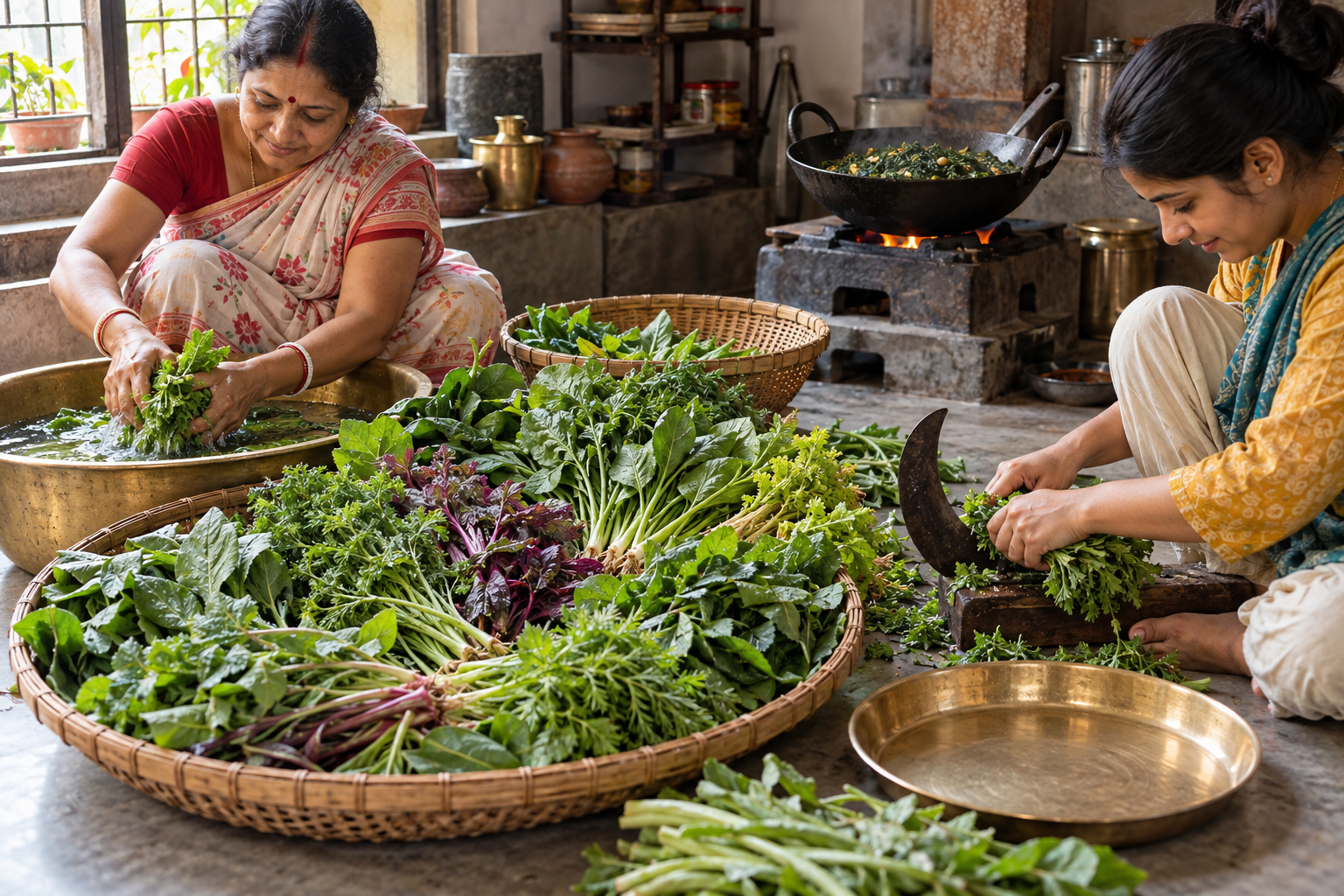
The defining instruction available to us concerns what is eaten: fourteen different shaak. It does not establish one universal recipe for every Bengali household. If your family has an inherited preparation, follow it. If it does not, avoid declaring a newly chosen cooking method to be the mandatory traditional method.
- Lay out the fourteen identified ingredients separately before cleaning or cutting them. Count them while their identities are still visible.
- Attach a written name to any bundle you do not recognize immediately. This prevents two similar-looking greens from being confused during preparation.
- Keep a regional replacement distinct in your notes. A substitution may preserve your local observance, but it should not erase the name of the version from which you began.
- Use only greens that a knowledgeable person has identified as edible. Do not forage for an unknown leaf merely to complete the number; a mistaken identification creates a real safety risk.
- Let the family method govern how the greens are combined or served. The ritual does not become more authentic because someone adds unsupported restrictions to it.
This approach keeps the practical work aligned with the tradition’s actual shape. You preserve the number, the diversity of greens, and the local chain of knowledge without pretending that every Bengali kitchen must contain an identical set of plants.
What the custom preserves beyond a single meal
You do not need an elaborate origin story to recognize what this observance does. Preparing fourteen greens requires a family to remember plant names, consult older knowledge, notice regional availability, and place those things inside the sacred calendar. The practice carries vocabulary and household memory precisely because it has to be performed, not merely admired.
Regional variation is part of that transmission. A plant available under one name in one locality may be absent, differently named, or replaced elsewhere. Recording those differences does not weaken the tradition. It shows how a shared Bengali ritual lives through particular landscapes and families.
What weakens the chain is avoidable vagueness. If every green becomes simply “some shaak,” the next generation inherits a number without the knowledge that gives the number substance. Teach the names while preparing the food. Keep the Bengali spellings. Say openly which entries belong to your family’s version.
Quick answers before you shop
When are the fourteen greens eaten?
They are eaten on Bhoot Chaturdashi, the observance immediately before Kali Puja.
Does every Bengali household need the identical list?
No. The exact selection can vary by region. Preserve your family’s or locality’s established version where you know it, while retaining the defining pattern of fourteen different types.
Can one green be counted several times?
No. The custom calls for fourteen different greens, not fourteen servings made from one type.
What should you do if a green cannot be identified?
Do not guess or consume an unknown plant. Take the Bengali name and your complete list to a trusted local seller or knowledgeable family member. Use a replacement only when it belongs to an accepted family or regional practice, and note the change for the future.
Before the next Bhoot Chaturdashi, make one durable family checklist with all fourteen Bengali names and your local variations. Bring it into the kitchen, invite a younger family member to identify each green, and pass on more than a plate: pass on the knowledge required to prepare it again.
References

Leave a Reply
You must be logged in to post a comment.