

You are at a temple entrance and someone asks you to affirm faith before proceeding. You may accept the deity as sacred yet hesitate because the request sounds like a demand to change your religious identity. Do not answer from embarrassment, pressure, or a desire to end the argument quickly.
The decisive questions are practical: What, exactly, are you being asked to affirm? Who has imposed the condition? What will your answer be taken to mean? Those questions separate a temple’s legitimate sacred boundary from a broader claim over your identity.
Affirmation and conversion are different acts

An affirmation states what you accept in a particular setting. At a temple, it may concern faith in the presiding deity, the devotional purpose of your visit, or your willingness to observe the discipline of worship. Conversion is broader: it involves adopting or being treated as having adopted a religious identity.
The two acts can accompany each other when a person intentionally makes an affirmation as part of conversion. That possibility does not make them synonyms. A statement about one deity, one act of darshan, or one sacred space does not automatically amount to accepting every Hindu doctrine, joining a particular sampradaya, or renouncing another identity. The actual words and intended consequences matter.
This distinction became concrete in a temple-entry dispute in which the Madras High Court said Tamil Nadu Chief Minister Vijay had been asked to affirm faith in the deity, not convert to Hinduism. That distinction is useful, but it should not be turned into a universal rule for every temple or every declaration. Temple traditions, entrance conditions, wording, management authority, and applicable law can differ.
A temple is not merely a monument or public viewing gallery. It is a consecrated place ordered toward a deity and a living tradition of worship. Its custodians can therefore have a serious interest in preventing mockery, disruption, deceptive entry, or the treatment of darshan as spectacle. The visitor’s conscience is serious too. Sacredness is not protected by inducing someone to make a statement that is untrue.
Key takeaways
- Do not let the labels “affirmation” or “conversion” decide the issue. Read the exact words.
- A declaration focused on faith in a deity is ordinarily narrower than a declaration adopting a new religious identity, unless its wording expressly goes further.
- If you cannot affirm the requested belief truthfully, do not simulate faith merely to obtain entry.
- A temple should state the minimum spiritual or behavioural condition it actually needs, not rely on an improvised or ambiguous demand.
- A judicial distinction made in one dispute can clarify the concepts without creating an identical entrance rule for every temple.
Test the request for scope, authority, and consequence
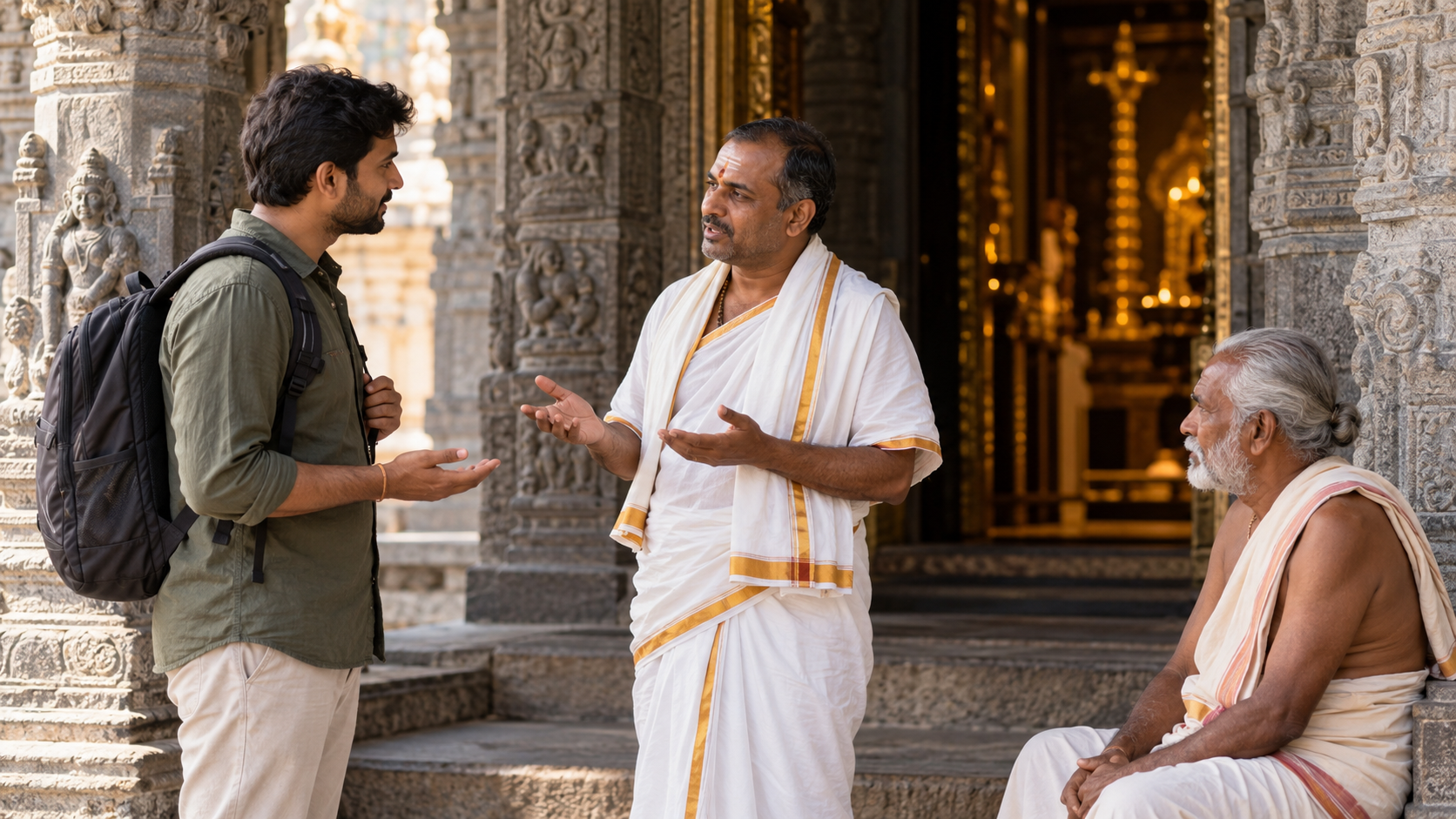
Before deciding whether a temple-entry condition is reasonable or whether you can accept it, test it on three axes. This works whether you are a visitor, trustee, priest, official, or advocate.
Scope: Identify the precise proposition. “I will observe the dress and photography rules” concerns conduct. “I acknowledge this deity as sacred” expresses reverence. “I have faith in this deity” states belief. “I adopt Hinduism and renounce my previous religious identity” makes a much broader identity claim. These sentences are not interchangeable, even if someone casually calls all of them an affirmation.
Watch especially for bundled wording. A person may sincerely affirm devotion to the deity while being unable to accept an unrelated political statement, an undefined institutional allegiance, or a declaration about every aspect of religious identity. If the protected interest is faith in the deity, the request should stay focused on that interest.
Authority: Ask whether the request comes from the temple’s recognised management or from an individual improvising at the gate. A published rule administered consistently is different from a new demand made by a volunteer, bystander, or crowd. Request the rule in writing when its authority is unclear. If no written version exists, ask for the responsible temple officer rather than debating theology with gate staff.
Consequence: Determine what happens after you answer. Is the statement limited to access for worship on that visit? Will it be signed, recorded, published, or used in an existing legal dispute? Does it purport to establish religious identity beyond the temple premises? The more permanent, public, or legally consequential the declaration is, the less safely you can infer its meaning from a casual verbal explanation.
If a written or recorded declaration purports to alter your legal status, affect civil rights, or become evidence in litigation, obtain advice from a lawyer familiar with the applicable jurisdiction before signing. A temple volunteer’s reassurance is not a substitute for understanding a document with possible legal consequences.
What to do when you are the visitor
You do not need to choose between hostility and blind compliance. A disciplined response protects both your conscience and the dignity of the temple.
- Ask for the exact sentence. Say: “Please show me the precise declaration and explain whether it concerns entry for worship or a change of religious identity.” Do not argue over a paraphrase if an official form or rule exists.
- Translate it into plain language. Identify whether it asks for respectful conduct, recognition of sacredness, personal faith, membership in a tradition, or renunciation of another identity. If it combines several claims, ask whether they can be considered separately.
- Answer only to the extent that the statement is true. If you have faith in the deity and the request is limited to that faith, you can say so directly. Do not add a broader profession that no one asked for, and do not allow someone else to enlarge your answer afterward.
- Decline false words without insulting the tradition. You can say: “I respect this temple, but I cannot truthfully make that declaration.” Respectful non-entry is more honest than performing belief to cross the threshold.
- Ask whether a permitted alternative exists. Depending on the temple, there may or may not be access to an outer precinct, a visitor area, an information point, or another authorised arrangement. Ask; do not assume an exception and do not enter a restricted area by deception.
- Keep the dispute orderly. Note the wording, the stated authority, and the official contact for review. Do not violate photography rules or disrupt worship while trying to document the encounter. If you contest the decision, do so through the temple’s responsible management or the appropriate legal process.
You should also resist a common mistake: treating personal offence as proof that the condition is illegitimate. A sacred institution may draw boundaries that disappoint you. The proper questions are whether the boundary genuinely serves the temple’s religious character, whether the authorised rule says what staff claim it says, and whether it is being applied lawfully and honestly.
How temples can protect sanctity without creating confusion

Temple administrators face a different responsibility. They must protect a living sacred space while ensuring that visitors and staff understand the boundary. Vague wording weakens that work because it invites inconsistent enforcement and turns a theological condition into a quarrel over labels.
- Name the protected interest. Decide whether the condition concerns faith in the deity, ritual eligibility, observance of conduct rules, or qualification under a particular tradition. Do not collapse these into one undefined test.
- Use the minimum necessary declaration. If faith in the deity is the relevant condition, ask about faith in the deity. Do not attach unrelated ideological, political, or identity claims.
- Separate belief from conduct. Dress, cleanliness, photography, food, noise, and ritual movement are behavioural matters. State them as rules of conduct rather than pretending that compliance proves belief.
- Define the boundary. Identify the area or ritual for which the condition applies. A rule for entry into a restricted sanctum should not be described imprecisely as though it governed every part of the temple complex.
- Publish the wording before the point of refusal. Clear notice gives a visitor time to understand the condition without holding up worship or creating a confrontation at the threshold.
- Authorise specific staff to explain it. Gate personnel should know the wording, the reason for it, and the person to whom a disputed case must be referred. They should not invent extra tests.
- State what the declaration does not claim. If it concerns devotional access rather than conversion, say so plainly. This prevents both exaggerated accusations and exaggerated claims about what the visitor has professed.
A clarity model might read: Entry to this worship area is reserved for those who affirm faith in the presiding deity and agree to observe the posted rules of worship. This declaration concerns access to this area; it does not by itself ask a visitor to adopt a new religious identity.
That wording is a model of precision, not a universal legal form. A temple should adapt any declaration to its own tradition and have it checked under applicable law, especially where access is contested. The aim is not to drain the threshold of theological meaning. It is to make the meaning intelligible.
Hindu pluralism does not require a temple to become spiritually neutral. Nor does reverence permit careless language about another person’s identity. Before the next dispute, temple boards should put the actual rule, its scope, and its review path in writing. Before your next visit, decide what you can affirm truthfully. When the words match the sacred boundary being protected, the deity is honoured without turning entry into a test of guesswork.
References

Leave a Reply
You must be logged in to post a comment.