

If you are deciding whether the World Hindu Congress 2026 deserves your time, do not begin with the speakers you might hear or the prominent people you might meet. Begin with a harder question: what problem affecting Hindu Samaj are you prepared to help move?
The Congress is scheduled for 18-20 December 2026 at Mumbai’s Jio Convention Centre. Its theme, Samanam Vrtam Saha Cittam, is rendered as Shared Commitment: Collective Resolve. You will get more from those three days if you arrive with a defined concern, a useful contribution and a realistic request instead of treating the gathering as a large lecture programme.
Treat the Congress as a working sangam, not a lecture circuit
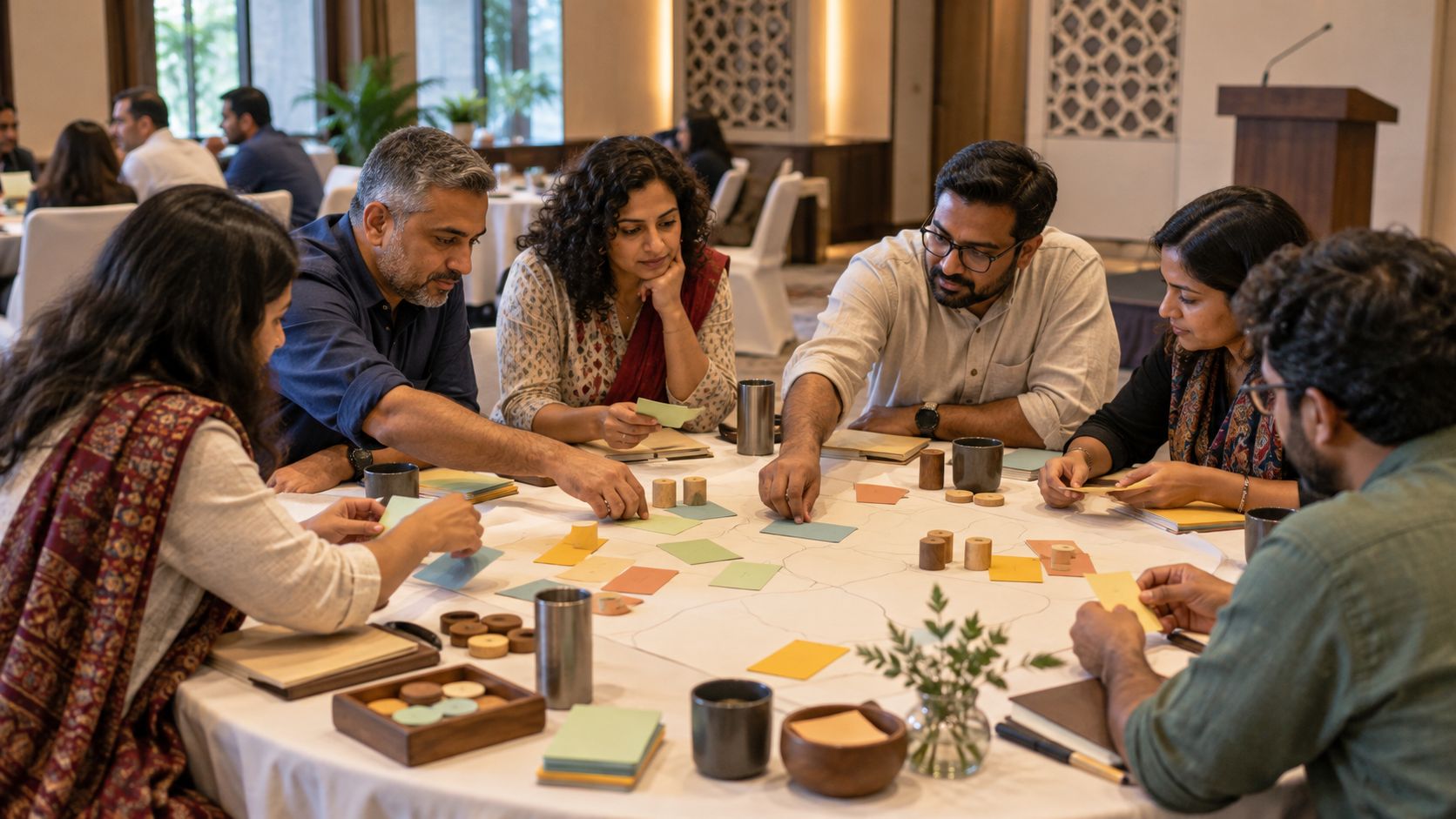
The scale is considerable. Hindu communities include an estimated 1.2 billion people across 180 countries, or about 17 percent of the world’s population. Those communities do not share identical political environments, educational systems, media conditions, economic resources or institutional needs. A global Hindu gathering therefore has to create cooperation without pretending that every participant faces the same problem.
Shared commitment should not be confused with uniform opinion. Serious intellectual work requires precise definitions, verifiable evidence, room for disagreement and a clear account of trade-offs. If a session produces applause but nobody can identify the decision, responsibility or next action, enthusiasm has not yet become collective resolve.
WHC brings leaders, thinkers, activists and influencers into seven concurrent thematic conferences. Earlier congresses were held in New Delhi in 2014, Chicago in 2018 and Bangkok in 2023. The announced agenda combines cultural, spiritual and material advancement with responses to discrimination, denial of rights, and physical or cultural threats faced by Hindus. That breadth is valuable, but it can also tempt you to arrive with a concern so large that nobody can act on it.
Before you go, reduce your concern to a workable scope. Ask yourself:
- Which community, institution or jurisdiction does this problem affect?
- What part of the problem can my organisation or network genuinely influence?
- What do we know, and what are we merely assuming?
- Which decision or relationship could move the work forward?
- What can we contribute before asking anyone else to contribute?
This discipline does not make your aspiration smaller. It turns a civilisational concern into a task another person can understand, examine and join.
Choose your conference by the work that is blocked
You may fit several parts of the programme. A teacher can also be a writer, a temple volunteer, a parent and an entrepreneur. But the concurrent design makes indiscriminate participation costly. Choose your principal conference according to the bottleneck in your work, not simply according to your professional label.
| Conference | Who and what it brings together | A useful working question to carry |
|---|---|---|
| World Hindu Economic Forum | Industrialists, entrepreneurs, bankers, executives, economists and business strategists, with an emphasis on trade, investment and mentorship | Which credible commercial or mentoring relationship would help a Hindu enterprise or professional network advance? |
| Hindu Education Conference | Educators, academics, administrators, officials, students and other stakeholders concerned with access, academic leadership and accurate representation of Hindu civilisation | Is our present obstacle curriculum quality, institutional access, scholarly standards, teacher capacity or public understanding? |
| Hindu Media Conference | Journalistic, cinematic and entertainment-media participants working on honest reporting and authentic representation | Which specific Hindu reality is poorly represented, what evidence establishes the problem, and what format could communicate it accurately? |
| Hindu Political Conference | Lawmakers, diplomats, administrators, policy specialists, and human and civil-rights advocates working under the idea of responsible democracy | Which policy or rights issue needs a better factual record, institutional route or democratic response? |
| Hindu Women’s Conference | Women from varied professions and backgrounds sharing expertise, forming connections and strengthening leadership | What contribution by women leaders is currently missing, underused or isolated from the institutions that need it? |
| Hindu Youth Conference | Students and young people engaging with Hindu values, history, leadership, human rights, democracy and responsible citizenship | What can young Hindus own and lead, rather than merely attend or endorse? |
| Hindu Organisations Conference | Hindu organisations, temples, associations and institutions exchanging experience and operational knowledge | Which practice, resource or partnership could help institutions cooperate instead of duplicating effort? |
The right choice may be less obvious than it first appears. If you are correcting the representation of Hindu civilisation in a curriculum, your intellectual work belongs in education, but your immediate bottleneck may be public communication. If you run a youth initiative, your programme may belong in the youth conference while its sustainability problem belongs in the economic forum. If a temple has valuable local evidence about discrimination, its most important connection may be with rights advocates or responsible media professionals.
Select a principal lane, then identify the adjacent lane on which your result depends. Do not try to cover all seven conferences. Your aim is not to accumulate session notes. It is to connect the right forms of knowledge and responsibility.
Bring a collaboration brief that people can act on

Large gatherings produce countless introductions and very few usable proposals. The difference is usually not passion. It is preparation. A concise collaboration brief gives a new contact enough information to decide whether the work is relevant, credible and within their capacity.
- Name the problem precisely. Identify the affected community, place, institution or process. Avoid phrases such as Hindu awareness must increase unless you can say whose awareness, about what and for what purpose.
- Separate evidence from interpretation. List what you can document, what people have reported, what you infer from those facts and what remains unresolved. This prevents a working hypothesis from hardening into a public accusation.
- State what you already contribute. This could be subject knowledge, verified records, community access, organisational capacity, a venue, volunteers, editorial skill or a professional network. A partnership begins with reciprocal value.
- Make a bounded request. Ask for an expert review, a relevant introduction, a pilot partner, access to a defined body of knowledge or help testing a method. Do not ask a new acquaintance to solve the whole problem.
- Define the first decision. Specify what needs to be decided, who has authority to decide it and what information that person will require.
- Prepare the handoff. Have a document, contact channel and named owner ready so that the conversation can continue without reconstructing it from memory.
A usable education brief, for example, would not merely declare that Hindu civilisation is misrepresented. It would identify the syllabus or institution being reviewed, show the passages in question, explain the standard by which they are being assessed, and request qualified academic and editorial scrutiny. The resulting conversation can test evidence and method. A sweeping grievance usually produces only agreement in principle.
The same rule applies to rights concerns. If the matter involves discrimination, threats or assault, do not turn an allegation into networking copy. Preserve original records, distinguish direct testimony from inference, protect vulnerable people and determine who is authorised to share sensitive information. Credibility is not a restraint on Hindu advocacy. It is what allows advocacy to survive scrutiny.
Connect the seven tracks without blurring their responsibilities

The deepest value of an intellectual gathering often lies between its formal tracks. Hindu challenges rarely respect professional boundaries, yet collaboration fails when everyone assumes that another sector will perform the difficult part. Map the handoffs explicitly.
- Representation in education may require educators to establish the scholarly case, media professionals to explain it faithfully, and policy participants to identify the proper institutional route.
- Human and civil-rights concerns may require local organisations to preserve evidence, advocates to assess remedies, and journalists to establish an accurate public record without endangering those involved.
- Youth leadership may require young people to define their actual needs, educators to develop sound learning material, experienced professionals to mentor, and community institutions to provide responsibility rather than ceremonial visibility.
- Economic advancement may require business expertise, access to emerging talent, participation by women leaders and trusted community institutions capable of extending opportunity beyond an existing network.
- Organisational strength may require shared operating practices, responsible financing, clear communication and a method for transferring knowledge when volunteers or office-holders change.
When you meet someone from an adjacent field, use a working handoff instead of a generic exchange of contact details. Record the shared problem, the contribution each side can make, the next action, its owner and the date both sides accept. If no owner has accepted the next action, you have an interesting conversation, not a commitment.
Also verify authority. A participant may understand your concern without being empowered to commit an institution, publish material, provide funding or speak for a community. Before announcing a partnership, confirm the person’s role, the approval process and what can be stated publicly. If an initiative involves money, personal data, formal representation or potentially defamatory claims, obtain the appropriate financial, legal, privacy or editorial review before acting.
Make collective resolve visible after Mumbai

A conference can create attention and trust, but it cannot execute your obligations after everyone leaves. Build the follow-through system before the gathering begins.
For every substantive conversation, capture:
- the person’s role and the institution they are authorised to represent;
- the problem as both sides understood it;
- points of agreement and any important disagreement;
- the action each participant actually accepted;
- dependencies, approvals or evidence still required;
- the agreed contact channel and follow-up date;
- what, if anything, may be shared outside the conversation.
Review your notes at the end of each conference day. Mark confirmed commitments separately from ideas that still need verification, introductions that have only been requested, and conversations that produced no fit. This keeps social warmth from being mistaken for institutional agreement.
Your follow-up message should be short enough to answer. Restate the context, the agreed action, the owner, the required material and the accepted deadline. Attach only what is needed for that action. A crowded group message containing every person you met makes responsibility less clear rather than more collective.
Measure results through completed commitments, not the number of contacts collected. Depending on your purpose, a meaningful result could be a reviewed curriculum submission, a documented rights case sent through the proper channel, a responsible media collaboration, a mentorship relationship, an institutional resource exchange or a defined civic initiative led by Hindu youth. Record why a commitment stalled as carefully as you record a success; repeated obstacles reveal where future coordination is needed.
Key takeaways
- WHC 2026 is scheduled for 18-20 December at Mumbai’s Jio Convention Centre under the theme Shared Commitment: Collective Resolve.
- Choose among the seven conferences according to the bottleneck in your work, then identify the adjacent field on which progress depends.
- Carry a concise brief that distinguishes evidence from assumption and states your contribution, request, decision and handoff.
- Treat disagreement as part of intellectual work. Unity becomes stronger when claims can withstand examination.
- Do not call an introduction a partnership. Confirm authority, ownership, permission and the next action.
- Judge the gathering by what participants responsibly complete after Mumbai, not by the volume of applause, photographs or contact exchanges.
Before you commit your travel and time, write down the problem you will carry, the contribution you can offer, the request you will make and the person who will own the next step. If those lines remain vague, refine them now. If they are clear, the World Hindu Congress can become more than an inspiring gathering for you: it can become the place where necessary Hindu work finds the people, discipline and shared resolve to begin.
References

Leave a Reply
You must be logged in to post a comment.