
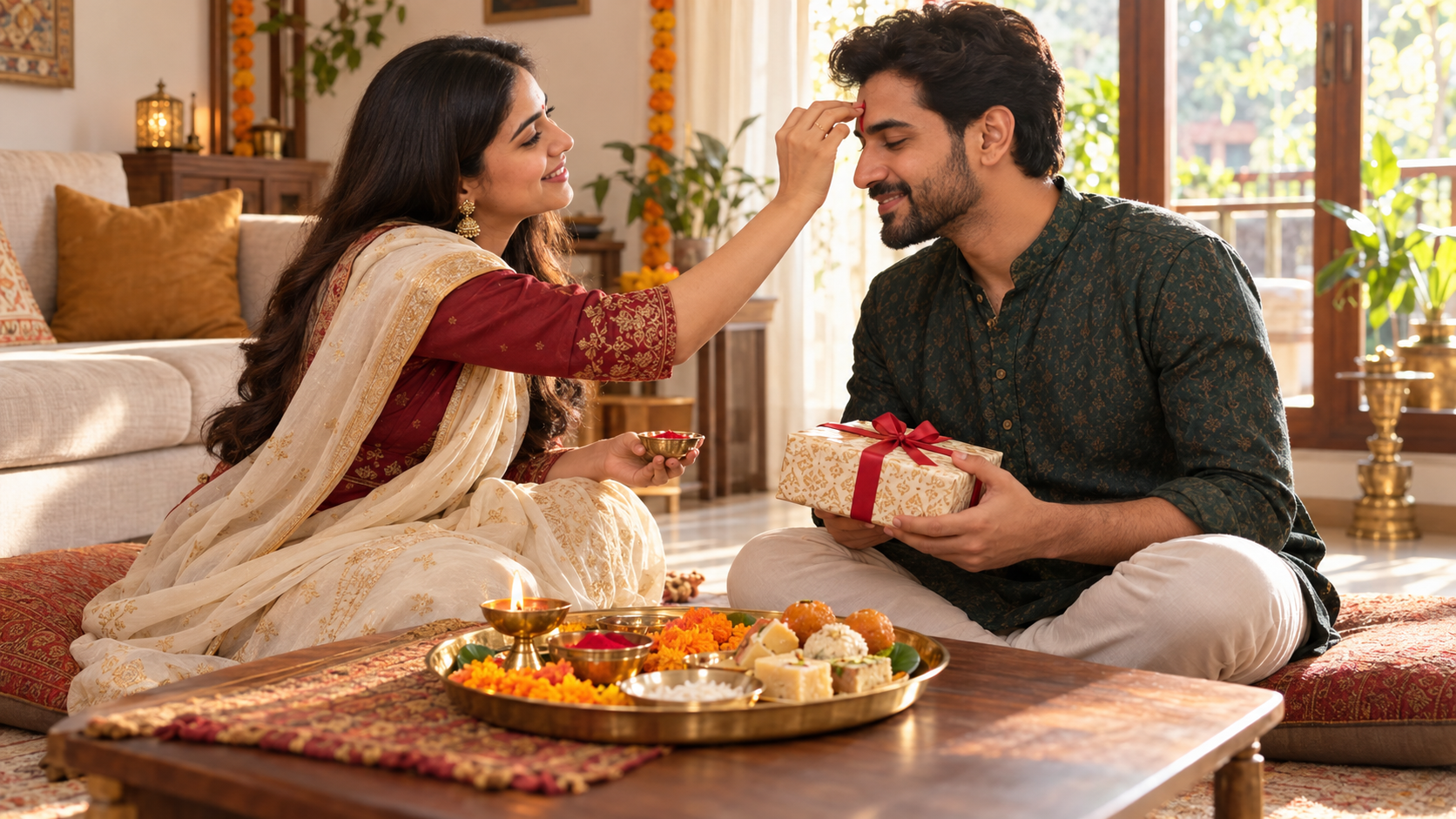
If you want to observe Bhai Dooj but aren’t sure which family version is correct, begin with the relationship rather than the performance. Set aside a deliberate meeting between sister and brother, offer reciprocal blessings, and let your inherited custom determine the details.
That distinction matters. A tilak, a sweet and a gift can be completed in minutes, yet the observance asks for more than a ceremonial photograph. It gives siblings a protected moment to recognise the struggles each is carrying and to express practical goodwill for the year ahead.
Keep the reciprocal purpose at the centre
Bhai Dooj is observed two days after Diwali and is set apart for brothers and sisters. If you are choosing a date for a family gathering, use the Bhai Dooj, Bhai Phonta or Bhaubeej entry in the panchang or temple calendar followed by your family. Do not assume that adding two ordinary 24-hour periods to a Diwali gathering will always settle the local ritual time.
The festival’s emotional structure is reciprocal. The sister prays that her brother will return victorious from life’s battles; the brother wishes his sister success in her own struggles. The brother is therefore not the only person whose welfare matters, and the sister is not merely performing a service for him.
You can make that reciprocity concrete. Before the ritual, each sibling can name one real challenge ahead: an examination, a demanding responsibility, a difficult decision or the work of caring for a family. After the traditional blessing, each can offer one specific form of support. A promise to make a weekly call, help with an application or accompany someone to an important appointment gives the blessing a life beyond the day itself.
Victory here need not mean defeating another person. It can mean meeting difficulty without abandoning dharma, returning safely from a demanding undertaking, or finding the steadiness to do what is right. That reading keeps the language of blessing strong without turning it into empty praise.
Read the stories as models for sibling conduct
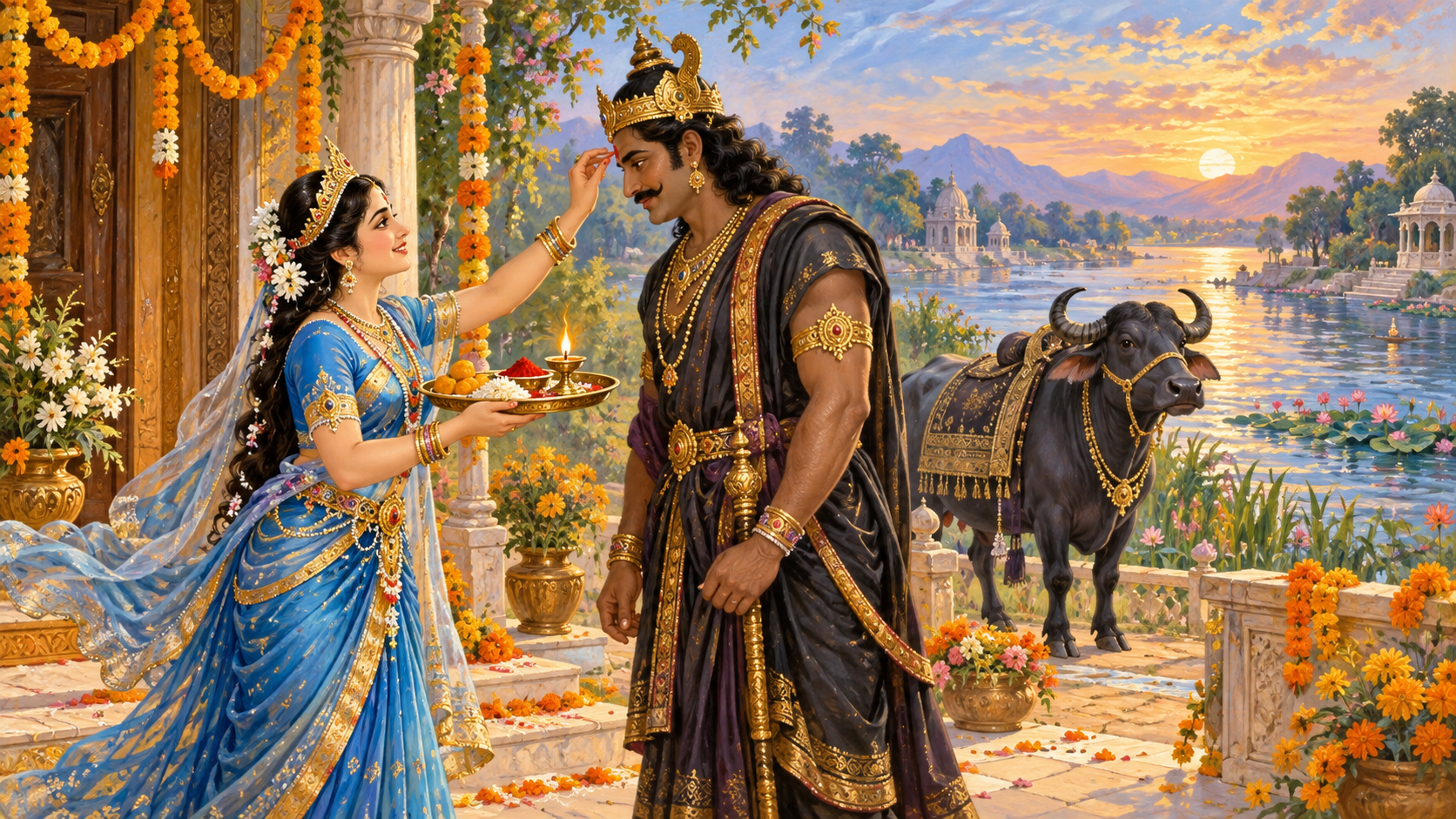
Krishna and Subhadra: welcome after struggle
One prominent Bhai Dooj tradition remembers Sri Krishna and his sister Subhadra. Krishna returns after conflict, and Subhadra receives him with an auspicious welcome. The story gives the familiar forehead mark a relational meaning: the sister acknowledges the brother who has returned, honours his effort and blesses what lies ahead.
Its lesson is subtler than a claim that a powerful brother needs ceremonial praise. Even Krishna is received by a sister. Strength does not cancel kinship, and success does not make someone independent of affection, prayer or a place of welcome. When you apply the tilak or phonta, let it communicate that the returning sibling is seen as a whole person, not valued only for achievements.
Lakshmi and Bali Raja: relationship carries obligation
Lakshmi and Bali Raja form another narrative current associated with the day. Families and regions may preserve different sequences when telling this story, and related festival narratives can become mixed in casual retellings. If this is the account inherited in your home, ask an elder to narrate the complete family version instead of assembling one from disconnected details.
The useful question carried by this tradition is not simply, “Which event happened first?” It is, “What does a recognised family bond require of us?” Sacred kinship brings duties of honour, hospitality, protection and truthful dealing. A festival story has done its work when those duties become visible in family conduct.
You do not need to force the Krishna-Subhadra and Lakshmi-Bali Raja traditions into one universal origin account. Hindu observances often live through regional memory, household practice and more than one sacred narrative. Preserve the version you actually received, while allowing another family to preserve its own.
A simple Bhai Dooj observance you can adapt at home
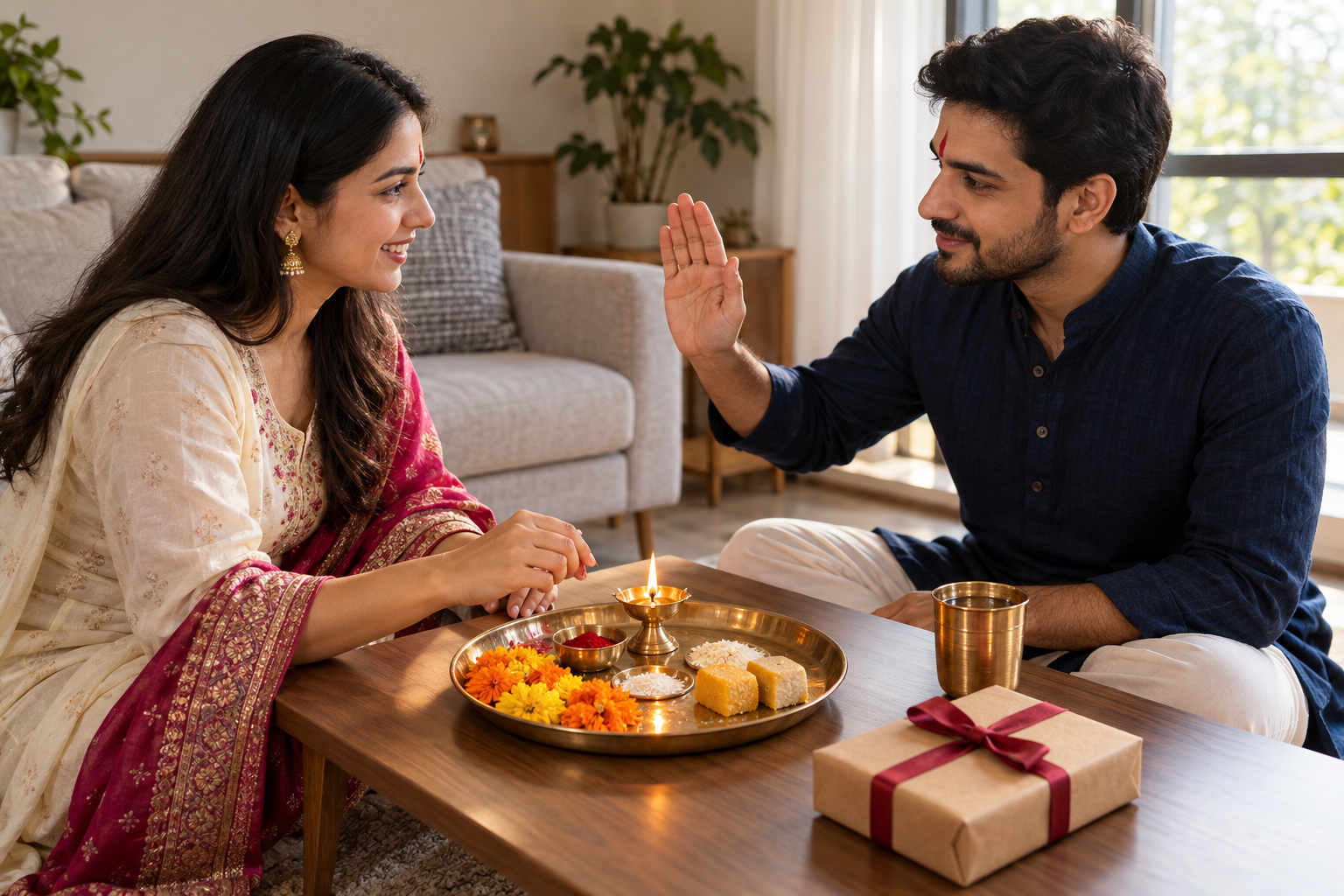
If your household already has a complete paddhati, follow it. If family memory has become thin, the following sequence preserves the recognisable core without pretending that every region uses identical materials or words.
- Confirm the day locally. Check the calendar used by your family or community. If a particular ritual time matters in your tradition, confirm that as well.
- Prepare only the customary essentials. Arrange the material your family uses for the tilak or phonta, along with a sweet or meal. Include a lamp, aarti or other items when they belong to your practice; a longer tray is not automatically a more faithful ritual.
- Begin with welcome. Let the meeting feel intentional rather than squeezed between unrelated errands. The sister applies the ceremonial mark and offers her prayer or blessing for the brother’s well-being and right victory.
- Answer the blessing. The brother responds with a sincere wish for the sister’s success and welfare. A gift may accompany this response, but it should not replace the words.
- Share food and attention. Eat together where possible. Use the time to ask what the other person is carrying and what support would actually help.
A family blessing does not need elaborate Sanskrit to be sincere. Use an inherited mantra when you know it accurately. Otherwise, speak plainly and respectfully: wish for sound judgment, courage, protection, success in rightful work and a safe return from every difficult undertaking. Do not invent a supposedly ancient formula and present it as tradition.
The same restraint applies to gifts. Choose something suited to the sibling rather than treating price as the measure of affection. A book they need, help with a practical task or time reserved for a long-delayed conversation can express the duty behind the ritual more clearly than an expensive but impersonal purchase.
Preserve regional practice without turning it into a purity test
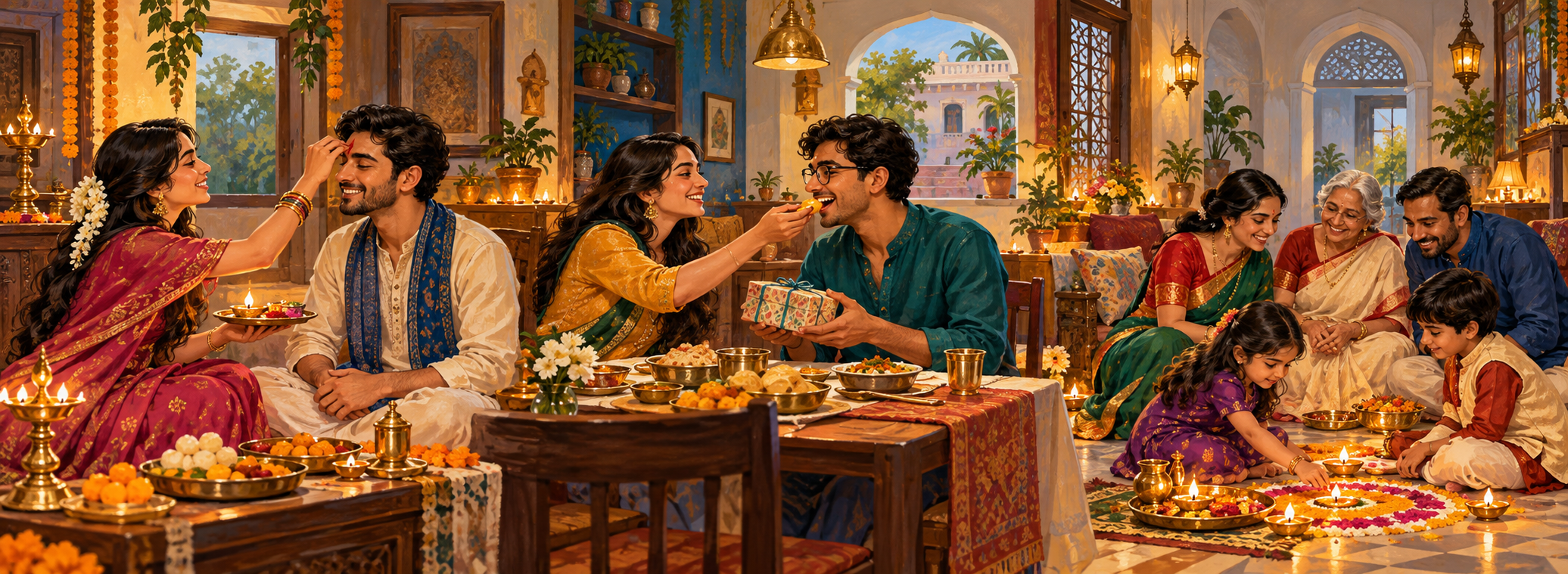
The names Bhai Dooj, Bhai Phonta and Bhaubeej signal a tradition expressed through different languages and household forms. Materials, foods, gestures and the order of the rite may vary. Variation by itself is not evidence that one family is careless or another has discovered the only authentic form.
When customs differ, use a simple order of precedence: follow your received family practice first, then the established custom of the local Dharmic community, and finally the simple reciprocal core when neither is available. This approach prevents a short online video from displacing living memory merely because its presentation looks more elaborate.
If your family no longer remembers the rite, ask the oldest available relatives precise questions: What was used for the forehead mark? Was there a lamp or aarti? What words were spoken? Which food was prepared? Who gathered, and in what order? Record the answers with the relative’s name and region. Even incomplete memories can help the next generation distinguish an inherited custom from a modern addition.
When siblings live apart, name the adjustment honestly as a contemporary adaptation. Fix a time for a call, speak the two blessings aloud, and arrange a later meal or visit if possible. The screen is not an ancient rite, but distance need not erase the festival’s reciprocal duty. What should not disappear is the deliberate exchange of goodwill and support.
Key takeaways
- Bhai Dooj belongs to the period two days after Diwali and deliberately gives the sibling relationship its own space.
- The central movement runs in both directions: the sister blesses the brother’s struggles, and the brother wishes success in hers.
- The Krishna-Subhadra and Lakshmi-Bali Raja traditions should guide conduct, not become ammunition in an argument over a single universal story.
- When customs differ, give priority to genuine family and regional practice rather than copying the most elaborate version you can find.
- A simple rite needs an intentional welcome, the customary forehead mark, reciprocal blessings and shared attention; gifts and decoration remain secondary.
Before buying this year’s gift, ask your sibling one direct question: “What struggle do you want me to stand beside you in?” Carry the answer into the blessing, then choose one action you will take after the festival. That is how Bhai Dooj remains a living family dharma rather than a ritual completed and forgotten.
References

Leave a Reply
You must be logged in to post a comment.