

If you have found the name Vajraprastarini beside an unfamiliar image of Devi, the immediate temptation is to match every object, gesture, and ornament to a ready-made story. That is precisely where a careful identification can go wrong.
The secure description is narrow but useful: Vajraprastarini is a rare, eight-armed form of Devi seated upon the waters. You can use those features to evaluate a possible representation, but they do not supply a complete list of weapons, gestures, colours, ornaments, or accompanying figures.
The four details you can treat as reliable
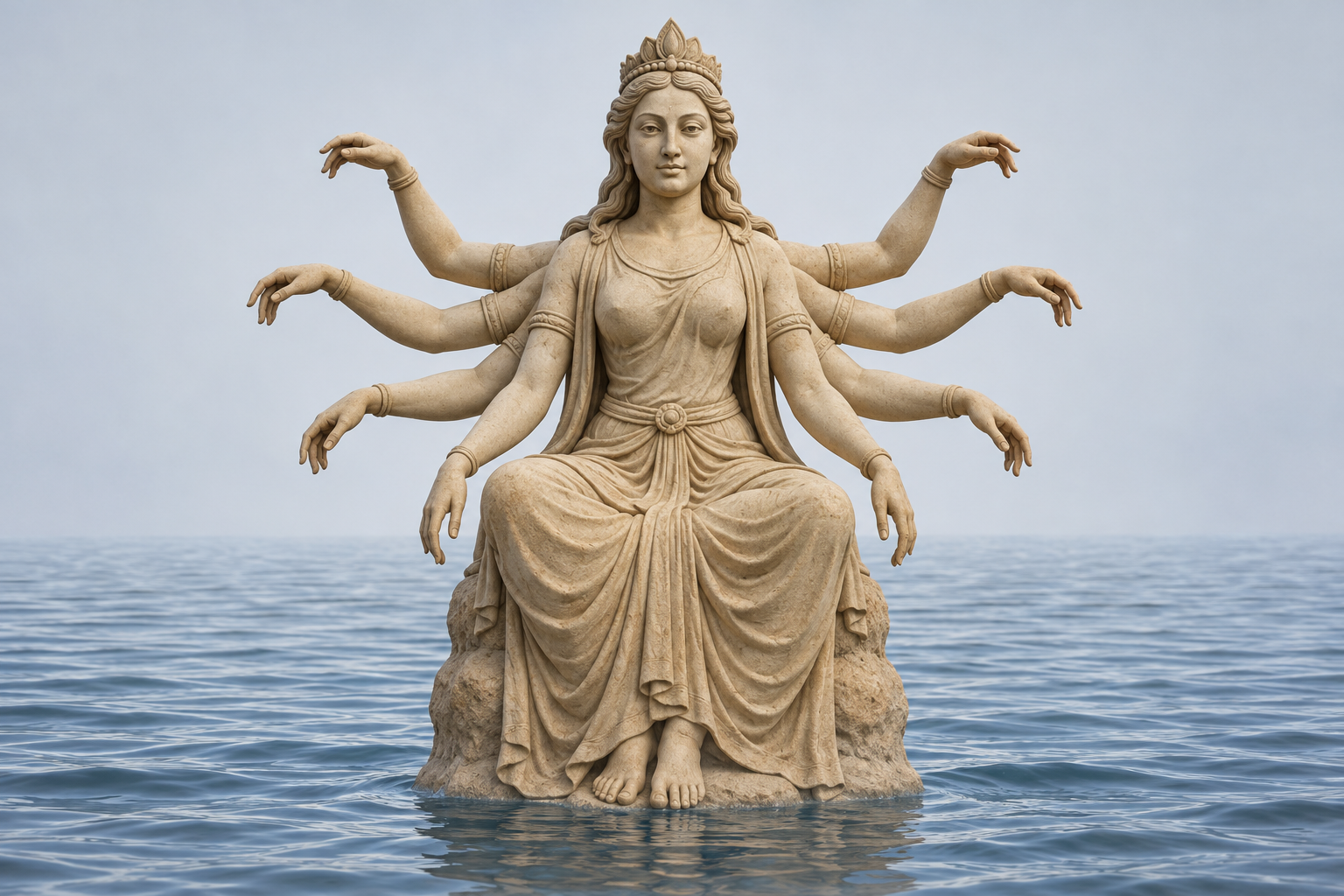
Begin with what the description actually establishes. Four elements form the dependable core of the iconography:
- Divine identity: the figure is a form of Devi.
- Number of arms: she has eight arms in total.
- Posture: she is seated, not standing.
- Setting or support: she is seated upon the waters.
These features should be read as a cluster. Eight arms alone are not distinctive enough to establish the name, because multi-armed forms occur widely in Hindu sacred art. A watery setting alone is also insufficient. The useful question is whether the figure combines all four features and whether an inscription, ritual tradition, catalogue record, or textual description independently supports the identification.
Her rarity matters to your method. Vajraprastarini is seldom represented in sculpture or painting and is not readily encountered in widely circulated iconographic compendia. Scarcity does not reduce her sacred status. It does mean that a familiar-looking modern illustration may reflect an artist’s reconstruction rather than a firmly documented historical model.
How to examine a possible image
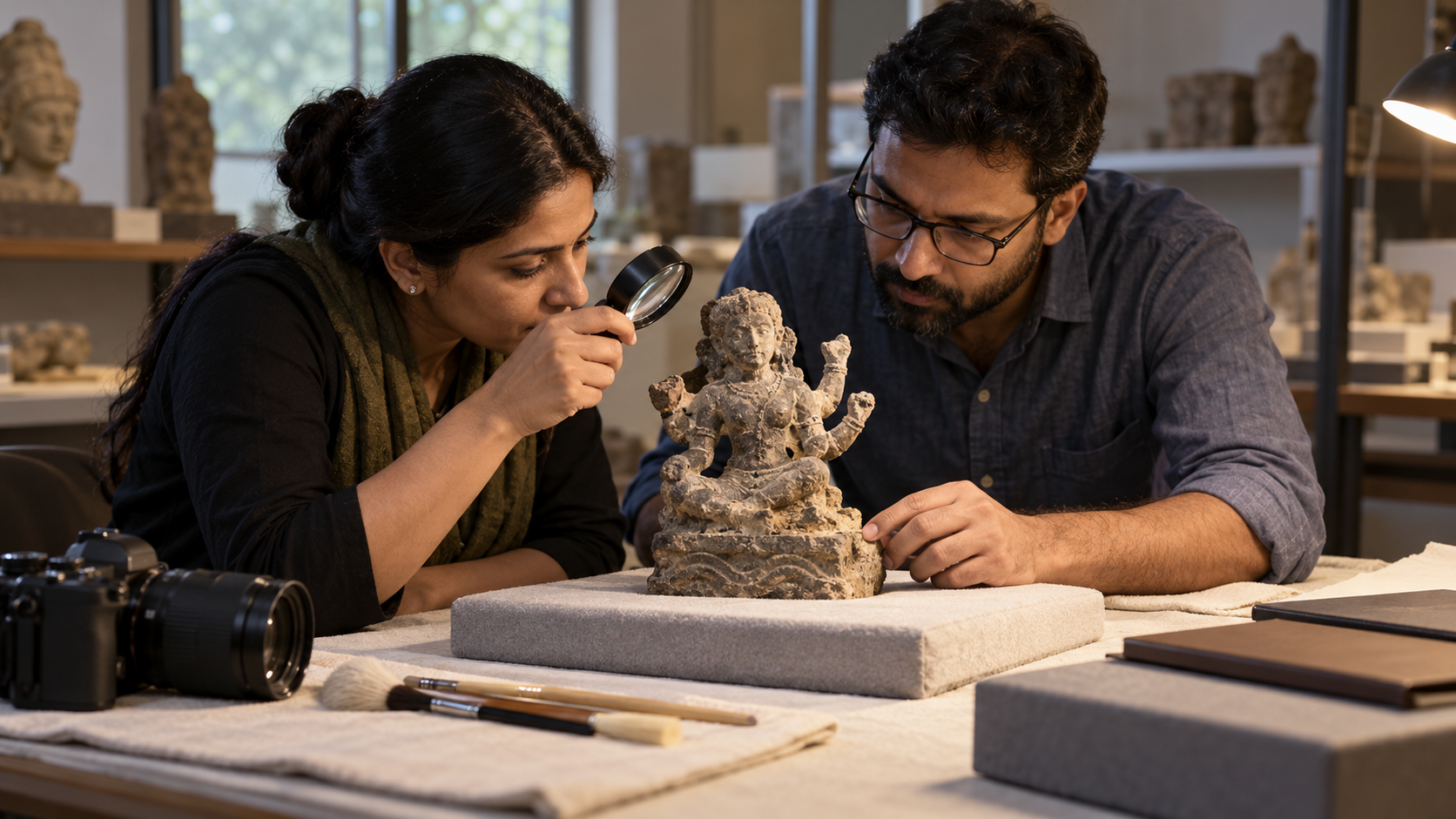
Iconographic reading starts with visible form, not symbolic speculation. If you are looking at a temple image, manuscript painting, photograph, or catalogue reproduction, examine it in a fixed order.
Count the arms before naming the objects
Confirm that eight arms are actually represented. Damage, overlapping limbs, cropped photographs, and objects held close to the body can make the count uncertain. Look for surviving hands, arm contours, sockets, broken projections, or symmetrical placement. Record uncertainty plainly: “seven hands visible; one probable broken arm” is more useful than silently restoring an eighth hand in your description.
Separate posture from the thing beneath her
“Seated upon the waters” gives you two observations: the body is seated, and water belongs to the setting or support. It does not, by itself, establish a particular seated pose, a lotus throne, an aquatic vehicle, a river identity, or a specific cosmological episode. If waves, a lotus, an animal, or another support appear, record each one separately rather than treating them as interchangeable signs.
Inventory every hand without filling the gaps
For each hand, note whether it holds a recognisable object, makes a gesture, rests on the body, is empty, is damaged, or is obscured. State whether “right” and “left” refer to the Devi’s perspective or the viewer’s perspective. That small convention prevents confusion when another person checks your record.
Do not assign a weapon merely because one would make the arrangement symmetrical. Do not convert a worn object into a vajra because the name begins with “Vajra.” A name can guide further inquiry, but it cannot replace what is visible or textually attested.
What the surviving description does not establish
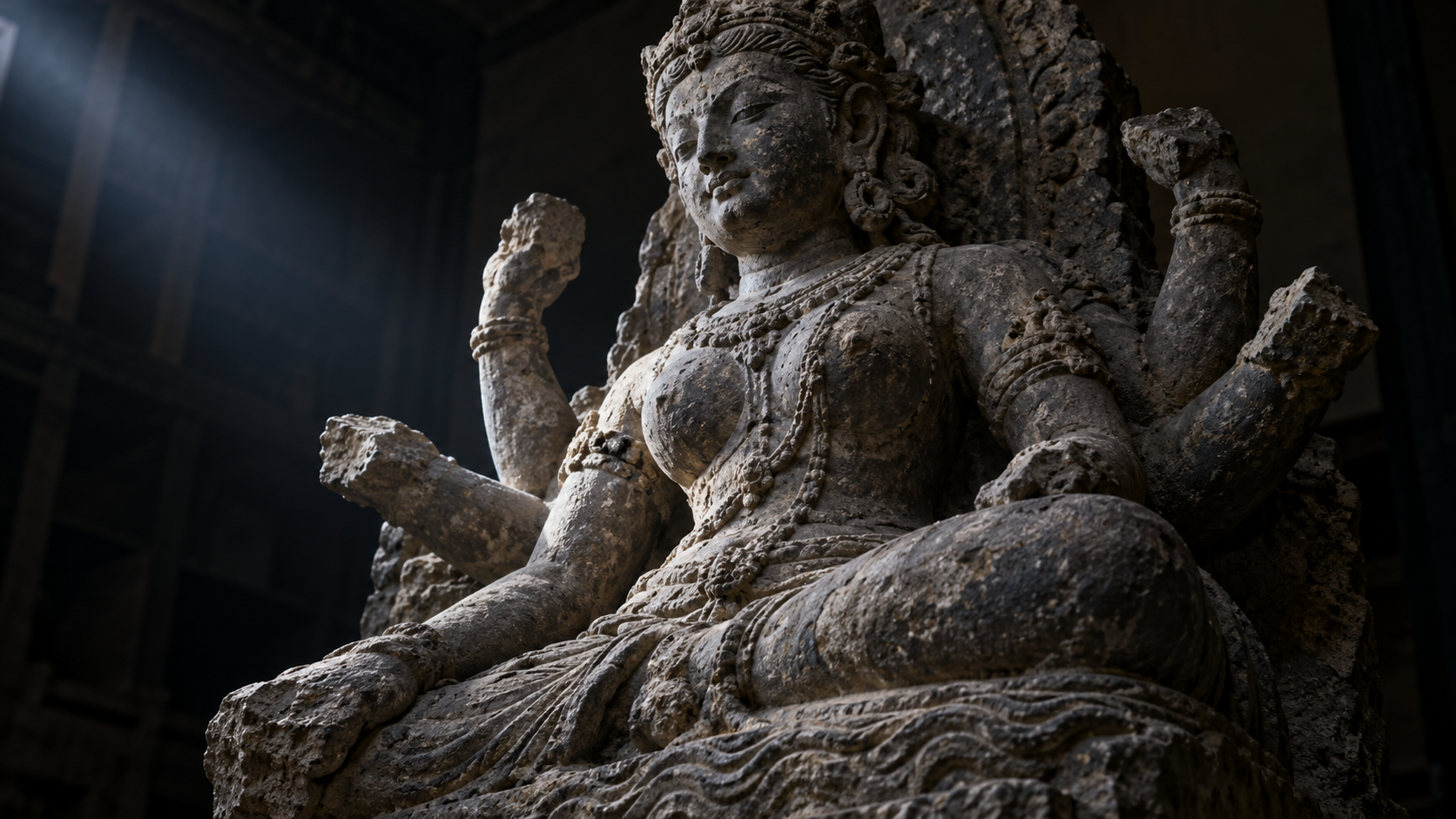
A responsible account is defined partly by the claims it refuses to make. The available description does not establish any of the following:
- A complete sequence of eight hand-held attributes.
- A prescribed arrangement of those attributes between the right and left hands.
- A particular mudra, weapon, crown, garment, complexion, or bodily posture beyond being seated.
- A named vahana or a particular aquatic creature beneath the Devi.
- A specific myth explaining the waters.
- A ritual procedure, mantra, festival, regional cult, or temple association.
This boundary is not a weakness. It protects Vajraprastarini from being turned into a composite of better-known goddesses merely because their visual details are easier to find. When a feature lacks support, label it “unidentified,” “unclear,” or “not established.” Those terms preserve evidence for the next researcher instead of concealing the gap.
Key takeaways for identification
- The dependable visual core is Devi, eight arms, a seated posture, and a setting upon the waters.
- Treat that combination as an identification lead, not conclusive proof by itself.
- Do not invent a hand-attribute scheme or infer a vajra solely from the name.
- Record water, throne, lotus, animal, and other supports as separate visual elements.
- Give inscriptions, established ritual names, provenance, and exact visual correspondences more weight than resemblance to an unattributed online image.
A practical record for a temple, archive, or collection
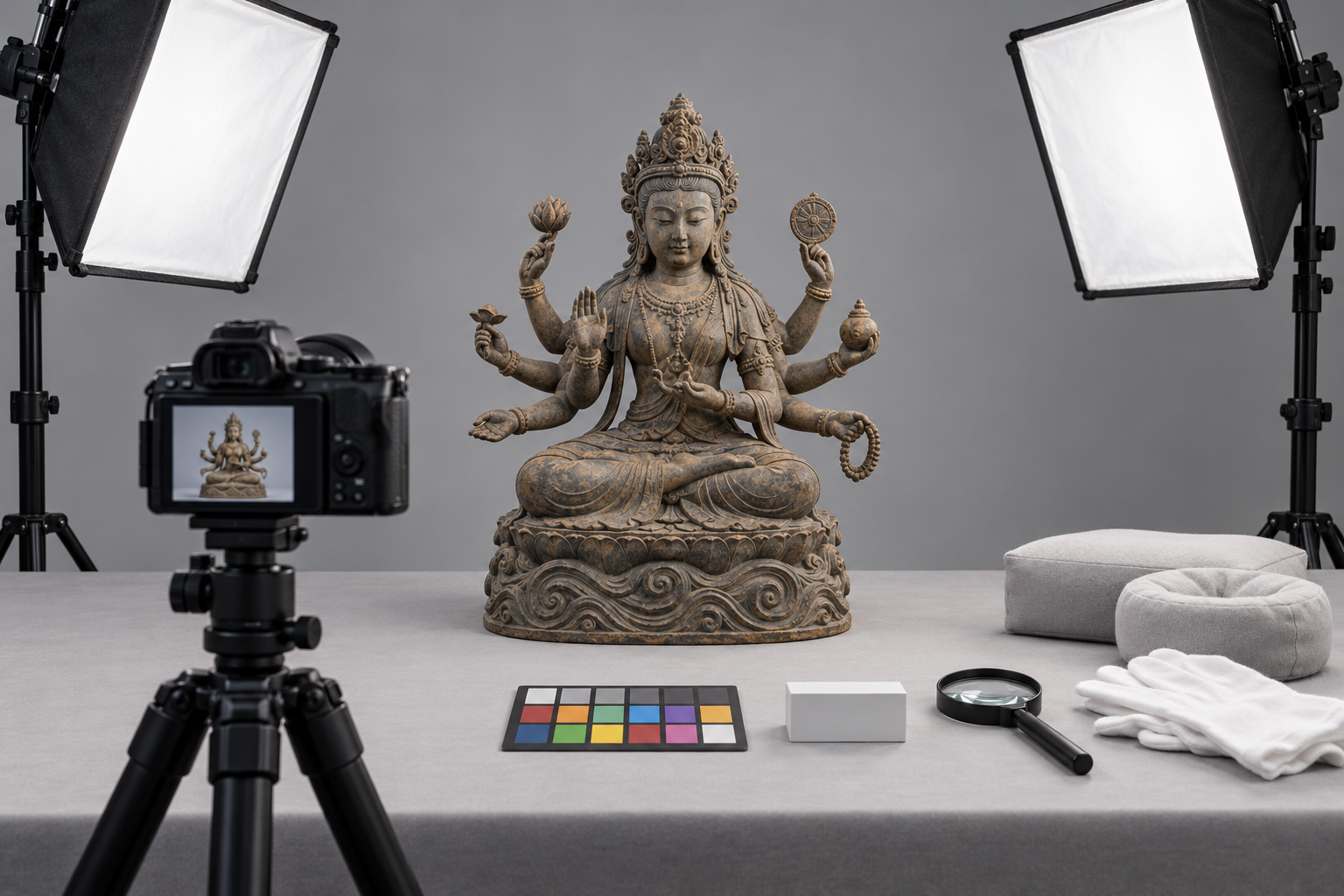
If you encounter an image that may represent Vajraprastarini, create a record that someone else can verify. A useful workflow is:
- Photograph the whole composition. Include the pedestal, surrounding frame, accompanying figures, and any watery imagery rather than cropping tightly around the face.
- Make detailed images. Capture every hand, held object, damaged area, inscription, and feature beneath the seated figure.
- Describe before interpreting. Write “curved object in upper hand” before deciding that it is a particular weapon. Keep observation and identification in separate fields.
- Transcribe labels exactly. Preserve the original script, spelling, and honorifics when possible. A modern English caption should not silently replace a local or ritual name.
- Record context. Note the present location, reported place of origin, material, condition, worship context, catalogue number, and the person or institution that supplied the identification.
- Compare complete configurations. A useful comparison should match the arm count, posture, water setting, hand attributes, and associated figures. A match based only on “eight-armed goddess” is too broad.
- Grade your conclusion. Use practical labels such as confirmed, probable, possible, or unsupported, and write down what evidence would be needed to move the identification to the next level.
In a living shrine, preserve the community’s ritual identification even when an art-historical question remains open. A worshipped name is evidence about living tradition; a historical attribution asks about textual and visual correspondence. Recording both without forcing them into false agreement respects the devotees as well as the object.
Rarity calls for precision, not embellishment
Vajraprastarini’s limited circulation makes every securely labelled representation potentially valuable. It also makes unsupported details unusually easy to repeat until they look authoritative. You can interrupt that cycle with a disciplined record: count all eight arms, document the seated figure and the waters, preserve any original name, and leave uncertain attributes unresolved.
If you are preparing a painting, sculpture, educational caption, or temple display, distinguish the attested core from any modern artistic choices. Mark reconstructed details as reconstructions. That single act allows devotion and creativity to continue without presenting conjecture as inherited iconographic rule.
References

Leave a Reply
You must be logged in to post a comment.