
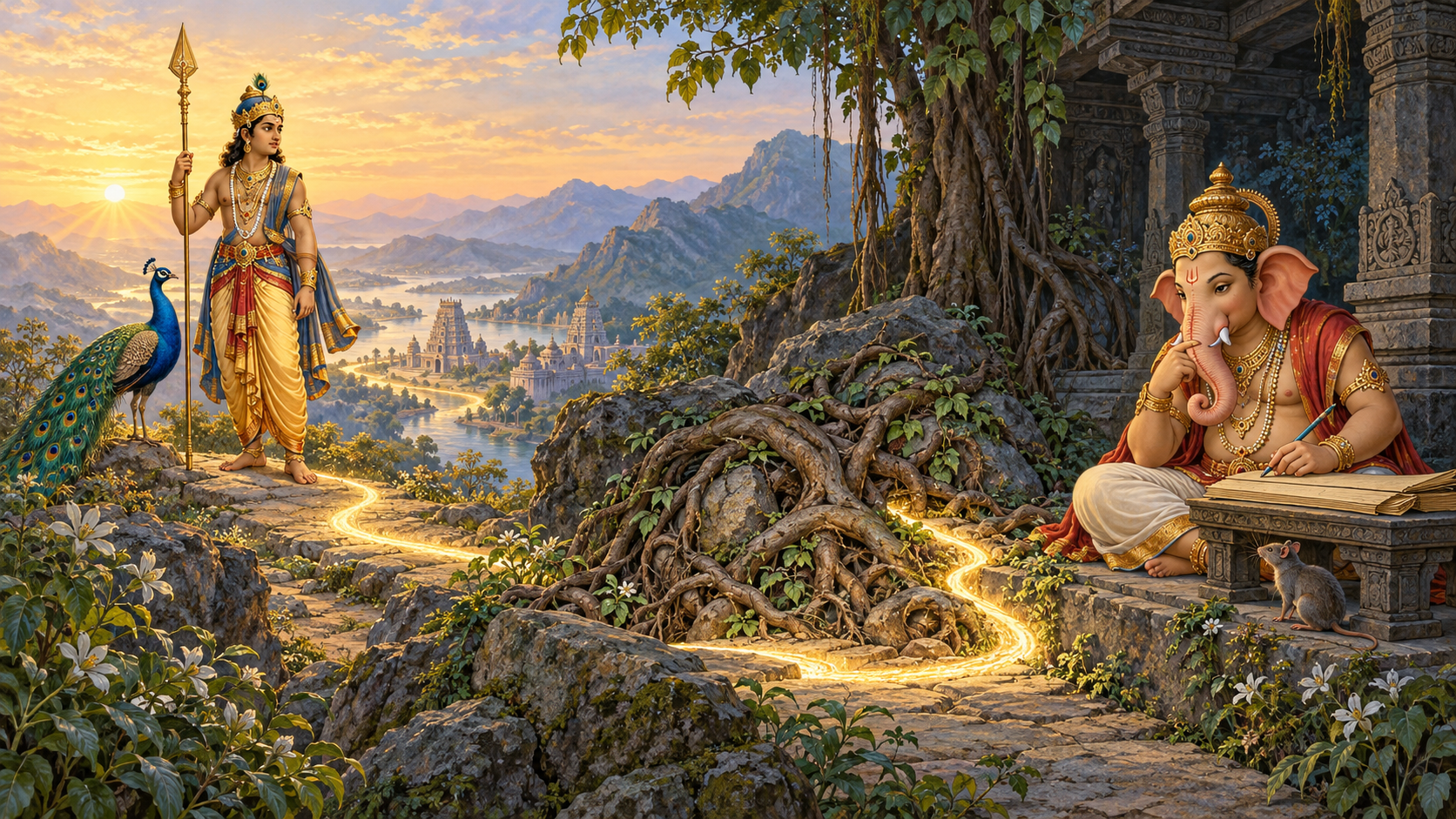
You know something must be done, but you cannot tell whether the dharmic next step is to think more carefully or to act more courageously. Move too soon and you may serve the wrong aim. Wait too long and reflection becomes an elegant excuse for avoiding duty.
Kartikeya and Ganesha offer a practical way through that tension. They do not represent rival temperaments from which you must choose a favourite. Read together, they teach you to understand an obstruction, determine your duty, and then move with discipline.
Why dharma needs both the warrior and the scholar
The family relationship matters. Shiva and Parvati are presented as the parents of two sons whose contrasting capacities span human and cosmic effort: Kartikeya, also known as Skanda, Murugan, or Subrahmanya, commands the celestial armies and destroys Tarakasura, while elephant-headed Ganesha embodies the scholar. Their difference exists within a deeper unity.
Calling them archetypes does not reduce devatas to psychological symbols. It simply recognises that sacred forms can also educate the devotee. Kartikeya shows what rightly directed force looks like. Ganesha shows what intelligent attention brings to an obstacle. One converts duty into movement; the other prevents movement from becoming blind.
This corrects a common mistake in moral decision-making. We often treat courage and wisdom as competing virtues. The forceful person distrusts deliberation as weakness. The reflective person distrusts decisiveness as recklessness. Dharma requires a more demanding question: what does this situation need from you now?
- If the purpose is unclear, more force will magnify the confusion.
- If the duty is clear, more analysis may merely shelter reluctance.
- If the obstacle keeps returning, effort alone is not enough; its cause must be understood.
- If understanding produces no commitment, intelligence has not yet completed its work.
The aim is therefore not permanent moderation. Sometimes dharma calls for patience, sometimes for speed, and sometimes for resistance. The deeper skill is putting discernment and action in the right order.
Kartikeya turns a clear duty into disciplined action

Kartikeya’s warrior form is useful when you already know the relevant duty but hesitate to carry it out. Perhaps a boundary must be defended, a neglected responsibility must be accepted, or an avoidable wrong must be confronted. At that point, gathering more opinions can become a way of transferring responsibility away from yourself.
The Kartikeya discipline begins by naming what must be protected. Not your pride, image, or appetite for victory, but the legitimate good at stake: truth, a promise, a vulnerable person, a shared institution, or a practice you have freely undertaken. Once that good is named, action becomes easier to judge. A response is dharmic only if its means remain answerable to its purpose.
Before acting in this mode, ask:
- What duty is already clear enough that delay no longer improves my understanding?
- What am I responsible for, as distinct from what I merely want to control?
- What necessary action am I avoiding because it may cost comfort, approval, or status?
- What is the smallest complete act that genuinely advances the duty?
The phrase “smallest complete act” is important. A symbolic gesture may relieve your conscience without changing anything. A complete act has a defined object and consequence: state the boundary, make the decision, assign the responsibility, fulfil the promise, or begin the practice you have already judged necessary.
Warrior energy becomes adharmic when it starts manufacturing enemies. Irritation is not evidence that battle is required. Speed is not proof of clarity. Loudness is not strength. Kartikeya’s archetype is command disciplined by a rightful aim, not aggression searching for moral permission.
You can notice the distortion through its language. If your mind keeps saying that someone must be humiliated, crushed, or made to suffer, the purpose has probably shifted from protection to ego. Pause and return to the duty. Ask what outcome would restore order without feeding vengeance. The warrior serves dharma; dharma does not serve the warrior’s excitement.
Ganesha reveals the obstacle before force is applied
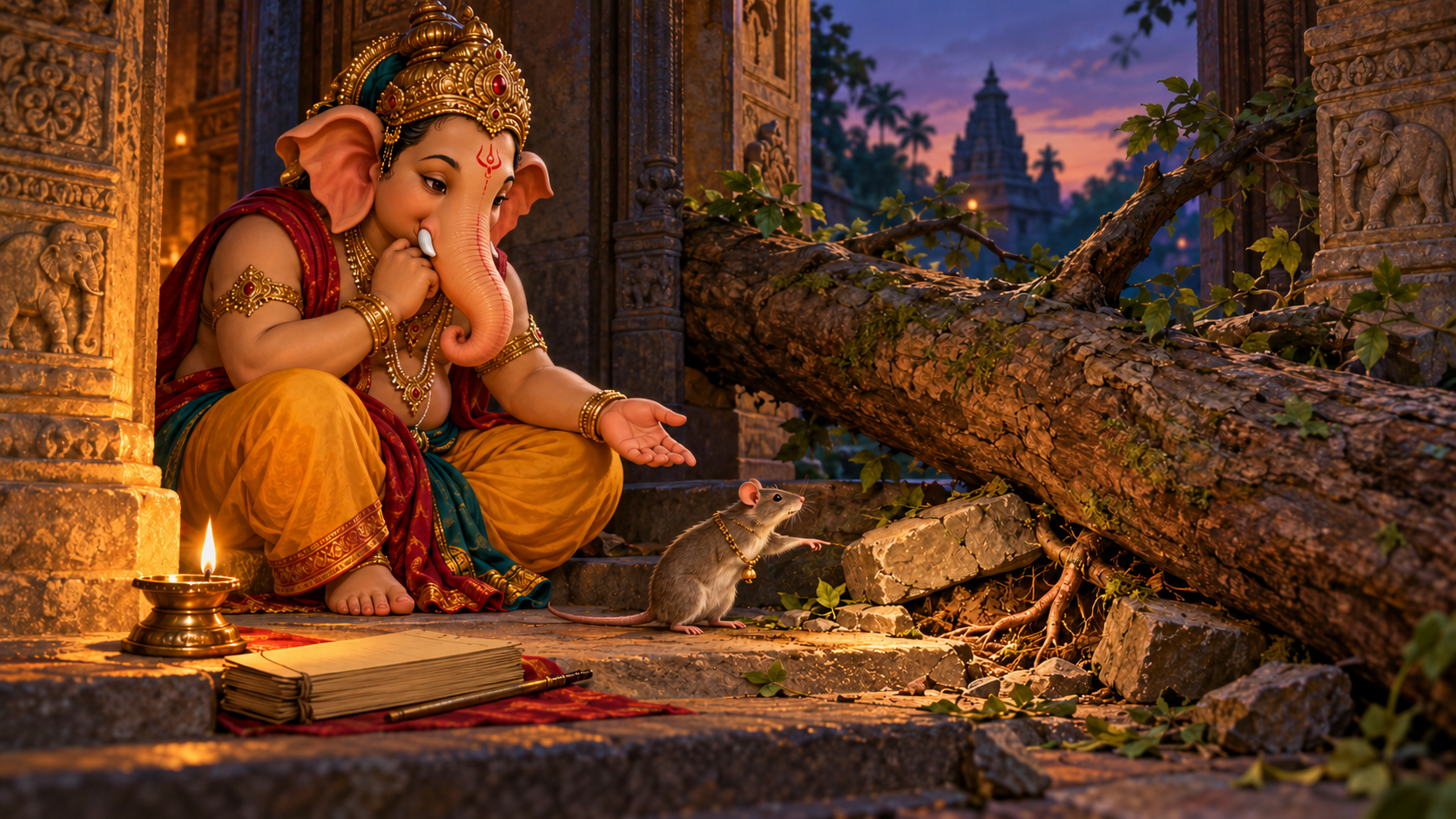
Ganesha’s scholarly intelligence is useful when the obstruction has not yet been understood. We often call something an obstacle merely because it frustrates our first plan. Yet the blockage may be exposing a false assumption, a conflict between duties, missing knowledge, poor sequencing, or an attachment to one preferred outcome.
That is why removing an obstacle does not always mean pushing it aside. Sometimes you remove its power by understanding what created it. Sometimes you discover that the supposed obstacle is a boundary you ought to respect. Sometimes the route changes because the destination was badly chosen.
Use the Ganesha discipline to separate four things that the anxious mind tends to mix together:
- What you know from what you assume.
- The duty itself from your preferred method of performing it.
- An external constraint from an internal reluctance.
- A genuine warning from the ordinary discomfort of beginning.
Suppose a family or community disagreement appears to demand an immediate stand. Begin by stating each obligation without naming a villain. There may be a duty to tell the truth, preserve trust, respect a legitimate role, and prevent further harm. Those obligations may point in different directions. Ganesha’s mode asks you to define the conflict before choosing the intervention.
This does not mean endless consultation. Discernment needs a completion condition. Ask what missing fact could actually change the duty or the proposed action. Seek that fact. If nothing you are still investigating would alter the decision, continued inquiry is probably delay rather than wisdom.
Ganesha’s shadow is clever inaction. It produces more categories, caveats, and explanations while leaving the necessary task untouched. Knowledge fulfils its dharmic purpose when it clarifies what deserves commitment. If your reflection never reaches a decision, let Kartikeya take the next turn.
The practical lesson is sequence, not personality

Do not ask whether you are “a Kartikeya person” or “a Ganesha person.” That turns a spiritual discipline into a personality label and gives your habits an excuse to remain unchanged. The impulsive person needs Ganesha most. The habitual overthinker may need Kartikeya. The useful archetype is often the one that corrects your default.
| What you notice | Begin with | Your next move |
|---|---|---|
| The duty is clear, but discomfort keeps delaying you | Kartikeya | Perform the smallest complete act that serves the duty |
| The facts are disputed or the obligations conflict | Ganesha | Verify what could change the decision and define the governing duty |
| Repeated effort keeps producing the same failure | Ganesha | Inspect the cause, assumptions, and sequence before applying more force |
| Your analysis repeats itself without adding relevant knowledge | Kartikeya | Commit to a proportionate action and observe its result |
| A quick action produced unintended effects | Ganesha | Stop, learn from the consequence, and correct the course |
A sound dharmic process can move through both modes several times. You understand enough to act, action reveals new conditions, and those conditions require renewed understanding. Reflection then becomes part of action rather than its opposite.
This sequence also helps when people around you have different strengths. A group does not need every member to behave identically. It needs honest discernment, legitimate decision-making, and reliable execution. The thoughtful member must not use nuance to disable the doer. The decisive member must not use urgency to silence inconvenient facts.
In public life, the same discipline guards against two failures. Ganesha’s mode resists rumour, careless accusation, and action built on an untested premise. Kartikeya’s mode resists the belief that perfect information must arrive before any stand can be taken. Verify what matters, name the principle, choose a proportionate response, and remain willing to correct it.
A repeatable examination for difficult choices
When you face a decision that feels morally tangled, use the two archetypes as consecutive examinations. Writing the answers is better than carrying them as a vague internal debate.
- State the duty in one sentence. Describe what must be served or protected without mentioning the outcome you personally prefer. If you cannot do this, remain with Ganesha’s inquiry.
- Separate knowledge from assumption. List what is established, what is inferred, and what is missing. Investigate only the missing information that could materially change your duty or method.
- Name the obstacle precisely. Decide whether it is ignorance, conflicting obligations, lack of authority, fear of consequence, attachment to approval, or an ineffective method. Different obstacles require different responses.
- Choose the smallest complete action. It should be proportionate to the duty, within your rightful responsibility, and concrete enough that you will know whether it happened.
- Review the consequence. Ask whether the action served its stated purpose, created avoidable harm, or revealed a fact that changes the next step. Then return to discernment without using review as an excuse to abandon the duty.
This examination is especially useful in personal discipline. If a practice repeatedly fails, do not simply demand more willpower. First examine when and why the obstruction appears. Change the arrangement if the arrangement is unsound. Then make a clear commitment and keep it. Ganesha diagnoses the recurring blockage; Kartikeya carries the corrected decision into conduct.
It is equally useful in community work. Before launching a campaign or confrontation, establish the facts, the legitimate aim, who has authority to act, and what success would mean. Once those matters are sufficiently clear, assign responsibility and move. A meeting that produces neither a decision nor a defined question has served neither archetype.
Key takeaways
- Do not choose between Kartikeya and Ganesha as fixed identities. Ask which discipline the present situation lacks.
- Begin with Ganesha when the facts, obstacle, or governing duty remain unclear.
- Begin with Kartikeya when the duty is clear and further delay mainly protects your comfort.
- Let discernment determine the aim and limits of action; let courage carry the decision into conduct.
- Treat aggression and paralysis as distortions, not as expressions of either sacred archetype.
At your next difficult crossroads, resist the urge to ask only, “Should I act or should I wait?” Ask what remains genuinely unknown, what duty is already clear, and which necessary act is now yours. Give Ganesha the confusion and Kartikeya the commitment.
References

Leave a Reply
You must be logged in to post a comment.