
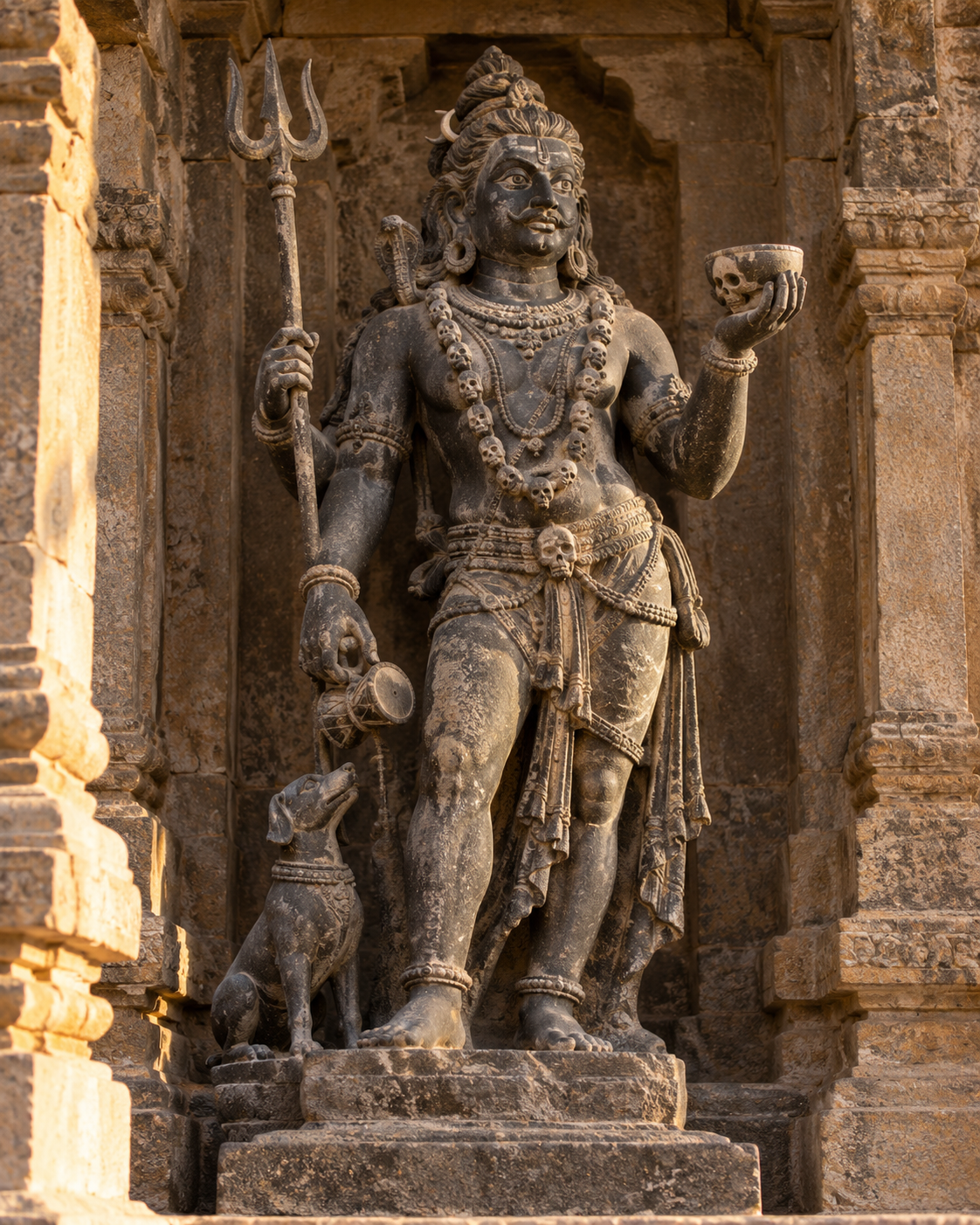
You are standing before a temple sculpture or looking at a photograph of one. A deity holds a small rounded object, but weathering has blurred its rim and surface. Is it an ordinary vessel, an offering bowl, or a kapala? The answer cannot come from the object’s resemblance to a cup alone.
Kapala hasta gives you a disciplined way to read that detail. Begin with the hand and its attribute, test the identification against the complete figure, and interpret the skull-bowl only after the visual evidence is secure. That order protects you from two common errors: overlooking an important divine attribute and turning every unusual bowl into something macabre.
What kapala hasta names
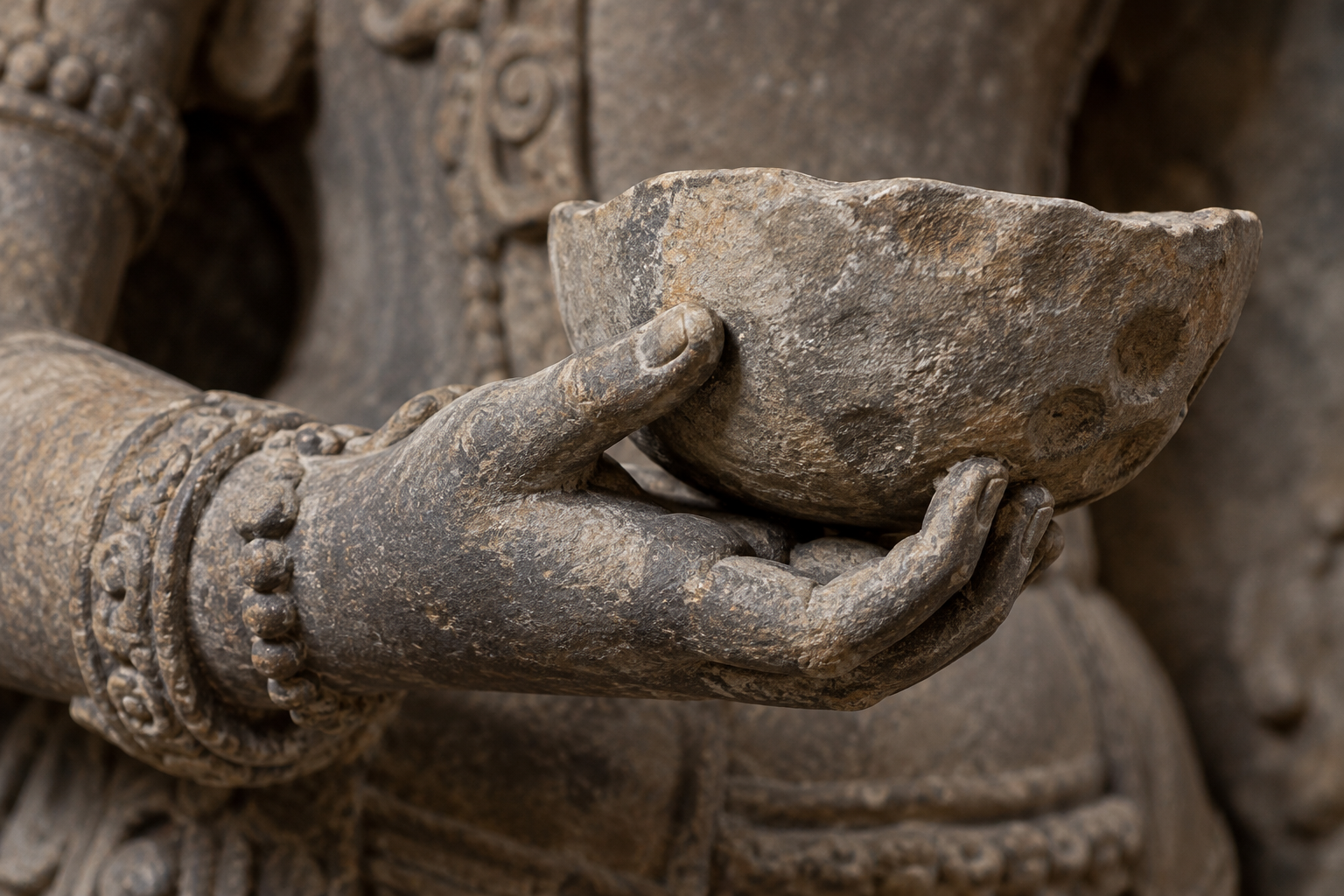
Kapala refers here to a skull or skull-bowl, while hasta means a hand or hand gesture. Kapala hasta is therefore the hand configuration through which a sacred figure bears, supports, presents, or otherwise makes the kapala visible. Within Hindu sculpture and dance, codified hastas communicate divine attributes, moods, and powers without relying on written explanation.
This is an attribute-bearing gesture, not merely an expressive hand shape. The object matters. An empty hand that happens to curve like a cup should not automatically be identified as kapala hasta, especially when the original attribute may have broken away. Conversely, a surviving bowl-like object should not be classified from its shape alone. You must ask how the hand relates to it and how the attribute relates to the figure.
Keep three layers separate as you examine the image:
- The hand: Is the palm supporting the object, are the fingers gripping it, or is the hand merely positioned nearby?
- The attribute: Does the object actually have the form of a small bowl or cranial vessel, or could it be another implement?
- The iconographic setting: Do the figure’s other attributes, posture, expression, attendants, and placement support the identification?
The name becomes reliable only when these layers reinforce one another. A label based on the isolated hand is provisional, not conclusive.
A five-step check for sculpture and temple art
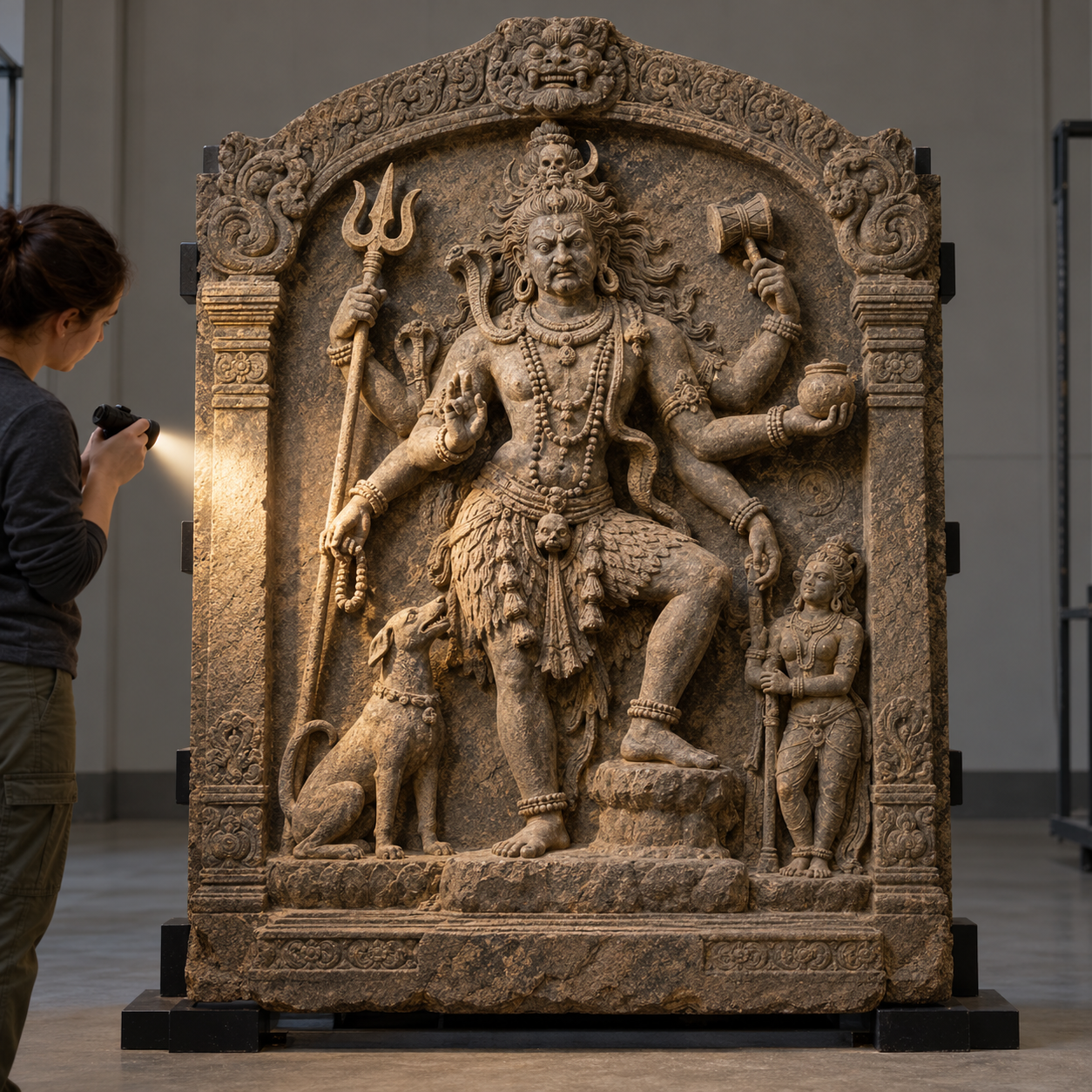
You do not need to begin with an elaborate symbolic theory. Start with visible evidence and move outward. This five-step sequence works for a temple wall, a freestanding murti, a museum photograph, or a damaged fragment.
- Locate the hand-object unit. Follow the wrist into the palm and identify exactly where the object begins. This prevents nearby ornaments, drapery, or another hand’s attribute from being mistaken for something held in the palm.
- Examine the object’s structure. Look for a discernible rim, an interior cavity, a rounded lower portion, or another sign that it functions as a vessel. Do not let one curved outline settle the question when erosion has removed most of the form.
- Determine what the hand is doing. A palm may support an object from below, fingers may secure it from the side, or the hand may display it toward the viewer. The physical relationship is often more informative than one damaged finger position.
- Inventory the rest of the figure. Note every surviving attribute, the number and position of the arms, the body’s stance, the expression, accompanying figures, and the architectural setting. Kapala hasta belongs to a larger iconographic programme; it should not be used by itself to identify the deity, sect, period, or theological meaning.
- State the degree of certainty. Use definite language only when the object and context agree. If the form is damaged, write that the hand appears to hold a kapala or that the identification is possible. Honest uncertainty is better than a precise but unsupported label.
Material affects what you can see. Deep stone carving may preserve a firm hand-object connection while losing surface detail. A small image may compress the bowl into a simple rounded mass. A photograph taken from below can hide the cavity that would make the vessel easier to recognise. Before rejecting or confirming the identification, check whether angle, lighting, scale, or damage explains the ambiguity.
If you are writing a caption or field note, separate observation from identification. A careful entry might read: The lower hand supports a small bowl-like attribute; in the figure’s wider iconographic context, it may represent a kapala and the configuration may be read as kapala hasta. If the evidence is stronger, remove the qualifying language. This format lets another reader see how you reached the conclusion.
Move from description to meaning without sensationalism
A skull is visually arresting, so interpretation often runs ahead of identification. That is precisely where a careful reader should slow down. In sacred iconography, an object associated with death does not automatically signify evil, cruelty, or the glorification of violence. It can turn attention toward mortality, the impermanence of the body, the crossing of ordinary boundaries, or divine power over what human beings fear. The applicable meaning depends on the complete image and its tradition.
Use three stages when explaining the gesture:
- Describe what is visible: a particular hand supports or displays a bowl-like object.
- Identify the iconographic feature: contextual evidence indicates that the object is a kapala, making the hand-object configuration kapala hasta.
- Interpret its function: explain what the kapala contributes to this figure’s identity, mood, or power, while making clear that the interpretation belongs to this image rather than to every occurrence of a skull-bowl.
This sequence matters because description can remain sound even when interpretation is disputed. Two viewers may agree that a deity bears a kapala while differing over which aspect of its symbolism is primary. Do not erase that distinction by presenting one symbolic gloss as a universal definition.
Context also prevents the opposite mistake: reducing the kapala to anatomical remains. Sacred art transforms objects by placing them in a divine hand. The skull-bowl’s significance comes from that relationship. Ask what the deity does with it, how it balances the other attributes, and what mood the complete form communicates. The gesture is meaningful because the hand, object, and divine presence operate together.
Reading kapala hasta in dance and embodied abhinaya
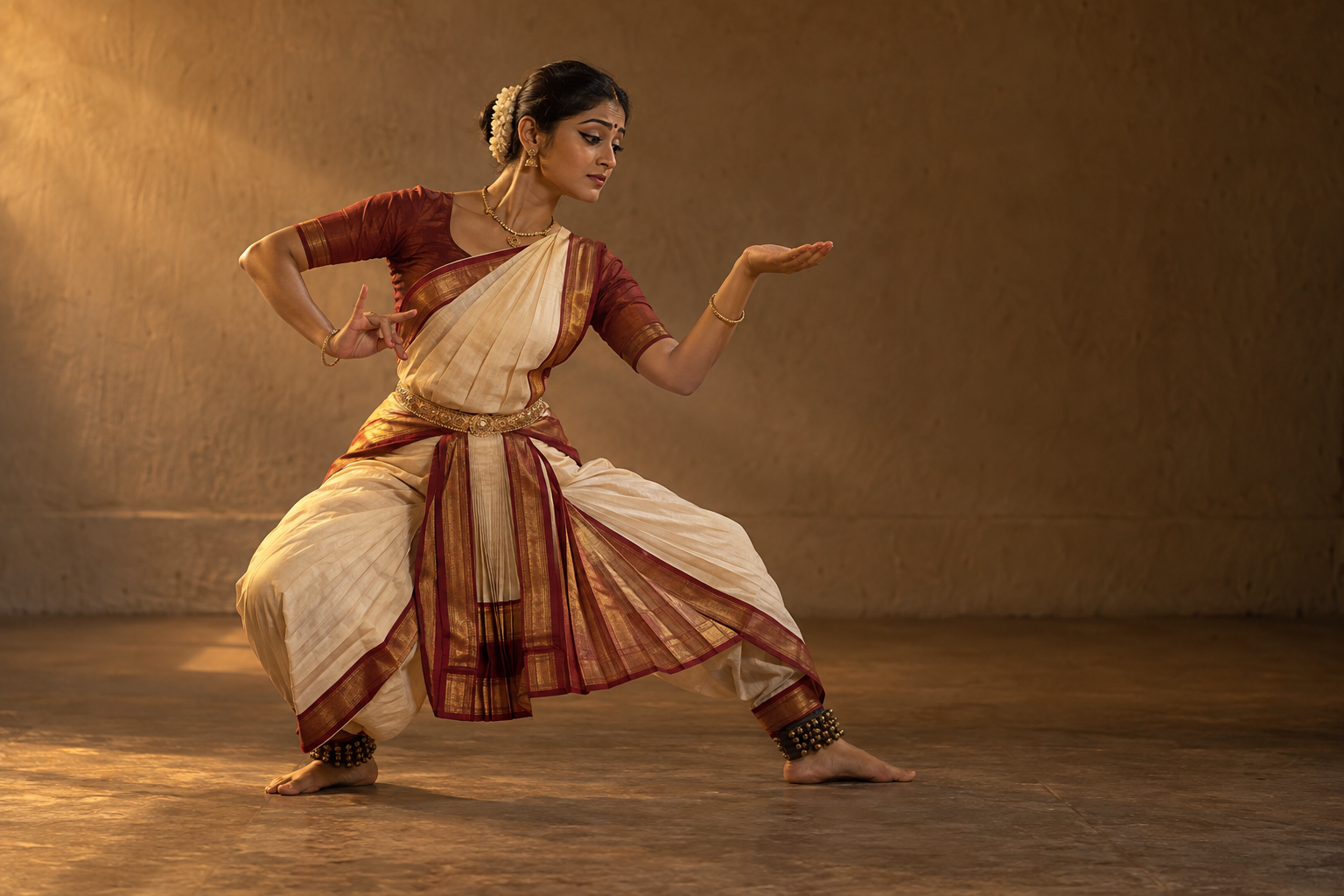
Stone gives an attribute durable physical form. Dance must often make an absent object present through the performer’s body. You therefore read kapala hasta in performance as an unfolding action rather than as a frozen outline.
Watch the hand shape, but also follow the performer’s gaze, the height and orientation of the imagined vessel, the movement leading into the gesture, and the action that follows it. A hand treated as though it has weight and an interior is different from a superficially similar expressive gesture. The other hand may further establish whether the unseen object is being carried, presented, received, or used within the scene.
Do not demand that a dancer reproduce the geometry of a carved hand. Sculpture must solve problems of stone, support, visibility, and permanence. Performance uses timing, direction, focus, and repetition. The shared principle is communicative: the audience must be able to understand the attribute and its place in the character’s action.
When viewing or documenting a performance, ask four practical questions:
- Does the performer consistently preserve the imagined object’s size and orientation?
- Does the gaze direct your attention toward the hand as though an object were present?
- Does the surrounding action clarify what the hand is holding or doing?
- Does the character and scene support a kapala reading, or are you relying only on a resemblance between hand shapes?
If only the last resemblance is available, leave the identification open. Abhinaya is read through coordinated signs, not through one hand detached from the dramatic moment.
Key takeaways
- Kapala hasta names a relationship between a hand and the skull or skull-bowl it bears; it is not a free-floating symbol that can be identified from any cupped hand.
- Read from the smallest unit outward: hand, object, complete figure, setting, and only then symbolic meaning.
- Do not identify a deity, tradition, date, or doctrine from this gesture alone. Confirm the reading through the figure’s other attributes and context.
- In damaged sculpture, distinguish what you can see from what you infer, and state whether the identification is secure, probable, or merely possible.
- In dance, follow gaze, movement, orientation, and dramatic action as well as the fingers. The invisible attribute must remain coherent in performance.
- Treat the skull-bowl as a sacred iconographic attribute, not as automatic evidence of evil or violence.
The next time you encounter a possible kapala hasta, resist the urge to begin with symbolism. Trace the hand, verify the vessel, inventory the figure, and record how certain you are. Once that foundation is sound, the gesture can lead you toward a richer reading of how Hindu art confronts mortality and expresses divine power.
References

Leave a Reply
You must be logged in to post a comment.