
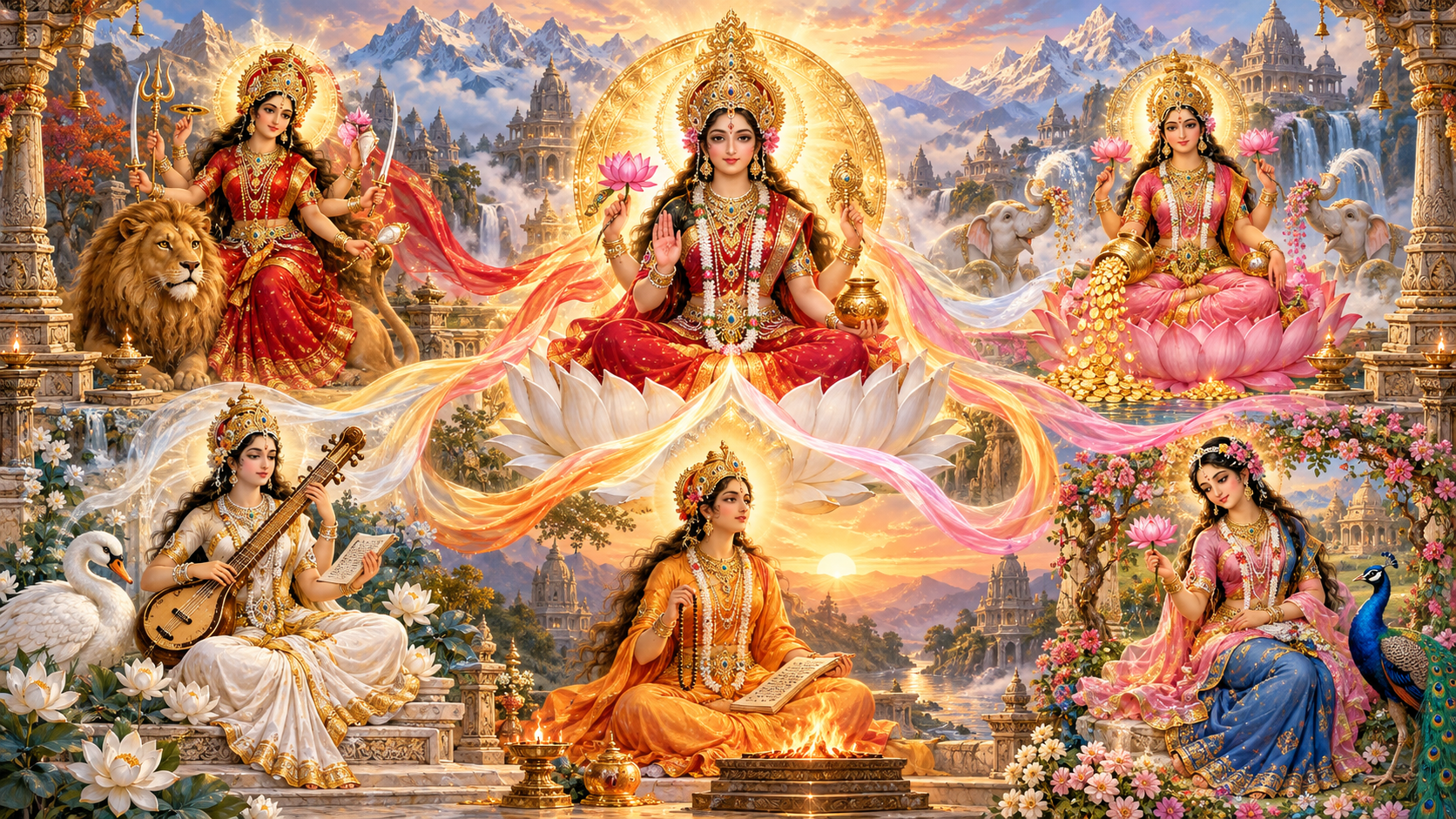
If you have encountered Durga, Lakshmi, Saraswati, Savitri and Radha as the five forms of Prakriti, the first challenge is not remembering the names. It is understanding what kind of five they are. Are they separate goddesses, competing powers, stages on a ladder, or different approaches to one Divine Mother?
Read them as unrelated deities and the teaching becomes a catalogue. Read them as interchangeable names and its distinctions disappear. The useful middle path is to see five recognizable operations of one creative Shakti. That gives you a coherent way to approach the theology, examine your own life and keep worship connected to conduct.
Begin with one Prakriti, not five competing powers

Prakriti can be translated broadly as nature or the primordial matrix of manifestation. In the Shakta understanding considered here, however, she is not merely unconscious material waiting to be shaped by something higher. Prakriti is revered as the supreme creative energy of the universe: the Divine Mother through whom existence arises, becomes intelligible, is sustained and returns to its source.
That changes how you should read the word “form.” A form is not a fragment cut away from the whole. It is the whole made approachable through a particular relationship. The same Shakti may be encountered as protection when disorder must be confronted, as abundance when life must be nourished, as knowledge when confusion must be dispelled, as sacred illumination when intention must be renewed, and as love when separation must be overcome.
The number five therefore describes differentiated manifestation, not five ultimate realities. A lamp can illuminate a shrine, a book, a meal, a difficult path or the face of someone you love without becoming five different kinds of light. In a similar way, the names distinguish how divine power is encountered without dividing the Mother herself.
- Start with unity. Do not treat the five forms as rivals competing for supremacy.
- Study their functions, not just their images. Iconography becomes clearer when you understand the power to which it points.
- Do not assume that the list is a ranking. Nothing in the fivefold idea requires you to place material care beneath knowledge, protection beneath devotion, or one goddess beneath another.
- Keep the map in context. Shakta traditions are diverse, and a fivefold presentation should not be turned into a universal census of every form of Devi.
This distinction also keeps the teaching from collapsing into sectarian boxes. Durga, Lakshmi, Saraswati, Savitri and Radha carry associations that appear across different streams of Hindu life. Their gathering under Prakriti emphasizes the unity of Shakti beneath those familiar devotional relationships.
The five forms and the work each one reveals
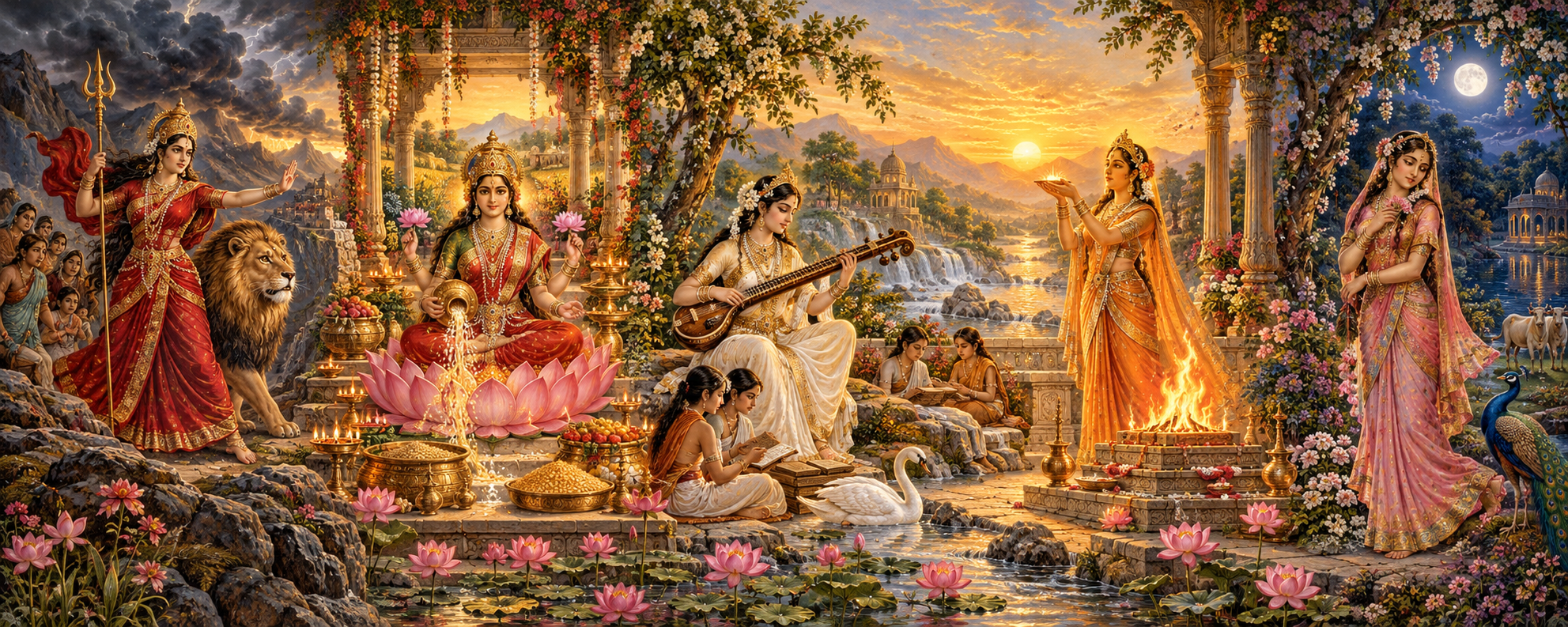
Durga: the power to protect, confront and transform
Durga reveals Prakriti as strength that meets disorder directly. Her protection should not be reduced to aggression, anger or victory over an external enemy. Protection also requires discernment: knowing what must be defended, what must be refused and what within you can no longer be allowed to rule.
You are encountering Durga’s field whenever a situation demands a truthful boundary, sustained courage or disciplined resistance to a destructive tendency. The practical question is not simply, “How do I become stronger?” It is, “What is this strength for?” Shakti without dharmic direction can become domination. Durga’s force is meaningful because it restores right order.
To contemplate this form, name one thing you have been avoiding because it requires courage. Then choose a proportionate action: speak a necessary truth without cruelty, stop cooperating with an unhealthy pattern, complete an obligation you have postponed, or protect someone without turning the act into a display of power.
Lakshmi: the power that nourishes flourishing
Lakshmi reveals Prakriti as abundance, beauty, harmony and auspicious order. Money can belong to this field, but equating Lakshmi with cash is a serious reduction. Wealth that corrodes relationships, rewards dishonesty or leaves everything around it neglected is not the fullness of sacred prosperity.
Lakshmi becomes visible in what allows life to flourish: care for a home, responsible use of resources, generosity, hospitality, cleanliness, gratitude and the maintenance that keeps good things from decaying. Her question is not merely, “What can I acquire?” It is, “What has been entrusted to me, and am I sustaining it well?”
Apply this by looking for neglected support rather than chasing a symbol of success. Repair what you use, settle an obligation, organize a disordered space, share food, or give proper attention to the person whose quiet work sustains your household. Do not reverse the teaching and treat poverty or misfortune as proof of spiritual deficiency. The contemplative point is responsible participation in flourishing, not judgment of another person’s circumstances.
Saraswati: the power of knowledge, speech and discernment
Saraswati reveals Prakriti as the intelligence through which experience becomes understandable and expression becomes meaningful. Learning, speech, music and disciplined inquiry belong naturally to her field. She is not merely the patron of passing examinations or accumulating information. Knowledge reaches its dharmic purpose when it clarifies rather than confuses, refines rather than inflates the ego, and helps truth take articulate form.
Her presence matters whenever careless language is making a problem worse. Before speaking, ask whether your words are true, necessary and sufficiently precise. Before forming an opinion, identify what you actually know, what you have merely repeated and what remains uncertain. Before studying, define the question you are trying to answer.
A practical offering to Saraswati is intellectual honesty. Correct a false statement even when it benefits your side. Read beyond a headline. Learn the meaning of a sacred term instead of using it as decoration. Listen carefully enough to represent an opposing view accurately before answering it. These acts make knowledge a discipline of truth rather than a collection of credentials.
Savitri: the power of sacred illumination and renewed intention
Savitri can be the hardest of the five to distinguish from Saraswati because both touch knowledge and sacred expression. A useful distinction is that Saraswati emphasizes understanding and articulation, while Savitri points toward the illuminating, generative force by which truth becomes a living orientation. One makes meaning clear; the other presses that meaning into disciplined remembrance and renewal.
You need this distinction when spiritual activity has become mechanical. It is possible to recite words accurately, keep a routine and still lose contact with the intention that gives the practice life. Savitri asks whether what you repeat has entered how you see, choose and act.
When approaching this form, return to a prayer, recitation or contemplative discipline already rooted in your tradition. Slow down enough to attend to its meaning. Then identify the decision that meaning should change. If a prayer invokes light but your conduct depends on concealment, the missing step is not more vocabulary. It is alignment.
Radha: the power of devotion, delight and self-transcending love
Radha reveals Prakriti as love’s power to draw the finite beyond self-enclosure. Her inclusion in the fivefold vision matters because it prevents Shakti from being understood only as force, possession or achievement. The highest relationship with the divine is not merely control over energy. It is intimacy, devotion, delight and willing self-offering.
Radha should not be flattened into ordinary romance or vague emotional sweetness. Devotion tests the ego precisely because love asks for presence without constant calculation of return. It changes worship from a transaction – “I offer this so that I receive that” – into a relationship in which offering is itself meaningful.
Bring this form into conduct by noticing where affection has become possession or service has become performance. Listen without preparing your reply. Help without arranging to be admired. Dedicate an achievement rather than using it to establish superiority. Radha’s field asks a demanding question: “Can I love the divine, another person or the work before me without making myself the center of it?”
Use the fivefold map without turning Devi into self-help

A reflection for a real decision
The five forms can help you examine a difficult situation, provided you do not treat them as personality types or a device for predicting outcomes. Begin with the actual condition in front of you. Then use each form as a different diagnostic doorway.
| Form | Field to notice | Question to ask | Grounded response |
|---|---|---|---|
| Durga | Fear, disorder, boundaries and resistance | What must be protected or confronted? | Take one courageous action without cruelty. |
| Lakshmi | Nourishment, resources, care and sustainability | What must be maintained or shared? | Repair neglect and support genuine flourishing. |
| Saraswati | Knowledge, language, learning and discernment | What must be understood or expressed clearly? | Study, verify and speak with precision. |
| Savitri | Illumination, intention and disciplined remembrance | What truth must become lived orientation? | Reconnect practice with meaning and action. |
| Radha | Devotion, relationship, delight and self-offering | Where must possession give way to love? | Serve with presence and less concern for display. |
Do not automatically choose the form you find most attractive. A person drawn to force may invoke courage when the neglected need is careful study. Someone comfortable with learning may gather more information when a boundary is overdue. Someone who speaks constantly of devotion may overlook financial disorder or practical duties. The map works best when it exposes the dimension you habitually avoid.
- Describe the difficulty in plain language, without giving it a spiritual label.
- Read the situation through all five fields rather than stopping at your favorite form.
- Identify the field whose absence is causing the greatest distortion.
- Choose one action small enough to complete but concrete enough to change the situation.
- Return mentally to the unity of Prakriti: the form helped you recognize Shakti’s operation, but it did not divide the Mother.
Keep formal practice rooted in a living tradition
A conceptual map can improve your attention, but it is not initiation into a specialized tantric discipline. If your family, temple, teacher or lineage has given you a form of worship, let that tradition govern its ritual details. Do not invent esoteric procedures from a brief explanation or combine practices simply because their symbolism seems compatible.
The same restraint applies to interpretation. Do not use the five forms to diagnose other people as spiritually deficient. Their first use is self-examination. Ask what courage, care, clarity, alignment or devotion your own response is missing. Then let worship correct that omission in conduct.
This keeps the fivefold teaching from becoming either abstraction or spiritual consumerism. You are not selecting a goddess as though choosing a service for a desired result. You are learning to recognize one Divine Mother through the distinct demands she places upon a human life.
Key takeaways
- The five forms are best understood as distinguishable manifestations of one Prakriti, not five rival ultimate powers.
- Durga reveals protective and transformative strength; Lakshmi reveals sustaining abundance and harmony.
- Saraswati reveals knowledge and truthful expression; Savitri reveals sacred illumination becoming disciplined orientation.
- Radha reveals devotion and love that move the practitioner beyond possession and self-centered calculation.
- The map becomes practical when you use it to identify the missing quality in a decision and express that quality through a concrete action.
- Conceptual understanding does not replace lineage guidance for formal tantric worship.
The next time you meet these five names, resist the urge to memorize a row of attributes. Take one unresolved situation and place it before all five forms. Notice which question unsettles you most. That is often the doorway through which your understanding of Shakti needs to become action.
References

Leave a Reply
You must be logged in to post a comment.