

If you have wondered whether Yudhishthira’s reluctance to rule makes him weak, indecisive, or unusually fit for the throne, look first at what he refuses to do: he refuses to treat power as proof of virtue. For him, winning a kingdom does not settle whether every choice made along the way was righteous.
That is why his struggle still matters when you must make a decision that affects other people. Yudhishthira shows that dharmic leadership is not the art of keeping your conscience clean. It is the discipline of acting under imperfect conditions, examining the harm that follows, and accepting duties that remain after the decision is over.
Righteousness does not make ruling easy
Treating Yudhishthira as a flat emblem of righteous monarchy misses the difficulty that gives his character its force. A righteous person may know the rule and still face a situation in which following it causes harm. He may act for a defensible purpose and still become responsible for consequences he did not desire.
His decision to gamble, participation in war, grief afterward, and final test on the journey should therefore be read as connected moral problems. The gambling decision asks whether consenting to a process can itself be a failure. The war asks what duty requires when every available course carries damage. His grief asks whether victory can erase the suffering produced by a victorious cause. The final test keeps moral accountability alive even after royal power has fallen away.
If you are judging a difficult act, including your own, separate four questions that are often collapsed into one:
- Was the purpose defensible?
- Was the process itself just?
- Who was harmed, including people who never chose the risk?
- What duty of restraint, repair, or restitution remains?
A good intention answers only the first question. Formal permission may answer part of the second. Neither cancels the third or fourth. This is the first burden of kingship: the ruler is answerable not only for what he meant, but also for what his authorized actions set in motion.
The crown changes the scale of personal dharma
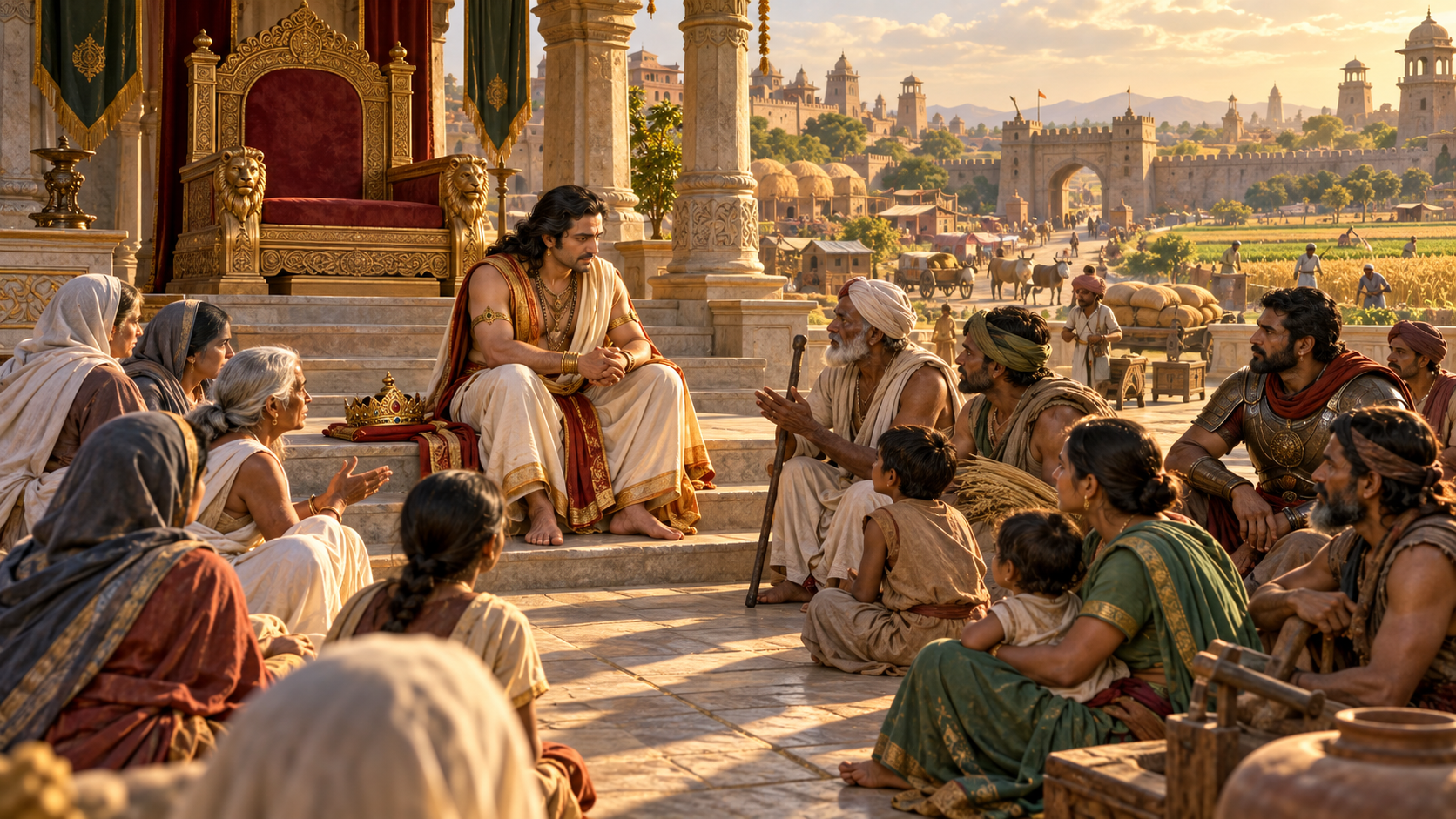
The crown is not a decoration placed upon an otherwise private moral life. It changes the field of responsibility. A private person may risk what belongs to him. A ruler holds the safety, order, and future of others in trust. His choices must therefore be judged by more than personal honour or fidelity to a familiar rule.
This is where rajadharma becomes harder than the pursuit of an untroubled conscience. The leader cannot ask only, Have I remained true to myself? He must ask, What did my decision do to those placed under my protection? The second question does not abolish principle. It prevents principle from becoming self-regard.
There is an opposite danger. A ruler can excuse almost anything by claiming that circumstances demanded it. Yudhishthira’s burden should not be turned into a blank cheque for expediency. Necessity must be tested, not merely announced. Before accepting a harmful course as unavoidable, apply these checks:
- Authority: Are you deciding something that is actually yours to decide?
- Trust: Are you risking your own interests, or interests you merely hold on behalf of others?
- Alternatives: Have less harmful options been examined honestly, or dismissed because they are slower, harder, or less flattering?
- Accountability: Will you remain answerable for the result, or are you preparing to blame custom, advisers, opponents, or fate?
- Repair: If harm cannot be prevented, what concrete obligation will begin afterward?
You can use these questions outside a palace. They apply whenever you act as a trustee, parent, manager, community organizer, or public official. The scale changes, but the moral structure does not: entrusted power increases the number of people whose interests must enter your decision.
The gamble warns against surrendering responsibility to procedure
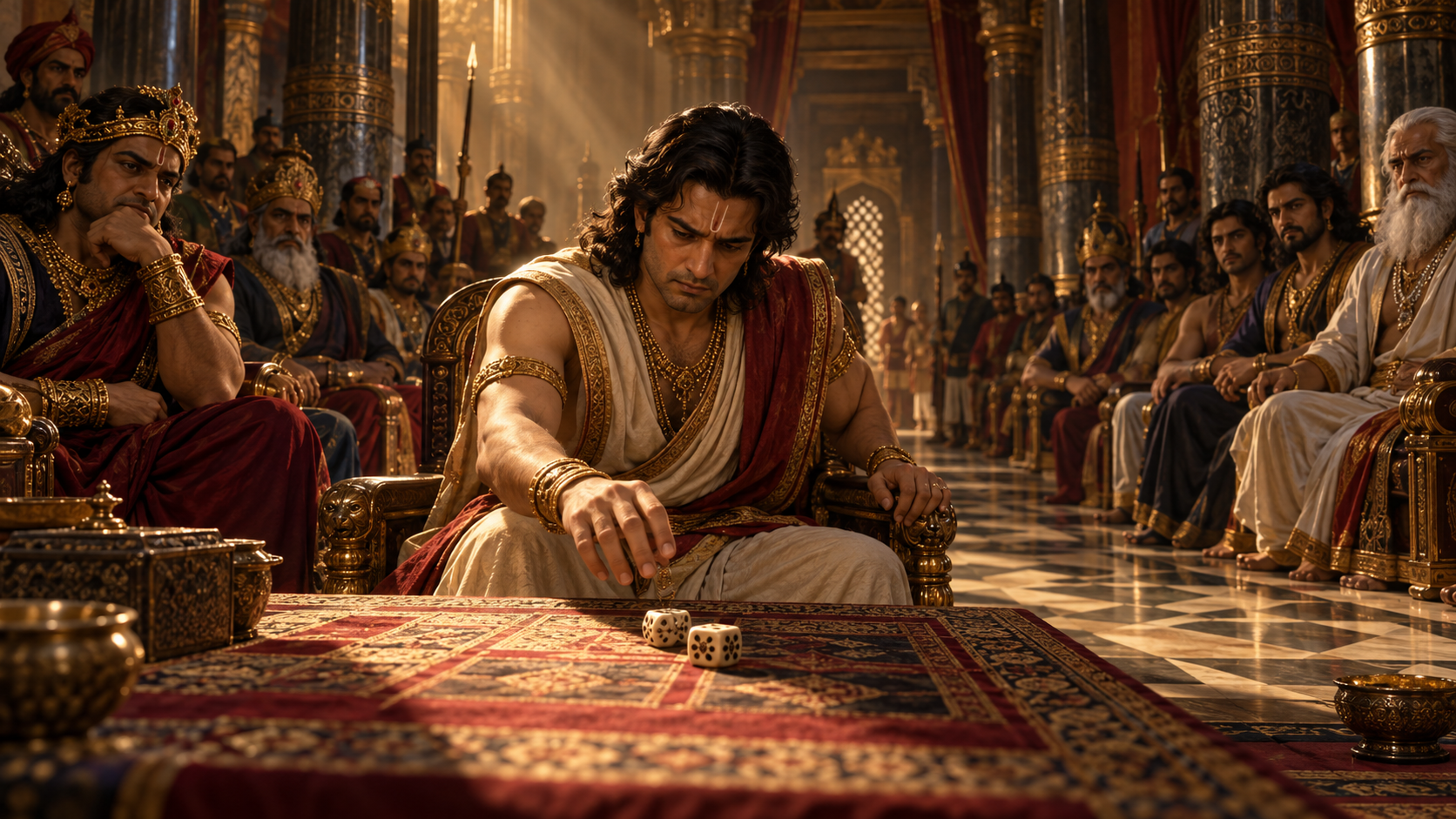
For a reader concerned with governance, the gambling decision raises a problem larger than personal weakness. A leader may consent to a recognized process and then behave as if the process, rather than the person who empowered it, owns the consequences. That is procedural surrender.
Rules, wagers, votes, negotiations, and institutional conventions can determine outcomes, but they cannot absorb moral responsibility. If the process places other people’s welfare at risk, participation is already an ethical decision. Saying that the rules produced the result does not answer why those rules were allowed to govern what was never yours to dispose of freely.
Before you enter a consequential process, especially one that becomes difficult to stop once it begins, write down four things:
- What belongs to you and may legitimately be risked.
- What has been entrusted to you and must not be treated as personal property.
- The condition that will make you pause or withdraw.
- The person who has standing to challenge your judgement before the damage is done.
This exercise prevents momentum from disguising itself as duty. It also exposes a crucial distinction: courage may require accepting a personal loss, but leadership does not authorize you to make unwilling dependants pay for your honour. The practical lesson is simple and severe: do not stake what you only steward.
War and grief show why victory cannot certify dharma
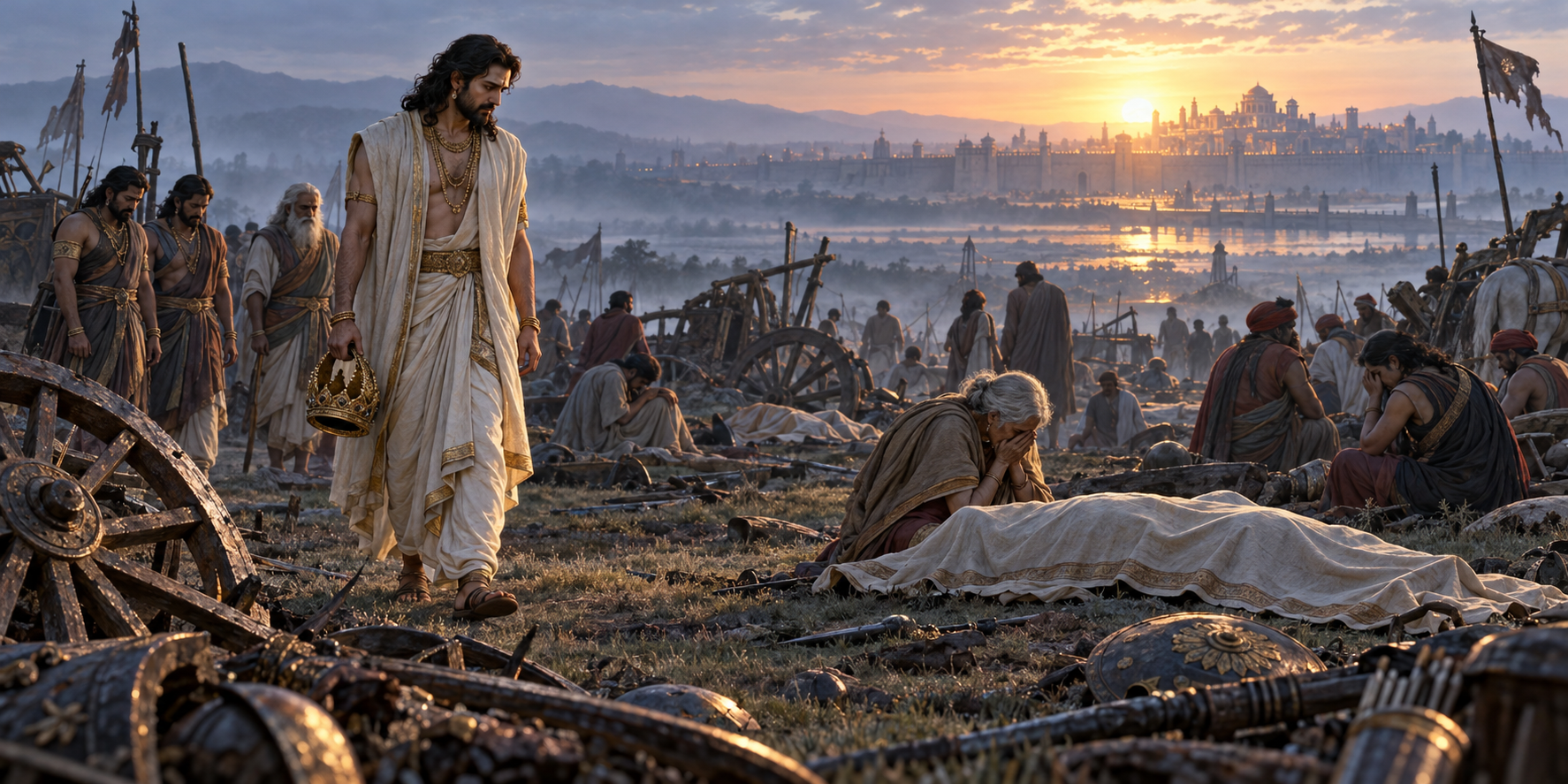
Yudhishthira’s participation in war and his grief afterward reveal another burden. Sometimes a ruler must choose in conditions already deformed by adharma. Refusing to act may carry its own consequences. Yet the necessity of action cannot make the resulting suffering unreal.
Two easy conclusions should be resisted. The first is that victory proves the victorious side was righteous in every respect. The second is that grief proves the decision to act was entirely wrong. Neither follows. Victory establishes an outcome, not moral innocence. Grief registers a cost, not a complete verdict.
This is why Yudhishthira’s grief matters. It prevents a just cause from becoming a story of spotless self-congratulation. A leader who recognizes no remainder after destructive action will probably repeat the same damage. A leader who treats all remorse as proof that action was forbidden may become incapable of protecting anyone. Dharmic judgement has to hold necessity and consequence in view at the same time.
After any decision that causes serious harm, keep three separate ledgers:
- Necessity: What danger or obligation made action necessary, and what evidence supported that judgement?
- Consequence: Who suffered, including those outside the intended field of action?
- Repair: What must now be restored, restrained, compensated for, or prevented from recurring?
Do not use one ledger to erase another. A defensible necessity does not cancel injury. Injury does not automatically prove that every alternative was better. Repair is not an admission that the original cause lacked justice; it is an acknowledgement that even necessary power can leave obligations behind.
Key takeaways for dharmic leadership
- Judge intention, procedure, consequence, and repair separately. A favourable answer in one category cannot settle the others.
- Distinguish personal sacrifice from entrusted welfare. You may surrender what is yours; you need stronger authority to risk what belongs to those under your protection.
- Set limits before entering a process. Momentum, custom, and formal rules can conceal the moment at which participation becomes complicity.
- Do not treat success as moral certification. A victorious decision may still require grief, restraint, and restitution.
- Do not treat remorse as a substitute for duty. Let it change future conduct, safeguards, and the treatment of those who bore the cost.
Yudhishthira is compelling because he does not allow kingship to become possession, spectacle, or moral immunity. The throne enlarges his duty without guaranteeing an innocent choice. His unease is therefore not merely a defect to be excused. It is evidence that he understands what power places upon the person who exercises it.
The next time you face a decision that will bind other people, pause before asking only whether you can justify it. Ask what you are placing at risk, who will pay if you are wrong, and what repair you will owe even if you are right. That small discipline is one practical way to carry authority without worshipping it.
References

Leave a Reply
You must be logged in to post a comment.