
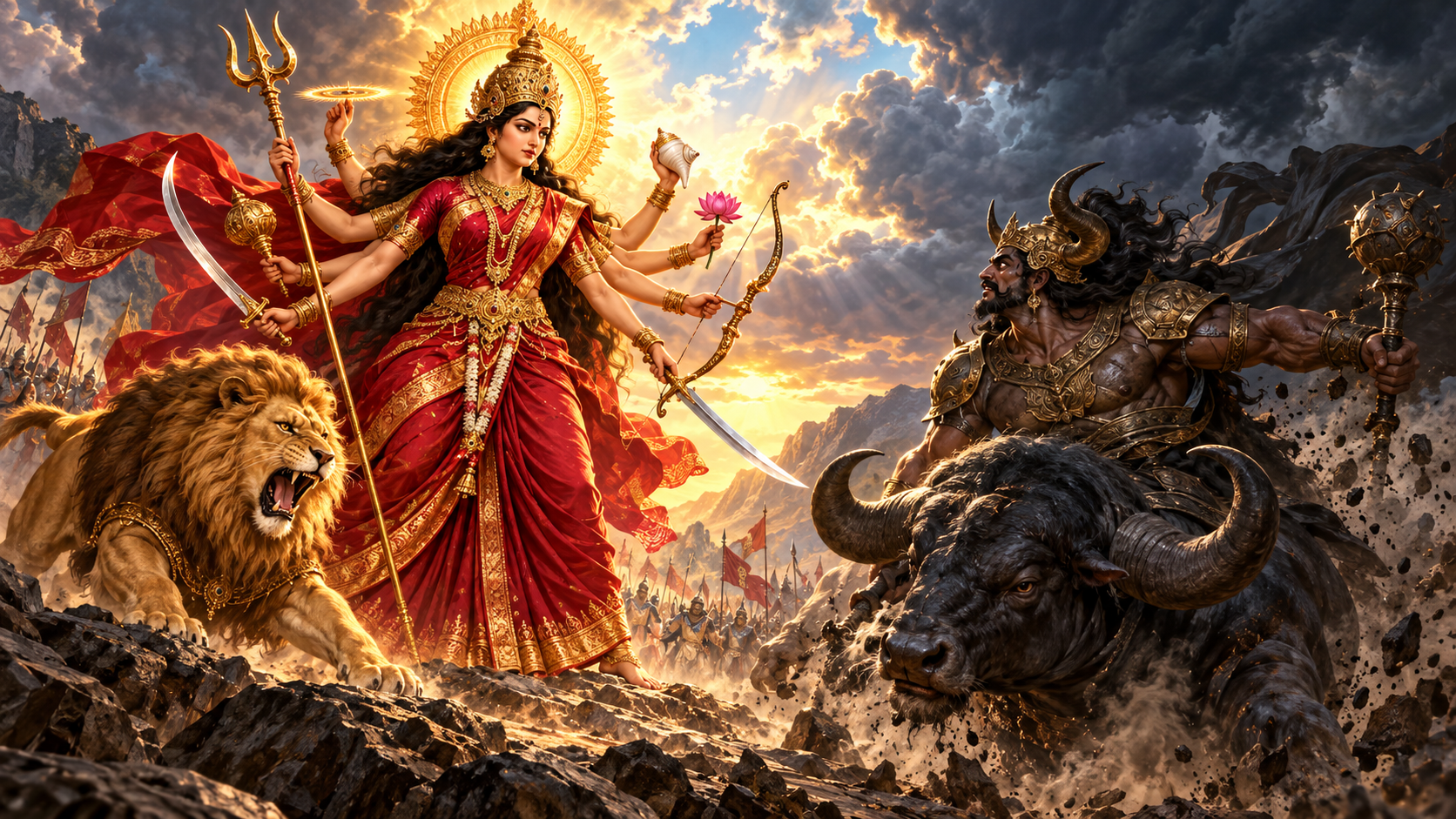
If you are trying to understand why Mahishasura could be killed by a woman, the crucial detail comes before his battle with Devi. His death was not simply an unexpected defeat. A rishi’s curse had already declared the form in which justice would reach him.
That distinction matters. The curse explains why Mahishasura’s enormous strength could not protect him, why the feminine form is central rather than incidental, and why Durga’s victory is understood as the restoration of dharma rather than a contest of brute force.
The conduct that brought the curse upon Mahishasura

Mahishasura was born of Rambha and a she-buffalo. He possessed exceptional strength and magical powers, but the decisive issue was how he used them. Pride turned power into aggression. Instead of respecting those engaged in tapas, he disturbed the penance of sages and devotees.
Rodrashava, a devoted disciple, was among those he wronged. This places the episode within a familiar Dharmic moral structure: austerity is not passive weakness, and an ascetic is not powerless merely because he refuses ordinary violence. Tapas produces spiritual potency. An attack on sincere spiritual discipline therefore creates consequences that physical strength alone cannot cancel.
Rishi Katyayana’s curse condemned Mahishasura to death at the hands of a woman. The punishment answered more than one isolated offence. It exposed the deeper disorder behind his actions: Mahishasura had begun to treat strength as permission, disruption as mastery, and apparent vulnerability as inferiority.
When you encounter a shortened retelling that jumps directly to Durga’s battle, remember this chain: power became arrogance, arrogance violated tapas, and that violation produced a consequence stronger than the offender’s power.
A curse is not the same thing as an immediate punishment
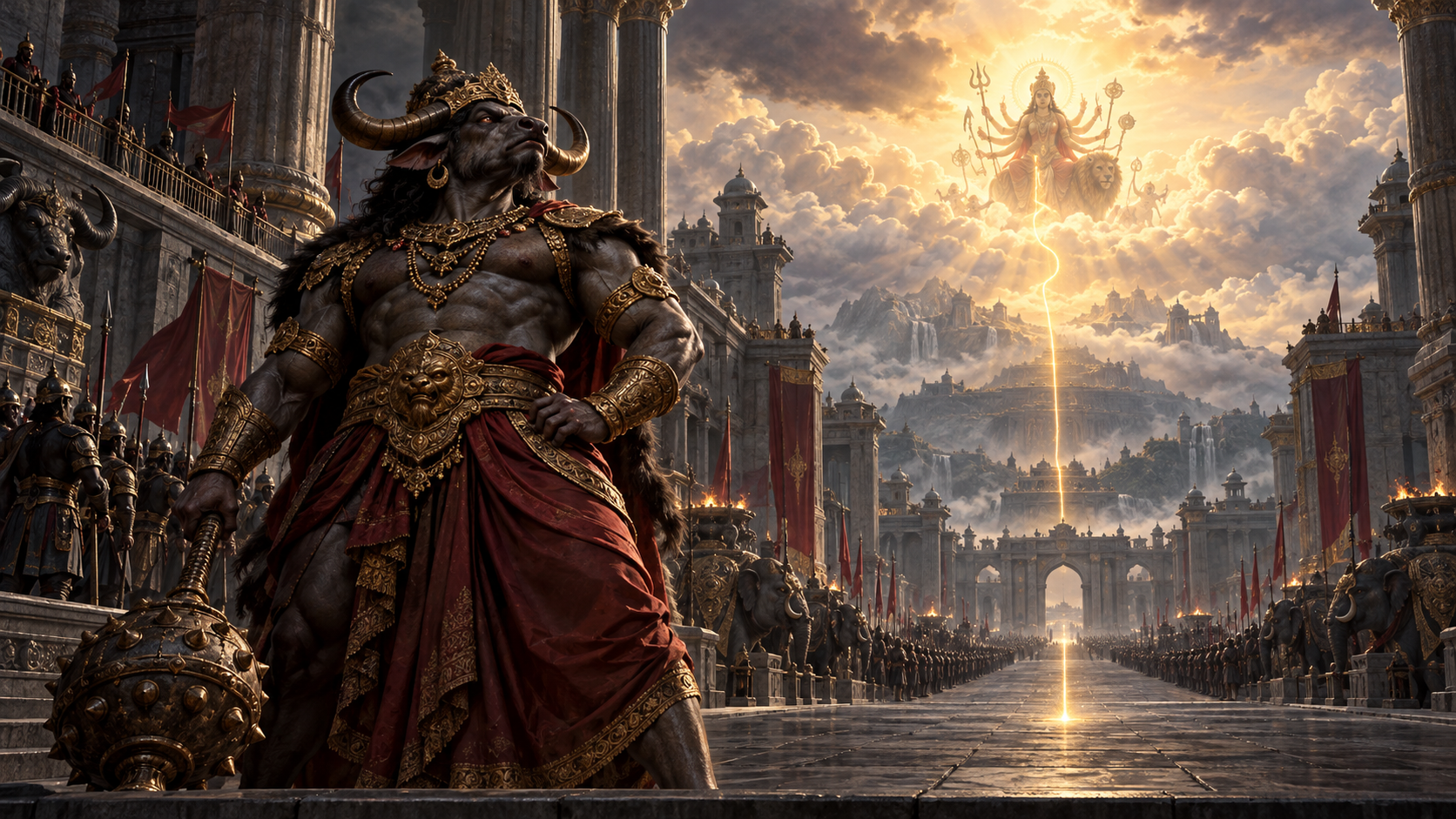
Within Puranic narrative logic, a rishi’s curse is speech empowered by tapas. It does not have to strike its target at once. It can establish the condition under which an apparently invincible being will eventually fall.
That is the best way to understand Mahishasura’s foretold death. The curse did not need to remove his strength or magical abilities. It placed a boundary around them. He could remain formidable, continue to inspire fear, and appear unconquerable, yet his power could no longer give him an unlimited future.
The curse and the later battle therefore do different work. The curse identifies the form of the consequence: Mahishasura will die by the hand of a woman. Durga brings that consequence into history through action. Foretelling does not make the battle meaningless; it explains why the battle ends as it does.
Nor does foretelling erase moral agency. Mahishasura’s end is fixed because of what his conduct has already set in motion. His continued reliance on domination carries him toward that end. The episode is not fatalism in which choices mean nothing. It is moral causation in which choices eventually become consequences.
Why death at the hands of a woman is the precise answer
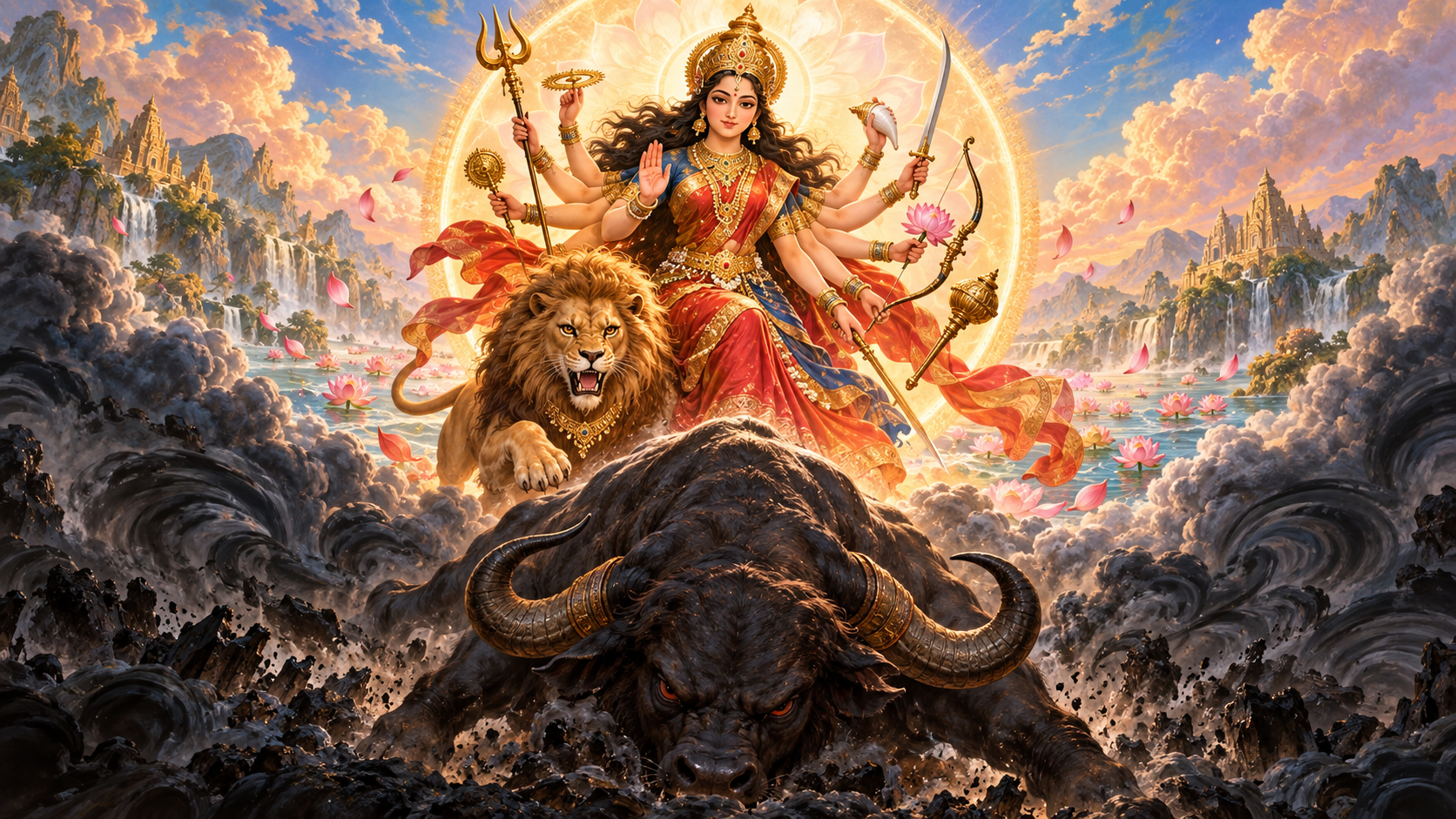
The phrase “by the hand of a woman” should not be read as though womanhood were merely an unusual technical loophole. That reading is too shallow. The feminine form is the revelation at the centre of the episode.
Mahishasura understood power through force, intimidation, and the ability to interrupt the sacred work of others. Devi reveals another order of power. As Durga, she is not an imitation of masculine force. She is Shakti: divine power manifest, conscious, disciplined, and aligned with dharma.
This is why the name Mahishasuramardini carries such weight. It identifies Devi as the destroyer of Mahishasura, but her victory is not reducible to killing an enemy. She destroys the false measure by which domination is mistaken for supremacy. The being who terrorized ascetics discovers that neither outward quietness nor feminine form indicates powerlessness.
The symmetry is exact:
- Mahishasura uses strength to violate tapas; the spiritual power of tapas determines his end.
- He acts as though force places him beyond restraint; the curse establishes a restraint he cannot break.
- He embodies arrogant domination; Devi confronts him as power governed by dharma.
- He appears difficult to defeat through familiar means; the feminine divine becomes the means of his defeat.
So when you see Durga standing over the buffalo demon, do not read the image as a generic celebration of violence. Read it as a judgment about power: force severed from dharma eventually encounters a power it failed to recognise.
How to carry this meaning into Durga worship

The episode becomes useful when it changes what you notice in worship. During recitation, puja, temple darshan, or contemplation of Mahishasuramardini, hold together three stages that abbreviated versions often separate: the violation of tapas, Katyayana’s curse, and Devi’s victory.
First, notice what makes Mahishasura adharmic. His defining fault is not that he is powerful. Hindu traditions do not treat power itself as evil. His fault is the arrogant use of power to obstruct spiritual practice and injure those he considers unable to resist him.
Second, notice that justice may be delayed without being absent. Mahishasura’s continuing strength after the curse can resemble success, but it is success inside a limit he cannot see or overcome. This is a sober lesson for anyone discouraged by the temporary ascendancy of adharma: delay is not acquittal.
Third, recognise Devi as the agent of restoration. She does not enter the narrative as a secondary figure who happens to exploit a weakness. Her arrival discloses what Mahishasura’s worldview excluded: Shakti is fundamental, and dharmic power cannot be measured by the assumptions of an arrogant opponent.
You can turn that reading inward without reducing Mahishasura to a vague metaphor. Ask where strength in your own life has become entitlement, where you dismiss disciplined quietness as weakness, or where repeated success has made correction seem impossible. Those are specific habits to watch. The episode calls for respect toward tapas, restraint in the use of power, and humility about the forms through which correction may come.
Key takeaways
- Mahishasura’s foretold death followed his arrogant misuse of strength and his disruption of the penance of sages and devotees.
- Rishi Katyayana’s curse established that a woman would bring about his death; it did not need to destroy his powers immediately.
- The curse explains the form of divine justice, while Durga’s battle enacts that justice.
- Death by a woman is not a trivial loophole. It reveals Devi as Shakti and overturns Mahishasura’s false understanding of power.
- The practical lesson is not to reject strength, but to place strength under dharma, restraint, and respect for spiritual discipline.
The next time you behold Mahishasuramardini, begin before the battlefield. Remember the tapas that Mahishasura violated and the limit his own conduct placed upon his power. Then Durga’s victory becomes clearer: adharma does not fall through greater arrogance, but through Shakti acting in perfect alignment with dharma.
References

Leave a Reply
You must be logged in to post a comment.