
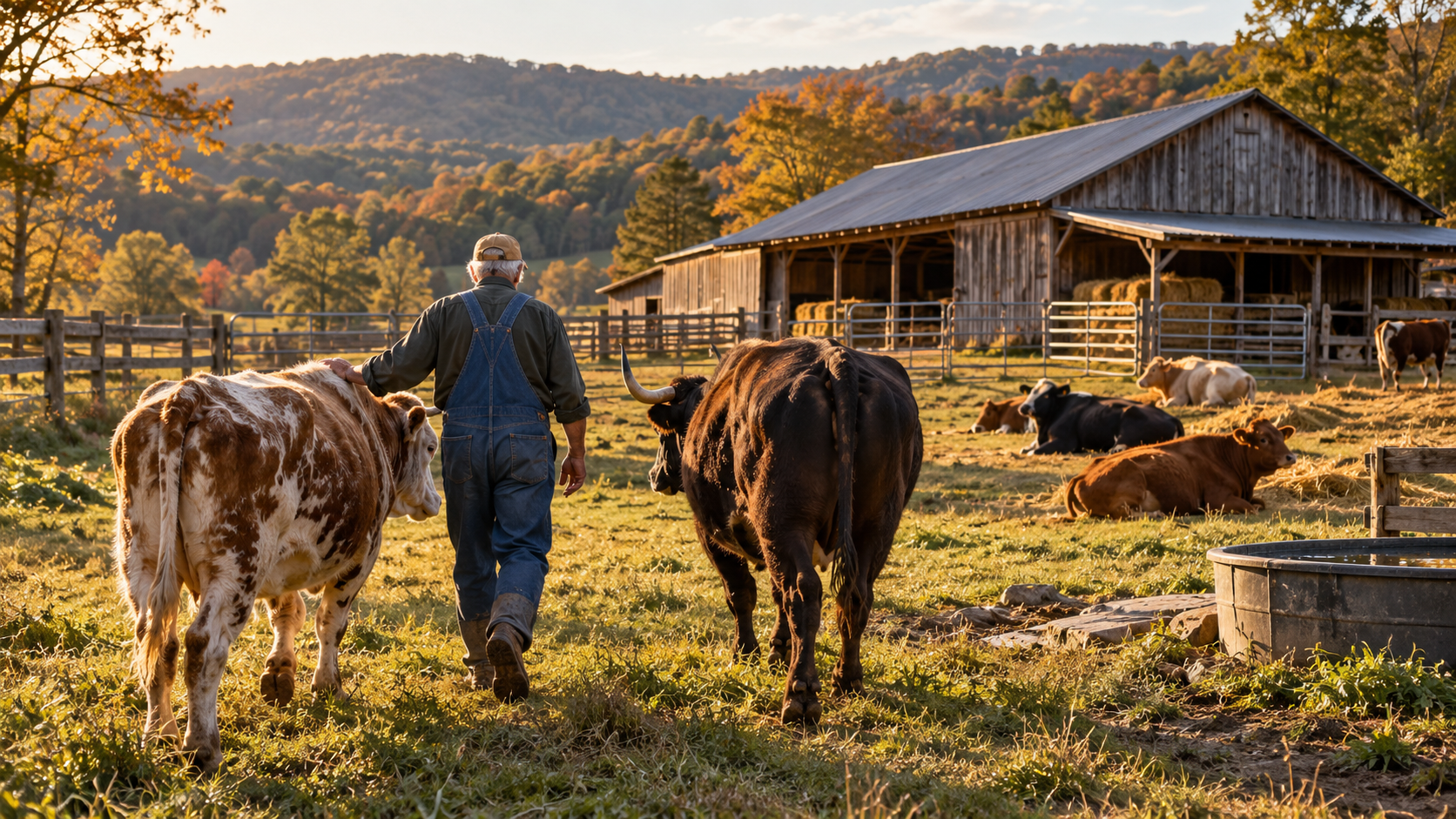
Perhaps you came here wanting to know what Balabhadra Das actually contributed to cow protection, or how you can honour him now. The shortest answer is demanding: he helped turn go-seva from a noble sentiment into a lifelong system of care.
Balabhadra Das passed away peacefully at the ISCOWP cow sanctuary on October 17, 2026, at the age of 80. The setting was fitting, but the standard he leaves us is more important than the image: protection must still work when an animal becomes old, when an ox requires patient training, when money is tight, and when the founding cowherd is no longer there to carry everything personally.
The hard test of go-seva begins after sentiment
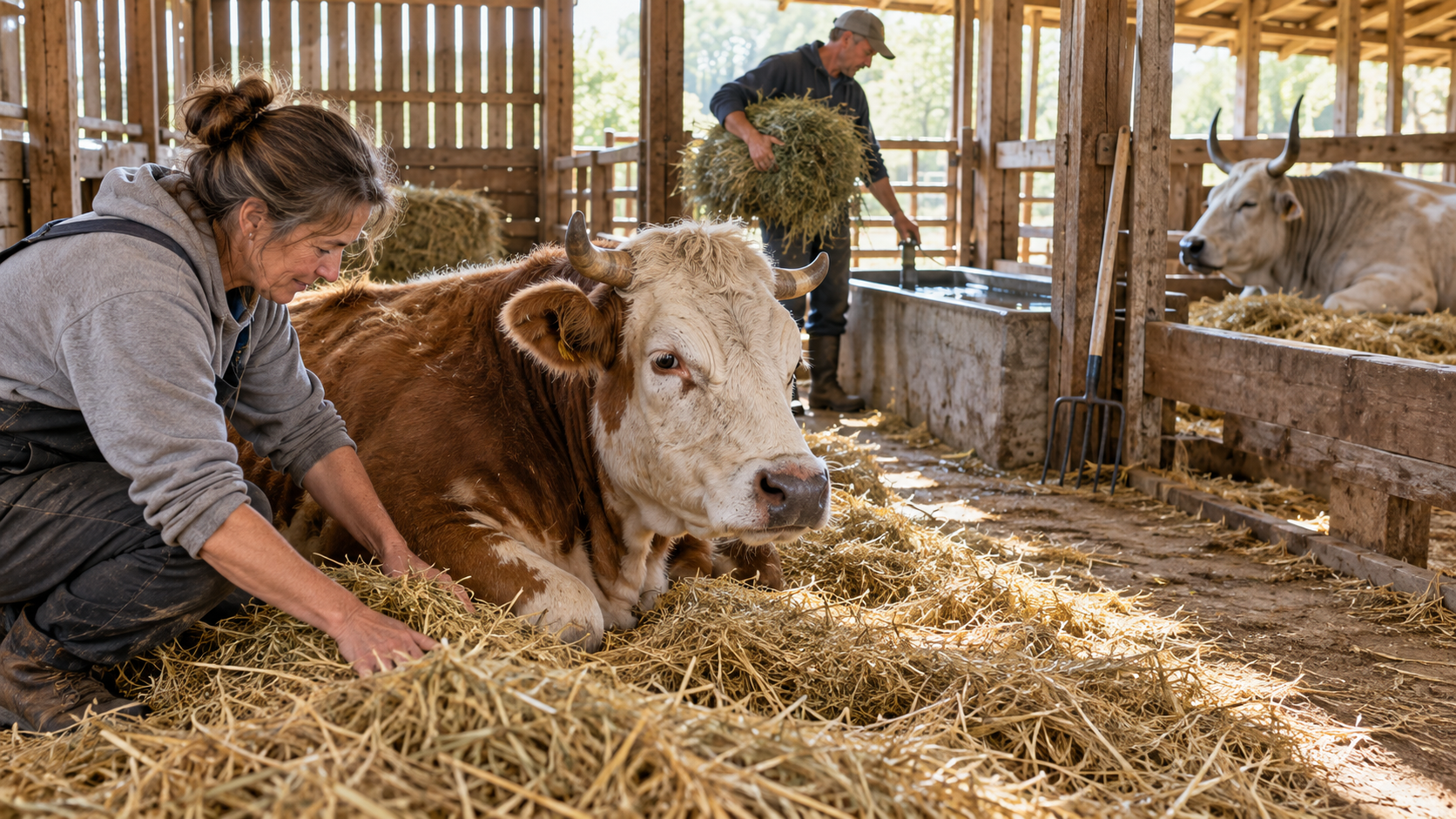
It is easy to feel affection for a healthy calf or a gentle milk cow. Cow protection becomes serious when that affection is translated into obligations that cannot be abandoned when circumstances change.
Balabhadra and his wife, Chaya Devi, founded the International Society for Cow Protection, or ISCOWP, to promote practical and spiritual care for cows without slaughter. That final condition changes the entire undertaking. If slaughter is excluded, the protector must plan beyond an animal’s productive years. Land, feed, shelter, handling, human labour and institutional continuity become parts of the same promise.
His work gives you four useful tests for distinguishing durable cow protection from a temporary display of concern:
- The lifetime test: Does protection continue when an animal is old, ill or no longer economically productive?
- The ox test: Are male cattle patiently trained and given an honoured place in farm life, rather than treated as an unwanted by-product?
- The competence test: Do the people responsible for the herd possess practical husbandry and handling skills, or only good intentions?
- The continuity test: Are finances, standards, training and succession strong enough to protect the animals after a founder retires, becomes ill or dies?
If a project cannot answer one of these questions, that does not automatically make it unworthy. It identifies the place where help is most urgently needed. Your donation, volunteer time or professional knowledge should strengthen that weak point instead of merely increasing the number of animals for which the project has made an open-ended promise.
He learned the work before building the institution
Balabhadra’s path did not begin with an organisation or a title. Born on April 22, 1946, he grew up on Oahu and was already a vegetarian reading the Bhagavad Gita when he met devotees in Honolulu. Srila Prabhupada initiated him on March 25, 1969, only ten days after their first meeting, making him the first person initiated in Hawaii.
His early service revealed a willingness to place real resources behind conviction. He helped arrange public kirtans, served as temple commander and gave his inheritance toward the purchase of the McKinley Street ISKCON temple in Honolulu in 1971. After marrying Chaya in January 1973, he supported his growing family through dairy work and a honey-distribution business. The desire to protect cows remained, but he did not confuse desire with readiness.
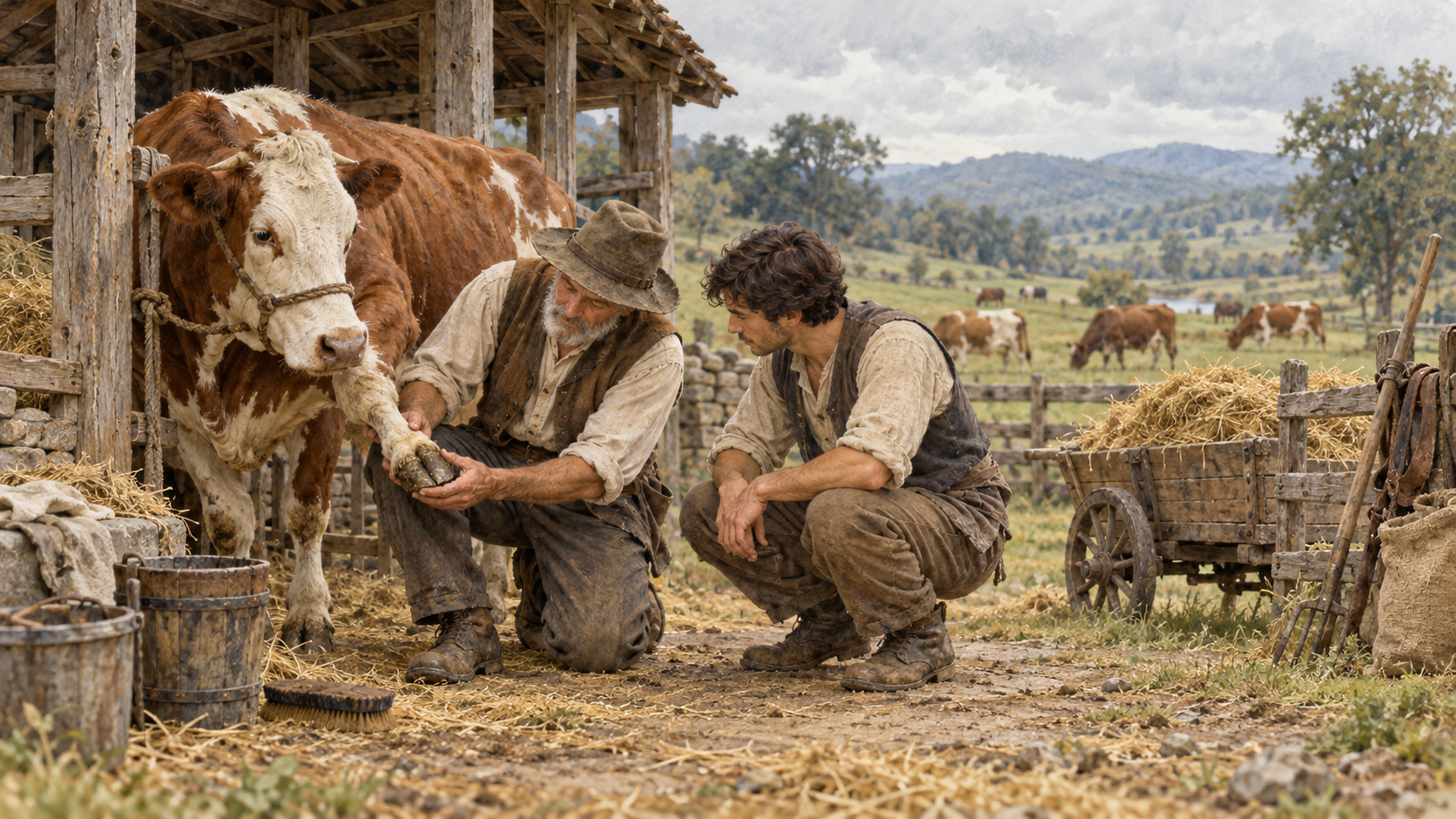
The decisive apprenticeship came at Gita Nagari. Balabhadra spent ten years learning to work with oxen under Paramananda Das. That period joined spiritual commitment to daily skill: approaching animals, reading their responses, training them and working with them consistently. Anyone hoping to establish a sanctuary should notice the order. Learn husbandry under capable people before accepting lifelong responsibility for a herd.
He also learned that protection does not occur only beside a cow. While raising funds for World Galleries, he regarded work to pay Gita Nagari’s mortgage and improve its agricultural capacity as another way of securing the cows’ home. This corrects a common misreading of seva. The person repairing a fence, maintaining accounts, securing land or funding winter feed may be protecting cows as directly as the person holding the brush.
Balabhadra and Chaya incorporated ISCOWP in 1990. During its early years, the family travelled across North America in a renovated school bus without air conditioning, beds or a toilet, hauling two oxen of approximately 2,000 pounds each. They brought working oxen to Ratha Yatras and state fairs so that people could encounter cow protection as a lived practice rather than an abstract appeal.
Institutional responsibility followed practical experience. Balabhadra became ISKCON Minister for Cow Protection and Agriculture in 1998. An international group of devotee cowherds then drafted the Minimum Cow Protection Standards, adopted as ISKCON Law 507 in 1999. Cow Protection Book 1 followed in 2003 to explain those standards. Skill had become policy, and policy had been made teachable.
That sequence is worth copying: practise, document, establish standards, train others and prepare successors. When health problems made extensive travel difficult, Balabhadra resigned from the ministry in 2012. His later wish was that ISCOWP be ready to continue its mission after his death. Succession was therefore not an administrative afterthought. It was part of protecting the cows.
Gentle ox training starts with relationship, not force
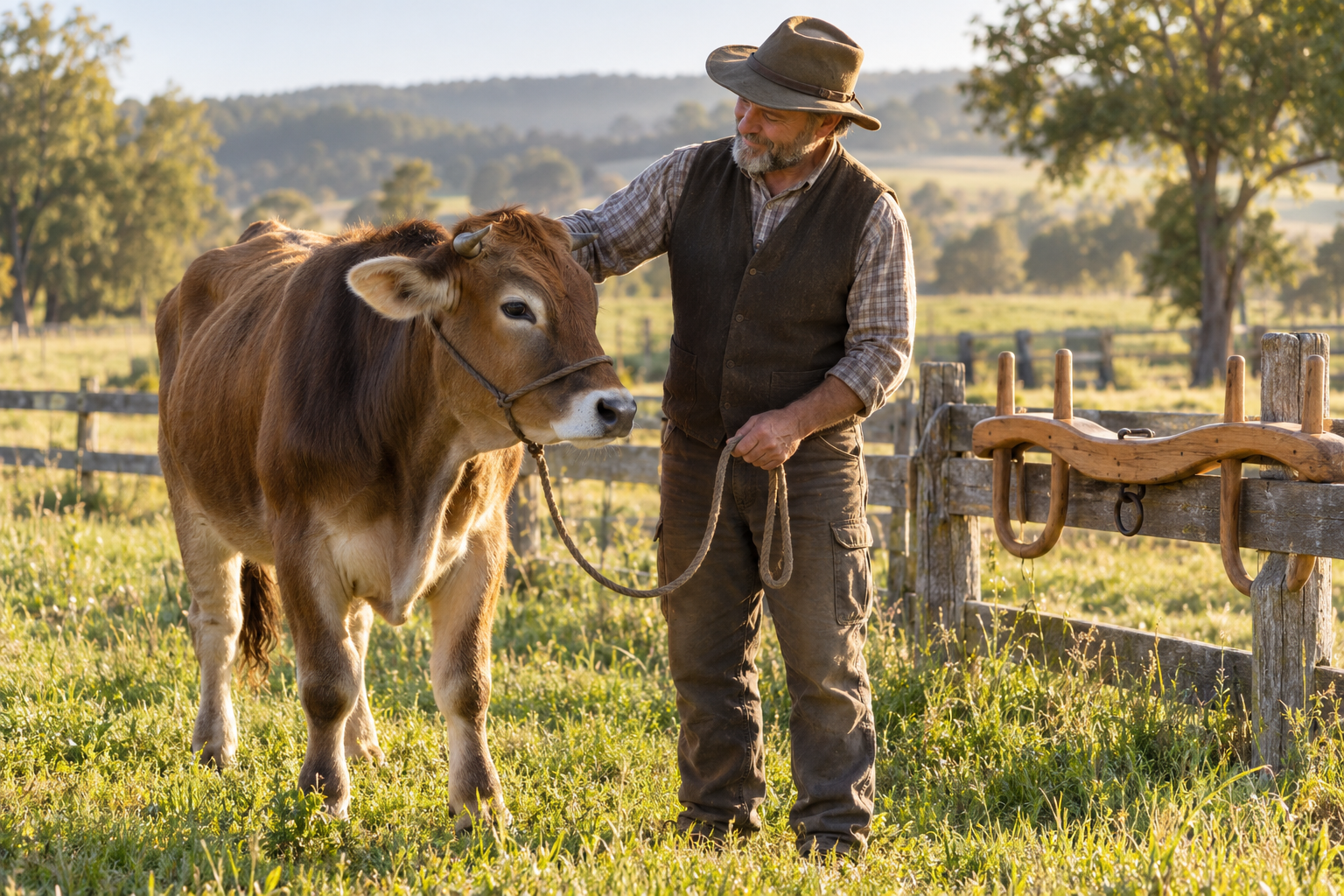
Balabhadra was especially respected for training oxen and teaching teamsters. His method began before commands or farm work: the handler first made friends with the animal. That meant spending time with the ox, using his name, brushing him and stroking him. Voice commands then became the basis of gentle engagement.
This is not mere softness. A large animal learns through repeated associations with a handler’s presence, touch and voice. Calm familiarity makes communication possible. Force may produce immediate movement, but it does not create the dependable relationship required for years of cooperative work.
If you are learning to work with oxen, translate the principle into a careful progression:
- Begin under an experienced cattle handler or teamster who can read the animal and keep both people and cattle safe.
- Spend regular, unhurried time with the animal before asking him to perform work.
- Use his name and a consistent set of voice commands rather than changing words or tone from session to session.
- Introduce brushing and touch only in a controlled setting and with attention to the animal’s response.
- Train additional handlers in the same commands and routines so that trust does not depend on one person.
Do not attempt to handle or train a large ox from written instructions or videos alone. The animals Balabhadra transported could weigh about 2,000 pounds each. An inexperienced person’s mistake can injure the handler, bystanders or the animal. The safe way to honour his example is apprenticeship with a competent teamster, suitable facilities and patient repetition.
Questions to ask before supporting a cow-protection project
Is rescuing a cow the same as protecting her?
Rescue can be the first act of protection, but it is not the whole obligation. The harder question is what happens during the following years. Before funding an intake, ask whether the project has room, labour and a lifetime-care policy for animals already present. Adding one more cow without strengthening long-term capacity can transfer immediate danger into chronic insecurity.
Does fundraising and administrative work count as go-seva?
It can, when the connection to care is clear. Balabhadra considered fundraising for Gita Nagari’s mortgage and agricultural development to be protection because it secured and improved the cows’ home. Apply the same test to your own service: identify the concrete need, show how the work meets it, and make the result accountable. Bookkeeping labelled as seva is not enough; bookkeeping that keeps feed purchased, land secure and obligations visible is indispensable.
What shows that an organisation can outlive its founder?
Look for written standards, documented routines, trained second-line leaders and a clear policy on lifelong care. Ask who can make decisions when the founder is unavailable and whether more than one person understands each essential job. Balabhadra’s movement from hands-on practice to formal standards and educational materials shows why this matters. Charisma can begin a mission; transferred competence keeps its promises.
Put the legacy into practice where you are
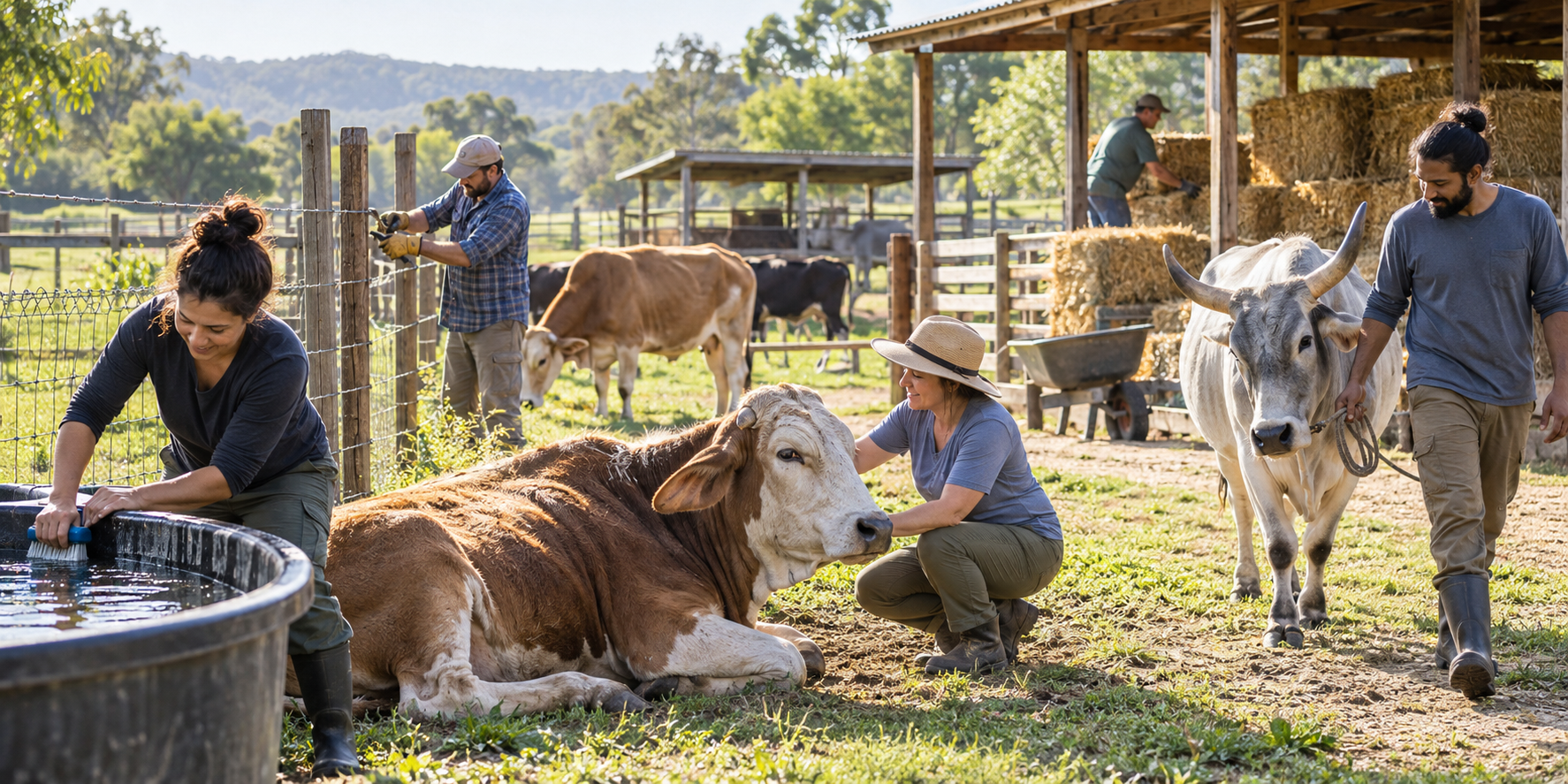
You do not need to own a farm to carry Balabhadra Das’s work forward. You do need to choose a responsibility specific enough to be completed and sustained.
- If you donate: ask for the project’s no-slaughter and lifetime-care commitments, how it cares for oxen and older animals, and which recurring cost your contribution will meet.
- If you volunteer: choose a dependable role such as maintenance, record-keeping, outreach or fundraising. Enter animal-handling work only with proper supervision.
- If you lead a goshala or sanctuary: write down the care policy, commands, routines and emergency responsibilities that currently live in people’s memories. Then train at least one other person for every essential function.
- If you work in agriculture: study how respectfully trained oxen can be meaningfully engaged rather than treating male cattle as outside the protection question.
- If you teach dharma: connect reverence for the cow with the material duties it creates. Affection without provision leaves the difficult work to somebody else.
Choose one of those roles and take its first concrete step: request a care policy, arrange supervised training, cover a recurring need or document a routine. Balabhadra Das’s most useful memorial will not be admiration alone. It will be another cow protected by people whose devotion is patient, skilled and prepared to endure.
References

Leave a Reply
You must be logged in to post a comment.