
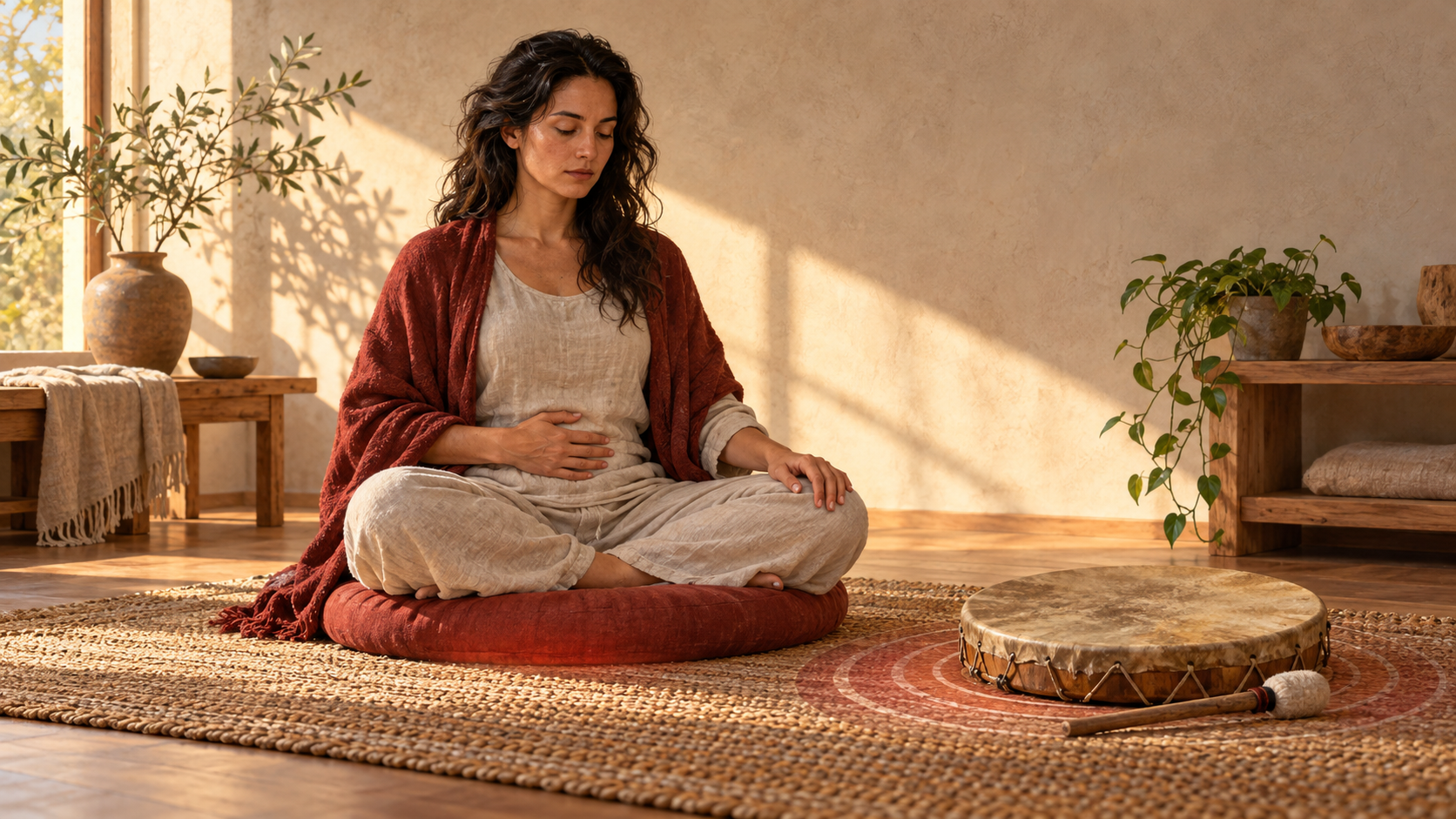
You may have seen charts assigning a note, frequency, raga or instrument to every chakra. If you want a trustworthy spiritual practice, don’t begin by memorising the chart. Begin by separating a traditional association from a medical claim, then pay close attention to what the music actually does in your experience.
This approach leaves room for shraddha without asking you to manufacture a result. Music can support contemplation, prayer and disciplined self-observation even when you cannot prove that a chakra has been “opened” or “healed.”
Begin with the claim you can responsibly make
A chakra is a subtle centre within particular yogic and tantric ways of understanding the human being. It is not simply another name for an organ, gland or nerve. Chakra maps also vary among traditions, so a correspondence taught within one lineage should not automatically be presented as a universal law accepted by every Dharmic school.
Sri Sri Ravi Shankar specifically associates both large and small drums with Mooladhara, the base or first chakra. That gives you a clear traditional instruction to explore. It does not establish that every drum rhythm produces the same effect in every listener, nor does it justify inventing a complete instrument-to-chakra chart around this one correspondence.
Hold the distinction carefully: “Drums are used in this teaching in relation to Mooladhara” is a fair statement. “This recording will medically repair your root chakra” is not. The second claim turns spiritual language into an unsupported diagnosis and promise.
What the drum-Mooladhara association asks you to notice
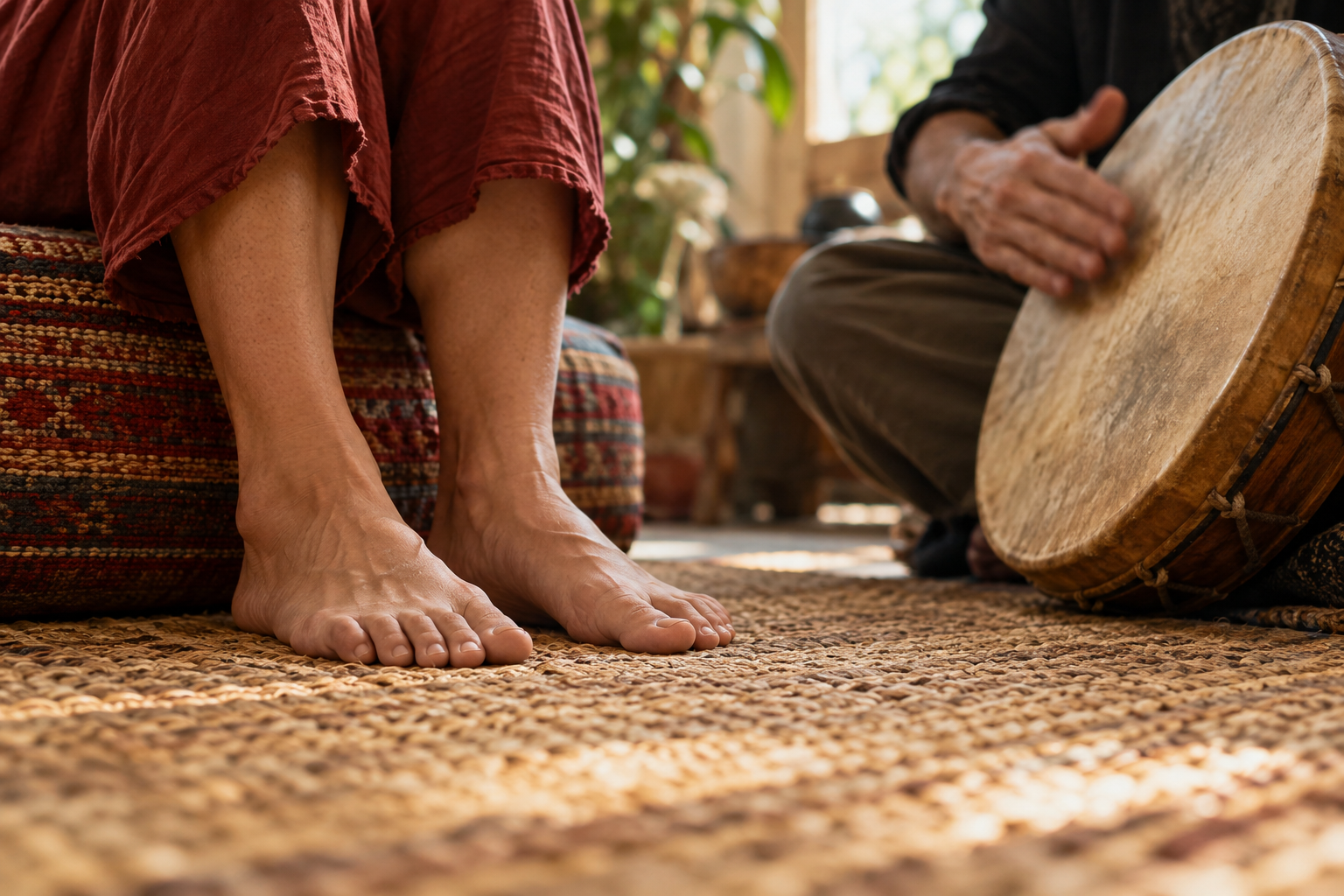
Mooladhara is identified as the base chakra. A practice centred on it can therefore direct your attention toward support: the floor under your feet, the seat beneath your body, the steadiness of your posture and your ability to remain present rather than drift into fantasy.
A drum is well suited to this kind of inquiry because its pulse is easy to follow. You hear an impact, a pause and a return. Instead of constructing elaborate inner pictures, you can let that recurrence bring attention back to the body. The useful question is not, “Did I feel something dramatic?” It is, “Did I become more settled, embodied and attentive?”
Do not assume that louder, faster or more bass-heavy drumming must be spiritually stronger. Intensity can produce excitement or physical sensation without producing steadiness. A useful Mooladhara practice should be judged by the quality of attention it supports, not by how forcefully the sound enters the body.
A repeatable way to practise with drumming

Use a simple procedure so that expectation does not swallow observation. You are not trying to force an experience. You are creating conditions in which a subtle response, an ordinary response or no response can all be noticed honestly.
- Choose a modest intention. Ask whether drumming helps you feel steadier and more present. Avoid beginning with the demand that Mooladhara must activate.
- Select an uncluttered drum passage. A recording or live rhythm with few competing elements makes it easier to observe your response to the drum itself. Keep the volume comfortable.
- Establish your baseline. Before the music begins, notice your breathing, muscle tension, mood and points of contact with the ground or seat. Do not try to improve any of them yet.
- Let the pulse anchor attention. When thought wanders, return to the beat and to the body’s contact with its support. You do not need to visualise a colour, repeat an affirmation or imitate somebody else’s reported sensation.
- Keep the silence after the music. When the drumming ends, remain still long enough to notice whether the effect continues, changes or disappears. Sometimes the contrast created by silence is more revealing than the sound.
- Write a plain before-and-after note. Use observable words such as settled, restless, alert, heavy, distracted or unchanged. Record bodily sensation separately from the meaning you assign to it.
- Repeat before drawing a conclusion. Use the same passage on different days. A response that appears only once may reflect fatigue, mood, expectation or the surrounding situation rather than a stable relationship with the practice.
If the music belongs to a living ritual, devotional or lineage context, respect that context. Sacred music is more than raw material for an energy experiment. Its words, rhythm, intention, participants and setting may work together; removing one element can change the character of the practice.
Interpret your response without turning it into a diagnosis

You might feel calm, restless, emotional, physically heavy, unusually alert or nothing noticeable at all. None of those reactions, by itself, proves that Mooladhara is open, blocked, purified or damaged. It tells you what arose during a particular session. That is useful information, but it is not yet a metaphysical conclusion.
To test your interpretation, sit in silence for the same span on another occasion and follow the same before-and-after observation. You can also compare the drum passage with music that does not feature drums. These comparisons will not turn private contemplation into a laboratory experiment, but they can help you distinguish the effect of pausing and paying attention from the effect you attribute specifically to drumming.
Be especially cautious with recordings marketed through exact frequency claims. A frequency printed in a title does not, on its own, establish a healing effect or a chakra correspondence. Look for the actual tradition behind the claim, the practice in which it belongs and the limits its teacher places on it.
If you follow a formal lineage, learn its chakra framework as a coherent system rather than mixing isolated correspondences from unrelated charts. The same term may carry different meanings, symbols or methods in different settings. A competent teacher should be able to explain not only what to practise, but how the practice fits its wider discipline.
Stop if the sound causes pain, ringing in the ears, dizziness, panic or escalating distress. Lowering the volume, ending the session and seeking an appropriate health professional when symptoms persist is safer than interpreting them as spiritual progress. Music-and-chakra practice is not a substitute for medical or psychological assessment.
Key takeaways
- Treat chakra correspondences as instructions within a spiritual framework, not as universal medical anatomy.
- The specific teaching available here connects large and small drums with Mooladhara, the base chakra.
- Judge a session by observable changes in attention, posture and felt steadiness, not by pressure to experience something dramatic.
- Repeat the same practice and compare it with silence before assigning a fixed meaning to one response.
- Do not treat discomfort or persistent distress as evidence that a chakra practice is working.
Begin with one drum passage and one honest question: does this help you become more grounded and present? If the effect remains clear across repeated practice, keep it as part of your sadhana. If it does not, let the expectation go rather than forcing your experience to fit the map.
References

Leave a Reply
You must be logged in to post a comment.