
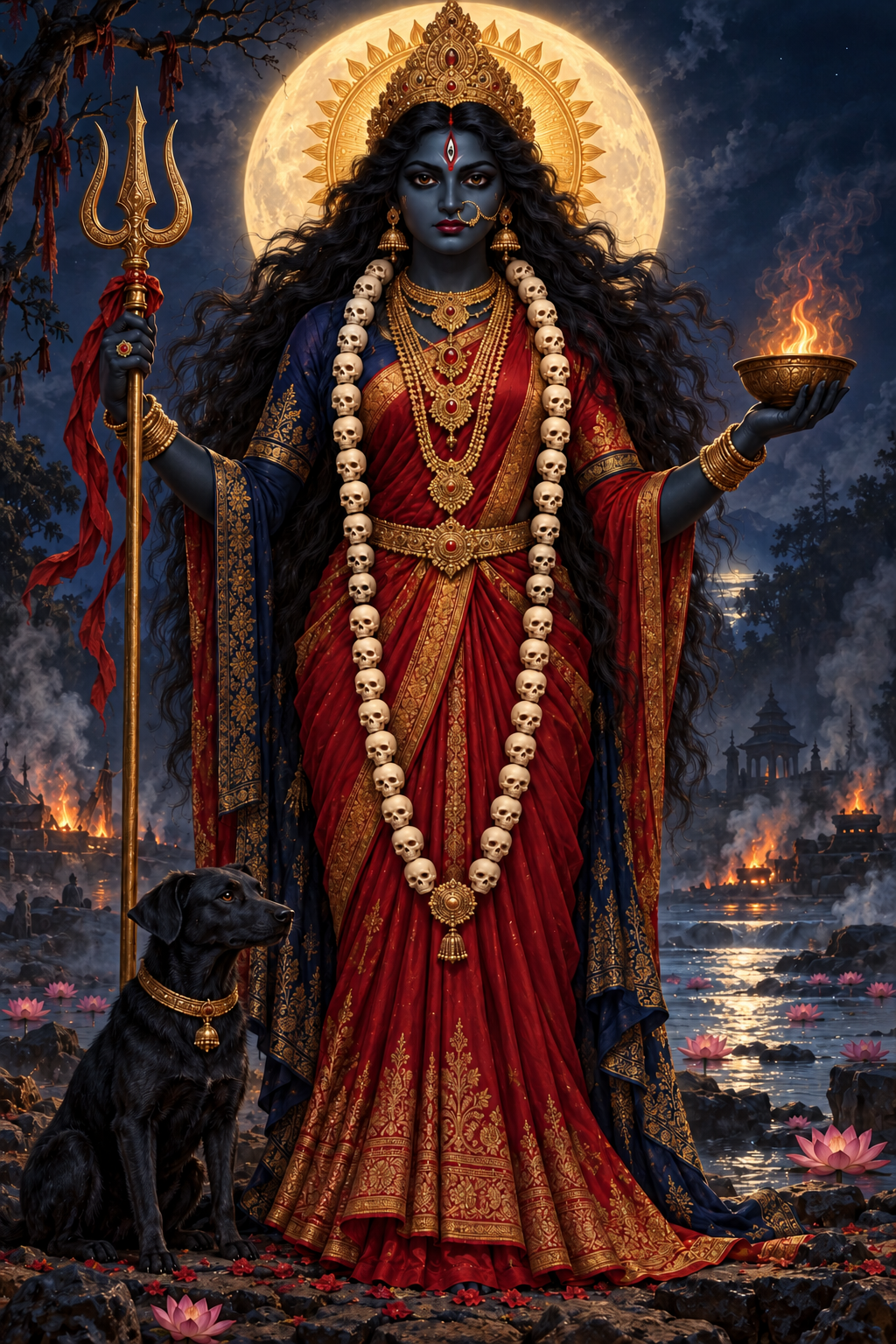
If Kali’s garland makes you recoil, don’t rush to make it pleasant. The discomfort is part of the encounter. Her Mundamala asks whether you can look directly at death, identity and the limits of human knowledge without confusing a fierce image with an evil one.
The central clue is that the garland isn’t a random trophy. In its familiar form of fifty skulls, it signifies Kali’s power of knowledge. Once you begin there, the image opens into a disciplined teaching about language, ego, impermanence and liberation.
Read an icon, not a crime scene
A literal reading asks, “Whom did Kali kill?” An iconographic reading asks, “What has been placed before me, where has it been placed, and what truth does it disclose?” The second set of questions is the useful one.
The name Mundamala is direct: munda means a head or skull, and mala means a garland. Yet its meaning comes from the whole arrangement. The skulls are gathered into one ordered form and worn around the Goddess’s neck. What ordinarily provokes fear has become her ornament. What seems to rule embodied beings does not rule her.
This reverses your first impression. Kali isn’t diminished by mortality; she wears its sign. She isn’t silenced by the dissolution of individual voices; the symbols of those voices rest at her throat. She isn’t one frightened personality facing time from the outside. Her form places death and transformation within a greater reality.
Use this three-part method whenever you encounter challenging Hindu iconography: identify the object, notice its position, and interpret its relation to the deity. Here the object is a garland of skulls, its position is around the neck, and its bearer is Kali. That is already enough to move beyond the shallow conclusion that the image merely glorifies violence.
Why fifty skulls point toward language and knowledge
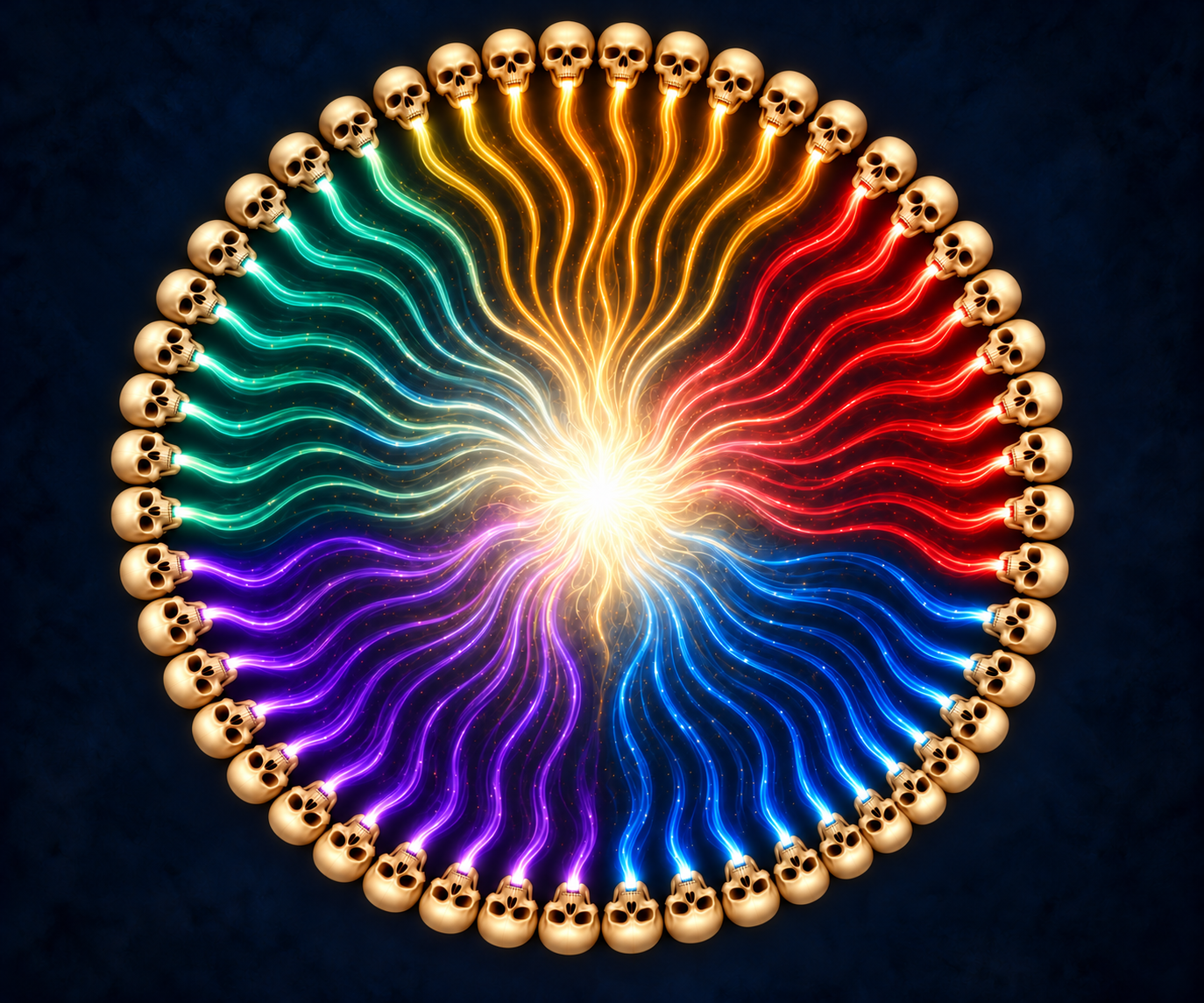
A well-known Shakta interpretation connects the fifty skulls with the letters or sound-units of the Sanskrit varnamala. Enumerations can differ across traditions, so the number shouldn’t be turned into a claim that every Sanskrit system counts its letters identically. In this particular symbolic reading, fifty represents the complete field of articulated sound.
That matters because letters don’t remain isolated marks. They become syllables, names, doctrines, commands, memories and stories. Through language, you divide experience into “self” and “other,” “success” and “failure,” “sacred” and “ordinary.” Language makes knowledge communicable, but it also encourages you to mistake your descriptions for reality itself.
The Mundamala therefore holds two truths together. Speech is Shakti: it can reveal, teach, invoke and transform. But no word, category or intellectual system can contain the source from which expression arises. Kali bears the entire alphabet while remaining more than any sentence formed from it.
This doesn’t mean that Kali destroys knowledge or that spiritual life requires intellectual blankness. It means that knowledge must become liberating rather than possessive. A concept can direct you toward truth, but clinging to the concept can prevent you from seeing what it was meant to reveal.
You can test this meaning in ordinary life. Notice a label you repeat about yourself: capable, unworthy, successful, betrayed, devout or misunderstood. Then ask what remains present before that label appears and after it falls silent. The exercise isn’t an attempt to erase your history. It is a way to stop treating one verbal identity as the whole of your being.
The skull exposes mortality without condemning life

A skull retains the outline of a person while removing nearly every social distinction. Rank, beauty, wealth, reputation and profession no longer announce themselves. The symbol strips identity to the condition shared by embodied beings: every formed life changes, ages and ends.
That is why the Mundamala can be frightening and compassionate at once. Kali’s compassion isn’t always expressed as reassurance. Here it takes the form of refusing the illusion that possessions, status or even the present body can be made permanent. The image confronts you now so that change doesn’t have to teach the same lesson only through loss.
The head also carries the face by which others recognize us and the mental story through which we recognize ourselves. Symbolically severing it can therefore represent the cutting of ahamkara: the contracted claim that the temporary personality is an independent and final self. It does not mean despising reason, damaging the body or becoming passive. Healthy personality remains necessary for responsibility, relationship and dharmic action.
The practical distinction is between using an identity and being imprisoned by it. You may be a parent, student, leader, devotee or citizen, and each role can carry real duties. Bondage begins when you assume that the role exhausts who you are, or when protecting its image becomes more important than performing its dharma.
Read the garland accordingly. It is not permission to devalue embodied life. It is a demand to value life without pretending you can possess it forever. Awareness of death should sharpen conduct: speak what is true while speech is available, repair what can still be repaired, and stop postponing the duty you already recognize.
A practical way to contemplate the Mundamala

You don’t need to force the image into a single formula. Give each symbolic layer its own attention, then notice how the layers converge. The following practice is interpretive contemplation, not a replacement for the ritual or mantra discipline of a particular sampradaya.
- Look at the whole form first. Don’t isolate the garland from Kali’s posture, expression and other attributes. Spend a few moments noticing the complete image before assigning meanings.
- Name your first reaction plainly. It may be fear, revulsion, fascination, reverence or confusion. Don’t treat the reaction as a verdict. Treat it as the mental material the icon has brought into view.
- Attend to mortality. Ask which possession, role or condition you are quietly treating as permanent. Name one without dramatizing it.
- Attend to language. Identify one word or story that currently controls how you see a person, event or yourself. Ask what that label reveals and what it conceals.
- Attend to ego. Ask whether you are protecting a necessary responsibility or merely protecting an image of yourself. The two can feel similar, but they lead to different conduct.
- Convert insight into one action. Correct an untruth, release a rehearsed grievance, complete a neglected duty or speak a needed word with restraint. Contemplation becomes dharmic when it changes how you act.
Keep the action proportionate. The Mundamala teaches relinquishment, but that doesn’t require an impulsive rejection of relationships, work or possessions. More often, it asks you to loosen the claim of ownership while fulfilling your responsibilities more cleanly.
Key takeaways
- Kali’s Mundamala is an emblem of spiritual knowledge and mastery, not merely an ornament of terror.
- The fifty skulls can represent the complete field of Sanskrit letters and articulated sound.
- Because language both reveals and limits, the garland points to a reality that can be expressed but never exhausted by words.
- The skull makes mortality visible and exposes the temporary nature of status, appearance and social identity.
- The symbolic severing of the head concerns bondage to ego, not rejection of intelligence, the body or responsible personhood.
- The most useful response is concrete: examine one controlling label, one attachment and one neglected dharmic action.
The next time you stand before Kali, resist both easy reactions: don’t dismiss the Mundamala as savagery, and don’t soften it into a harmless decoration. Let it ask the harder question. What would you say, release or do today if you remembered that your words, roles and body are sacred precisely because none of them is permanently yours?
References

Leave a Reply
You must be logged in to post a comment.