
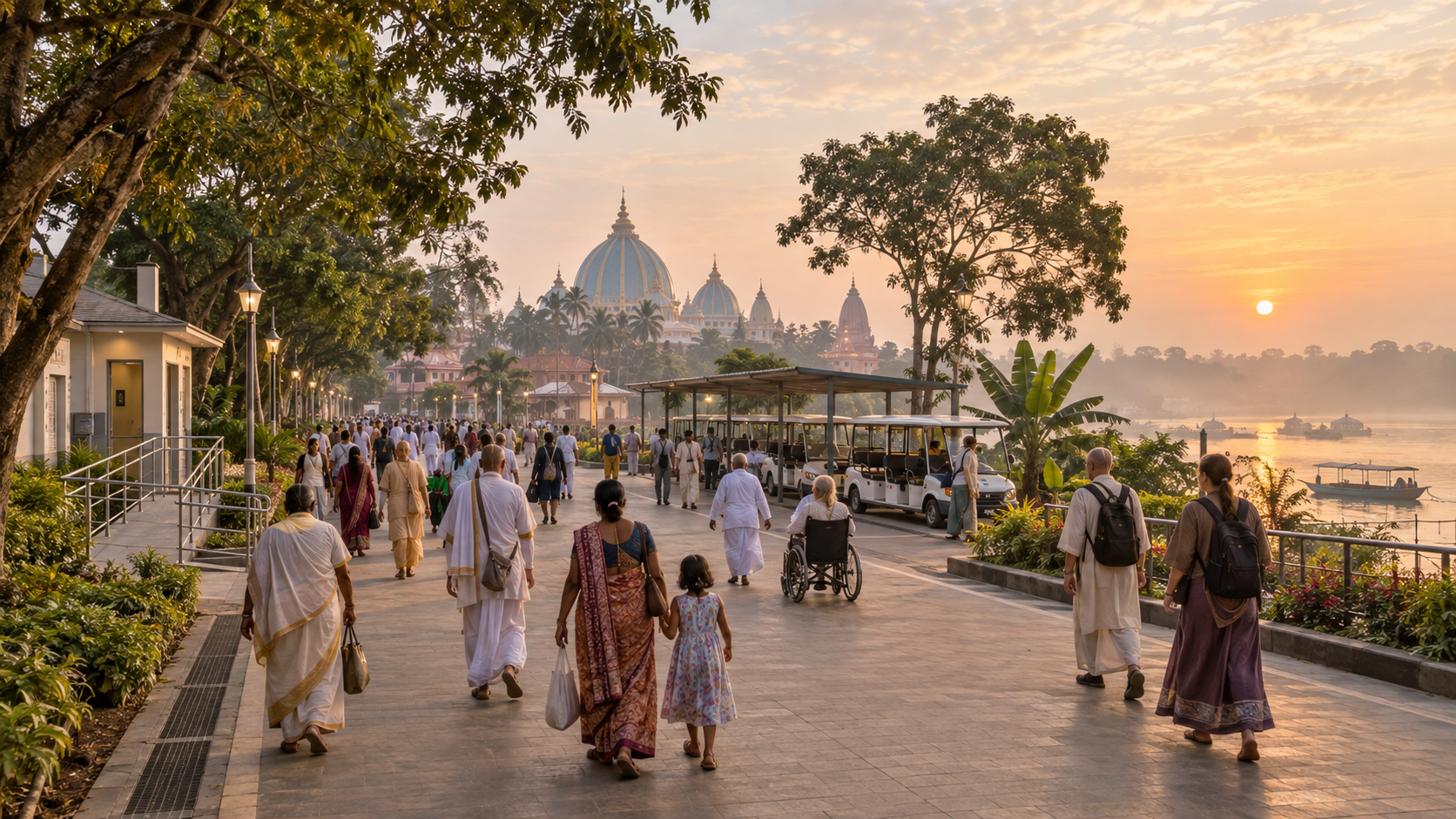
If you visit Mayapur for darshan, serve there, run a local business or live nearby, the real test of development is not whether the town looks more modern. It is whether you can arrive, move around, worship and find essential facilities without congestion, confusion or litter overwhelming the pilgrimage.
That is the standard by which you should judge the West Bengal government’s proposal. Modern infrastructure can protect the dignity of a tirtha, but only when the needs of pilgrims and the sacred character of the place control the design.
Read the announcement as a promise, not a finished project
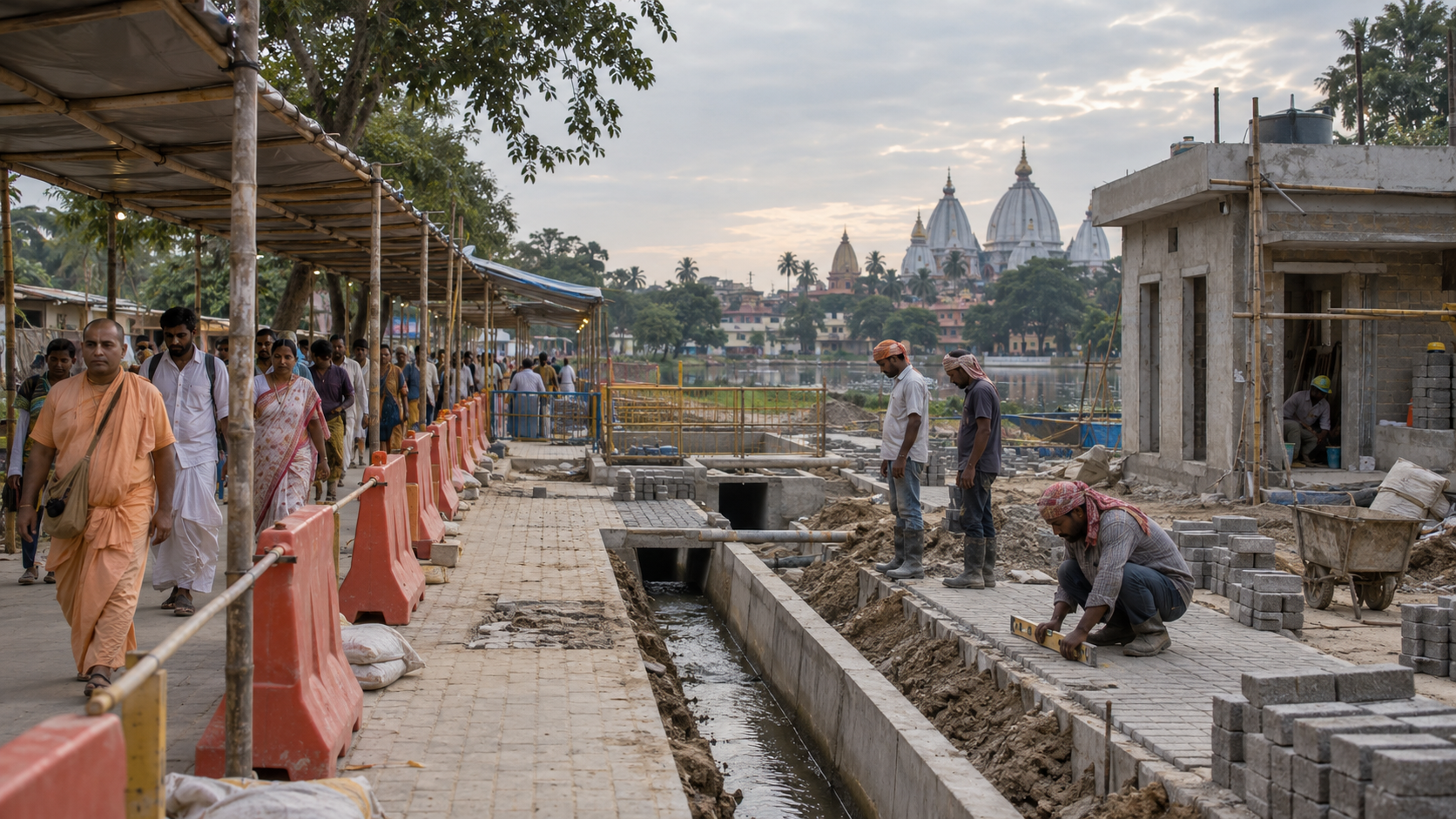
The state government has proposed an international-standard religious and tourist destination centred on ISKCON’s headquarters in Mayapur. The intended development area covers around 2,100 bighas near the temple. Roads, public transport, waste management, lighting and modern facilities for visitors are among the stated priorities.
Those commitments identify the right pressure points, but they do not by themselves tell you what will be built, in what order or how it will be maintained. A development announcement is not the same thing as a sanctioned project, a tendered contract, active construction or an operating public service. Keep those stages separate when you assess future updates.
The stated footprint also needs careful interpretation. Saying that a programme will cover around 2,100 bighas does not, by itself, explain the exact boundary, the proposed use of each part or the status of the land. Do not assume that the whole area will be built upon or acquired. Look for a published map and parcel-level explanation before drawing conclusions.
The next meaningful update should answer five practical questions:
- What is the precise project boundary?
- Which works have received administrative and financial approval?
- What will be delivered in each phase?
- Which public body or contractor will operate each service after construction?
- How can residents, pilgrims and religious institutions comment on the designs before they become difficult to change?
Design around the pilgrim’s whole journey
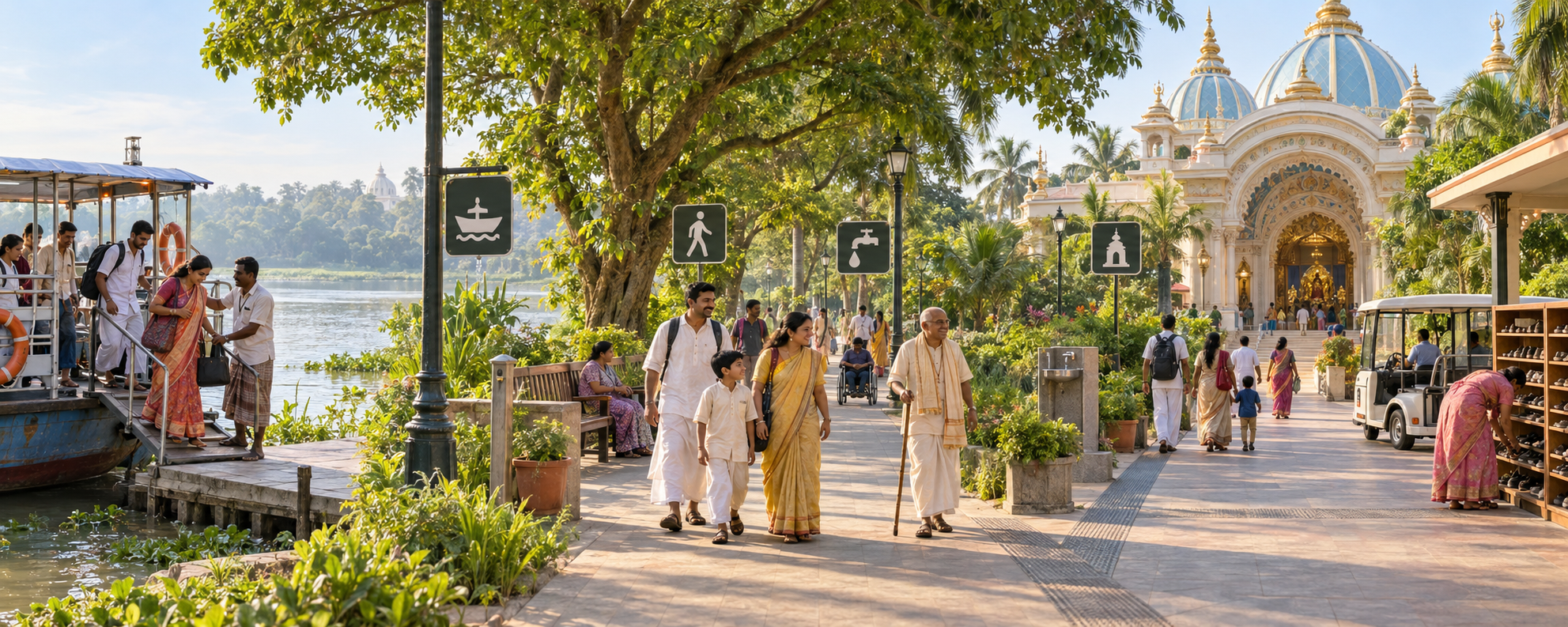
A pilgrim does not experience roads, buses, footpaths and temple access as separate departments. You experience one continuous journey. If the bus reaches Mayapur but leaves you at an unsafe or confusing final approach, the transport system has failed at its weakest link.
When route maps and street designs are published, examine the journey in this order:
- Arrival and transfer: Check where public transport stops, how clearly onward connections are identified, and whether operating hours match the periods when pilgrims actually need to travel.
- The final approach: Look for continuous pedestrian routes rather than isolated stretches of pavement that suddenly force people into vehicle traffic.
- Accessible movement: Routes should work for older pilgrims, people with disabilities and families carrying luggage. Ramps, even surfaces, rest points and unobstructed paths need to appear in the drawings, not be added as an afterthought.
- Wayfinding: Signs should direct visitors to transport, temple approaches and public facilities in the languages the intended visitors can use. A claim of international accessibility is hollow if a first-time visitor cannot understand the route.
- Operational access: Service and emergency vehicles need workable routes that do not routinely obstruct pedestrian movement or the main pilgrim approach.
Road improvement should therefore be judged by journey time, pedestrian safety and ease of transfer, not merely by the amount of new paving. Wider roads can carry more vehicles while making the final walk less humane. Ask to see the movement plan, including public transport stops and pedestrian connections, rather than relying on images of finished road surfaces.
Cleanliness, lighting and amenities must operate every day
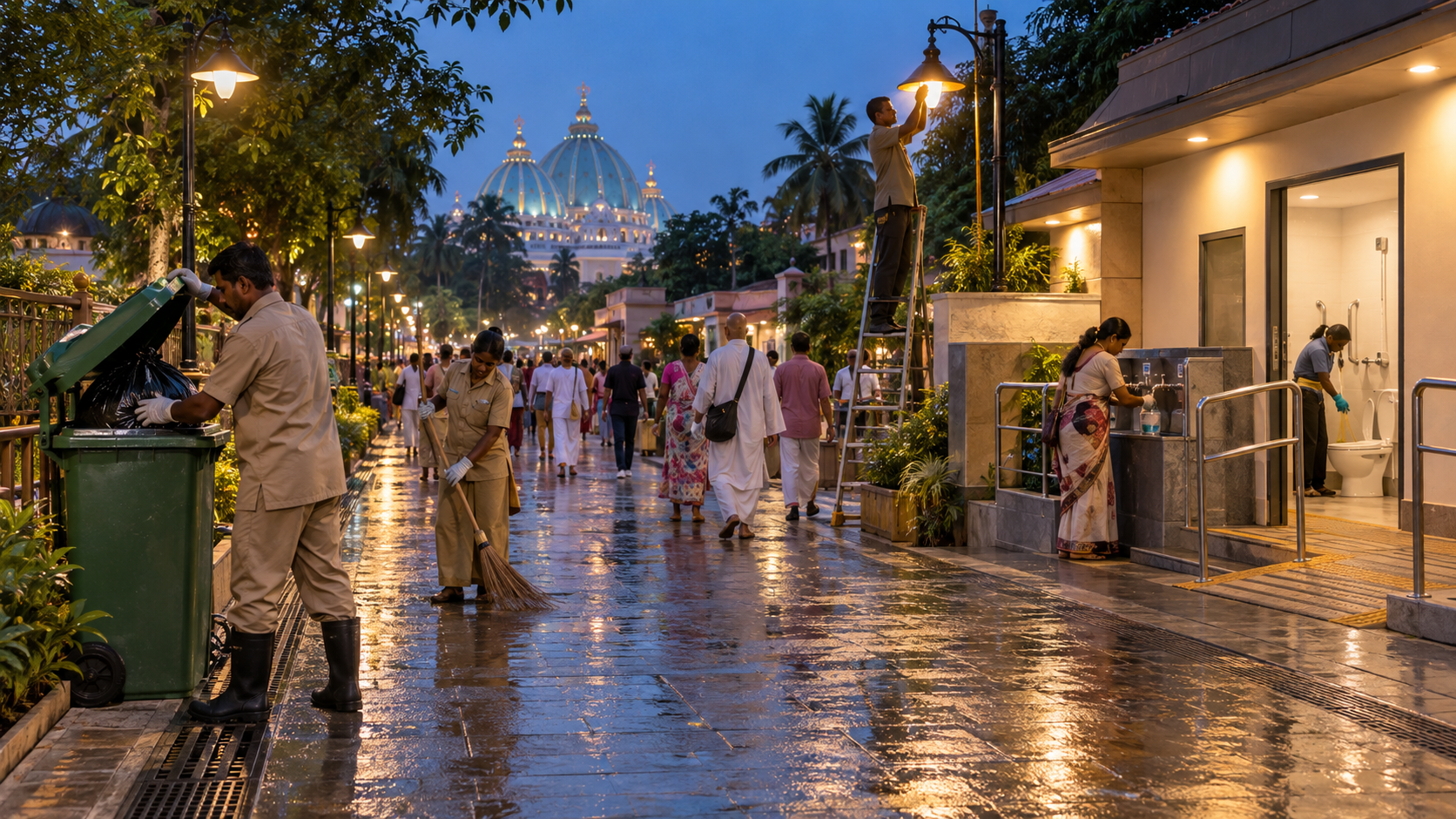
Waste management, lighting and visitor facilities are often presented as construction items. In practice, they are recurring services. Their value depends less on the opening ceremony than on what happens months later.
Waste management needs an entire service chain
Installing bins does not establish waste management. Waste still has to be collected on a dependable schedule, moved without spilling back into public space and taken to an appropriate processing or disposal point. The plan should identify the operating agency, collection schedule, arrangements for high-volume periods and a contact for reporting missed collection.
You can test any sanitation proposal with a simple question: what happens after a visitor places waste in the bin? If the answer stops at the bin itself, the system is incomplete.
Lighting should improve movement, not create spectacle
Lighting is useful when it makes approaches, crossings, transport points and public facilities legible after dark. Decorative illumination may have a place, but it should not consume attention while ordinary walking routes remain unevenly lit. Published plans should show coverage, responsibility for replacing failed lights and how glare near sacred spaces will be controlled.
Modern facilities must be defined before they can be judged
The phrase modern facilities is too broad to measure. A credible plan should name the facilities, show their locations and state who will maintain them. Toilets, safe drinking-water points, sheltered places to rest and clearly marked information or assistance points are more useful to a pilgrim than a grand but vague visitor complex.
For each facility, ask about opening hours, accessibility, cleaning frequency, user charges and the agency responsible for complaints. These details determine whether an amenity is genuinely public or merely present on a project map.
Connect Mayapur and Nabadwip without flattening either place
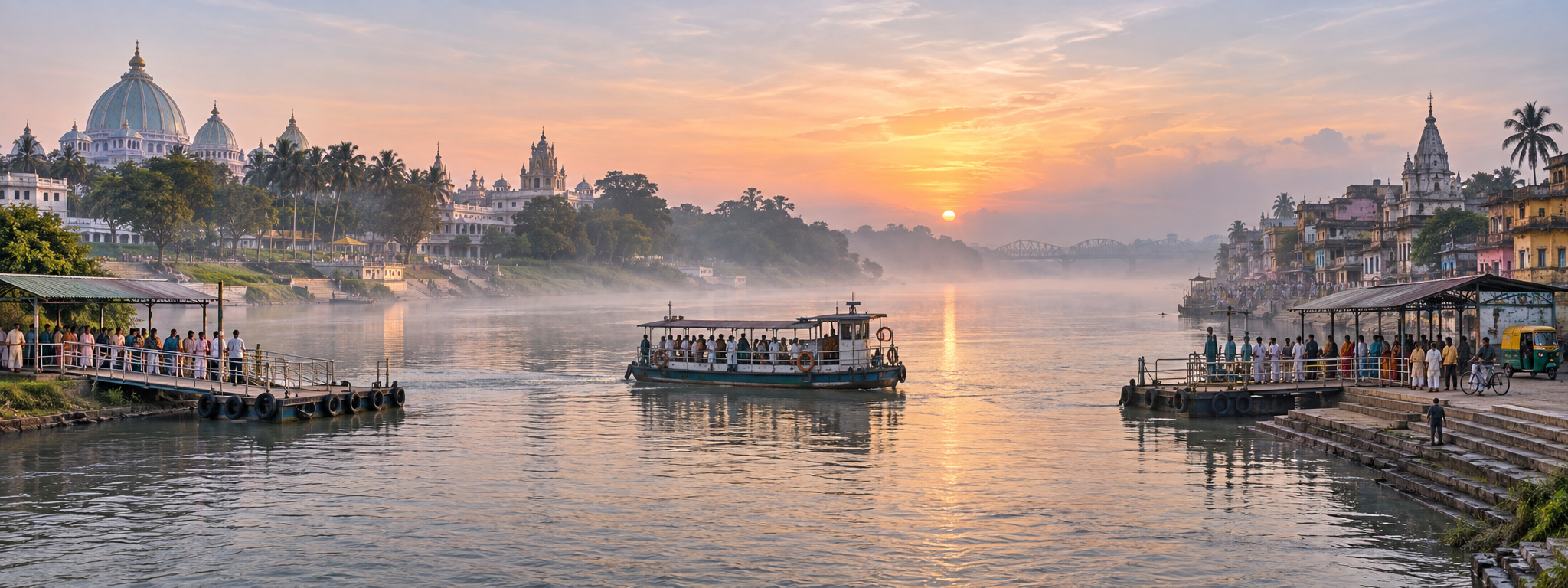
The broader proposal also anticipates bringing Nabadwip under a Smart City initiative. That creates an opportunity to plan Mayapur and Nabadwip as a connected religious region rather than as two unrelated sets of contracts.
Coordination should be visible in the parts of the journey that cross administrative boundaries: public-transport information, directional signs, visitor guidance, sanitation standards and emergency contacts. A pilgrim should not need to understand which agency controls a particular road before being able to complete the journey.
Integration does not mean imposing one generic tourism identity on both places. Each should retain its own sacred associations, patterns of worship and local character. Shared infrastructure should make those identities easier to encounter, not replace them with interchangeable commercial streets and decorative branding.
The reported planning discussion involved government officials and ISKCON representatives. That is an important starting point. As the design becomes more detailed, consultation should also reach residents, pilgrims with accessibility needs, local traders, transport workers and the people expected to operate sanitation and other services. They will often see practical failures before those failures are fixed in concrete.
Key takeaways: use this public scorecard
- Status: Distinguish an announced intention from approved funding, tendered work, construction and an operating service.
- Scope: Ask for a mapped boundary and phase-by-phase description of what the 2,100-bigha programme actually includes.
- Access: Follow the complete pilgrim journey from regional arrival to the final walk, including the needs of older and disabled visitors.
- Operations: For every bin, light or visitor facility, identify the agency, maintenance schedule and complaint mechanism behind it.
- Sacred fit: Judge whether the design supports worship and preserves the identity of Mayapur rather than treating the temple as an attraction inside a generic tourism zone.
- Regional connection: Look for practical coordination between Mayapur and Nabadwip in transport, information and public services.
Mayapur does need roads, reliable transport, cleanliness, lighting and humane facilities. Supporting those improvements does not require giving the project a blank cheque of public approval. When the next announcement appears, ask for the boundary map, project phase, operating responsibility and full pilgrim route. Those four details will tell you far more than another promise to make the destination look modern.
References
- Dandavats — West Bengal Government to Develop Mayapur as International Religious Destination
- Construction World — West Bengal Government to Develop Mayapur as International Religious Destination

Leave a Reply
You must be logged in to post a comment.