

You may already chant, perform puja, visit a temple, hear katha, or serve your community, yet still wonder whether you are truly advancing or merely repeating a routine. That question becomes sharper when early enthusiasm fades, prayer feels dry, or a missed practice produces more guilt than longing.
If that is where you are, change the measure. Bhakti is not a project you complete. It is a relationship you learn to inhabit through attention, service, honesty, and repeated return. Your schedule matters, but its deeper purpose is to help you remember the Divine and carry that remembrance into the way you live.
Stop treating devotion as a spiritual scorecard
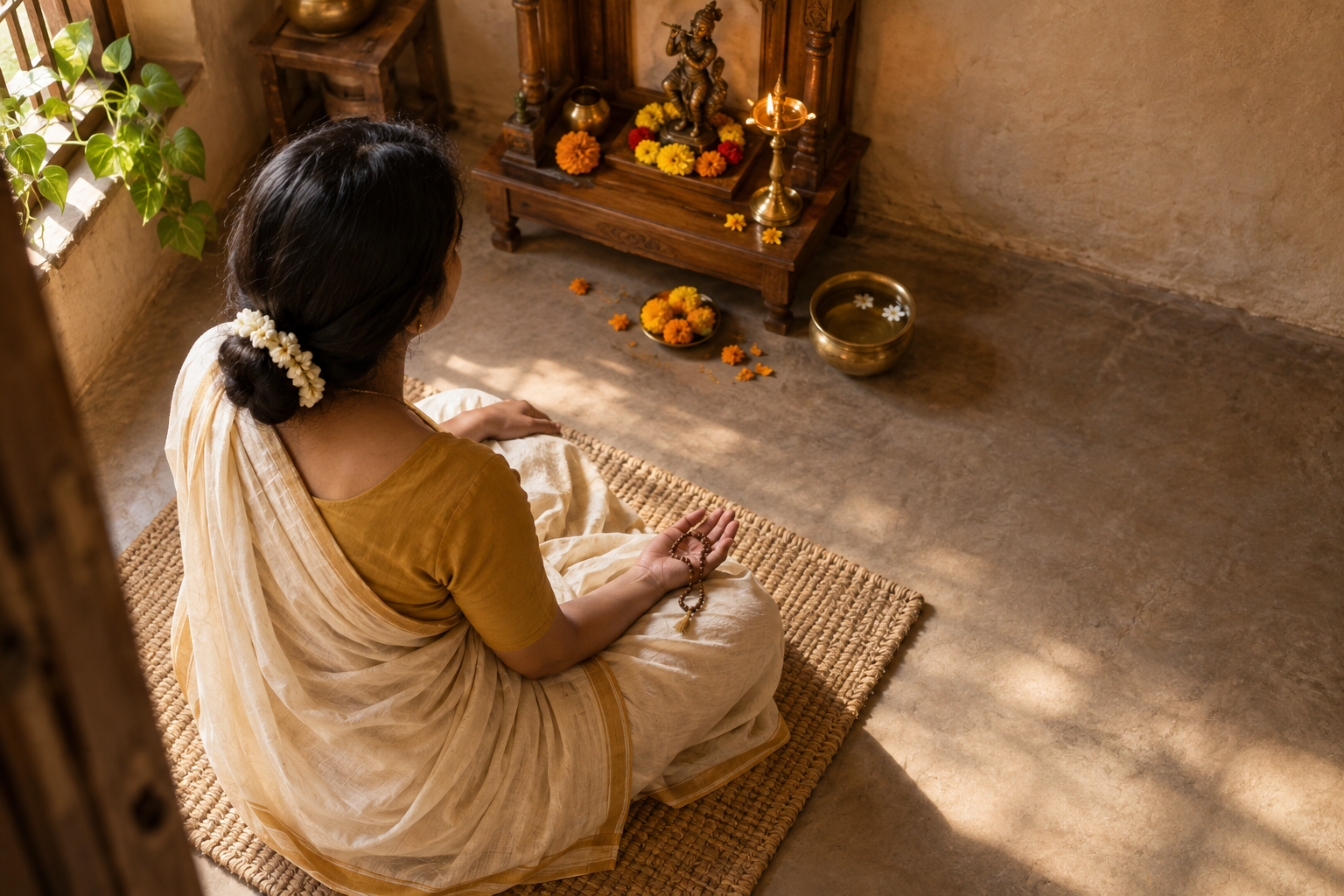
Devotional disciplines matter. A mala keeps the hands and mind engaged. A lamp gives prayer a visible form. A vow protects time that distraction would otherwise consume. A temple rhythm prevents spiritual life from being postponed indefinitely. These forms are not empty merely because they are regular.
The difficulty begins when the instrument becomes the verdict. You complete every item and assume that love must therefore be growing. Or you miss one observance and conclude that the relationship has been damaged beyond repair. In both cases, the practice has become a transaction: performance is offered in exchange for a desired spiritual status.
Bhakti matures when observance becomes a journey of love rather than a checklist. Rules remain important, but they serve remembrance; they do not purchase grace. The devotee’s question gradually changes from Did I complete everything? to What kind of relationship did my practice nourish?
You can recognize a scorecard mentality by its recurring habits:
- You compare the visible quantity of your practice with someone else’s.
- You bargain with the Divine, expecting a preferred result because you performed an observance.
- You hide a lapse because protecting a devotional image feels more important than returning honestly.
- You treat intense emotion as proof of grace and an ordinary day as proof of failure.
- You become exacting about ritual while remaining careless about speech, duty, or another person’s dignity.
After a devotional practice, ask questions that reveal direction instead of awarding a grade:
- Where did my attention keep wandering?
- What desire or fear did I place before the Divine?
- Did I become more willing to listen, serve, or correct myself?
- What is the next ordinary duty through which this remembrance can continue?
Use the answers practically. If the phone repeatedly scattered your attention, leave it outside the prayer space. If haste made the puja mechanical, prepare its materials beforehand. If chanting ended but irritation immediately returned, take the Divine name with you into the difficult conversation. The purpose is not to manufacture a devotional mood. It is to remove the avoidable obstacles to presence.
Build a practice that can outlive your changing moods

A lifelong practice needs both form and flexibility. If it depends entirely on inspiration, it will disappear when work becomes demanding, family responsibilities expand, health changes, or the mind simply feels dull. If it allows no adaptation, it may become impossible to carry through those same changes.
Use the following structure to make devotion sustainable:
- Choose the center of your practice. This may be nama-japa, puja, kirtan, remembrance of your ishta-devata, scriptural hearing, or another discipline received through your tradition. Where a mantra or vrata has been given by a guru, preserve its integrity and seek guidance before changing it.
- Establish a devotional floor. Decide what you can still offer on a difficult day: a sincere pranam, the prescribed mantra practice in an adapted setting, a brief prayer, an offering of food, or attentive remembrance during a necessary duty. The floor keeps the relationship present when the fuller routine is not possible.
- Maintain a fuller form for ordinary days. Give your primary practice enough protected time that it is not always squeezed between competing demands. Prepare the space and materials in advance so that beginning does not require a fresh act of negotiation each day.
- Attach the practice to a dependable cue. Waking, bathing, lighting the evening lamp, returning from work, or sitting before a meal can become the moment that calls you back. A stable cue is usually more reliable than waiting to feel devotional.
- Join worship to seva. Let cooking become an offering, income become honest duty, care for elders become reverence, and temple work become service rather than status. This prevents the sacred and the ordinary from splitting into separate lives.
- Keep recurring satsang. A trustworthy teacher, temple community, kirtan gathering, or circle of serious practitioners can correct blind spots that private enthusiasm cannot see. Look for company that deepens humility, responsibility, and remembrance rather than rivalry.
- Decide how you will return after interruption. Resume at the next available opportunity without dramatic promises or punitive compensation. If the same lapse keeps recurring, repair the schedule or environment that produces it.
The devotional floor is not an excuse to offer the minimum forever. It is a bridge through disruption. Once stability returns, rebuild the fuller practice deliberately. In the same way, a demanding routine is not automatically superior. A modest discipline kept with attention may form you more deeply than an elaborate program repeatedly attempted, abandoned, and concealed.
Hindu bhakti lineages do not all use the same mantras, ritual forms, or theological language. Vaishnava, Shaiva, Shakta, Smarta, and other traditions should not be flattened into a generic spiritual method. Follow the maryada of your path. The shared practical principle is narrower: love needs an embodied form, but correct form must continue opening into remembrance, surrender, and service.
Learn how to return through dry and interrupted seasons
Devotional feeling changes. At times, the name of the Divine seems naturally attractive. At other times, the same practice feels repetitive. This variation does not by itself tell you whether bhakti is present or absent. Emotion can begin a practice, but only fidelity allows it to accompany an entire life.
Do not respond to every dry period in the same way. Notice what is actually happening:
- If repetition has become automatic, slow down. Hear the mantra instead of racing to its end. Look at the murti rather than merely standing before it. Let one familiar prayer recover its meaning.
- If your routine is overloaded, simplify its structure while protecting its center. Remove optional complexity before abandoning the practice that keeps you connected.
- If you have a genuine theological doubt, study it. Bring the question to a qualified teacher who can explain the position of your tradition without demanding that you pretend certainty.
- If you are carrying disappointment, speak it in prayer without staging a pious emotion. Honesty offered before the Divine is more relational than polished words used to hide resentment.
- If conflict with a religious person or institution has wounded your trust, distinguish the Divine from human fallibility. Seek counsel from a trustworthy senior who is not invested in protecting the immediate conflict.
- If laziness is the issue, do not rename it spiritual dryness. Begin the next appointed practice before the mind constructs another justification.
A lapse becomes dangerous when shame makes hiding seem safer than returning. Bhakti gives you another response: acknowledge what happened, make any repair that dharma requires, and resume. If harsh speech harmed someone, prayer does not replace an apology. If neglected duty burdened another person, extra ritual does not cancel the need to put that duty right.
This distinction protects bhakti from becoming an escape. A practice that consistently helps you avoid grief, accountability, family obligations, or ethical correction is not functioning as love. Bring the avoided matter into the light of practice, then take the necessary human action.
You do not need a dramatic spiritual restart. Begin with the next sincere act. Bow. Chant. Offer the meal. Complete the duty you have been evading. Return to satsang. Lifelong devotion is not a life without interruption; it is a life in which interruption does not receive the final word.
Measure growth by what love changes in you
Bhakti is inward, but it is not invisible. Over time, love changes the quality of attention, desire, and conduct. This does not mean the devotee becomes flawless or permanently serene. It means that self-centered habits are noticed sooner, defended less fiercely, and brought back into relationship with the Divine.
Look for direction in questions such as these:
- When events oppose your plans, does prayer remain only a demand, or does it also become a willingness to listen?
- When another person receives honor, can you rejoice without turning spiritual life into competition?
- When you are wrong, can you apologize without protecting an image of humility?
- Can you perform service that will not be noticed or credited?
- Does reverence at the altar make you more careful with the people who depend on you?
- When the practice feels dry, can you remain truthful instead of imitating someone else’s emotion?
- Are your petitions gradually joined by gratitude, surrender, and concern for the good of others?
These are not another checklist. They are places to notice whether devotion is crossing the distance between the shrine and the rest of your life. Progress may be uneven. You may show patience in one relationship and remain defensive in another. Let the contradiction identify the next field of practice.
A brief evening review can help. Remember where the Divine entered your attention. Notice where you forgot. Receive something from the day with gratitude. Name any repair that should begin when the next opportunity comes. Keep the review plain. Its purpose is to sustain relationship, not to rehearse self-condemnation.
Bhakti’s timescale is long enough to hold separation, change, and return. The human significance of meeting again after forty years is that duration can reveal what a hurried assessment cannot: spiritual relationships and impressions may continue across long, complicated stretches of life. You need not force every season to resemble the beginning.
At first, you may approach a guru, sadhu, or community mainly for answers, inspiration, and belonging. Maturity adds another question: What truth am I now responsible for living? Respect then becomes more than admiration. It becomes faithful practice, ethical discernment, gratitude, and a willingness to serve without surrendering the responsibility to think honestly.
The destination is therefore not a perfected devotional persona. It is an increasingly truthful relationship in which you can bring enthusiasm, distraction, gratitude, doubt, failure, duty, and love before the Divine without abandoning the path.
Key takeaways
- Use disciplines to protect remembrance, not to calculate your spiritual worth.
- Keep both a sustainable devotional floor and a fuller practice for ordinary days.
- Anchor practice to a dependable cue instead of waiting for a devotional mood.
- Diagnose dryness honestly: boredom, overload, doubt, hurt, and avoidance require different responses.
- After a lapse, repair what needs repair and return at the next available opportunity.
- Look for bhakti’s growth in humility, truthful speech, responsible duty, unseen service, and freedom from comparison.
- Honor the particular mantra, theology, and maryada of your lineage rather than reducing every tradition to a generic technique.
Before your next practice, choose one point of living attention. Hear the name you are chanting, see the form before which you bow, or offer the duty directly in front of you. Do not demand that this moment prove the condition of your entire spiritual life. Offer it sincerely, then return at the next appointed time. A lifelong journey of love is made through precisely these renewals.
References
- Dandavats — 40 years later. Meeting Gary and Radhanath Swami // The Journey Home
- Dandavats — Bhakti Is Not a Checklist—It’s a Journey of Love | SB 11.10.5 | Morning Class with Dayal Gauranga

Leave a Reply
You must be logged in to post a comment.