
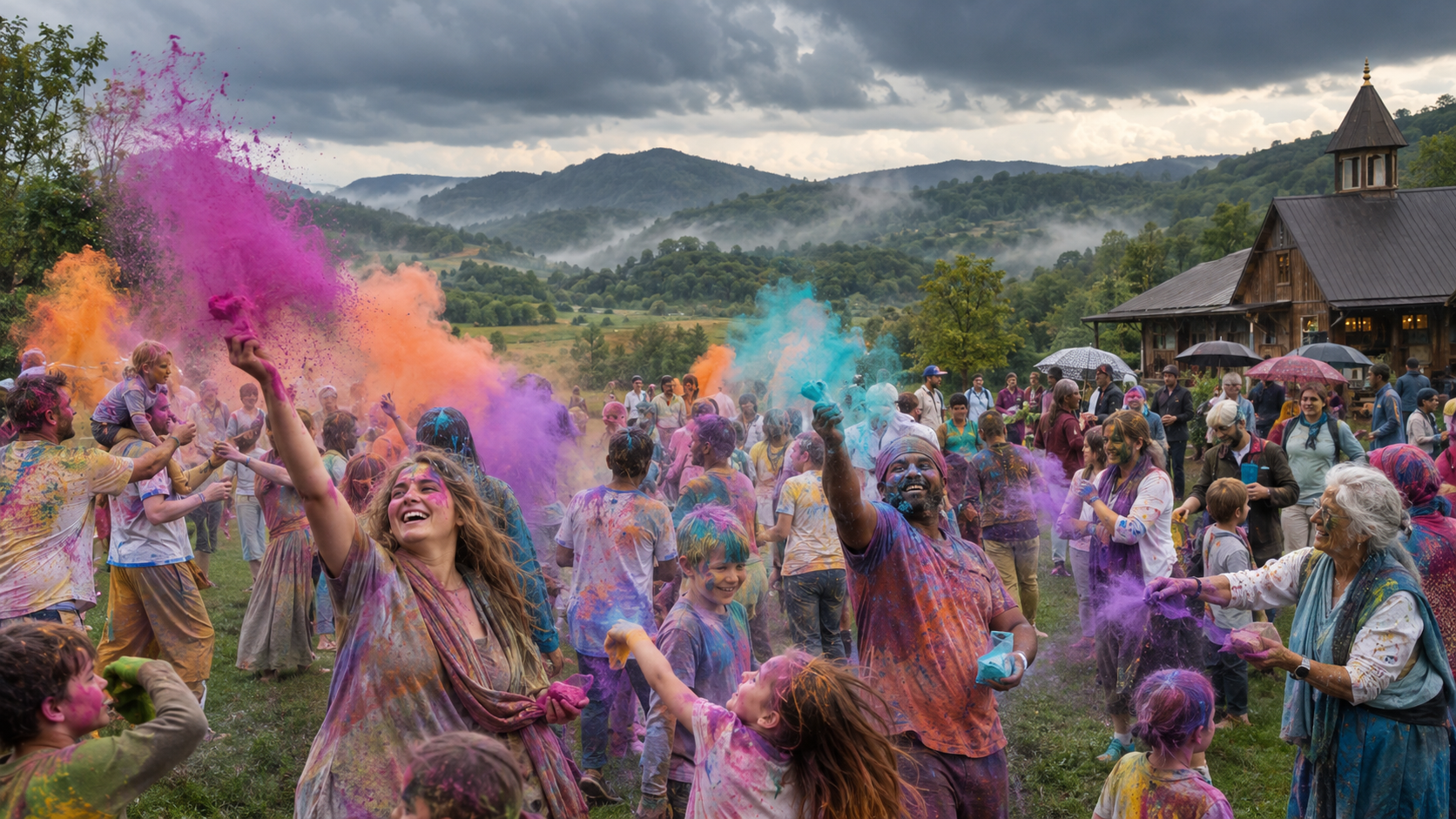
If you are watching the forecast and wondering whether New Vrindaban’s Festival of Colors is still worth the journey, ask a more useful question: do you want only the outdoor color throw, or do you also want the devotional and community gathering around it? Rain can interrupt the first without erasing the second.
That distinction became tangible when expected Sunday rain prompted the festival to open on Saturday, turning a one-day celebration into a two-day event. Saturday allowed outdoor color throws; Sunday became a quieter day of yoga, dance and food inside the community center. If you know which part matters most to you, you can make a sound decision even when the weather refuses to cooperate.
Rain changed the format, not the reason to gather
The most photographed moment is easy to identify: people dancing as bright powder rises above the crowd and settles over everyone. It is also the part most exposed to wind and rain. That makes the color throw a weather-sensitive expression of the festival, not the festival’s entire substance.
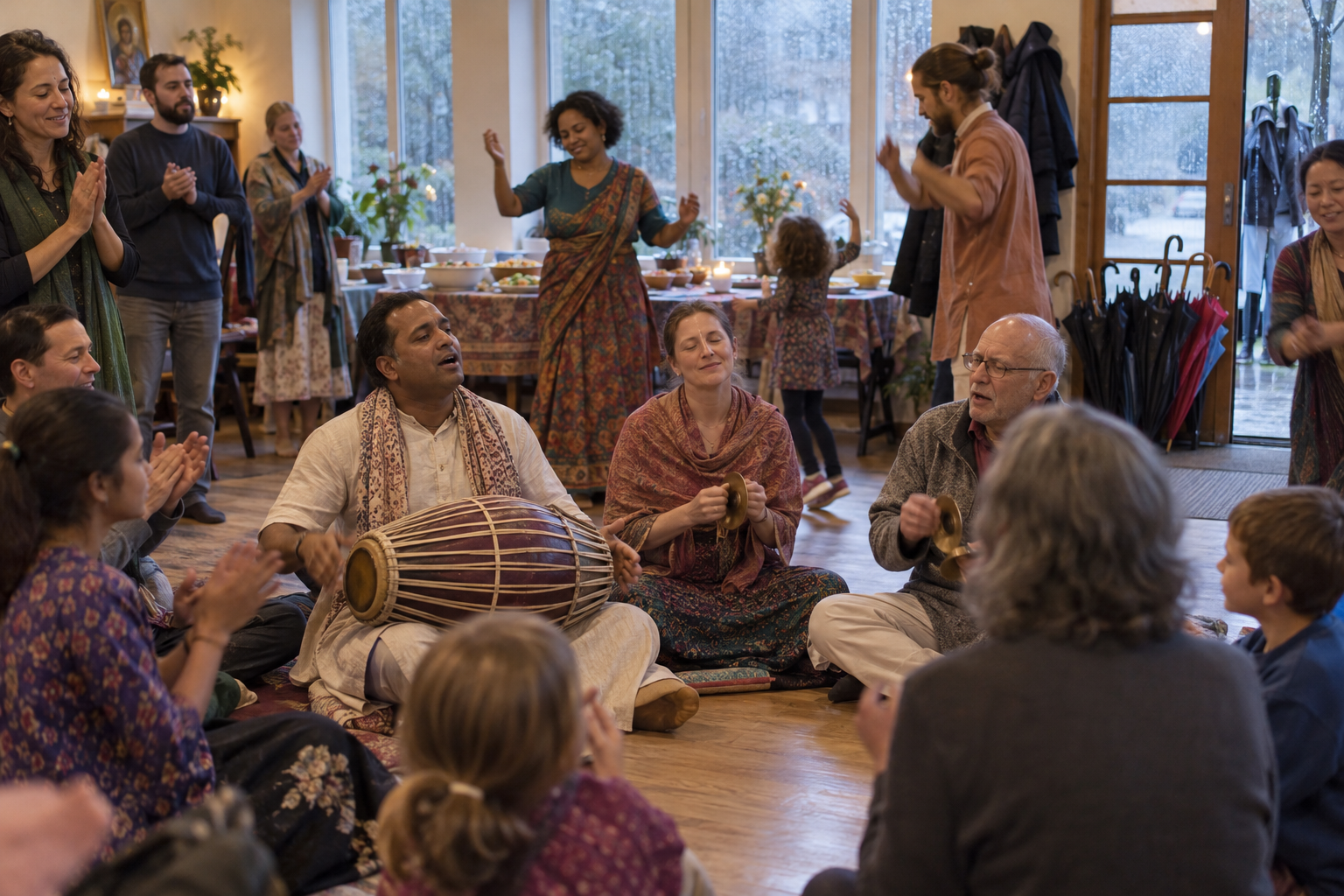
On the rain-affected Sunday, the announced event window ran from 11 a.m. to 5 p.m., but no powder had been thrown by 1:30 p.m. Yoga and dance were taking place indoors, and food was being served, while outdoor vendors were absent from their booths. The practical lesson is precise: event hours tell you when the gathering is operating, but they do not guarantee when every weather-dependent activity will begin.
If the color throw is your non-negotiable reason for going, confirm its status close to departure rather than relying only on the overall opening time. If you would also value yoga, dancing, food and time among the community, a wet day can still offer a meaningful visit. Neither choice is wrong. Trouble starts only when you expect one kind of day and arrive at another.
Join a Holi-inspired celebration without flattening Holi
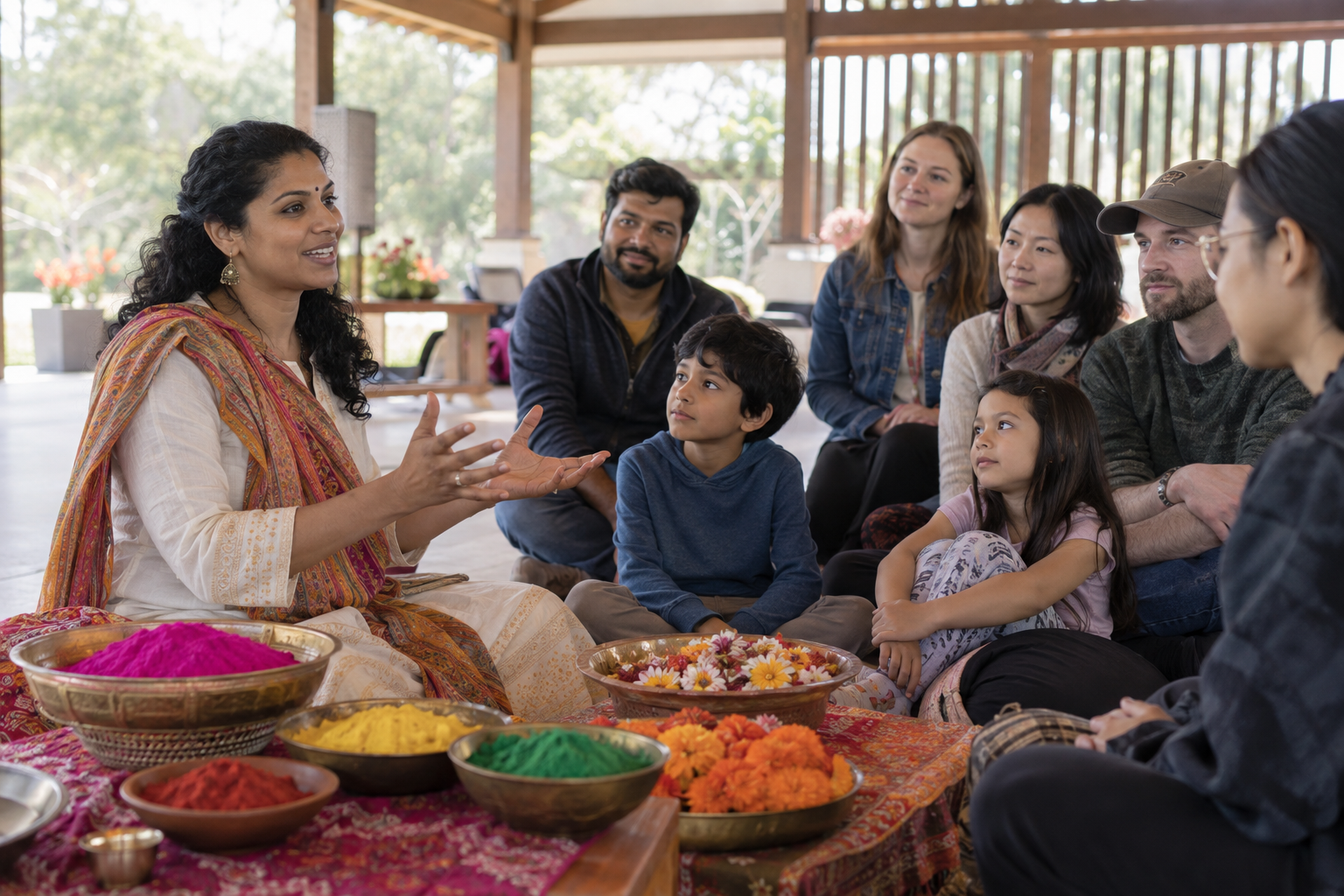
New Vrindaban describes its Festival of Colors as inspired by the ancient Indian tradition of Holi, associated here with color, love and the celebration of life. The wording matters. “Holi-inspired” connects the event to a living Dharmic tradition without pretending that one public celebration in America contains every regional, devotional and cultural expression of Holi.
The festival gives a newcomer an immediate way to participate. Music and dance create a shared rhythm. Participants throw brightly colored organic powders into the air and toward one another until clothing, hair and faces carry the same many-colored mark. No specialist knowledge is required to enter that moment of collective joy.
But accessibility should not become amnesia. You are not attending an anonymous color party that happens to have borrowed an Indian name. You are entering a Holi-inspired celebration within a Krishna-conscious community. Enjoying the powder and honoring that setting are not competing attitudes; the first becomes richer when accompanied by the second.
A respectful approach is simple. Follow the hosts’ directions, participate only in the activities you are comfortable joining, and allow some attention to move beyond the spectacle. Notice who has built the gathering, why Krishna is present in its language, and how celebration functions as an invitation into community. That small shift keeps Holi from being reduced to a colorful backdrop for photographs.
The color throw can become a doorway to belonging
A festival sometimes reaches people whom a lecture or formal introduction would not. Color, movement and shared food lower the social threshold. A person can arrive curious, take part without already knowing everyone, and then discover that the community surrounding the celebration matters more than the novelty that first caught the eye.
Vrindavani, a Festival of Colors staffer originally from Cambridge, Ohio, followed such a path. She visited New Vrindaban’s festivals frequently, was drawn by the color throws and dancing, and then entered the temple and saw Krishna. Her connection deepened until weekend stays followed those visits.
“I just felt like I had found where I belonged, and I found a community here.”
Vrindavani, Festival of Colors staffer
Her experience is personal, not a promised outcome for every visitor. It nevertheless shows what an open celebration can do: the enjoyable activity at the entrance may lead someone to encounter Krishna, the temple and a durable sense of belonging. The powder attracts attention; hospitality determines whether a stranger feels able to remain.
If this will be your first visit, give that possibility room. Where access and the day’s program permit, do not rush away as soon as the throw ends. Spend time in the devotional setting, observe how people relate to one another, and ask a sincere question if an appropriate opportunity arises. You do not need to manufacture a spiritual experience. You only need to avoid leaving before the festival has had a chance to become more than an image.
Build your visit around what weather can actually change
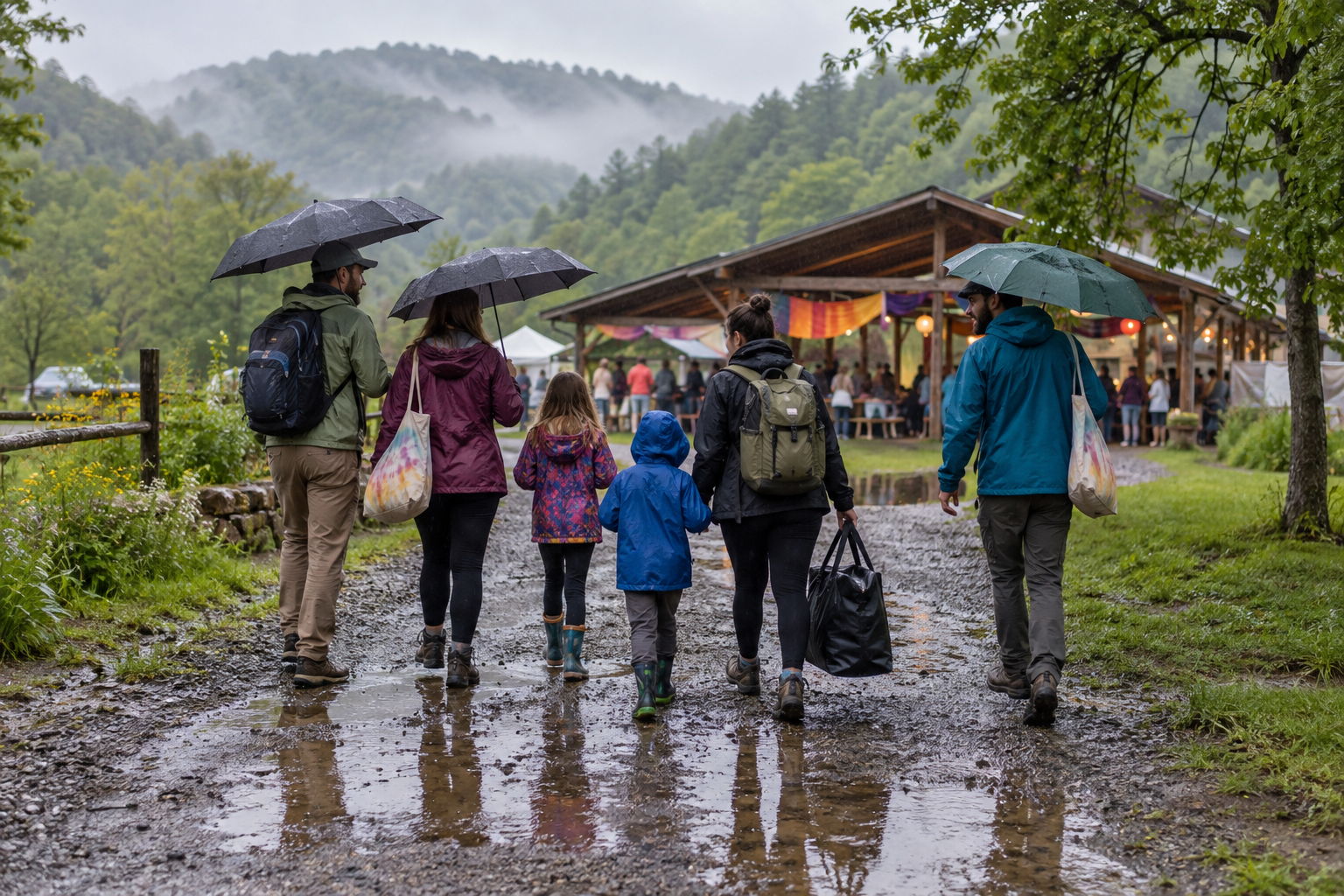
A useful plan separates the outdoor activity from the wider gathering. Make that distinction before you travel, especially if children are coming or the journey requires a firm schedule.
- Name your priority. Decide whether the color throw is essential or whether an indoor program would still make the visit worthwhile. This one decision prevents most weather-related disappointment.
- Check the day-of arrangement. Forecasts can change not only the location of activities but the shape of the event itself. In this case, anticipated rain led to an additional Saturday opening.
- Treat the event window as a window. A festival running from 11 a.m. to 5 p.m. does not mean the powder will fly at 11 a.m. Confirm the activity you care about rather than inferring its time from the overall hours.
- Separate movable activities from exposed ones. Yoga, dance and food could continue inside the community center. The outdoor vendor booths did not operate on the wet Sunday, and the color throw was delayed.
- Set children’s expectations before arrival. Children were able to run around and enjoy the colors during Saturday’s cooperative weather, while Sunday was described as more low-key. Tell young visitors that the day may become an indoor community event if outdoor conditions do not allow the expected throw.
This is not an argument for attending regardless of conditions. It is a way to decide without treating the most visible activity as the only valuable one. If your group would be unhappy without powder, wait for confirmation. If the indoor gathering appeals to you as well, uncertain weather need not settle the decision on its own.
FAQ for a first visit
Is New Vrindaban’s Festival of Colors the same thing as Holi?
It is explicitly presented as a Holi-inspired celebration. That makes Holi its cultural and Dharmic ground, but the event should not be treated as a complete definition of every way Holi is observed.
Does rain automatically cancel the experience?
No. Rain can delay the powder, remove outdoor vending and move suitable activities inside. A previous rain-affected day retained yoga, dance and food in the community center, although someone attending only for the color throw would have encountered a significant delay.
What makes a first visit respectful?
Join the celebration without stripping it of its setting. Follow local directions, recognize its connection to Holi, and leave time to notice the Krishna-centered community around the colors. Participation and reverence can occupy the same afternoon.
Before setting out, decide what would make the journey worthwhile for you and verify the weather-sensitive part of the program. Then arrive ready for the day that is actually unfolding. At New Vrindaban, the colors may be the invitation, but the deeper opportunity is to meet the tradition and community that give those colors a home.
References
- Dandavats — Festival of Colors Dodges Rain Drops
- The Intelligencer — Festival of Colors Dodges Rain Drops

Leave a Reply
You must be logged in to post a comment.