
You may know the nine names of Navadurga and still wonder what you are meant to do with them. Memorising a sequence is easy. Seeing how the sequence can shape your conduct, your household and your Navaratri practice requires a more careful reading.
The most useful approach is to treat the nine forms neither as interchangeable images nor as nine motivational slogans. Each name directs your attention toward a distinct expression of Shakti. Read in order, they offer a movement from stability and discipline through protection, creation, care, confrontation, purification and spiritual attainment.
Begin with the order, not an isolated image
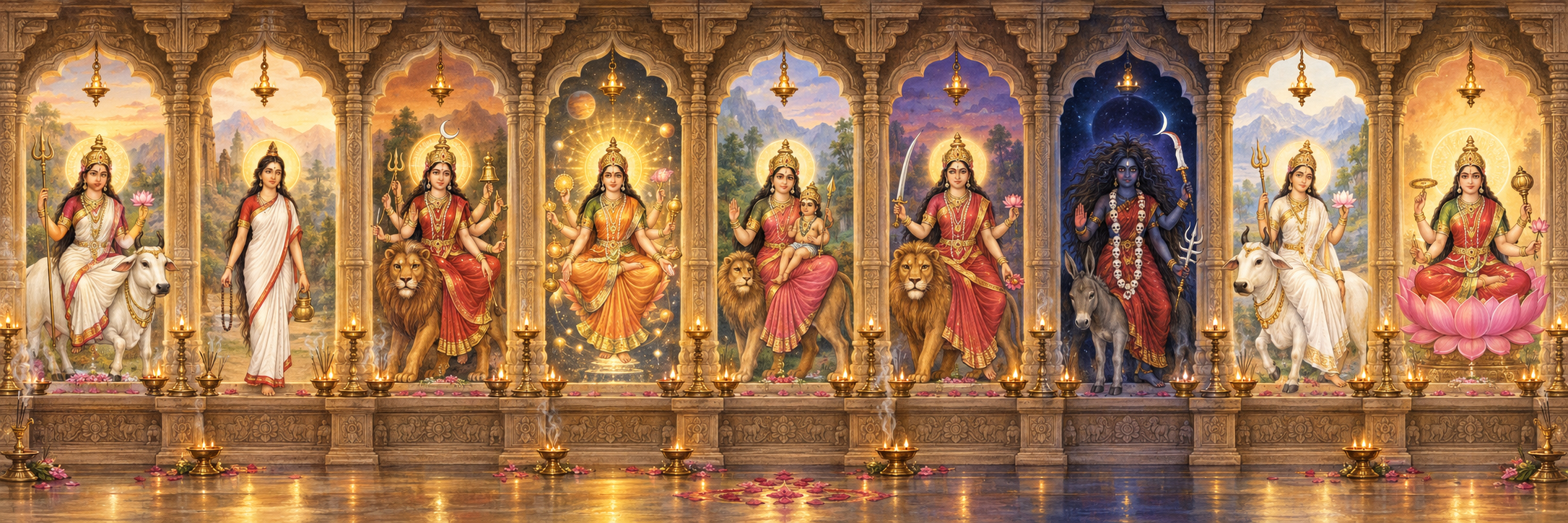
The traditional recitation names the forms in a fixed sequence: Shailaputri, Brahmacharini, Chandraghanta, Kushmanda, Skandamata, Katyayani, Kalaratri, Mahagauri and Siddhidatri. That order matters. It prevents us from choosing only the comforting aspects of Devi while avoiding discipline, fear, responsibility or change.
- Shailaputri establishes the ground on which practice can stand.
- Brahmacharini turns aspiration into sustained discipline.
- Chandraghanta shows that peace must sometimes be actively defended.
- Kushmanda expresses the warmth and abundance of creative power.
- Skandamata directs attention toward protective, responsible nurture.
- Katyayani asks whether conviction has become dharmic action.
- Kalaratri brings the practitioner face to face with darkness and fear.
- Mahagauri turns attention toward purification and clarity.
- Siddhidatri places attainment at the end of the journey, where it belongs.
This sequence can be used as a contemplative map, but it should not be mistaken for a claim that every region, temple or family performs identical rites on identical days. Navaratri customs vary. Colours, foods, mantras, fasting rules and forms of worship may come from a family tradition, a temple, a regional calendar or a guru-parampara. Preserve that inheritance where you have it. Use symbolic reflection to deepen a received practice, not to overwrite it with a standardised checklist found online.
Learn the visual grammar of a Navadurga form
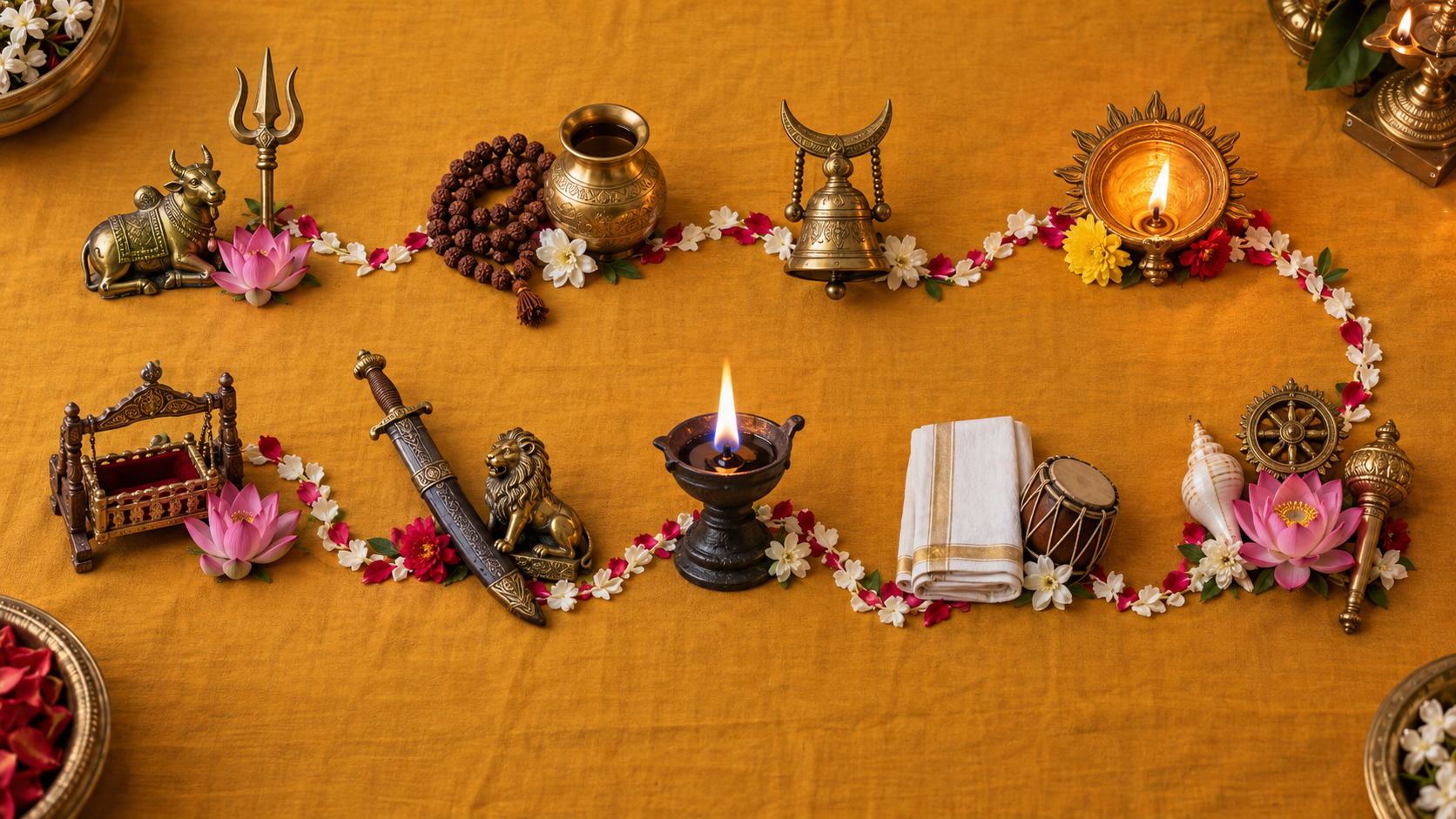
A murti or image is not merely a portrait. Its posture, vehicle, objects, weapons and expression form a visual language. Before looking for a quick interpretation, spend a minute noticing what is actually present.
- Read the name. Ask what relationship, quality or action it identifies. A name such as Shailaputri, daughter of the mountain, establishes a different mood from Kalaratri, the dark night.
- Notice how the Devi is situated. Is she standing, seated, walking or riding? Her vehicle can indicate how power moves through the world.
- Look at the hands. A weapon, lotus, mala or vessel does not cancel the others. Their coexistence is often the point.
- Look at the face. Serenity amid weapons communicates something different from anger without restraint. Shakti is not reducible to either softness or force.
- Only then turn inward. Ask what the complete image reveals about your conduct. Do not detach one attractive symbol from the form that gives it meaning.
Shailaputri makes this method clear. Her name means daughter of the mountain, and the Shiva Purana identifies her as Sati reborn to Himavat. She is shown riding a bull, with a trident in one hand and a lotus in the other. The mountain suggests stability. The trident introduces strength and discernment, while the lotus prevents firmness from becoming hardness. The image asks you to establish a reliable foundation without losing tenderness.
Brahmacharini strips away display. The Matsya Purana associates her with the prolonged tapas undertaken to attain Shiva. Her bare feet, simple white clothing, rosary and water pot place attention on the path rather than immediate reward. Her lesson is not that suffering is automatically holy. It is that a worthy resolve must survive repetition, delay and the absence of applause.
Chandraghanta holds an apparent tension together. She bears the crescent shaped like a bell, rides a tiger and is depicted with weapons in ten arms, yet her face remains serene. Her bell drives away harmful forces while her presence restores peace. The symbolism corrects a common mistake: peace is not the same as helplessness. A peaceful household still needs boundaries, courage and the willingness to protect those within it.
Kushmanda represents creative abundance. The Devi Bhagavata Purana connects her cosmic act of creation with a gentle smile arising amid darkness. She is radiant like the sun, riding a lion and bearing weapons, a rosary and a vessel of nectar among her eight hands. Here creation is not passive inspiration. It combines warmth, concentration, protection and nourishment.
Some contemplative interpretations connect these opening forms with the chakras: Shailaputri with Muladhara, Brahmacharini with Svadhisthana, Chandraghanta with Manipura and Kushmanda with Anahata. This can provide a useful inward progression from rootedness toward the heart. Treat it as a particular interpretive framework, however, rather than insisting that every Navadurga lineage must organise worship in precisely that way.
Turn the nine nights into a disciplined practice
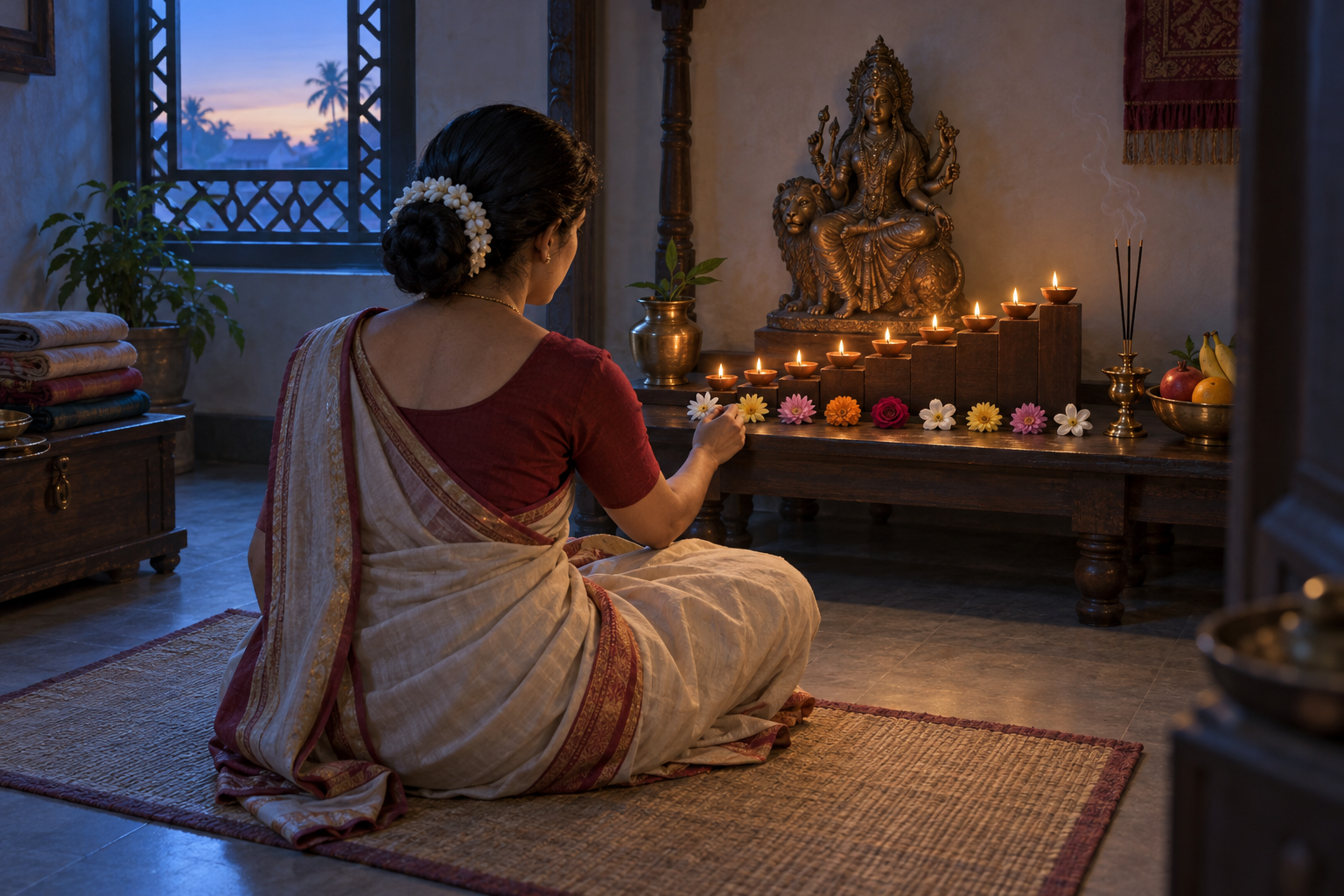
If your family already follows a vrata, mantra or puja paddhati, keep it intact. The following exercise is a short reflective companion, not a replacement ritual. After your customary worship, speak the day’s name, sit quietly with its central question and complete one concrete action before the next evening.
- Shailaputri — establish your ground. Identify one unstable foundation in your life: an untended altar, a broken daily schedule, a neglected obligation or a household arrangement that repeatedly causes disorder. Repair one part of it. Rootedness begins with what you can make dependable.
- Brahmacharini — choose a discipline you can repeat. Select one modest observance and keep it without bargaining with yourself. It may be a fixed time for prayer, a period of study or a duty performed attentively. The measure is continuity, not dramatic difficulty.
- Chandraghanta — protect peace without aggression. Resolve one avoidable disturbance. Have the conversation you have postponed, set a clear boundary or stop carrying conflict from one room into another. Calm that cannot defend what is right becomes mere avoidance.
- Kushmanda — create and nourish. Make something that brings life into the household. Prepare food, restore a neglected space, support someone’s work or begin a useful task that has remained only an idea. Creative Shakti becomes visible through what it sustains.
- Skandamata — nurture without possession. Her name identifies her as the mother of Skanda. Ask who or what has been entrusted to your care. Offer the help that enables growth rather than the control that produces dependence.
- Katyayani — convert conviction into action. Name one dharmic responsibility that you already understand but continue to postpone. Take a finite first step. Do not use symbolic language to conceal indecision.
- Kalaratri — face what fear has magnified. Write down the fear you have kept vague. Separate what is actually happening from what you are imagining. Then perform the next right action that remains possible. The purpose is not to glorify darkness but to stop letting the unnamed govern you.
- Mahagauri — remove what clouds clarity. Clean one physical space, correct one false statement, settle one resentment or abandon one habit of speech that leaves impurity behind. Purification becomes real when something is honestly relinquished.
- Siddhidatri — examine your idea of attainment. Siddhi can indicate attainment, perfection or spiritual capacity. Ask what any capacity you seek would be for. Dedicate the fruit of the nine-night discipline to service, worship or a duty larger than self-display.
Keep the exercise proportionate. One completed act teaches more than nine pages of ambitious promises. At the end of each night, write a single sentence recording what you noticed. By the ninth night you will have a record of conduct, not merely a collection of devotional impressions.
Let the Mother come home without turning devotion into sentiment
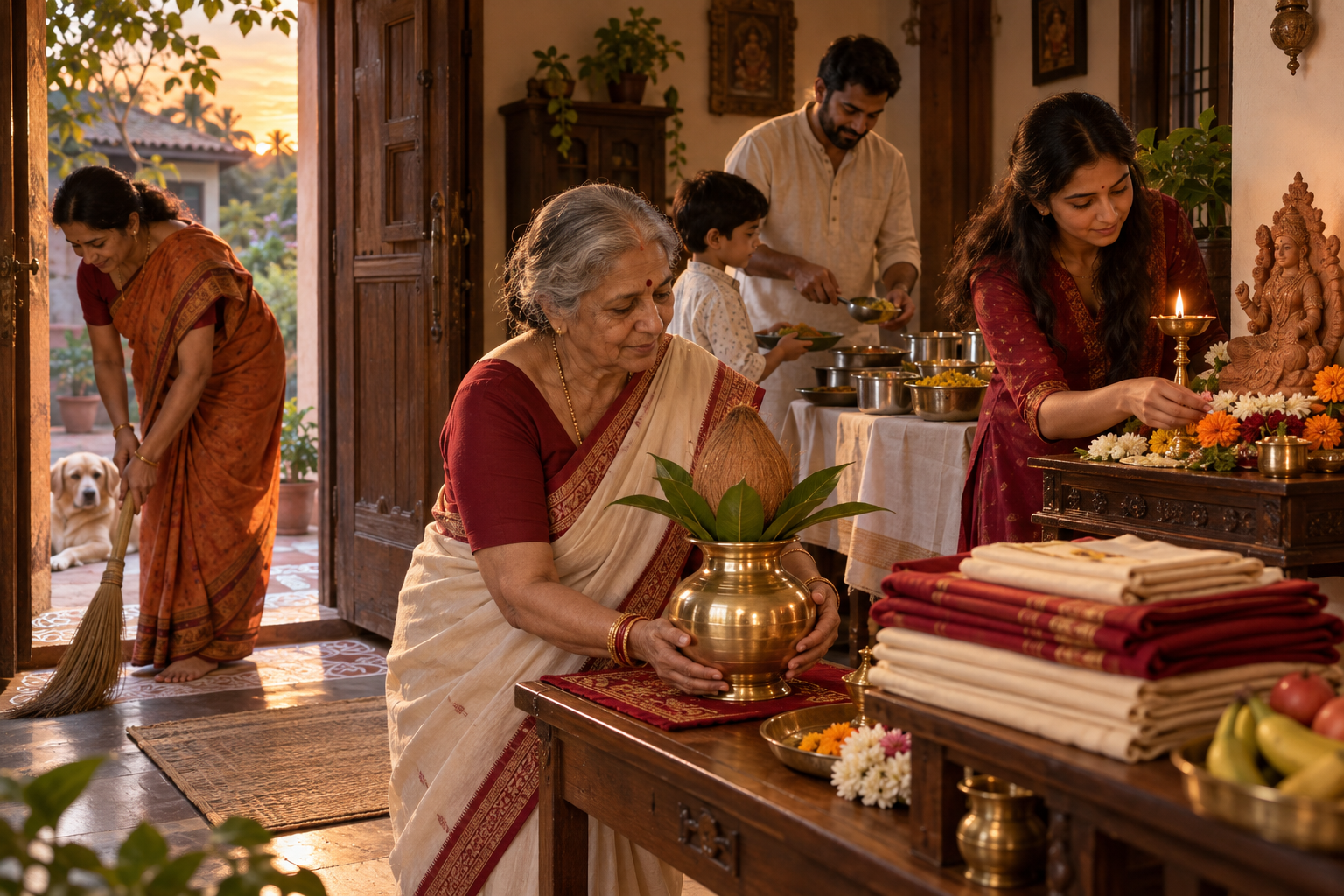
Navadurga becomes immediately intelligible when you notice Shakti in the work that holds a home together. Stability resembles the person who keeps a family secure during uncertainty. Tapas appears in years of patient, largely unseen labour. Protective peace appears when someone restores order without surrendering the household to fear. Creative abundance appears when limited ingredients, money or time are turned into nourishment.
This domestic lens is powerful because it brings theology close. It can also be misused. Honouring maternal sacrifice must never become an excuse to demand limitless sacrifice from women, romanticise exhaustion or assign all care work to mothers. Devi is not a device for keeping an unequal household unchanged. If worship teaches you to recognise sustaining labour, that recognition should alter how you share the labour.
You can make that recognition concrete during Navaratri:
- Ask an elder how Navadurga was worshipped in their childhood, then record the names, pronunciations and household customs accurately.
- Take responsibility for one recurring festival task instead of waiting to be directed.
- Explain one form to a child through its visible symbols: mountain, bull, lotus, mala, bell, tiger, lion or vessel.
- Thank the person whose preparation makes worship possible, and do it by relieving a real burden rather than offering praise alone.
- Keep regional and family distinctions visible. Do not tell another household that its inherited observance is wrong merely because it differs from an online calendar.
The home is therefore not a smaller or less serious setting than the cosmic battlefield. It is where qualities such as steadiness, tapas, protection and generosity become habits. If the symbolism never changes how people speak, work, share responsibility or protect one another, it has remained decorative.
Key takeaways
- Read the Navadurga in their traditional order; the sequence is more instructive than nine disconnected descriptions.
- Interpret the complete image. Name, vehicle, hands, objects, weapons and expression work together.
- Do not confuse symbolic commentary with a universal ritual manual. Family, regional, temple and guru traditions retain their authority within their proper settings.
- Give each night one question and one completed action. Small, repeated practice is more faithful to the symbolism than an elaborate plan abandoned midway.
- Recognising maternal and domestic Shakti should lead to gratitude, shared labour and protection from exploitation.
- Measure attainment by the responsibility it creates, not by spiritual display.
On your next night of Navaratri, begin with the form before you rather than trying to grasp all nine at once. Look carefully, speak her name, identify the demand the image makes on your conduct and complete one act before the next lamp is lit. That is how a sacred sequence moves from the calendar into a life.
References

Leave a Reply
You must be logged in to post a comment.