

You may be able to recite several Sanskrit names and still wonder what Sankhya is actually counting. The difficulty is usually not the vocabulary. It is the habit of mixing consciousness, mental activity, sensory experience, and physical form into one undivided thing.
The map becomes usable when you keep one distinction in view: the 24 tattvas describe the domain of Prakriti, while Purusha is consciousness itself. Learn that architecture first, and the list stops looking like an arbitrary catalogue.
Begin with the counting rule that prevents most confusion

In the standard Sankhya enumeration, Prakriti is included among the 24 tattvas. Purusha is not. When Purusha is added, the complete philosophical scheme contains 25 principles.
This matters because the English word matter can mislead you. Prakriti is not merely visible physical stuff. It is the entire unconscious field of nature: the unmanifest root, the intellect, the sense of individuality, the coordinating mind, the capacities of perception and action, subtle sensory potentials, and gross embodiment. Thoughts and decisions therefore belong to Prakriti just as bodies and physical objects do.
| Count | Principle or group | What it accounts for |
|---|---|---|
| 1 | Prakriti | Primordial nature, the unmanifest root of the changing field |
| 2 | Mahat or buddhi | Determination, discernment, judgement, and intelligence |
| 3 | Ahamkara | The I-making function that appropriates experience as I or mine |
| 4 | Manas | The coordinating mind that attends to, selects, and organises sensory information |
| 5-9 | Five jnanendriyas | The capacities for hearing, touch, sight, taste, and smell |
| 10-14 | Five karmendriyas | The capacities for speech, grasping, movement, elimination, and reproduction |
| 15-19 | Five tanmatras | The subtle potentials of sound, touch, form or visibility, taste, and smell |
| 20-24 | Five mahabhutas | Space, air, fire, water, and earth as the gross elements |
A compact memory formula is: one root, three inner functions, and four groups of five. In arithmetic, that is 1 + 3 + 5 + 5 + 5 + 5 = 24. The three inner functions are buddhi, ahamkara, and manas. The four pentads are the knowing capacities, acting capacities, subtle sensory potentials, and gross elements.
Do not add sattva, rajas, and tamas as three more tattvas. They are the three gunas, or modes of Prakriti, rather than separate products added to the count. Likewise, do not count Purusha within the 24 merely because discussions of Sankhya mention it alongside them.
Read the 24 as an order of dependence, not a random list
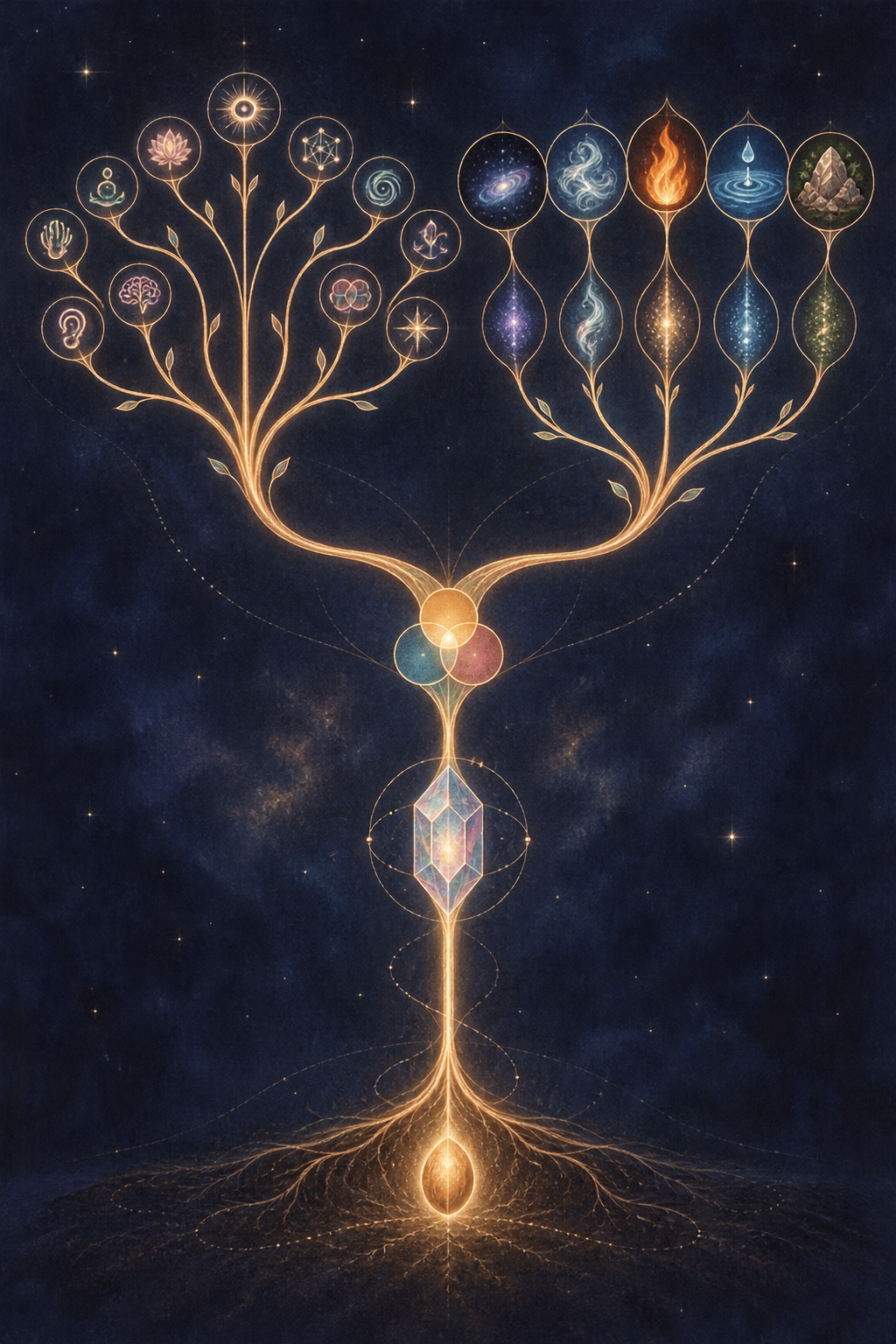
The table is convenient for counting, but Sankhya is easier to understand as an unfolding. Prakriti is the undifferentiated ground of the manifest field. Mahat is its first great determination; at the individual level, its discriminating function is commonly called buddhi. From this emerges ahamkara, the principle through which undivided experience becomes organised around individuality.
Ahamkara opens into two connected families. One contains manas and the ten capacities of knowing and acting. The other contains the five tanmatras, from which the five gross elements arise. The structure can be held in mind as follows: Prakriti to mahat or buddhi, then to ahamkara, then toward the eleven faculties on one side and the five tanmatras followed by the five gross elements on the other.
The gunas explain why differentiation can occur without becoming extra items in the list. Sattva is associated with illumination and clarity, rajas with activity and movement, and tamas with inertia, resistance, and obscuration. Every manifestation of Prakriti involves their interplay. They describe how Prakriti operates; the tattvas identify the levels and functions through which it becomes articulated.
This is a metaphysical dependency map, not a modern laboratory timeline. Subtle does not mean morally superior, and gross does not mean impure. A physical object depends on gross embodiment; embodied perception depends on sensory qualities and capacities; organised experience depends on manas, ahamkara, and buddhi. The map moves from the less differentiated toward the more differentiated.
You can study it in the reverse direction. Begin with an object, notice the quality being perceived, identify the relevant sensory capacity, observe the mind coordinating the impression, detect the I-making that calls it mine, and notice the judgement formed by buddhi. This reverse reading turns cosmology into self-inquiry.
Five distinctions keep the Sanskrit terms precise
Purusha is not a finer kind of thought
Thought, memory, attention, doubt, decision, and self-reference all change. Sankhya therefore places them within Prakriti. Purusha is not the most refined mental event or a hidden object inside the mind. It is the conscious principle by which changing mental events are known.
A practical test is simple: if you can notice a thought, mood, judgement, or sense of identity arising and passing, Sankhya treats that noticed event as part of Prakriti. The knower cannot be reduced to one more item in the collection of things known. This is why Purusha stands outside the list of 24.
Ahamkara means I-making, not merely arrogance
Reducing ahamkara to pride makes the system unnecessarily moralistic. Pride is one possible mental condition. Ahamkara is more basic: it is the function that frames an experience as happening to me, produced by me, or belonging to me.
The sentence I am better than everyone certainly involves ahamkara, but so do the ordinary thoughts my idea, I heard that, and this happened to me. Watch for appropriation rather than waiting for an obvious display of vanity.
Manas and buddhi perform different work
Manas coordinates impressions, directs attention, considers alternatives, and passes information within the inner apparatus. Buddhi determines, judges, and discriminates. When you hear a sound, turn toward it, consider what it might be, and decide how to respond, Sankhya does not compress that entire sequence into a single faculty called mind.
This distinction helps you diagnose your own confusion. If information is scattered and attention keeps shifting, examine manas. If the facts are present but the conclusion is unsound, examine buddhi. If the conclusion becomes inseparable from personal ownership, notice ahamkara.
An indriya is a capacity, not just an anatomical organ
The jnanendriyas are powers of knowing through hearing, touch, sight, taste, and smell. They should not be equated without qualification with the ears, skin, eyes, tongue, and nose. Those physical structures belong to embodied nature; the indriya names the corresponding perceptive capacity within Sankhya’s analysis.
The same caution applies to the karmendriyas. A hand is a physical structure, while grasping is the relevant capacity for action. Feet are physical, while locomotion is the capacity being classified. Keeping capacity separate from bodily instrument prevents several items from collapsing into the five gross elements.
Tanmatras and mahabhutas are not interchangeable
A tanmatra is a subtle sensory potential, not the gross object encountered through the senses. The sound-tanmatra is therefore not identical to a particular bell, voice, or ringtone. It marks the subtle basis of sound as a possible quality of experience.
The mahabhutas are the five gross elements: space, air, fire, water, and earth. They belong to an Indian philosophical account of embodiment and perceptible nature. Reading them as if they were competing entries in the modern periodic table asks the categories to answer a question they were not designed to answer.
Use one ordinary event to make the whole map intelligible

You do not need to force yourself to visualise 24 separate entities. Take an ordinary event instead: a notification sounds, you recognise it as yours, and you reach for the device. Then examine the event in stages.
- Locate the gross setting. The device, your body, and the physical environment belong to the gross field represented by the mahabhutas.
- Separate quality from object. Use the sound-tanmatra to mark the subtle possibility of sound, not the device or the particular tune as a physical object.
- Identify the knowing capacity. Hearing is the relevant jnanendriya. Distinguish that capacity from the anatomical ear.
- Notice coordination. Manas selects the sound from other impressions, directs attention toward it, and connects it with the ongoing situation.
- Catch appropriation. Ahamkara supplies the movement toward my notification, someone is contacting me, or I must respond.
- Observe determination. Buddhi judges what the sound means and decides whether it warrants a response.
- Name the acting capacity. Reaching for the device uses the karmendriya associated with grasping. Speaking in reply would involve the capacity of speech.
- Classify the entire chain. The object, sound, hearing, attention, ownership, judgement, and action all vary and are therefore placed within Prakriti. Purusha names the conscious principle to which the varying chain is manifest.
Repeat the inquiry with sight while reading, taste while eating, or movement while walking. Change only one example at a time. Ask which quality is present, which capacity knows it, how manas organises it, where ahamkara claims it, what buddhi determines, and which capacity acts.
This exercise does not prove Sankhya’s metaphysics simply by labelling an experience. Its value is more disciplined: it allows you to understand the system on its own terms and to test whether its distinctions reveal features of experience that you normally merge together.
Key takeaways
- The 24 tattvas include Prakriti and its differentiated principles; Purusha stands apart as consciousness and becomes the 25th principle in the full enumeration.
- The easiest memory pattern is one root, three inner functions, and four pentads: 1 + 3 + 20 = 24.
- Buddhi determines, ahamkara appropriates, and manas coordinates. Calling all three simply mind hides the structure Sankhya wants you to see.
- The jnanendriyas and karmendriyas are capacities for knowing and acting, not merely anatomical organs.
- The tanmatras are subtle sensory potentials, while the mahabhutas are gross elements. Neither group should be flattened into modern physical categories.
- The practical purpose of the map is discrimination: everything changing and knowable belongs to Prakriti, while Purusha is the conscious knower.
In your next study session, draw the map from memory using only the formula one root, three inner functions, and four pentads. Then trace one real perception through it. Once you can place perception, ownership, judgement, and action without collapsing them together, the 24 tattvas have become a working philosophical map rather than a Sanskrit vocabulary test.
References

Leave a Reply
You must be logged in to post a comment.