
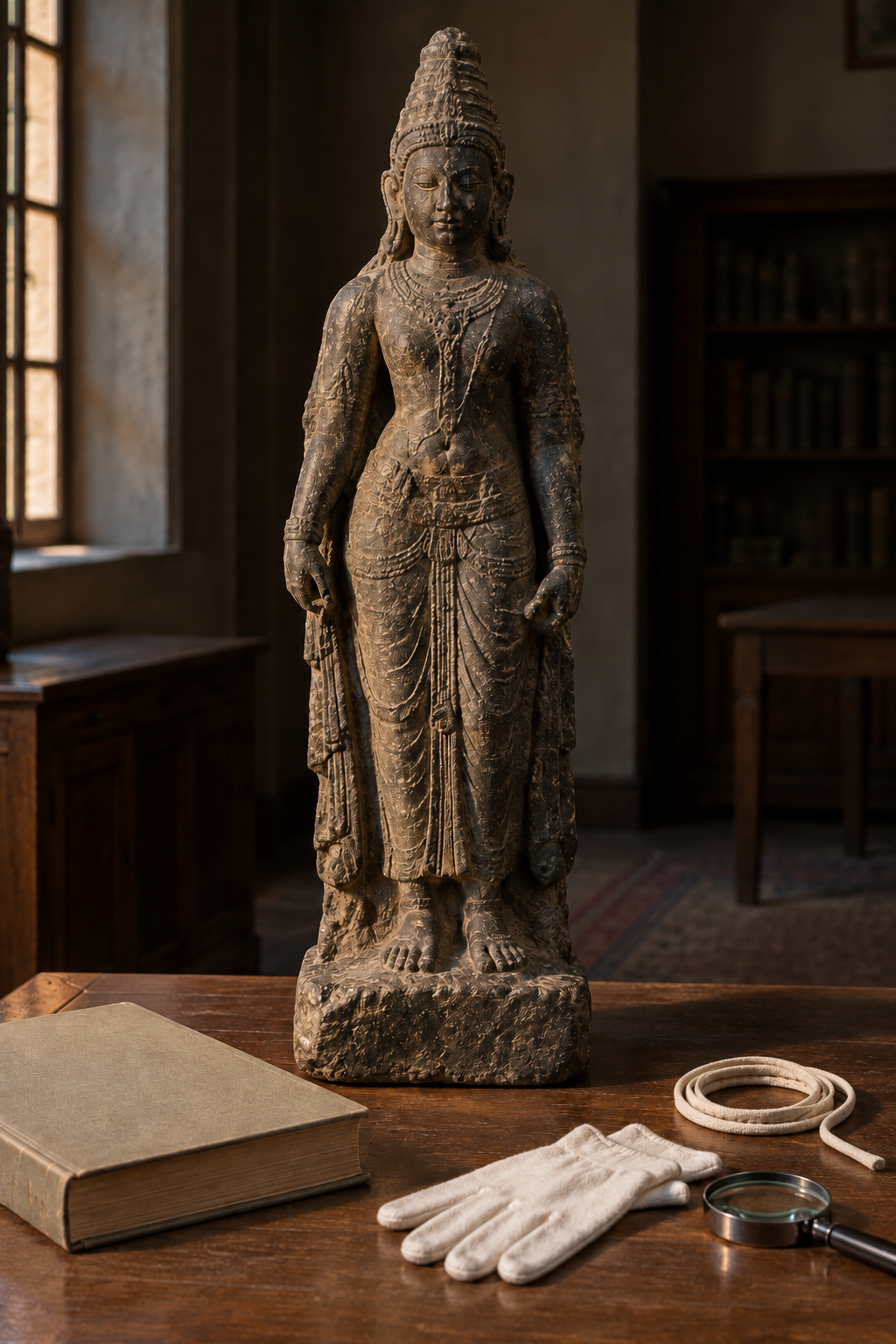
You have found a sculpture, painting, or online image labelled Chandra Parameshwari Devi, but the name alone does not tell you whether the identification is sound. It certainly does not justify adding a crescent moon, a particular weapon, or a preferred colour and calling the result traditional.
The dependable approach is to separate what is documented from what is merely plausible. Chandra Parameshwari Devi is a sparsely documented Devi form recorded in the Sritattvanidhi, a nineteenth-century compendium of iconography and iconometry. That gives you a real textual anchor, but it also demands restraint when identifying, describing, or recreating her form.
Begin with the narrow claim the evidence supports
Three things are often collapsed into one: a divine name, a prescribed iconographic form, and the identity under which a murti is worshipped in a particular community. They may coincide, but they are not interchangeable.
Chandra Parameshwari Devi belongs to the broad range of Devi manifestations preserved by the Sritattvanidhi. Her inclusion establishes that the name has a place in an iconographic tradition. It does not, by itself, prove that every image carrying the name follows one design or that an otherwise unidentified goddess becomes Chandra Parameshwari merely because she bears a lunar symbol.
This is also where the distinction between iconography and iconometry matters. Iconography concerns identifying features: attributes held in the hands, gestures, posture, seat or vehicle, attendants, ornaments, and other signs. Iconometry concerns the proportional system used to construct the sacred figure. A correctly proportioned image can still be assigned the wrong identity, while a securely identified figure may have been rendered with regional or artistic variation.
When you write a caption or discuss a murti, begin with the strongest statement you can defend. If the evidence reaches only the name in a textual catalogue, say that. Do not supply an exact number of arms, weapons, colours, gestures, or companions unless those details can be traced to a description, inscription, established temple tradition, or securely identified image.
Read a suspected image in a fixed order
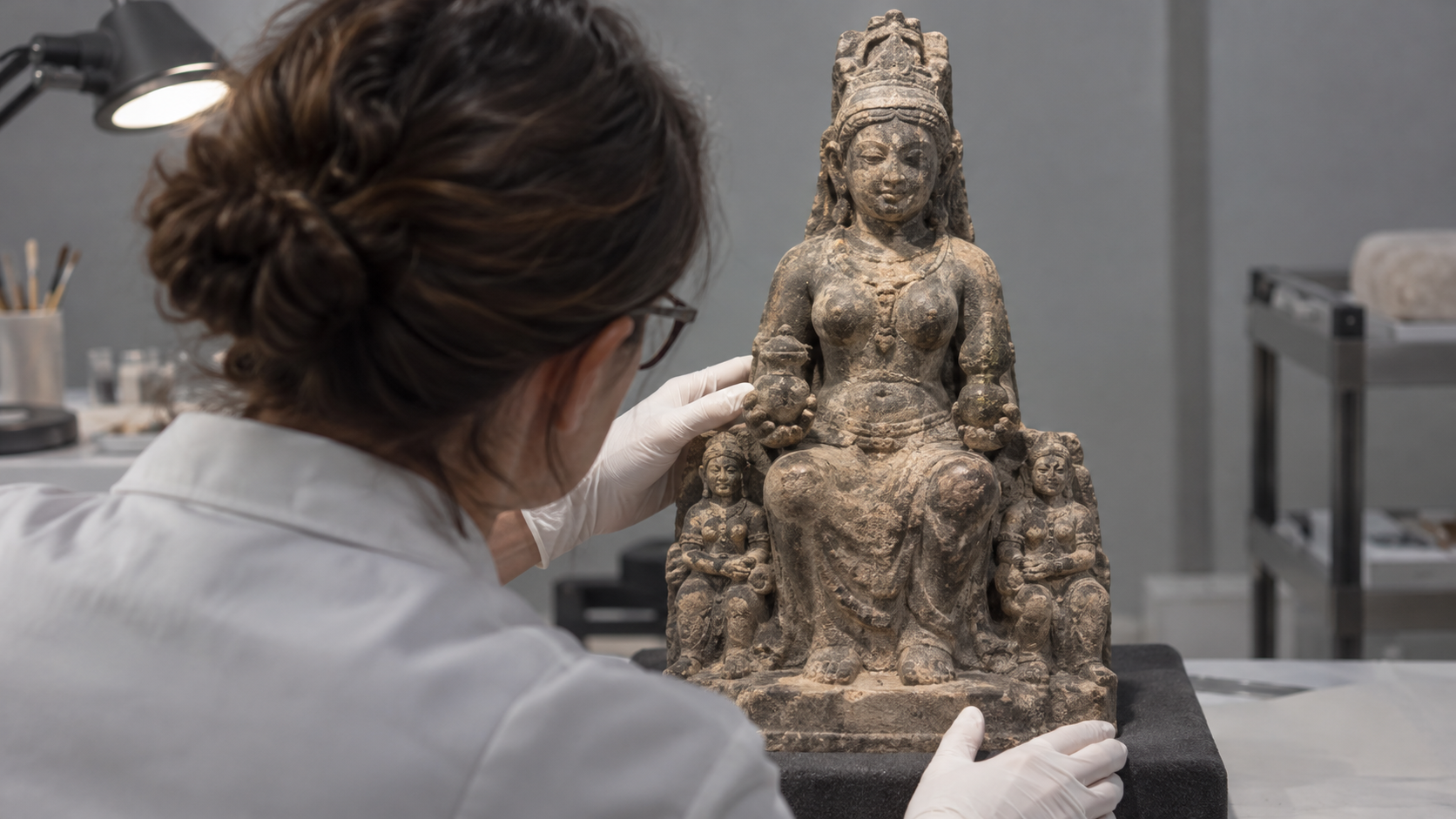
A fixed reading sequence prevents one attractive feature from controlling the whole identification. Record what you can actually see before deciding what any feature means.
- Record the provenance. Note the temple, collection, manuscript, workshop, website, or family shrine from which the image comes. Preserve the original caption and spelling rather than silently standardising them.
- Count faces and arms. Do not assume that a damaged, concealed, or empty hand was always intended to remain empty. If part of the figure is missing, mark the count as uncertain.
- List every object without interpreting it. Write “disc-shaped object,” “flower,” or “curved implement” first. Name it as a chakra, lotus, crescent, sword, or another attribute only when its form is clear.
- Identify hand gestures. Separate objects held in the hands from mudras such as blessing or protection. A hand may also have lost a detachable attribute.
- Describe posture and support. Note whether the Devi stands or sits, the form of the pedestal, and whether an animal, lotus, throne, or other support is visible.
- Inspect the head and surrounding field. Record the crown, hair, halo, possible lunar emblem, and any marks above or behind the head. Do not treat a circular halo as a moon without further evidence.
- Include attendants and subsidiary figures. Cropped reproductions often remove precisely the contextual features that help distinguish one form from another.
- Separate original work from later intervention. Repainting, replacement hands, renewed ornaments, and restoration can alter the features on which an identification depends.
After making this inventory, compare the complete cluster of features with the relevant description. One matching object is weak evidence. A consistent combination of name, provenance, posture, attributes, gestures, and context is much stronger.
Do not make the name perform the work of an image
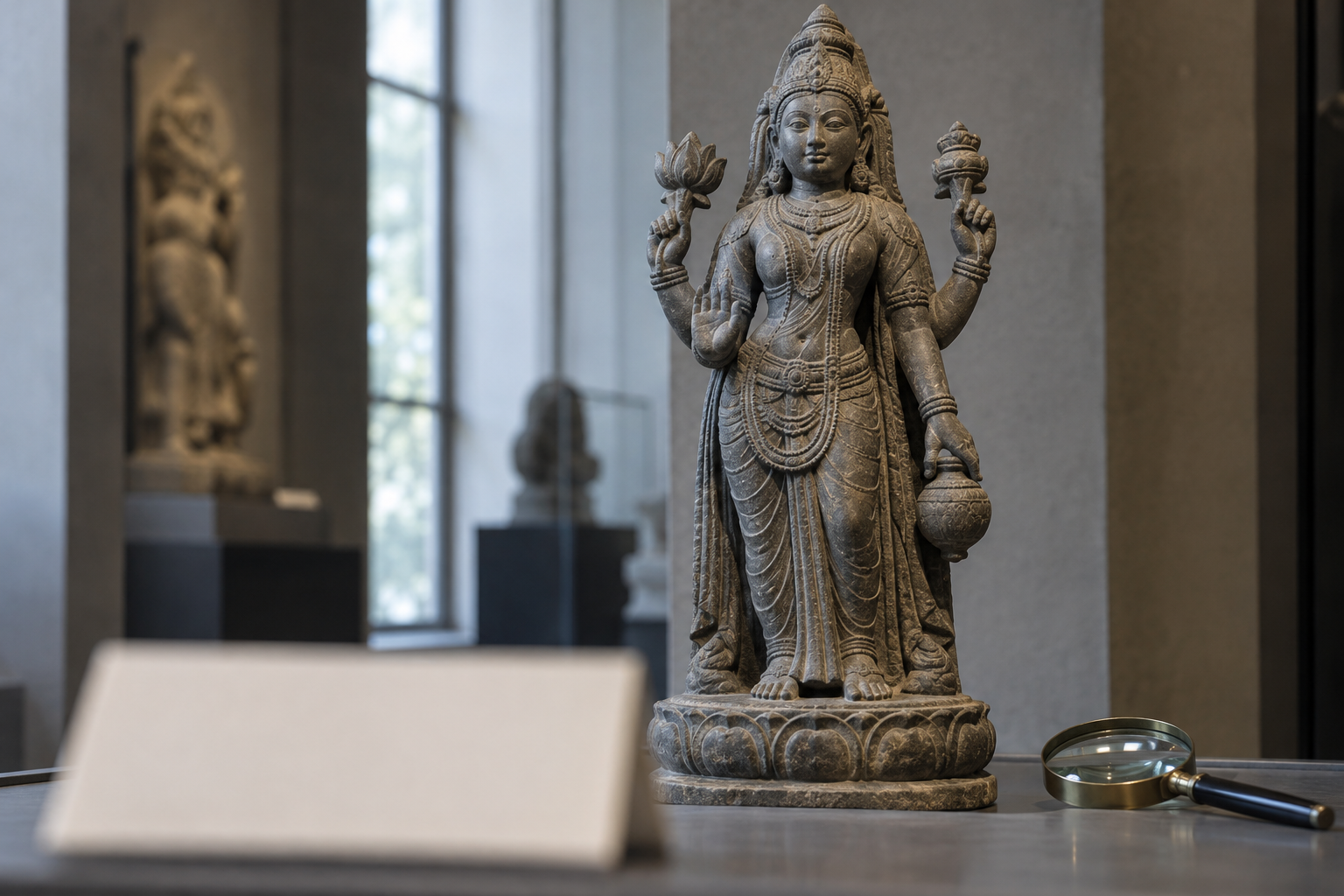
The word “Chandra” naturally invites a lunar interpretation. That makes the crescent, moon disc, pale colouring, and night-sky background tempting additions for a modern artist. They may be meaningful artistic choices, but none should be presented as a prescribed feature without a supporting description.
The error also works in reverse. The absence of an obvious moon does not automatically disprove the identification. A small emblem may be damaged, obscured by ornament, stylised beyond easy recognition, or absent in a regional rendering. Treat the name as a lead to investigate, not as a complete visual specification.
| Evidence | What it can establish | What it cannot establish alone |
|---|---|---|
| An original inscription or securely transmitted label | The name associated with that particular image | Every feature of a general canonical form |
| A textual iconographic description | A prescribed cluster of visual characteristics | The identity of an unlabelled object with only one matching feature |
| An established temple tradition | The worship identity and local understanding of its murti | That all other Chandra Parameshwari images must look identical |
| Visible attributes alone | A set of candidates for comparison | A secure name without corroborating context |
| A modern caption or social-media label | A claim that can be investigated | The historical accuracy of that claim |
This layered reading protects two truths at once. Sacred forms can have disciplined visual identities, and living Hindu traditions can preserve regional expressions that are not reducible to a single modern illustration.
Verify the form before captioning, teaching, or commissioning it
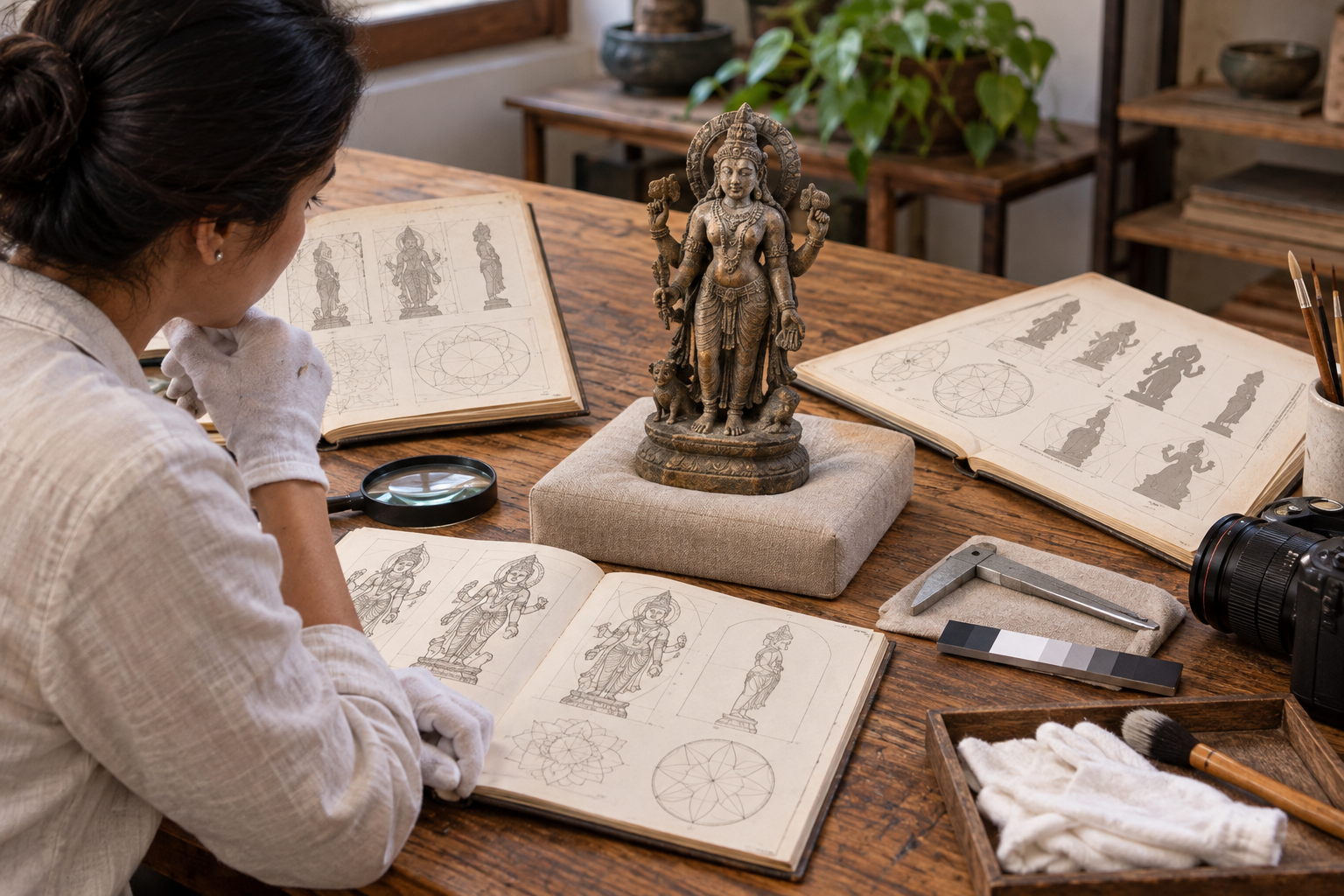
If you are identifying an existing image
Trace the label backwards. Find the earliest available catalogue record, inscription, temple identification, or uncropped reproduction. Check whether later websites merely copied the same caption from one another. Repetition increases visibility, not reliability.
Use calibrated wording. “Chandra Parameshwari Devi” is appropriate when the identification is secure. “Identified as Chandra Parameshwari Devi by the temple” preserves the authority of a living tradition. “Possibly Chandra Parameshwari Devi” is better when the conclusion rests on incomplete visual comparison.
If you are teaching or publishing
Give readers enough information to repeat your check. Include the spelling of the name, location or collection, approximate date if securely known, and the exact textual or traditional basis for the identification. If you cite the Sritattvanidhi, identify the edition, page or folio, and translation you actually used. Different spellings or editorial arrangements can otherwise make the trail difficult to follow.
Keep the full image whenever possible. A tight crop may remove the pedestal, vehicle, attendants, aureole, or inscription. Those are not decorative leftovers; they may carry the decisive evidence.
If you are commissioning a new image
Prepare a written iconographic brief before the artist begins. Divide it into three parts: documented features, features required by the worshipping tradition, and artistic decisions. That separation prevents an imaginative choice from acquiring false canonical status when the image is later copied.
For a decorative illustration, uncertainty can be stated openly in the caption: “modern devotional interpretation” or “artist’s reconstruction” tells the viewer what kind of image they are seeing. For a murti intended for consecration and worship, a general internet identification is not enough. The design should be settled with the relevant sampradaya, temple authority, ritual specialist, and sthapati or silpin responsible for the sacred form.
A compact evidence note can follow this pattern: Identification: Chandra Parameshwari Devi. Basis: inscription, textual description, or named temple tradition. Visible features: a neutral inventory. Uncertainties: damaged, obscured, restored, or interpretive elements. Keeping these four fields together makes later verification much easier.
Key takeaways
- Chandra Parameshwari Devi has a documented place among the Devi manifestations catalogued in the nineteenth-century Sritattvanidhi.
- A sacred name is not a substitute for a complete iconographic description.
- Record visible features before interpreting them, then compare the whole cluster rather than one striking symbol.
- A moon-like emblem may support a lunar reading, but it cannot establish the identity by itself.
- Distinguish textual prescription, local worship identity, and modern artistic reconstruction in every caption or commission.
- When the evidence is incomplete, mark the uncertainty instead of filling it with familiar Devi attributes.
Your next step should be practical: preserve the label and provenance, make a feature-by-feature inventory, and locate the exact Sritattvanidhi description before asserting or recreating the form. Careful identification does more than prevent an art-historical mistake. It honours the particularity of the Devi rather than dissolving her into a generic goddess image.
References

Leave a Reply
You must be logged in to post a comment.