
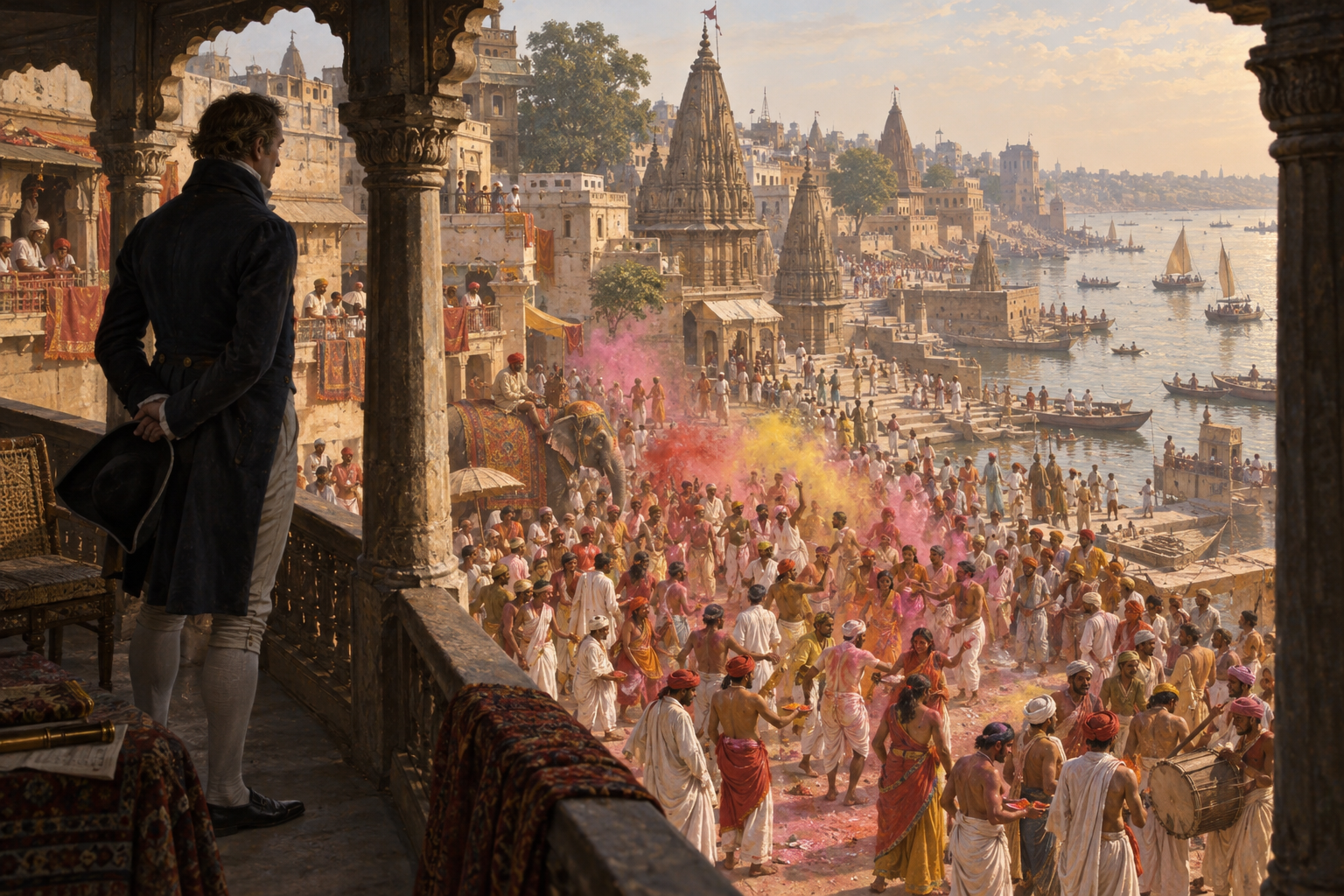
If you have ever wondered how a British visitor could praise Kashi’s skyline yet recoil from Holi, the contradiction is only apparent. Bharat could be admired as scenery while a living Hindu festival was rejected for crossing the visitor’s preferred boundaries.
To understand that response, don’t begin by asking whether an English nobleman liked colour. Ask where he stood, whose company he kept, and which rules he expected to govern an encounter. Viscount Valentia’s stay near Varanasi in March 1803 makes those questions unusually revealing.
The first clue is where Valentia stood
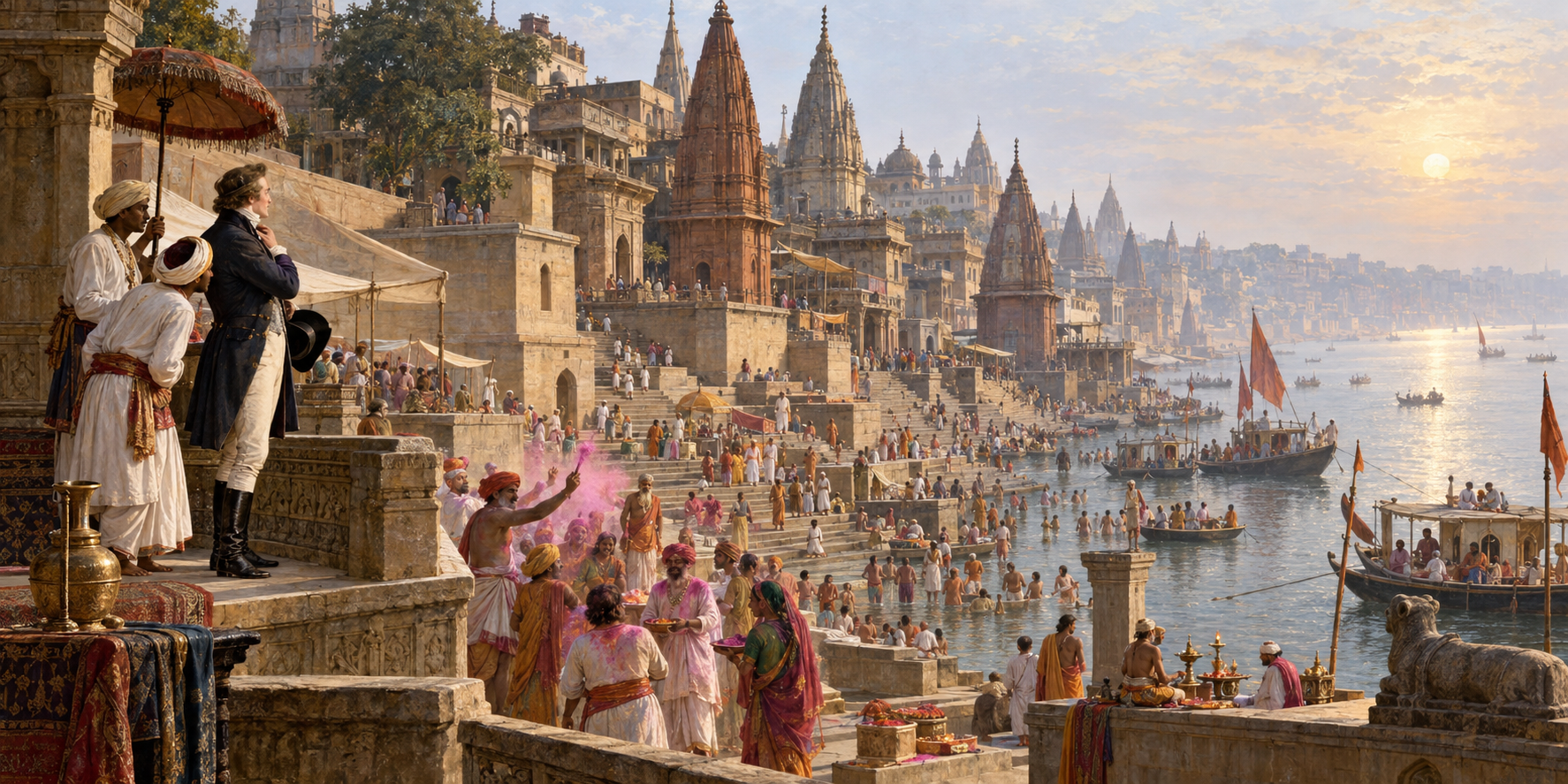
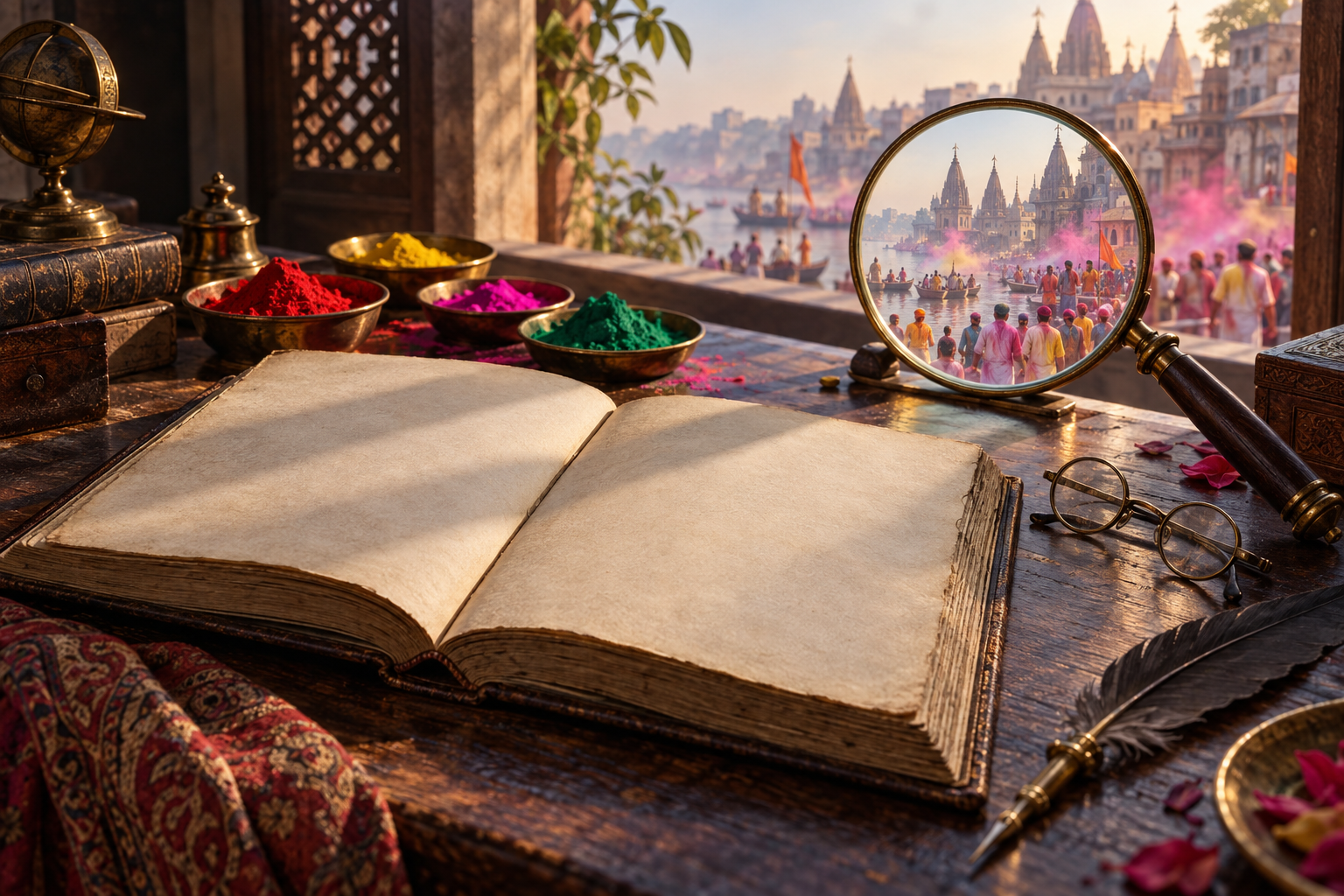
At four in the afternoon on 7 March 1803, Valentia saw Varanasi from his palanquin after travelling for a month from Calcutta by river and road. He described himself as highly delighted by the view of the city across the river. He recognised it as a great seat of Hindu religion, while finding its minarets especially conspicuous.
That admiration came from a distance. On arriving, he did not enter Kashi through its gates. He crossed Raj Ghat and continued for another two miles to Secrole, or Sikraul, where General Deare’s bungalow and the British official circle awaited him.
The route gives you a necessary distinction: seeing a sacred city is not the same as entering its world. Valentia could consume the panorama without submitting to Kashi’s crowds, customs, rhythms, or claims upon him. He encountered the city first as a composed view and then from the shelter of an official enclave.
This matters when you assess his hostility toward Holi. A distant skyline stays where an observer puts it. Holi does not. It moves through streets, gathers bodies, makes noise, changes ordinary social distance, and places colour on people rather than merely before them. The spectator’s wish to remain outside the festival can therefore shape what he thinks he sees.
When you read a colonial description of a Hindu celebration, locate the observer before accepting the observer’s adjective. Was he inside the neighbourhood or looking from a protected residence? Did he understand the ritual setting? Could participants answer his description on equal terms? In Valentia’s case, the physical map already warns you against mistaking an outsider’s overview for cultural understanding.
A dispute over visits reveals the hierarchy underneath
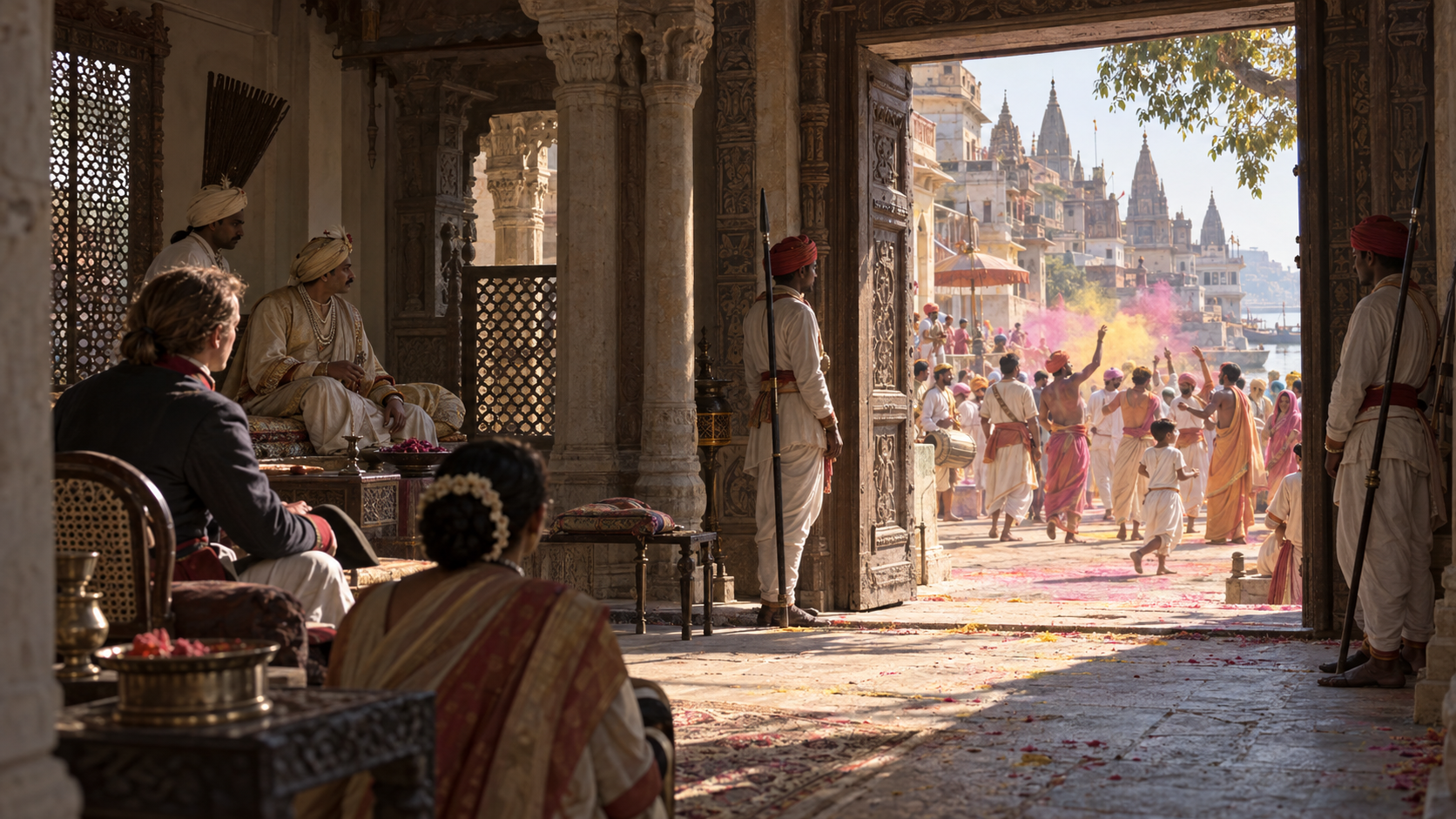
The social arrangements on the following day make the issue sharper. Brigade-Major Maxwell and Neave, a senior judge and an agent of the Governor-General, breakfasted with Valentia and prepared his meetings with local princes. He learned that local etiquette required a stranger to pay the first visit.
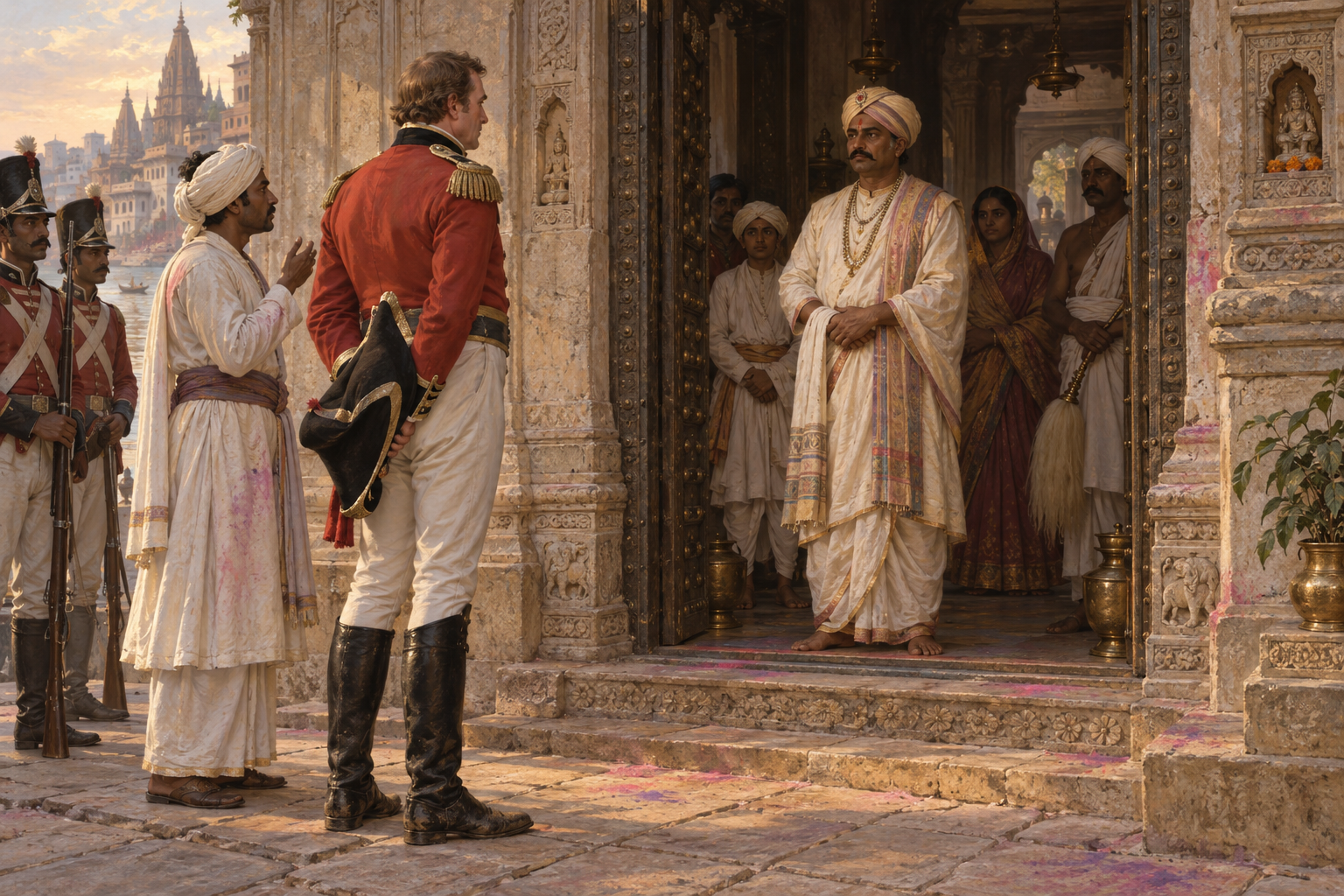
Valentia nevertheless had instructions from Wellesley to follow a different order. He declined the proposed arrangement, asked instead to be introduced to the British gentlemen resident there, and said he would return their visits. The disagreement may look like a small matter of courtesy. It was also a contest over whose custom would define status.
Imperial power often becomes visible in precisely such gestures. Who visits whom? Who waits? Who is introduced? Whose hospitality is treated as an honour, and whose is treated as an obligation? Political hierarchy enters daily life long before anyone states a formal doctrine.
This makes Valentia’s reaction to Holi easier to interpret. A public festival that relaxes ordinary reserve will feel especially disruptive to someone who is simultaneously guarding ceremonial precedence. If even the order of polite visits must confirm rank, uninvited colour, collective play, and temporary familiarity are unlikely to be received as neutral pleasures.
That connection should be treated as an interpretation, not as a licence to invent his motives. The secure point is narrower: his encounter with Varanasi was structured by distance, official hospitality, deference, and resistance to local protocol. Those conditions belong inside any explanation of his hostility; personal taste alone does not explain enough.
Why Holi unsettled the colonial posture
Holi is not merely coloured powder. It is a devotional and seasonal celebration with a highly public mode of participation. Its meaning cannot be reduced to whether an individual observer enjoyed being near a crowd. Colour-play is part of a wider festive world in which normal reserve may be loosened and social contact becomes difficult to regulate from above.
That embodied quality challenges the posture Valentia brought to Varanasi. He could admire architecture while remaining untouched by it. Holi threatened to make detachment itself impractical. The festival was not simply an object available for inspection; it surrounded the observer with sounds, bodies, gestures, and expectations that did not wait for British approval.
Once you notice this mismatch, several colonial judgements become easier to decode. Noise can be renamed disorder. Festive familiarity can be interpreted as insolence. A temporary easing of restraint can be presented as proof that the people lack restraint altogether. Personal discomfort then acquires the false authority of a civilizational verdict.
This does not mean every inconvenience associated with a large public celebration must be denied. Nor does it mean every European in India thought alike. It means inconvenience and inferiority are different claims. A reader should never allow the first to smuggle in the second without argument.
Valentia represents one aristocratic traveller moving through an elite East India Company setting in the early nineteenth century. He cannot stand for every British resident, official, missionary, soldier, or visitor. The responsible conclusion is therefore specific: in this encounter, imperial rank and physical separation helped turn Holi from a Hindu celebration into a perceived problem of control.
Key takeaways for reading colonial accounts of Holi
- Start with position, not opinion. Establish where the observer stayed, how close he came to participants, and whether he entered the sacred and social setting he judged.
- Treat etiquette as political evidence. Disputes over visits, introductions, hospitality, dress, touch, or bodily distance often disclose the hierarchy behind an apparently personal reaction.
- Separate the event from the judgement. Colour, noise, crowds, and temporary familiarity are observable features; calling them barbaric, chaotic, or uncivilized is an interpretation.
- Keep the scale honest. One traveller can reveal a colonial posture, but he cannot prove what every European believed or how every Holi celebration unfolded.
- Restore Holi’s own frame. Ask what the celebration meant to Hindu participants before evaluating it through the comfort, reserve, or status expectations of a foreign guest.
Recover Holi without creating a reverse caricature
A decolonial reading can fail by merely reversing the old judgement: the British observer becomes wholly irrational, while every action within the festival becomes immune to examination. That approach is unnecessary. The stronger method is symmetry.
Valentia’s reserve was cultural, just as Holi’s public familiarity was cultural. His insistence on precedence was a social ritual, just as local rules of welcome were social rituals. His cantonment-based distance was a choice with interpretive consequences, not a neutral platform above Indian life.
You can apply that symmetry with a three-column note whenever you encounter a colonial description:
| Column | What to record | Question to ask |
|---|---|---|
| Observed event | The action, location, people, and sequence that can be stated without an evaluative adjective | What actually happened? |
| Observer’s judgement | The conclusion drawn about order, morality, religion, or civilization | Does the observation establish this conclusion? |
| Conditions of perception | The observer’s rank, residence, companions, protocol, and degree of participation | What made this judgement seem natural to him? |
For Valentia, the first column includes the distant view of Kashi, the bypassing of its gates on arrival, residence at Secrole, and the dispute over who should make the first visit. The second includes his hostile response to Holi. The third contains the official British enclave, elite deference, imperial instruction, and his refusal to let local etiquette determine precedence.
Keep those columns separate until the evidence justifies connecting them. Do not add a motive that his words cannot establish. But do not erase the setting and then present his reaction as an unconditioned description of Hindu society.
The next time you meet a colonial adjective attached to Holi, perform this three-column test before repeating it. You will get closer not only to what happened, but also to the machinery that converted an elite visitor’s comfort into a measure of civilization. Kashi should appear in that history as a sacred society with its own terms, not merely as the colourful backdrop to a sahib’s displeasure.
References

Leave a Reply
You must be logged in to post a comment.