
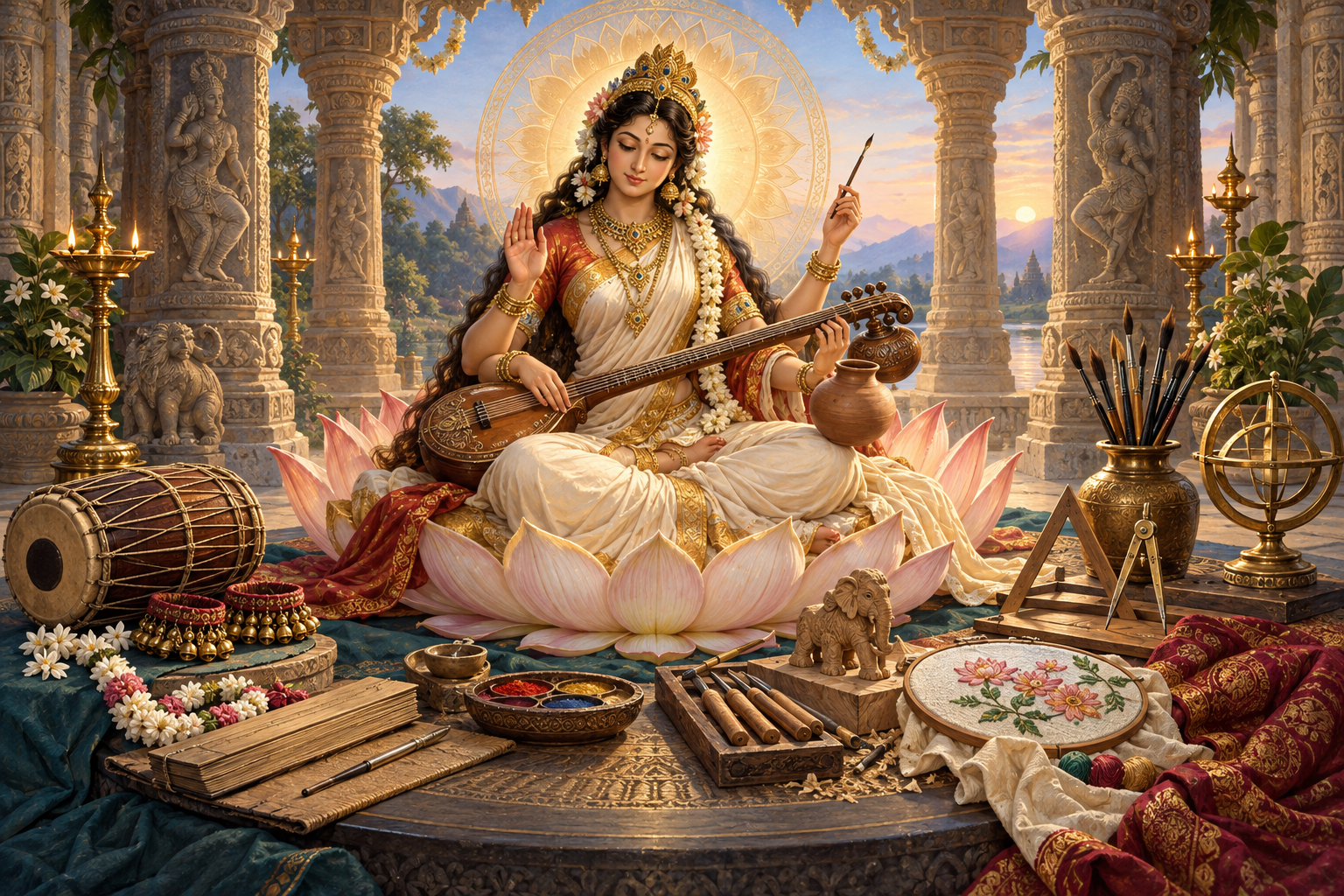
You may have encountered the name Shatshashti Kala Devi in a discussion of Hindu iconography and wondered what to do with it. Is she simply a patroness of artists? Does the number in her name point to a fixed syllabus? Can a musician, dancer, writer, artisan, or student meaningfully approach her?
The most useful answer begins with a distinction: sacred art is not merely art with a religious subject. It is cultivated ability placed under discipline, dharma, and devotion. Shatshashti Kala Devi gives that principle a divine form.
Begin with what the name tells you
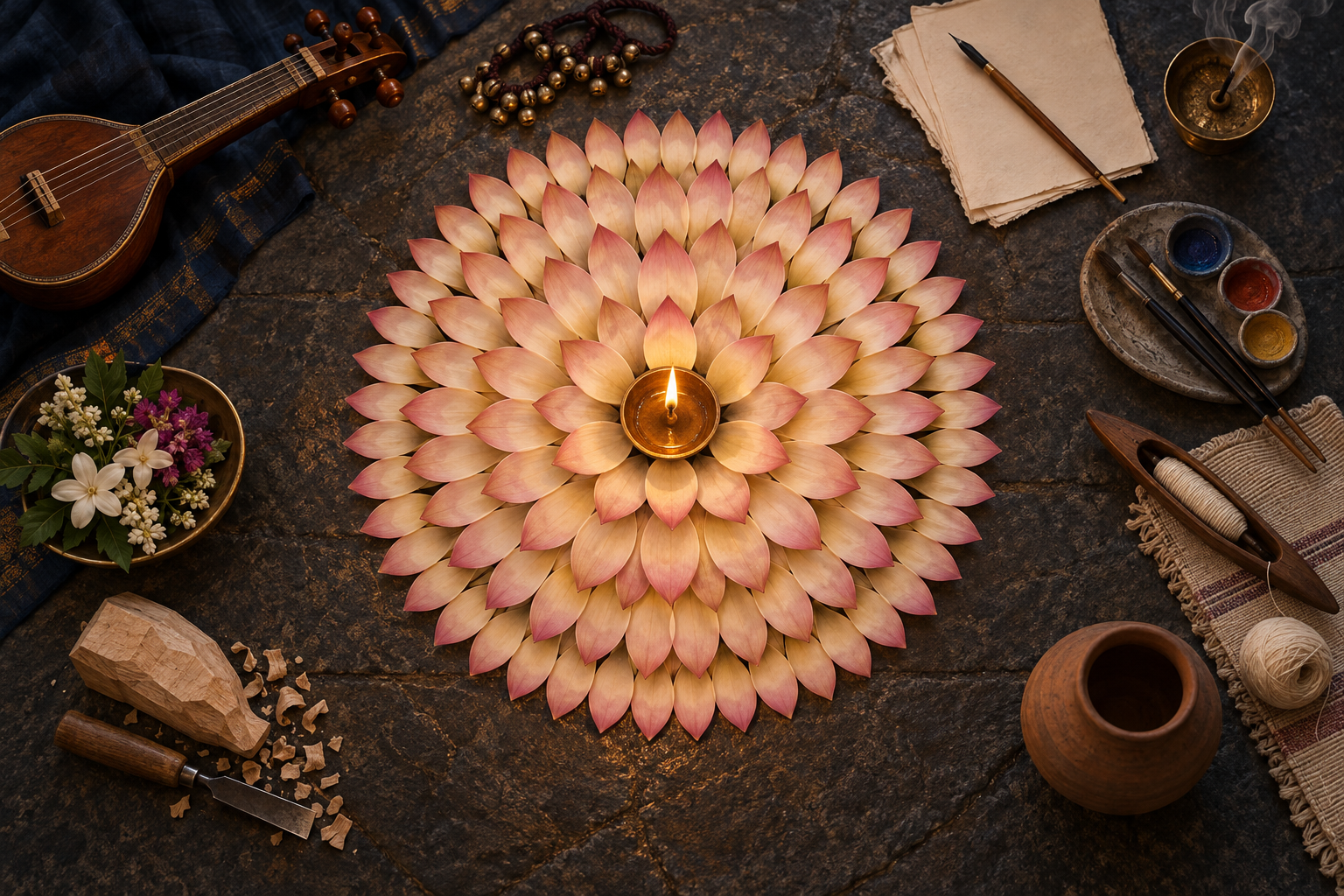
Shatshashti Kala Devi, also rendered Satsasti Kala Devi or Shatasashti Kala Devi, is a rare Hindu goddess identified with the embodiment of sixty-seven sacred arts and sciences. Her name therefore does more than identify a personality. It identifies a field of divine power: the many capacities through which human intelligence learns to shape sound, movement, language, material, knowledge, and conduct.
Do not reduce kala here to what a modern gallery calls art. The pairing of arts and sciences points toward trained capacities more broadly. A kala must be learned, refined, embodied, and applied. Knowledge that never reaches the hand, voice, body, memory, or judgement remains incomplete.
The goddess-form changes how you relate to those capacities. Skill is no longer just personal property or a way to display talent. It can be approached as shakti: a power received through aptitude, teaching, repetition, correction, and grace. That view encourages gratitude without weakening standards. If a capacity is sacred, careless use of it becomes less acceptable, not more.
Be precise when the numerical count matters. Do not silently replace the count attached to this form with a more familiar list of kalas, and do not infer Sanskrit etymology from an English transliteration alone. For ritual, historical, or academic use, record the name in its original script, identify the temple, text, teacher, or lineage using it, and ask whether its count is literal, classificatory, or symbolic. Until that evidence is available, it is better to preserve the received name and acknowledge uncertainty than to manufacture a definitive catalogue.
Read an unfamiliar image without inventing its meaning
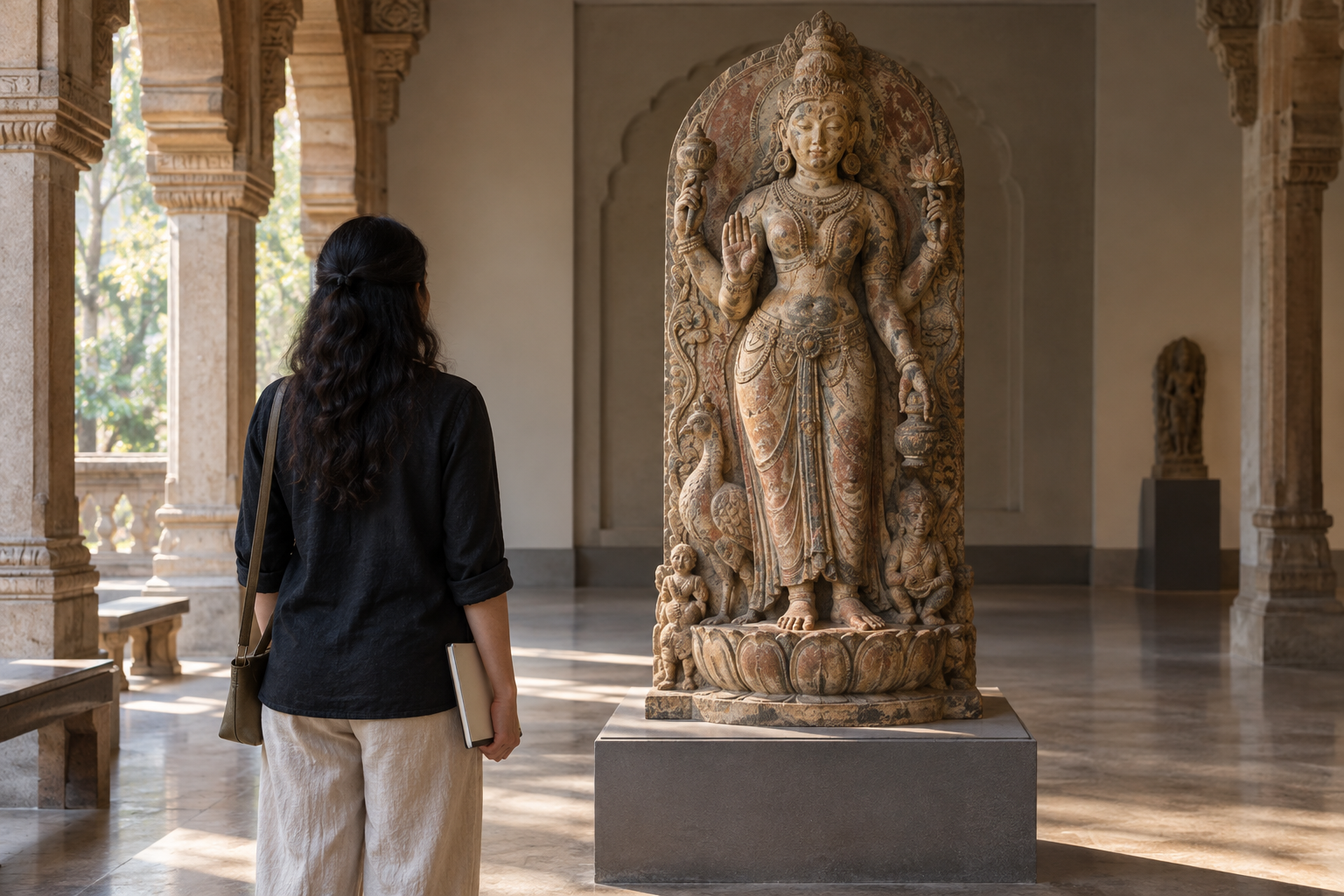
A rare deity presents a special problem: an attractive image can circulate much faster than the information needed to identify it. A caption may be copied from another page, a modern illustration may combine features freely, and a damaged sculpture may invite confident but unsupported guesses.
When you examine an image attributed to Shatshashti Kala Devi, keep observation separate from interpretation. Use this simple iconographic record:
- Establish provenance. Record where the image came from, whether it depicts a temple murti, manuscript painting, printed calendar, or recent digital artwork, and whether its identification comes from the custodial tradition or from a later caption.
- Describe before naming. Note posture, hands, visible objects, gestures, ornaments, seat, surrounding figures, and inscriptions. If an object is cropped, worn, or unclear, mark it as uncertain rather than completing it from expectation.
- Seek identification within the relevant tradition. An attribute can carry different meanings in different contexts. A temple inscription, ritual manual, lineage explanation, or informed local account has more evidentiary value than visual resemblance alone.
- Separate iconography from symbolism. Iconography asks what is actually represented. Symbolism asks what that feature may mean. The second question should not outrun the first.
- Label your confidence. Distinguish what is visible, what is traditionally identified, and what is your own philosophical reading. This protects both devotion and scholarship from false certainty.
This method is not sterile caution. Careful seeing is itself a discipline of kala. It trains attention, checks projection, and allows a sacred image to instruct you rather than merely confirm what you already expected to find.
What makes an art sacred
Calling the kalas divine does not mean that every display of technical ability is automatically dharmic. Skill can clarify or deceive, heal a community’s memory or manipulate it, preserve beauty or turn beauty into vanity. Technical excellence increases the reach of an intention; it does not purify that intention by itself.
A useful philosophical reading of Shatshashti Kala Devi therefore joins mastery with moral orientation. Test your own practice with questions that are concrete enough to expose self-deception:
- What faculty am I actually training? Replace vague aims such as becoming creative with an observable capacity: steadier rhythm, more accurate proportion, clearer reasoning, more truthful language, or more intelligible abhinaya.
- What standard governs the work? Devotion cannot substitute for learning the grammar, technique, material, or method of a discipline. Identify how an error will be recognized and corrected.
- What does the work serve? Ask whether it strengthens understanding, memory, beauty, livelihood, worship, education, or another defensible human good. Fame and applause may occur, but they are not sufficient purposes.
- What ethical boundary must skill obey? Refuse plagiarism, false attribution, deliberate distortion, exploitative representation, and claims of authority you have not earned.
- Can the result be offered? An offering need not be commercially worthless or anonymous. It means the work is not imprisoned within self-display: its benefit is consciously directed beyond the maker’s ego.
This is where the union of arts and sciences becomes important. Both require disciplined perception. Both depend on transmission and correction. Both can be used well or badly. The goddess gathers them into a larger vision of culture in which intelligence, craft, ethical responsibility, and spiritual orientation are not separate compartments.
Technique without dharma can make a harmful purpose more efficient. Piety without technique can turn avoidable carelessness into a supposed virtue. Sacred practice asks you to reject both errors.
Turn your chosen kala into a daily offering

You do not need an invented esoteric ritual to apply this teaching. If you have received a lineage-specific practice, follow its instructions. If you have not, do not assign the Devi a mantra, bija, yantra, initiation, or ritual sequence merely because her form is associated with specialized iconographic and Tantric study.
A respectful non-initiatory practice can begin with abhyasa, sustained and corrective repetition:
- Name the kala precisely. Choose a discipline you genuinely practise rather than collecting an impressive list. It might be singing, drawing, dance, poetry, textile work, architecture, teaching, calculation, research, or another cultivated capacity.
- State a dharmic intention. Before beginning, say plainly what the work should serve. A personal sentence asking for clarity, discipline, truthful expression, and beneficial use is an intention, not a claim to possess a traditional mantra.
- Select the fault to correct. A musician might attend to pitch or rhythm; a painter to proportion or line; a performer to timing or abhinaya; a writer to accuracy or needless ornament; a researcher to definitions, evidence, or reasoning.
- Practise against a real standard. Use the grammar of the form, feedback from a competent teacher, comparison with a reliable model, or another method that can reveal error. Repetition without correction merely rehearses the mistake.
- Notice the character being trained. Observe whether the session demanded patience, humility, courage, restraint, memory, coordination, or close attention. The inner discipline is not separate from the technical work.
- Close by dedicating the benefit. Name who should be served by the work and what responsibility accompanies sharing it. This keeps offering connected to consequence rather than sentiment.
Keep a brief practice record. Write down the technical defect you found, the correction you attempted, and the quality of mind the correction required. Over time, this prevents devotional language from becoming vague. You will be able to see whether reverence is producing greater care.
Seek a teacher when the discipline has a living pedagogy. Sacredness does not eliminate apprenticeship. It deepens your obligation to receive a form accurately, acknowledge its transmitters, and avoid presenting borrowed knowledge as self-created mastery.
Key takeaways
- Shatshashti Kala Devi personifies a complete field of sacred arts and sciences, not merely decorative creativity.
- Treat the spelling and numerical count carefully; preserve the form used by the relevant text, temple, teacher, or lineage.
- When reading an unfamiliar image, separate visible features, traditional identification, and personal interpretation.
- An art becomes a spiritual discipline through truthful technique, ethical purpose, corrective practice, and offering.
- Do not invent Tantric credentials or rites. Use received practice where you have it and honest devotional intention where you do not.
At your next practice session, place the discipline before the Devi in a concrete way: name the defect you will correct, the standard you will meet, and the person or community the finished work should benefit. Correcting that defect with full attention will teach you more about sacred art than collecting lists without practising any of them.
References

Leave a Reply
You must be logged in to post a comment.