
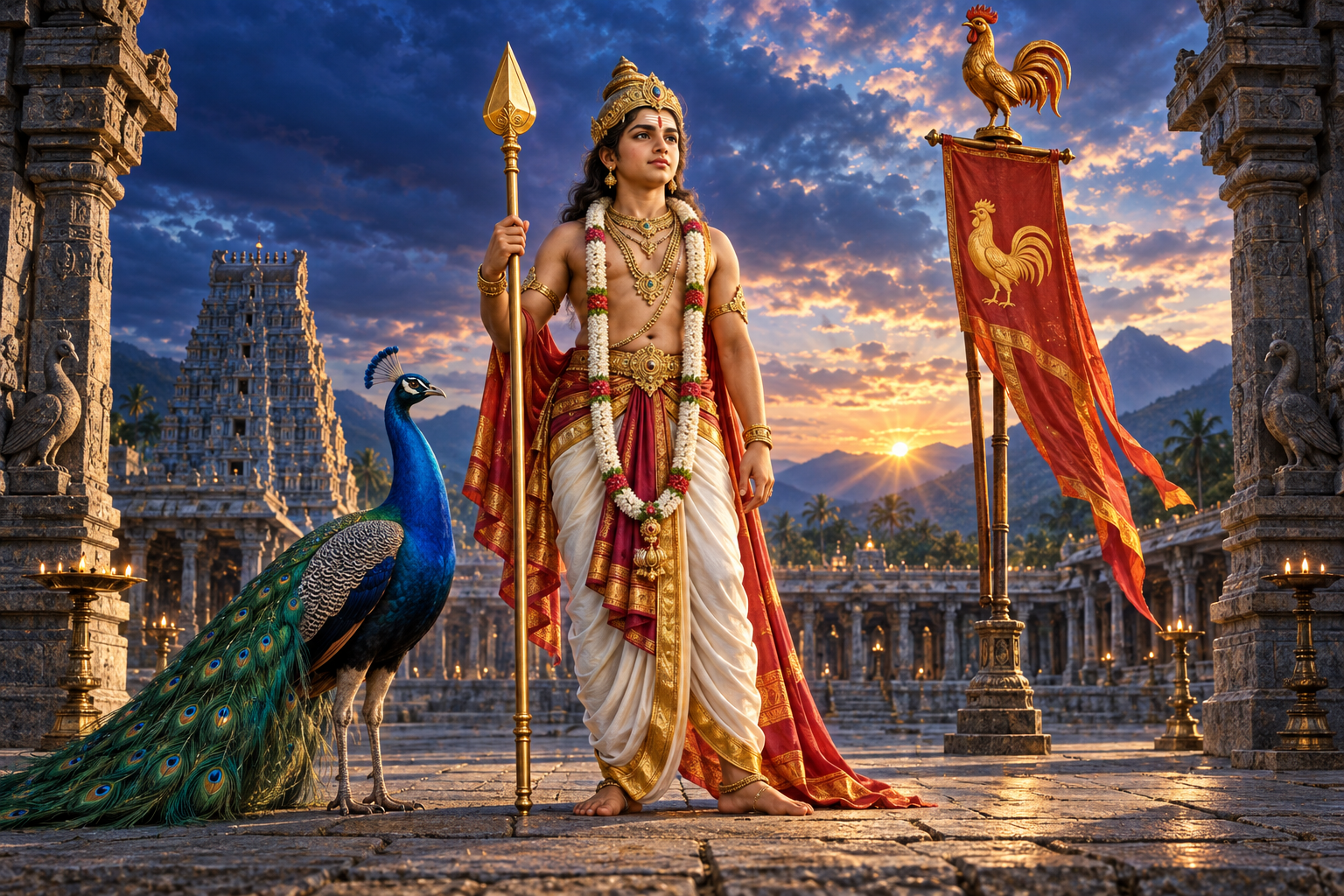
You notice a rooster on a Murugan image or temple flag and wonder what it is doing beside a warrior deity. It is not decorative livestock, and it is not an interchangeable symbol of generic courage. The rooster identifies Murugan as the bearer of a particular victory: one in which hostile power is defeated, transformed and placed in the service of dharma.
Once you recognise that relationship, the emblem becomes easier to read. Its crow at daybreak adds a second layer: wakefulness after darkness, readiness before action and the refusal to remain inwardly asleep.
The rooster belongs to Murugan’s banner
Murugan is known as Kukkuta-dhvaja, meaning the one whose banner bears the rooster. Kukkuta denotes the rooster, while dhvaja is a banner or standard. That wording tells you where to begin: the bird is an emblem displayed under Murugan’s authority.
This placement matters. A banner announces identity, allegiance and the power under which an army advances. The rooster therefore does more than accompany Murugan. It publicly proclaims something about his command. When you encounter it in an image, first look for a flag, standard or emblematic position rather than assuming that every animal near a deity must be a vehicle.
The title also prevents a common interpretive mistake. The rooster is not merely attached to Murugan because people admired its aggression. Its meaning is anchored in Murugan’s sacred narrative and in the precise role it occupies within his iconography.
Surapadman’s defeat explains why the emblem is there
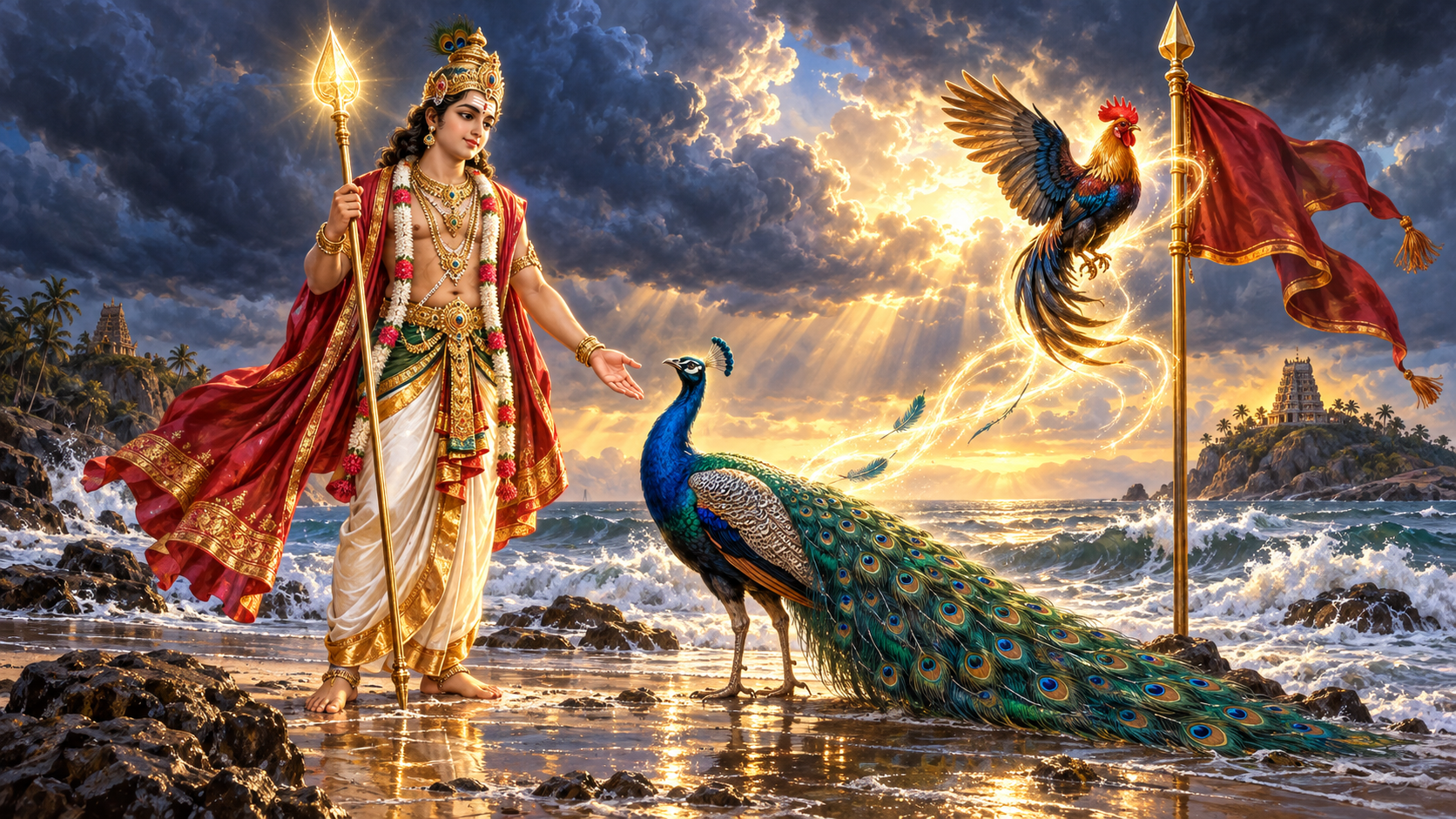
The Kanda Puranam connects the rooster to Murugan’s battle with the asura Surapadman. After Murugan overcomes him, the defeated power is incorporated into Murugan’s iconography: the peacock becomes associated with his mount, while the rooster appears upon his banner. This narrative relationship is the essential context for understanding the rooster.
The victory is complete, but it is not represented only as erasure. What opposed dharma no longer acts independently; it is brought under divine command. A devotional reading can therefore see the rooster as transformed energy. Pride, aggression and restless force are not allowed to govern, yet their energy need not remain useless once disciplined.
That distinction is practical. Spiritual discipline is sometimes misunderstood as becoming passive or weak. Murugan’s banner points in another direction. The problem is not strength itself. The problem is strength ruled by ego, disorder or hostility. Under dharmic command, intensity becomes vigilance, courage and purposeful action.
When you see the rooster, then, do not stop at “Murugan defeated a demon.” Notice the changed relationship. The former adversarial force now stands beneath Murugan’s authority and announces his triumph. The emblem asks a sharper personal question: which force within you needs direction rather than indulgence?
The dawn call turns victory into an inner discipline
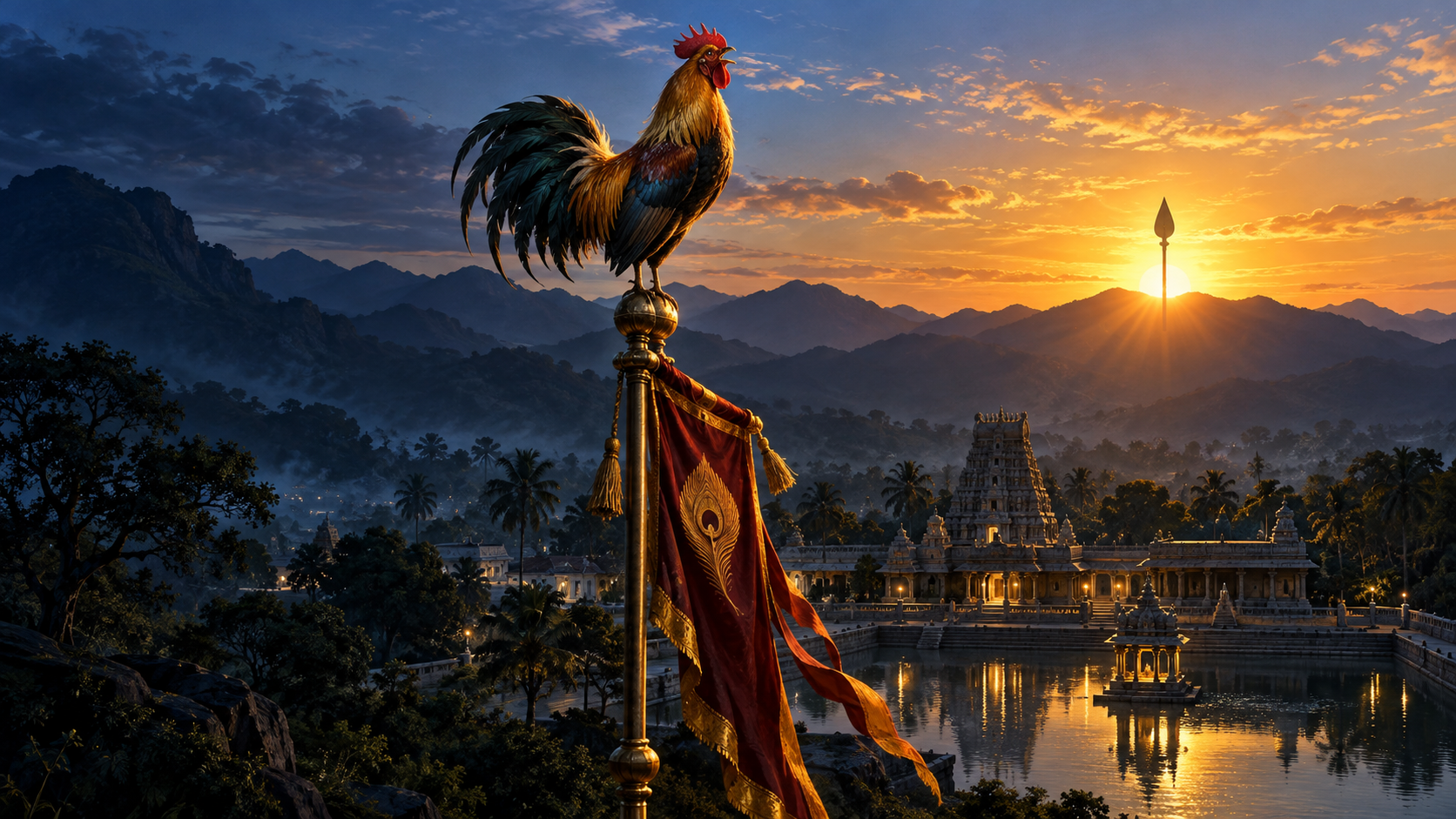
A rooster announces the approach of morning. Its call belongs to the threshold between night and day, when darkness is receding but the day’s work has not yet begun. That natural behaviour gives the Murugan emblem an intelligible symbolic vocabulary: awakening, alertness and timely action.
Awakening here should not be reduced to getting out of bed early. The more demanding question is whether you recognise confusion before it controls your conduct. Murugan’s warrior character makes this alertness active. You notice what is arising, distinguish dharma from impulse and act before negligence hardens into habit.
The rooster can also warn against a distorted kind of wakefulness. Its assertive presence can suggest pride or combativeness when separated from Murugan’s authority. The complete image corrects that distortion: alertness must serve dharma, not self-display. Readiness without self-command merely gives the ego more energy.
You can use the emblem as a compact discipline at the beginning of the day. Ask three questions: What am I failing to notice? Which impulse is trying to command me? What is the next dharmic action that should not be postponed? This is not a claim that tradition mandates a new rooster ritual. It is a way of allowing established iconography to sharpen your attention rather than leaving it as visual ornament.
How to read the rooster in a temple or sacred image
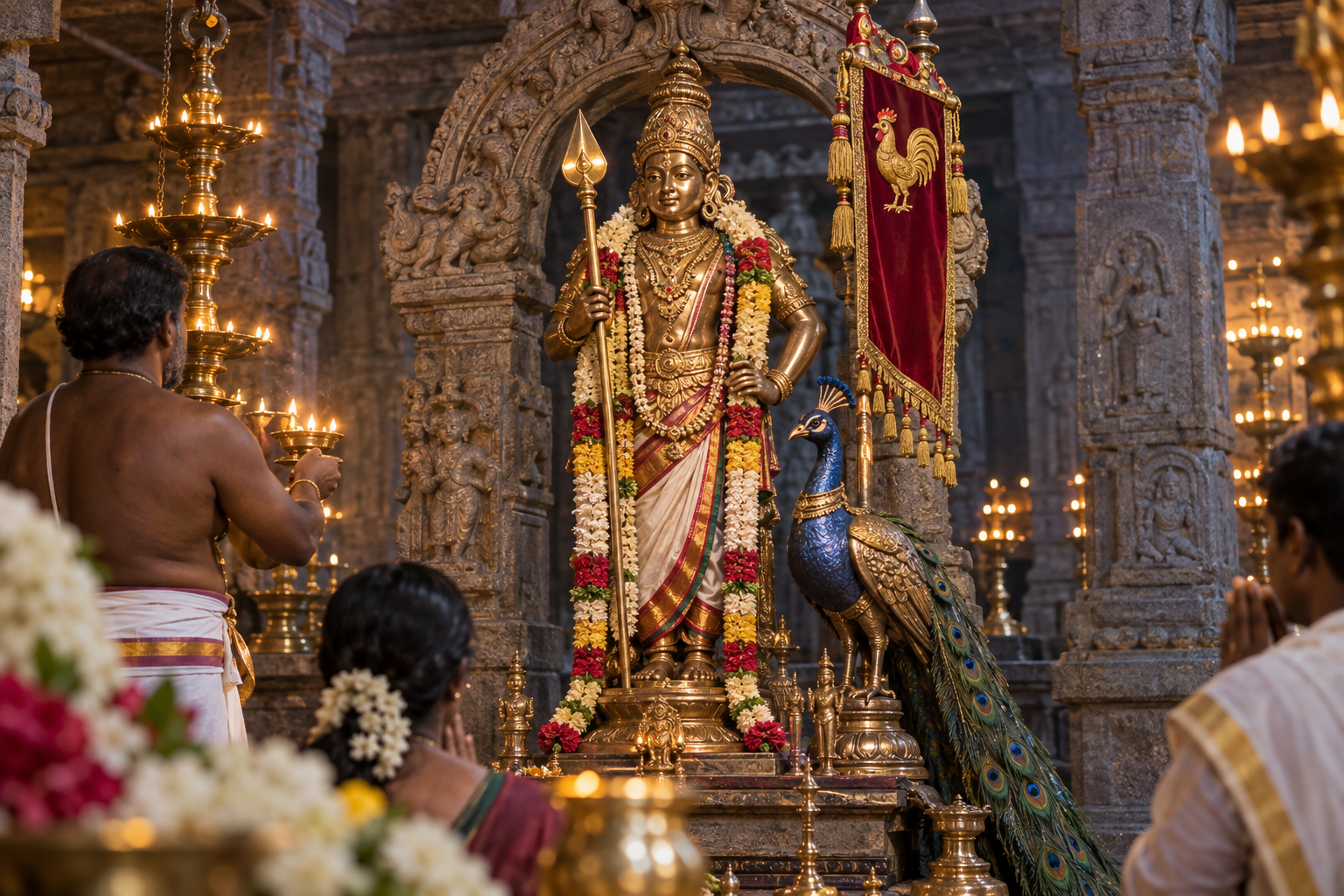
Murugan iconography carries relationships, not isolated symbols. If you encounter a rooster at a shrine, in a procession or in devotional art, use the following sequence before assigning it a meaning:
- Identify its position. Look for the rooster on a banner or standard. Placement establishes its role as Murugan’s emblem.
- Connect it to the Surapadman narrative. The bird signifies conquered power brought under divine rule, not an unrelated animal omen.
- Notice the dawn association. The rooster’s call makes wakefulness and readiness natural symbolic readings.
- Read the qualities under Murugan’s command. Courage and intensity become dharmic only when governed by discernment and discipline.
- Keep interpretation proportional. The emblem can support contemplation, but it should not be turned into a prediction about luck, fate or future events without a separate traditional basis.
This method is useful beyond one image. Hindu iconography often communicates through posture, placement and relationship. Asking “Where is the symbol, and what is it doing?” usually gives you a more reliable starting point than assigning a free-floating meaning to the object itself.
Key takeaways
- Murugan is Kukkuta-dhvaja, the deity whose banner bears the rooster.
- The Kanda Puranam places the emblem within Murugan’s victory over Surapadman.
- The defeated force is represented as subordinated and redirected under divine authority.
- The rooster’s dawn call supports the themes of awakening, vigilance and action at the proper time.
- The symbol does not glorify uncontrolled aggression; its force is meaningful because Murugan commands it.
- When viewing sacred art, interpret the rooster through its placement and narrative context before adding broader associations.
The next time you stand before Murugan and notice the rooster, let it interrupt passivity. Name one strong impulse that has been acting without discipline, place it beneath a dharmic purpose and take one clear action before delay becomes another form of sleep. That is how an emblem on a divine banner becomes a living instruction.
References

Leave a Reply
You must be logged in to post a comment.