

If you are a parent, teacher, or Class 9 student wondering whether NCERT’s new emphasis is a serious recovery of Indian history or simply a change of political vocabulary, start with a better question: what will a student be able to explain after completing the lesson?
Terms such as Ramrajya, Rajdharma, and Sengol belong in an Indian account of political thought. Medieval resistance also deserves more than a passing reference. But inclusion alone does not guarantee understanding. You need to examine how each concept is defined, what evidence supports the account, and whether the exercises teach inquiry or merely reward agreement.
What the Class 9 curriculum shift actually changes
NCERT’s Class 9 Social Science revision brings Ramrajya, Rajdharma, and the Chola Sengol into the study of indigenous governance while revising earlier European-history material to give medieval Indian resistance to foreign invasions greater prominence. These are two related but distinct changes.
The first change expands the vocabulary through which students encounter government. Instead of approaching political ideas only through categories inherited from modern Europe, students meet concepts that emerged within Bharatiya civilization. That is a welcome correction in direction. Indian political thought should be studied as political thought, not confined to mythology, ritual, or cultural background.
The second change alters the narrative balance of medieval history. More attention to resistance can restore the agency of Indian rulers and communities who are otherwise liable to appear only as recipients of conquest. Yet resistance must be explained, not merely celebrated. Students need to know who acted, what they opposed, what objectives they pursued, and what followed.
What we can establish from the curriculum shift is its direction. The exact balance of pages, evidence, captions, and assessment questions still has to be checked in the textbook itself. That distinction matters: a promising heading can introduce a rigorous lesson, a shallow slogan, or something in between.
Teach Ramrajya, Rajdharma, and Sengol as different kinds of ideas
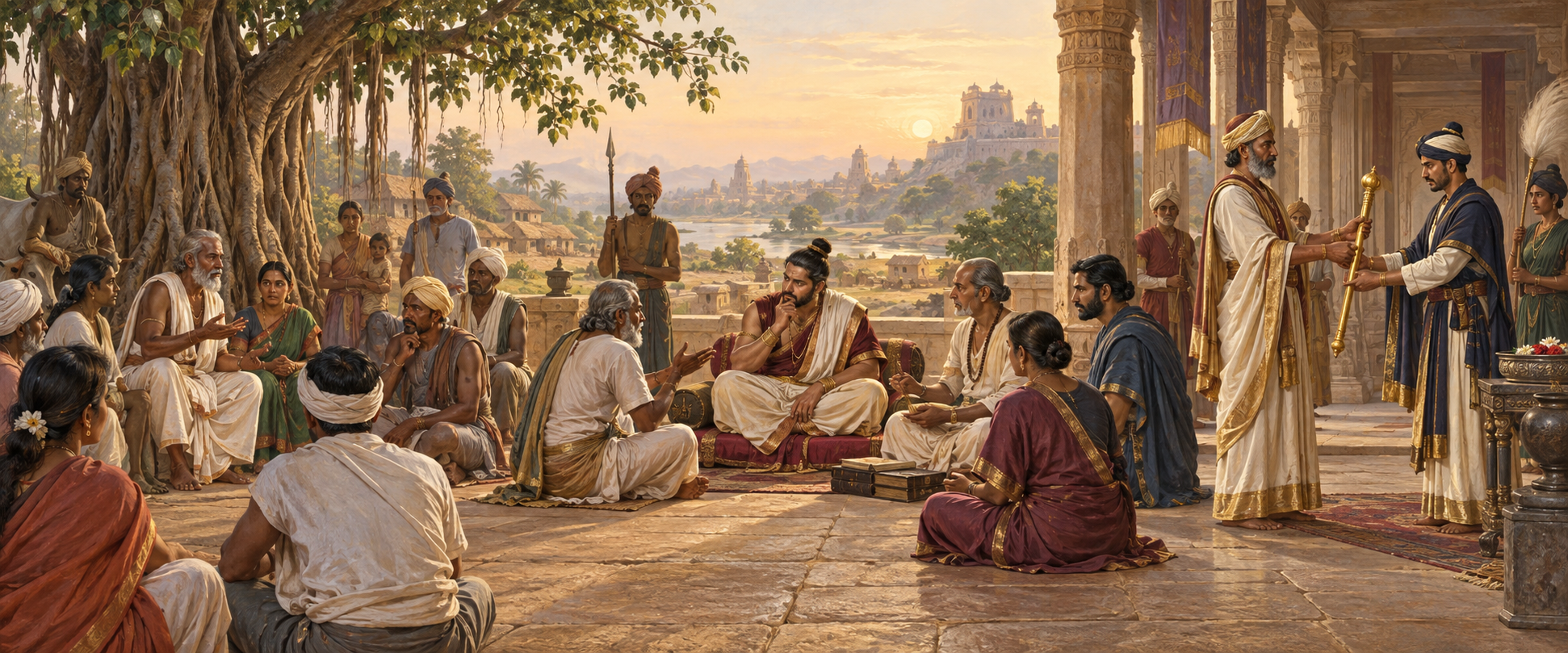
The three terms should not be placed in one undifferentiated basket called ancient Indian governance. They perform different intellectual jobs. A student who can repeat all three names but cannot distinguish an ethical ideal from a ruler’s duty or a symbol of authority has learned vocabulary without learning political thought.
Ramrajya is best approached as a normative ideal: an account of what righteous rule ought to look like. The central classroom question is therefore not, “Was this identical to a modern state?” It is, “By what moral standard is political power being judged?” This lets students examine the ideal without pretending that an ethical image is a complete administrative manual.
Rajdharma shifts attention from the state of society to the obligations attached to rule. It opens questions about restraint, responsibility, justice, and the relationship between authority and duty. The useful contrast for a student is between possessing power and being morally entitled to exercise it. Rajdharma becomes politically meaningful when it is studied as a discipline imposed on authority, not as a demand for passive obedience from the governed.
The Chola Sengol belongs to the material and symbolic language of rule. A political symbol can show how authority was represented and understood. It cannot, by itself, prove every broader claim made about an entire system of government. Students should learn to distinguish what an object is, what it signifies, and what historical conclusions can reasonably be drawn from it.
A teacher or parent can test whether these distinctions have landed by asking the student to complete four sentences:
- Ramrajya supplies a standard for judging rule because…
- Rajdharma limits or directs a ruler by requiring…
- The Sengol represents political authority, but the symbol alone cannot tell us…
- A modern comparison may help explain these concepts, but it does not prove…
The final sentence is especially important. Comparison is a teaching device; continuity is a historical claim. If a lesson compares Rajdharma with contemporary public duty, that can clarify the idea. It does not automatically establish that an institution has remained unchanged across centuries.
Read medieval resistance as history, not just moral theatre
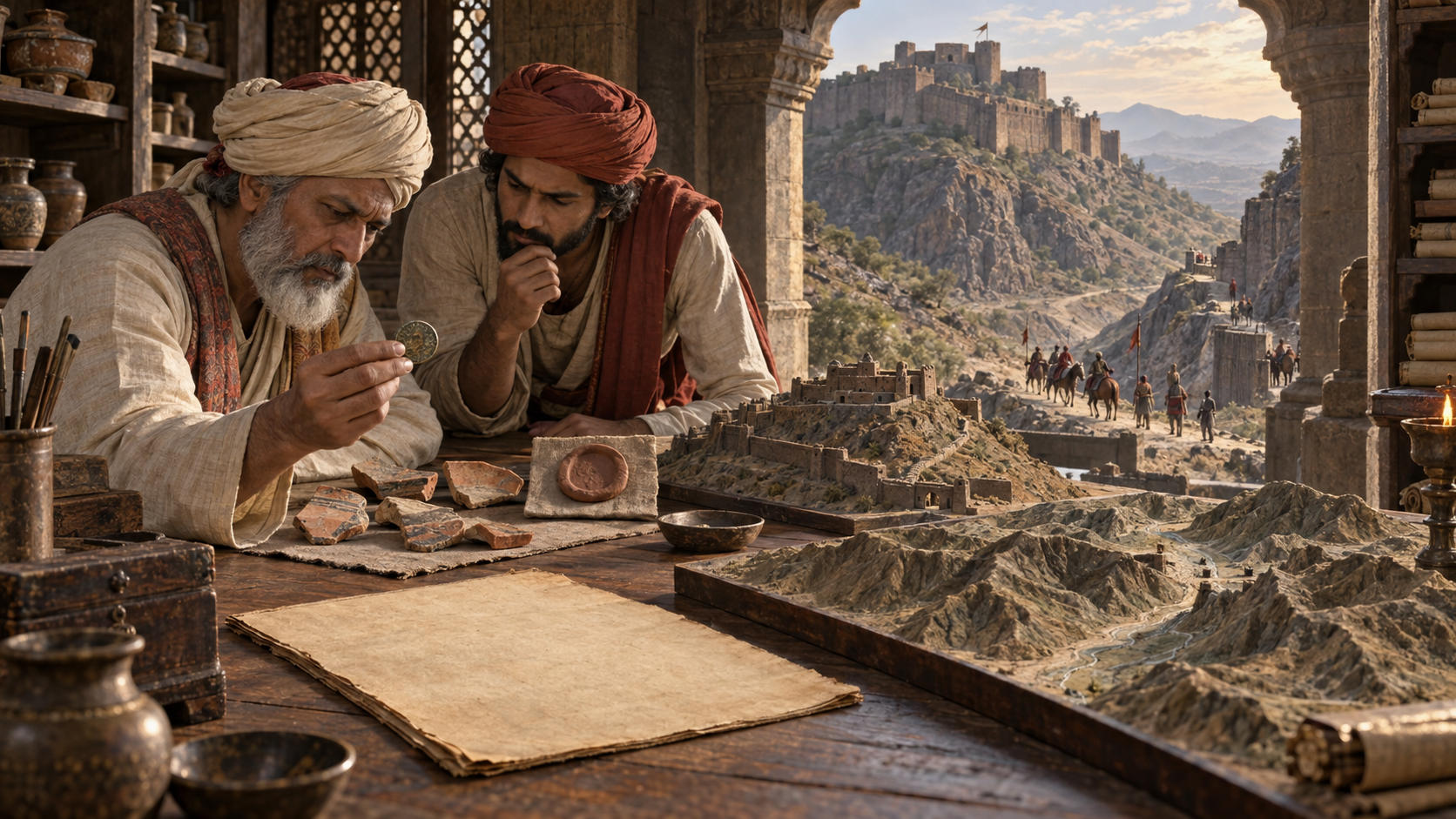
Giving resistance a larger place can correct a genuine narrative weakness: history told chiefly through the advance of invaders leaves Indian actors reacting at the edge of their own story. Restoring their decisions, strategies, losses, recoveries, and political aims returns agency to the account.
But the word “resistance” can become too easy. It can compress different conflicts into a single timeless struggle and replace analysis with a ready-made verdict. Historical seriousness requires students to unpack the word each time it appears.
- Who was resisting, and who or what was being resisted?
- Was the immediate objective territorial, political, economic, religious, dynastic, or some combination?
- What form did resistance take: battle, alliance, refusal, recovery, negotiation, or cultural preservation?
- What evidence supports the account?
- Did the action change political control, protect an institution, preserve a tradition, or fail in its immediate objective?
- Is a modern label being applied to people whose own political vocabulary may have been different?
The term “foreign” deserves the same care. It should identify the historical relationship being described rather than function as an all-purpose moral label. Students should be asked what made an invading power foreign in the context under study and whether that description changed across generations. This does not weaken the reality of invasion. It prevents a broad category from doing the work that evidence and chronology should do.
A Dharmic account of history does not need to choose between civilizational memory and disciplined method. Respect for those who defended land, institutions, and traditions is compatible with asking precise questions about motive, scale, evidence, and consequence. Indeed, honour becomes more durable when students understand what people actually did and what it cost them.
Replacing a Europe-heavy narrative with a string of heroic names would therefore be an incomplete correction. The goal should be a richer Indian-centred account: one in which Indian actors possess ideas, make choices, build institutions, confront invasions, disagree among themselves, and shape outcomes.
Use a page-by-page audit instead of arguing from headlines

You do not need to be a professional historian to evaluate the lesson. Work through the actual chapter with a pencil and use the following audit. It separates disagreements over political tone from questions that can be answered directly from the page.
- Map the allocation. Note how many headings, paragraphs, images, captions, and questions are devoted to indigenous governance, European history, invasion, and resistance. Space reveals emphasis more reliably than a chapter title does.
- Classify each major claim. Mark it as an ethical ideal, a historical event, an institutional description, an interpretation, or a statement about a symbol. Confusion often begins when one kind of claim is presented as another.
- Locate the evidence. Ask what supports each historical conclusion: textual material, an inscription, a physical object, a recorded event, or an interpretation. A picture can illustrate a claim without proving it.
- Apply the symmetry test. Check whether indigenous rulers, invaders, and European developments are judged by comparable standards. One side should not receive context and complexity while another receives only praise or condemnation.
- Inspect the verbs. Words such as “shows,” “represents,” “proves,” and “symbolises” make different claims. If “proves” appears where the material merely suggests or represents something, the wording is doing more work than the evidence.
- Read the exercises last. Recall questions reveal what students must memorise; analytical questions reveal what they are expected to understand. Look for prompts that ask students to distinguish ideal from institution, explain cause and consequence, or evaluate evidence.
Five warning signs deserve particular attention. Ramrajya should not be left as a self-evidently positive slogan. Rajdharma should not be reduced to obedience. The Sengol should not be made to carry conclusions larger than the evidence attached to it. Medieval resistance should not become a sequence of heroes and villains without context. European material should not be removed merely to create empty space; the Indian material replacing it should be deeper, not just closer to home.
If you teach the material, build one short exercise around claim types. Give students a paragraph and ask them to label each sentence as ideal, description, evidence, inference, or judgement. Then ask which sentence would need the strongest support. This single exercise trains historical reasoning while keeping the civilizational content at the centre.
If you are a parent, ask your child for an explanation rather than an opinion. “What is the difference between Ramrajya and Rajdharma?” is more revealing than “Did you like the chapter?” Follow it with, “What evidence did the lesson give you?” A student who can answer both has moved beyond memorisation.
If you are a student, keep two columns in your notes: “what the concept means” and “how we know.” Put definitions and values in the first column; put the evidence or reasoning used by the lesson in the second. When the second column remains blank, you have found the point that needs another question in class.
Key takeaways for judging the revision fairly
- Indigenous political vocabulary belongs in Indian social-science education, but naming a concept is not the same as teaching it.
- Ramrajya is an ideal of righteous rule, Rajdharma concerns duties attached to authority, and the Sengol functions as a political symbol; students should not treat them as interchangeable.
- More space for medieval resistance can restore Indian agency, provided the lesson identifies actors, motives, evidence, methods, and consequences.
- “Foreign” and “resistance” need historically specific explanations rather than automatic moral meanings.
- The most reliable test is the actual chapter: examine its allocation of space, claim types, evidence, wording, and assessment questions.
- A sound Bharatiya curriculum can affirm civilizational inheritance while holding every historical claim to a clear evidentiary standard.
The practical next step is simple: open the relevant Class 9 chapter and audit one section, not the whole curriculum at once. Mark each claim as ideal, fact, evidence, or interpretation. Then ask whether the student is being taught to distinguish them. That is where a genuine recovery of Bharatiya knowledge becomes education rather than rhetoric.
References

Leave a Reply
You must be logged in to post a comment.