

You may feel drawn to Kali’s fierce presence while remaining unsure which form to worship, whether a mantra requires initiation, or what a safe beginning actually looks like. Your first decision is not which secret syllable promises the fastest result. It is whether you are seeking devotional worship, serious study, or an initiated Tantric discipline.
That distinction protects both the integrity of the tradition and the practitioner. It lets you begin sincerely without pretending that every formula found online belongs to everyone.
Meet Kali as Devi before treating her as a technique
Within the Mahavidya framework, Kali comes first among the Dasa Mahavidyas and brings kala, or time, into view alongside destruction, transformation, and liberation. These ideas belong together. Time brings every constructed thing to an end; an ending makes transformation possible; liberation requires the release of what cannot be carried forward.
This does not reduce Kali to a metaphor for personal development. She is worshipped as the Divine Mother, not merely used as a psychological device. Yet her symbolism also confronts you personally. Before asking Kali to remove an obstacle, ask whether you are prepared to surrender the attachment, self-deception, or habit that keeps rebuilding it.
Fierceness is not permission for aggression. Destruction in spiritual practice must begin with falsehood, compulsive attachment, and conduct that violates dharma. If devotion makes you more reckless, cruel, or fascinated with domination, something has gone wrong in either the method or your interpretation of it.
Do not choose a Kali form by its image alone

Lists of Kali’s forms often create more certainty than they deserve. A name may be an epithet highlighting one quality, a particular iconographic presentation, a local temple manifestation, or the mantra-deity of a specific lineage. Those categories can overlap, but they are not automatically interchangeable.
Before adopting a form, investigate four things:
- Identity: Is the name being used as a devotional title, a distinct visualization, a temple name, or a lineage-specific form?
- Provenance: Which sampradaya, temple, teacher, or ritual tradition uses it? A form with no identifiable context may be a modern compilation.
- Method: Does its worship involve an ordinary public prayer, or does it include a transmitted mantra, visualization, ritual sequence, or restriction?
- Fit: Is the practice intended for household devotion, temple worship, contemplative practice, or an initiated discipline with continuing guidance?
Avoid constructing a hybrid practice from an image belonging to one tradition, a mantra taken from another, and ritual instructions copied from a third. The pieces may each be authentic in their own settings while becoming incoherent when assembled without guidance.
If you already have a family deity, guru-parampara, or trusted temple, begin there. Ask how Kali is understood and worshipped within that living context. If you do not have such a connection, you can still offer simple prayer and remember Kali by name while you learn. You do not need to claim a specialized form before you know what its practice entails.
Build a mantra practice that you can actually sustain
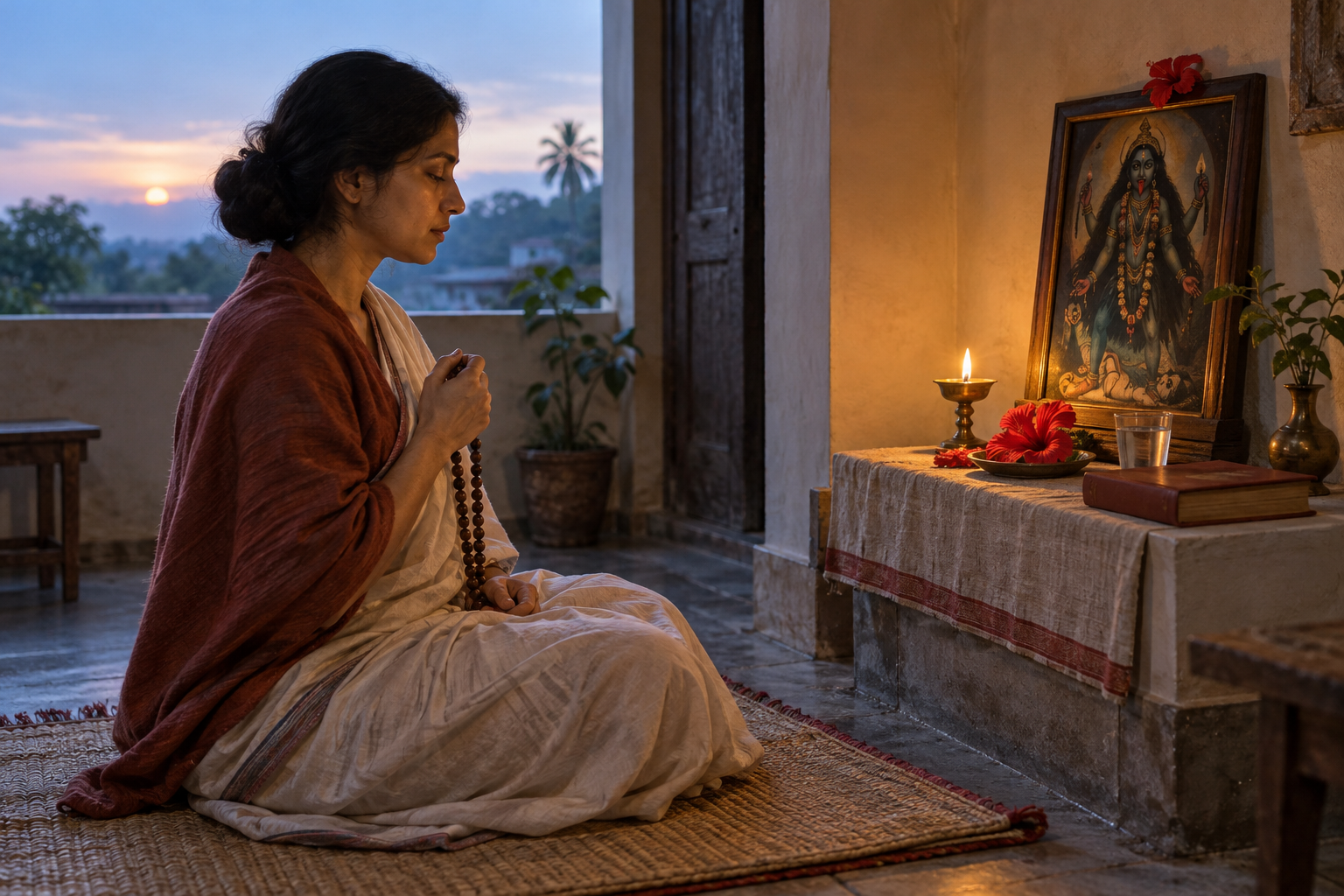
A mantra is not merely an affirmation with Sanskrit vocabulary. Its sound, deity, purpose, transmission, and method form a whole. Some devotional names and prayers circulate openly. Other formulas, especially those containing seed syllables or belonging to a particular ritual system, may be given through initiation. Do not assume that finding a formula publicly makes every use of it appropriate.
If you have received a mantra from an authorized teacher, follow that method instead of replacing it with generic advice. If you have not, use this conservative structure:
- State your intention plainly. Write one sentence explaining why you are approaching Kali. A workable intention concerns devotion, truthful self-examination, courage during change, or freedom from a harmful attachment. A wish to control another person is a reason to stop, not proceed.
- Classify the practice. Determine whether you are repeating Kali’s name in open devotion or using a formal mantra tied to initiation. If you cannot establish the status of a formula, do not add seed syllables, ritual gestures, or imagined pronunciations.
- Confirm the complete method. For a transmitted mantra, ask about pronunciation, repetition, timing, posture, offerings, restrictions, and the proper way to close. A mantra detached from its instructions is not the complete practice.
- Choose a stable container. Use a clean place and a regular time. Select either the repetition count given by your tradition or a modest fixed duration. Keep the basic conditions unchanged long enough to develop continuity instead of redesigning the practice whenever novelty fades.
- Keep the body unforced. Sit in an alert but sustainable posture and breathe naturally. Do not combine the mantra with breath retention, sleep deprivation, prolonged fasting, or another intense technique unless a qualified teacher has explicitly instructed and supervised it.
- Repeat with attention. Hear or mentally register the mantra rather than racing through it. When attention wanders, return without turning frustration into another object of worship.
- Close deliberately. Sit briefly in silence, offer gratitude, and connect the practice to one dharmic action in ordinary life. Record whether you completed the practice, how steady your attention was, and whether any after-effects disrupted sleep, mood, or daily responsibilities.
A trustworthy teacher should be able to explain the lineage of the method, whether initiation is required, and what obligations follow. Guarantees of instant supernatural power, pressure to conceal abuse, demands that you abandon medical care, or attempts to isolate you from ordinary support are not signs of spiritual authority.
Understand mantra siddhi without chasing phenomena

Mantra siddhi can be translated broadly as accomplishment or perfection in relation to a mantra, but traditions do not all define its requirements or signs in the same way. It should not be reduced to completing an arbitrary challenge, nor should it be self-certified because you had a vivid dream, felt a bodily sensation, or experienced an unusual coincidence.
For a beginner, the more reliable questions are practical. Is your repetition becoming steadier? Are you less evasive when facing change and loss? Is your speech more disciplined? Does devotion deepen alongside responsibility, or are you becoming preoccupied with proving that you possess power? These are not a universal certificate of siddhi, but they are better safeguards than excitement.
Do not increase intensity merely because nothing dramatic happened. More repetitions, harsher austerity, and less sleep can magnify agitation without deepening discernment. Fire rites, intoxicants, extreme fasting, isolated ritual settings, and other high-risk observances should never be improvised from fragments of online instruction.
If practice is followed by persistent panic, sleeplessness, paranoia, grandiosity, compulsion, or impaired functioning, pause the intensive practice and speak with a licensed health professional as well as a responsible spiritual mentor. Do not reinterpret a health crisis as proof of spiritual attainment. Mantra practice is not a substitute for medical or psychological care.
Key takeaways
- Kali’s relationship with time, endings, transformation, and liberation gives her fierceness a spiritual purpose; it does not authorize violence or domination.
- A form should be identified by its tradition, ritual context, and intended practitioner, not selected from an image or name alone.
- Open remembrance of Kali’s name is different from undertaking a lineage-specific mantra whose complete method may require initiation.
- Consistency, accurate transmission, and dharmic conduct matter more than novelty, escalating intensity, or extraordinary experiences.
- Mantra siddhi is not something a beginner can safely declare on the strength of dreams, sensations, coincidences, or promised shortcuts.
Your next step is simple: write down the name of the Kali form you are considering, the tradition that preserves it, the status of its mantra, and who can answer questions about the method. If any answer is missing, remain with respectful prayer and remembrance of Kali’s name while you investigate. A careful beginning is already part of the sadhana.
References

Leave a Reply
You must be logged in to post a comment.