
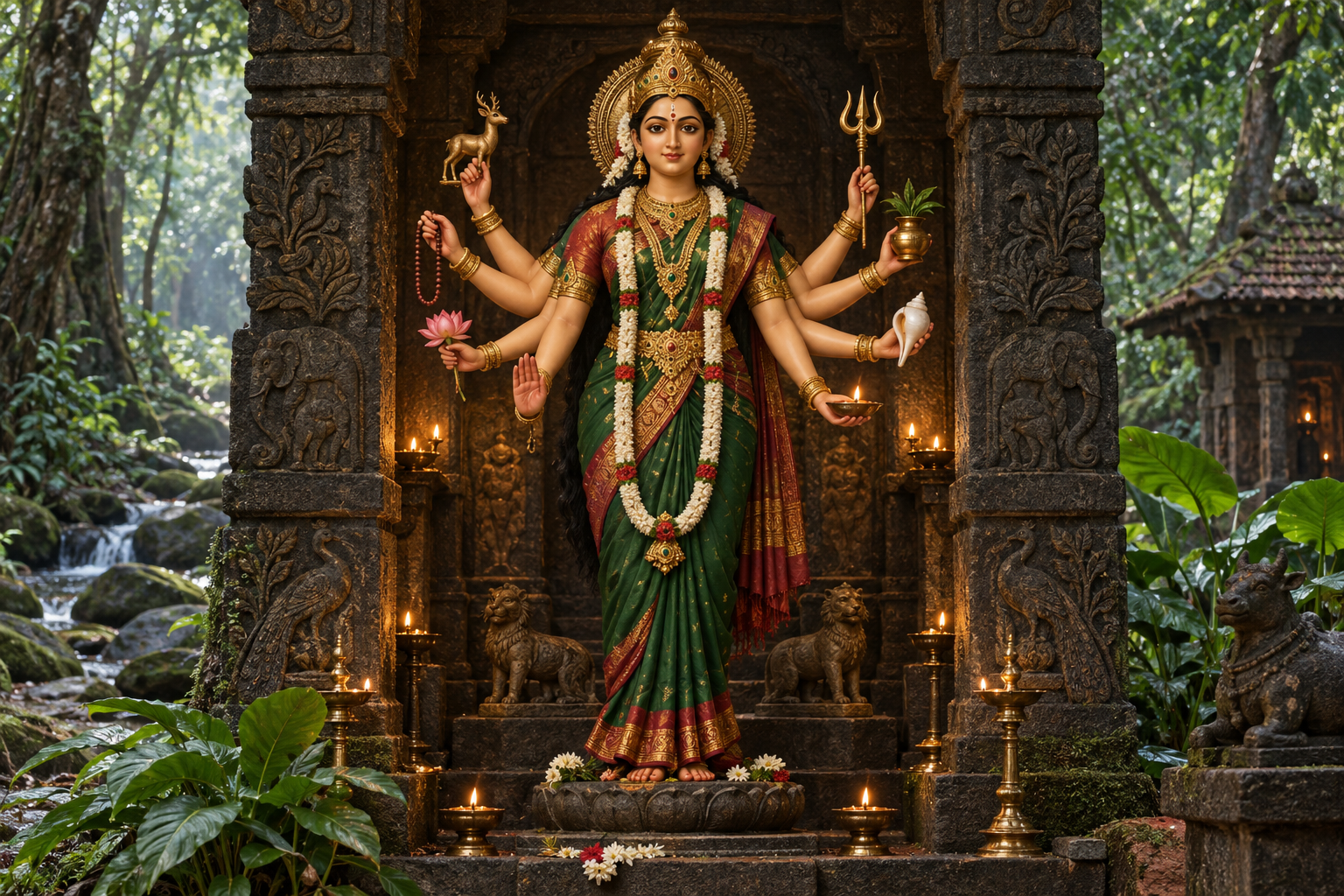
You may be looking at a temple image, photograph, sculpture, or printed devotional picture and wondering whether the name Vana Shankari is justified. Do not identify her from one familiar-looking weapon or ornament. Begin with a cluster of clues: the name, the number of arms, the regional setting, and any local identification attached to the image.
The firm starting points are limited but meaningful. Vana Shankari, popularly called Banashankari, is an eight-armed regional form of the Mother Goddess Shakti rooted in Karnataka. Her name joins the forest with Shankari, the feminine name connected to Shankara, or Shiva. Those facts give you a sound framework without requiring you to invent a weapon, vehicle, colour, or legend that has not been verified.
Let the name establish the iconographic boundaries
Vana means forest. Shankari identifies the Goddess in relation to Shankara, another name for Shiva. Read together, the name presents a forest-associated Goddess who belongs within the Shakta and Shaiva sacred world.
This gives you three distinct layers of identification:
- Her divine identity is that of the Mother Goddess Shakti.
- Her defining environment is the forest, carried in the word Vana.
- Her regional rootedness is in Karnataka, where Banashankari is the popular form of the name.
Keep these layers separate when you examine an image. Shakti tells you the broad theological family. Shankari expresses a relationship with Shiva. Vana supplies the distinctive environmental identity. Karnataka supplies the regional context. No single layer should be made to carry the entire identification.
The forest element also need not appear as a literal background of trees in every representation. Sacred names can preserve associations that a compact temple image does not illustrate as scenery. A missing forest backdrop is therefore not enough to reject the identification. Conversely, leaves or trees by themselves cannot prove that an otherwise unidentified Goddess is Vana Shankari.
Count the eight arms before interpreting what they hold
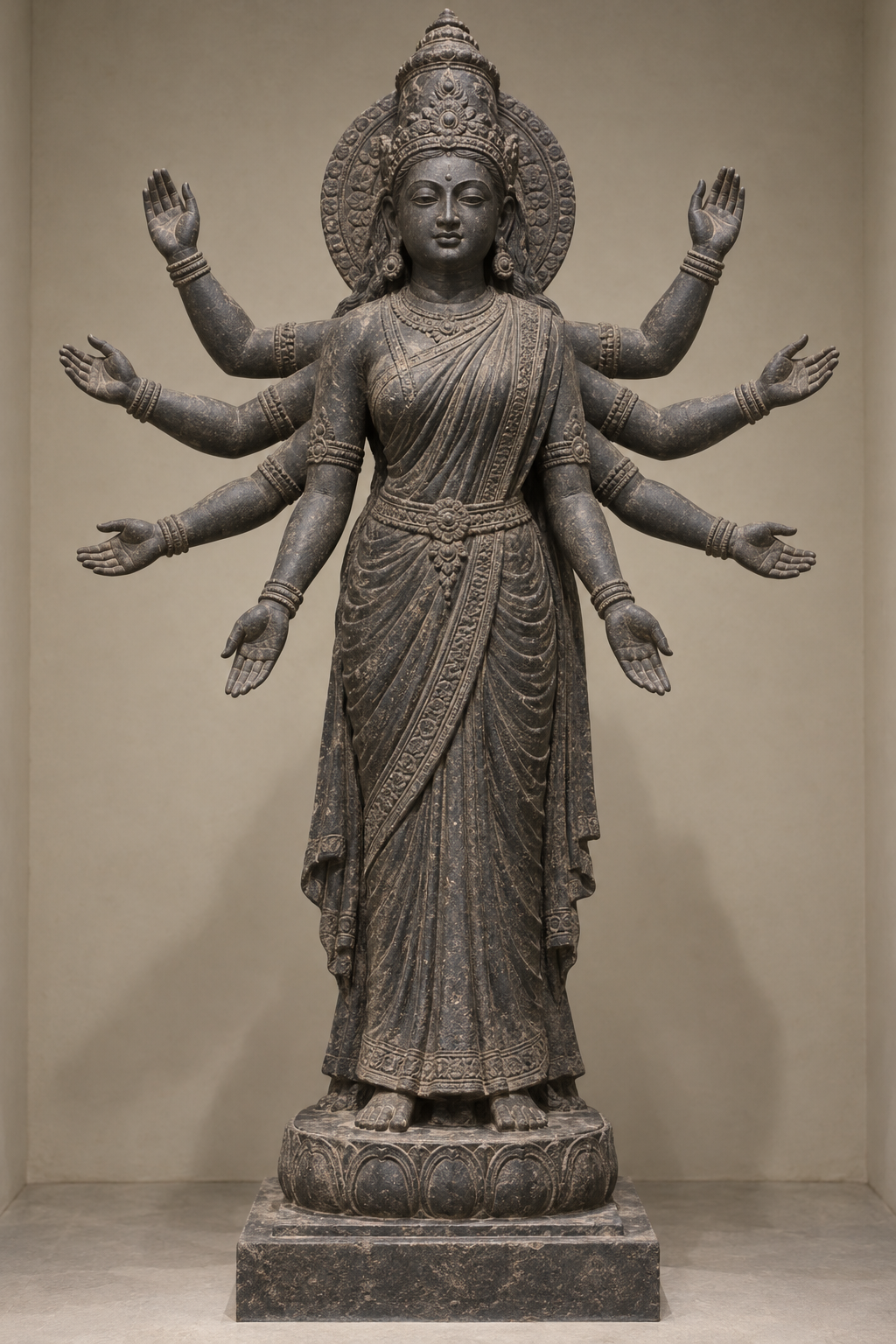
The eight arms are the clearest visual clue available to you. Multiple arms in Hindu sacred art allow several divine attributes and gestures to be shown at once. They express a capacity beyond an ordinary human body, but the number alone is not a unique name tag. Other divine forms can also have eight arms.
Count carefully, especially when the image is old, crowded, garlanded, partly covered, photographed from an angle, or damaged. Use this sequence:
- Begin at one shoulder and follow each arm outward rather than counting visible hands at random.
- Move around the figure in one direction so that crossed arms are not counted twice.
- Record whether each hand holds an object, forms a gesture, or is obscured.
- Mark a doubtful object as uncertain instead of supplying the name of the object from memory.
- If photography is permitted, take one full view and closer views of the hands for later comparison.
An eight-arm count supports the identification; it does not complete it. The stronger case combines eight arms with the name Vana Shankari or Banashankari and a Karnataka setting or provenance.
Resist the urge to reconstruct damaged attributes from another familiar Goddess image. Shared features are common within Hindu iconography, but similarity does not make two forms interchangeable. If a hand or object cannot be seen clearly, the accurate description is simply that it is indistinct.
Use Karnataka and the forest identity as contextual evidence
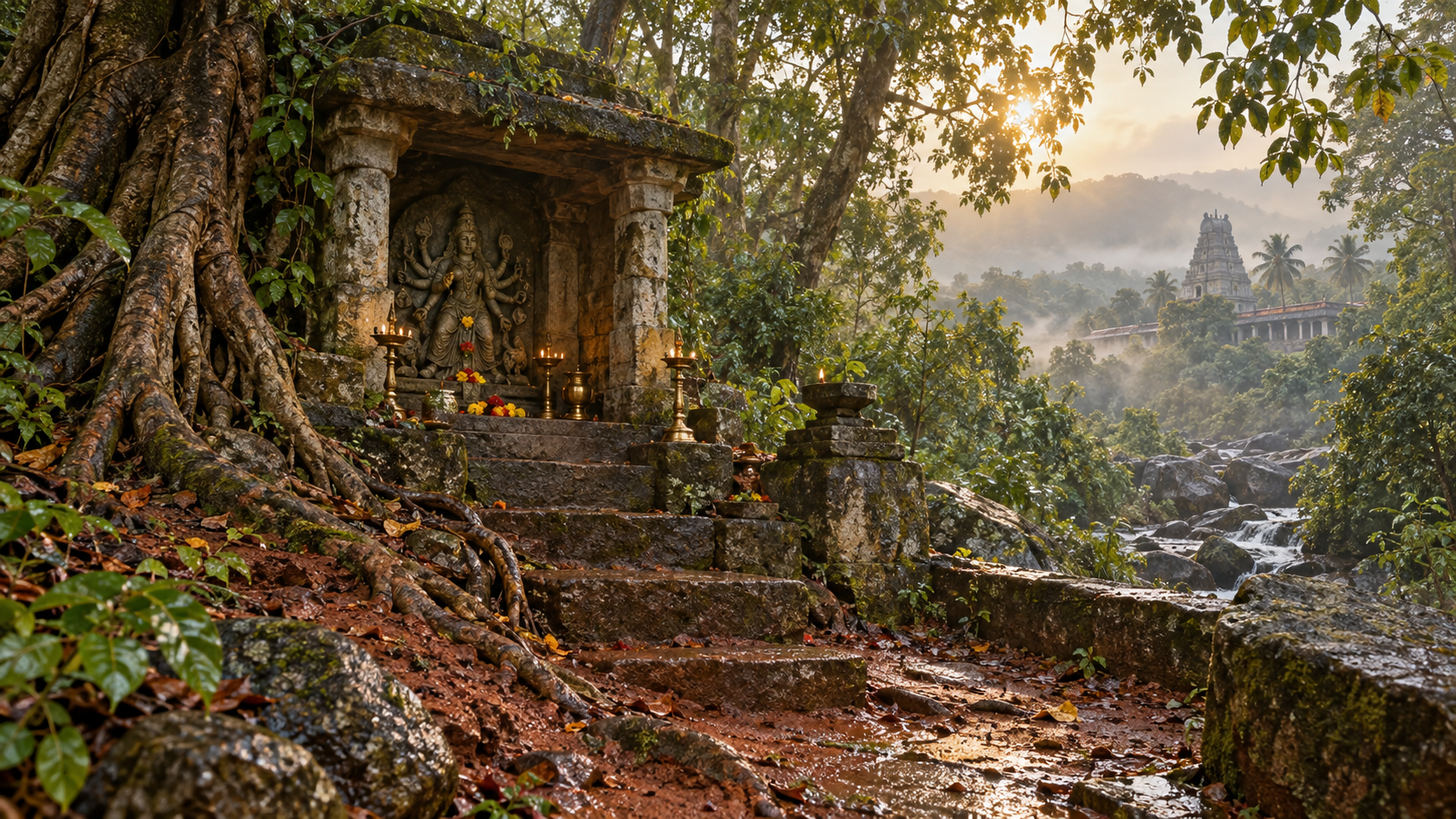
Context is not an afterthought. A labelled eight-armed Goddess called Banashankari in Karnataka presents a much stronger identification than an unlabelled eight-armed figure of unknown origin. The name, form, and place reinforce one another.
When you examine an image in a temple, museum, family shrine, or digital archive, record the context before focusing on decorative details. Look for the temple name, a Kannada or English caption, the stated place of origin, and the name used by worshippers or custodians. These clues can preserve an identity that is not visually obvious from the sculpture alone.
Vana Shankari and Banashankari should not be separated into two deities merely because one version of the name appears in a label and the other in a caption. Banashankari is the popular name for Vana Shankari in this context. Treat the two forms as connected unless reliable local information gives you a reason to do otherwise.
The forest meaning deserves the same restraint. It is central to interpreting the name, but it does not license unsupported claims about a particular tree, animal, community, ritual, or ecological teaching. Note such details when they are visibly present or locally attested. Do not derive them from the word Vana alone.
Build a caption from evidence rather than resemblance
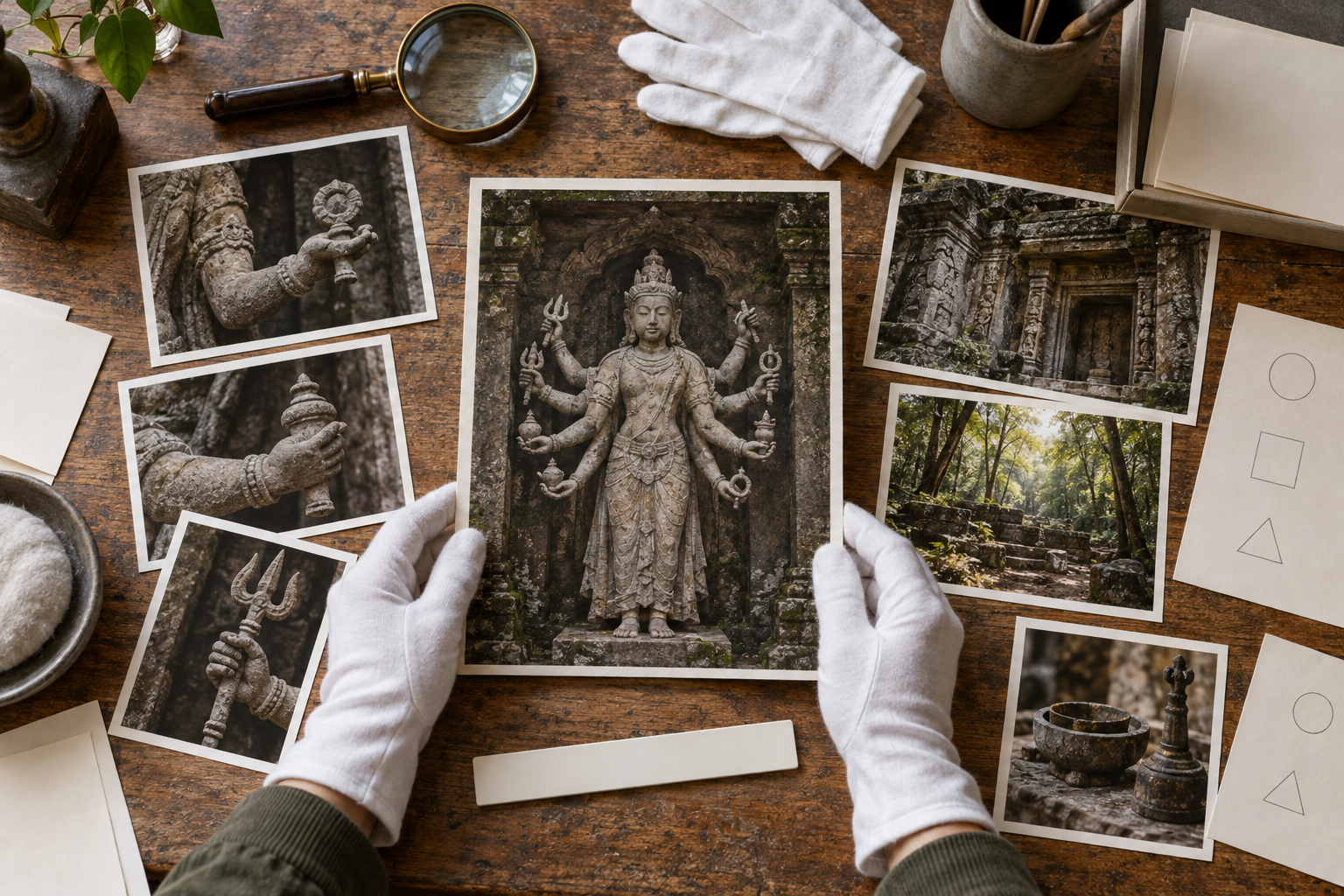
A useful iconographic description separates what you can observe from what the identification allows you to conclude. This prevents a plausible guess from hardening into a false traditional detail.
| Evidence | What it supports | What it cannot prove by itself |
|---|---|---|
| Vana Shankari or Banashankari label | The local or transmitted name of the Goddess | The identity of every object in her hands |
| Eight visible arms | Agreement with the documented form | A unique identification without name or context |
| Karnataka provenance | A strong regional fit | That every eight-armed Goddess from Karnataka is Banashankari |
| Forest imagery | Visual reinforcement of the meaning of Vana | Identification without the remaining clues |
| Connection with Shiva | The meaning carried by Shankari | That the Goddess is merely a secondary figure rather than a form of Shakti |
For a catalogue, study note, or image caption, a defensible description would be: Vana Shankari, also known as Banashankari, is an eight-armed regional form of Shakti associated with Karnataka. Her name combines Vana, meaning forest, with Shankari, the feminine name connected with Shankara or Shiva.
After that core description, add only what the particular image shows or what a reliable local identification confirms. If an object is unclear, write that the attribute is indistinct. If a hand is hidden by flowers, say that it is obscured. Precision about uncertainty is more useful than a complete-looking caption built from assumptions.
Quick questions when identifying Vana Shankari
Is every eight-armed Goddess Vana Shankari?
No. Eight arms are an important matching feature, but not a unique fingerprint. Confirm the name through a label, temple tradition, provenance, or another dependable contextual clue.
Are Vana Shankari and Banashankari different forms?
Banashankari is the popular name for Vana Shankari in this identification. A variation between the two names is not, by itself, evidence for two separate deities.
Does the image need to show a forest?
No. The forest association is embedded in the name Vana Shankari, but a compact icon need not depict a complete landscape. Forest imagery can strengthen an identification; its absence does not automatically disprove one.
Can the weapons, vehicle, and colours be inferred from the name?
No. The name establishes the forest association and the connection with Shankara, while the documented form establishes eight arms and the Karnataka setting. Other details require visible evidence or a dependable local account.
Your next step is straightforward: record the name exactly as it appears, count the arms, note the Karnataka context, and describe each visible attribute without filling gaps. That method gives Vana Shankari her proper identity while keeping conjecture out of the sacred record.
References

Leave a Reply
You must be logged in to post a comment.