
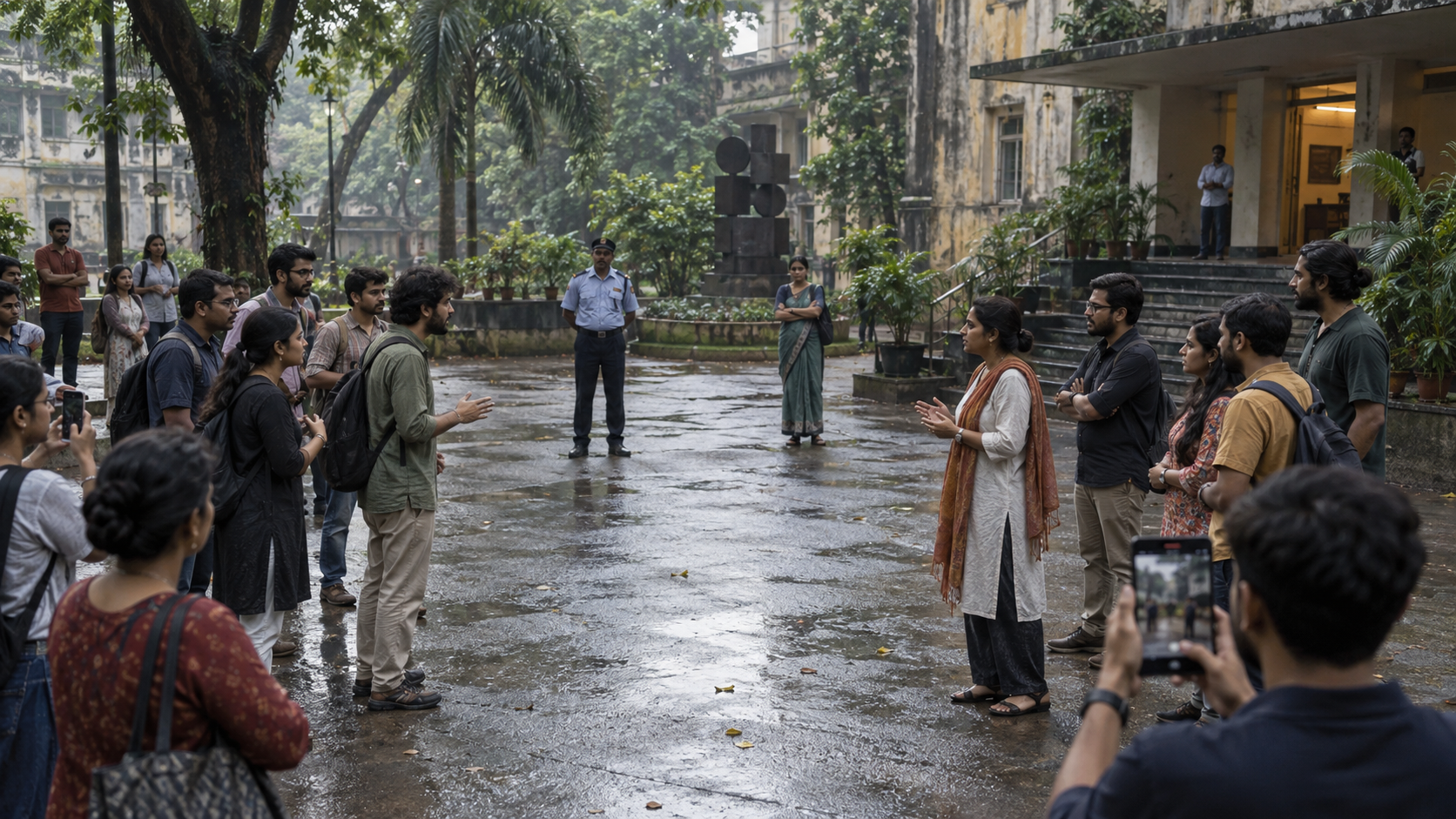
If you encountered a dramatic account of Hindu activists confronting people at a Kolkata film institute, your first decision is whether to share it, condemn it, or defend it. None of those choices should be made from a headline alone.
The responsible position is neither evasive nor neutral about wrongdoing. It is precise: establish who did what, separate political labels from identities, and reserve judgment on disputed conduct until the evidence supports it.
What can be established from the present record

The narrow factual record identifies a campus confrontation involving people described as members of Bangiyo Hindu Jagran Manch. Their action was framed as a protest against an alleged leftist stronghold at a Kolkata film institute.
Stone-throwing was also alleged. That allegation is serious, but no independent corroboration is available in the factual record before us. Nor do we have a verified sequence showing how the confrontation began, who initiated any physical escalation, whether anyone was injured, whether property was damaged, or what the institute and police formally recorded.
Those gaps matter. A confrontation can involve a legitimate protest, unlawful entry, provocation, defensive action, aggression, or several of these at different moments. A cropped clip or partisan description cannot establish the sequence by itself.
The phrase “Tukde Tukde Gang” is a political label in this context, not evidence of a person’s conduct or organisational affiliation. Likewise, “leftist stronghold” is an allegation about institutional culture, not a demonstrated fact merely because it is repeated. If you discuss the incident, preserve those distinctions in your own wording.
A Dharmic response requires courage and restraint
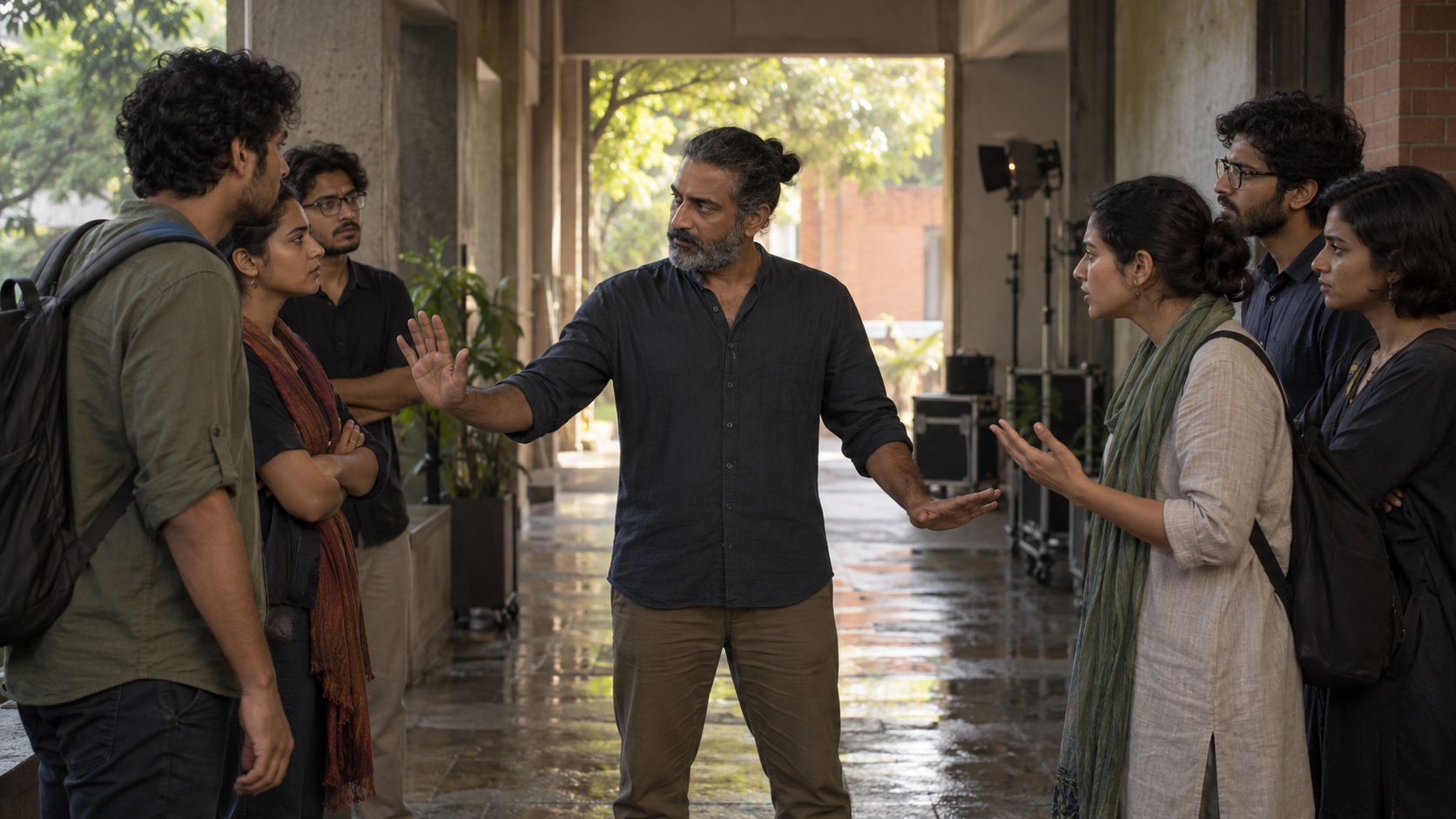
A pro-Hindu outlook does not require automatic approval of every tactic used in Hindu interests. It requires the confidence to defend Hindu participation and viewpoint diversity while judging conduct by a consistent standard.
If people threw stones, that conduct should not become admirable because the alleged throwers belonged to a Hindu organisation. If the allegation is false or exaggerated, it should not become believable because the targets were given a hostile political label. The honest position is conditional: condemn proven aggression, defend peaceful protest, and refuse to pretend that an unresolved claim has already been settled.
This is not weakness. Satya demands accuracy, and self-command prevents an opponent from choosing your reaction for you. When Hindu advocacy repeats an unverified claim, it gives critics an easy way to avoid the underlying question of whether Hindu viewpoints receive fair treatment in cultural and educational institutions.
You can therefore hold two thoughts at once: ideological exclusion, if demonstrated, deserves organised opposition; physical intimidation, if demonstrated, deserves rejection. Neither conclusion proves the other.
Use this verification protocol before sharing a claim

Do not begin by asking which side a clip appears to favour. Begin by writing down the exact claim you think it proves. Then test that claim through the following sequence.
- Freeze the wording. Distinguish “a protest occurred” from “the campus was stormed,” and distinguish “a projectile appears in a video” from “a named group threw stones.” Each sentence requires different evidence.
- Identify people without political shorthand. Ask which individuals were present, which organisation each person actually represented, and whether the affiliation is confirmed by the person, the organisation, or reliable documentation. Clothing, slogans and proximity are clues, not complete proof.
- Reconstruct the sequence. Look for continuous footage showing arrival, access to the campus, verbal exchanges, any barrier being crossed, the first physical contact and the aftermath. A short segment may show that something happened without showing why or who initiated it.
- Trace media to its earliest available version. Reposts often remove context. Check whether the original upload identifies a place and time, whether the recording has unexplained cuts, and whether independent recordings show the same moment from another angle.
- Separate observation from interpretation. “A person raises an arm” describes what can be seen. “An activist attacks a student” adds identity, object, intent and sequence. Verify every added element.
- Seek the missing records. Look for the institute’s formal account, responses from the people accused, medical or property-damage documentation where relevant, and any police complaint or official record. The absence of such material does not disprove an event, but it limits how confidently you can describe it.
- Publish with a confidence marker. Use “confirmed,” “alleged,” “disputed” or “not yet established” deliberately. If later evidence changes the picture, correct the claim as visibly as you first circulated it.
If a confrontation is still active, do not enter it merely to obtain footage. Keep a safe distance, preserve original recordings without editing them, and avoid publishing personal identifiers unless identity is necessary, verified and responsibly handled. A mistaken identification can expose an uninvolved person to harassment.
Make allegations of institutional bias testable

Calling an institute a leftist stronghold may express a genuine experience, but it does not show a reader what the institution actually did. If you believe ideological capture is the real issue, replace the label with evidence that another person can inspect.
- Name the decision being challenged: access to campus, event approval, speaker selection, curriculum, disciplinary action, employment, admissions or another specific institutional act.
- State the rule or criterion that should have governed that decision.
- Show how comparable cases were treated, including cases that do not support your preferred conclusion.
- Identify the responsible office or decision-maker instead of assigning collective guilt to every student, teacher or artist at the institute.
- Ask for a concrete remedy: publication of criteria, an explanation on the record, equal access, a review process, a right of reply or a peaceful public forum.
This method makes Hindu advocacy harder to dismiss. It turns a broad accusation into a claim that can be answered. It also distinguishes ideological disagreement from discrimination. A person holding left-wing views is not, by that fact alone, proof of institutional unfairness; a demonstrable pattern of exclusion is a much stronger case.
Keep tactics aligned with the remedy you seek. If the demand is open debate, model open debate. If the demand is equal institutional treatment, document unequal treatment. If the demand is accountability for violence, apply the same evidentiary standard to allies and opponents.
Key takeaways
- A confrontation involving people identified with Bangiyo Hindu Jagran Manch was described at a Kolkata film institute, but crucial details remain uncorroborated in the available record.
- Stone-throwing is an allegation requiring evidence, not a fact to celebrate or condemn as attributed conduct before verification.
- “Tukde Tukde Gang” and “leftist stronghold” are political characterisations; neither establishes identity, responsibility or institutional bias.
- A credible response reconstructs the sequence, checks original media, seeks institutional and official records, and labels uncertainty openly.
- The strongest case for viewpoint fairness names specific decisions, standards, patterns and remedies rather than relying on slogans.
Before you forward the next clip or headline, write one sentence stating exactly what it proves. Remove every identity, motive and sequence claim the evidence cannot carry. What remains may be less dramatic, but it will be far more useful to anyone seeking truth, accountability and fair treatment for Hindu voices.
References

Leave a Reply
You must be logged in to post a comment.