
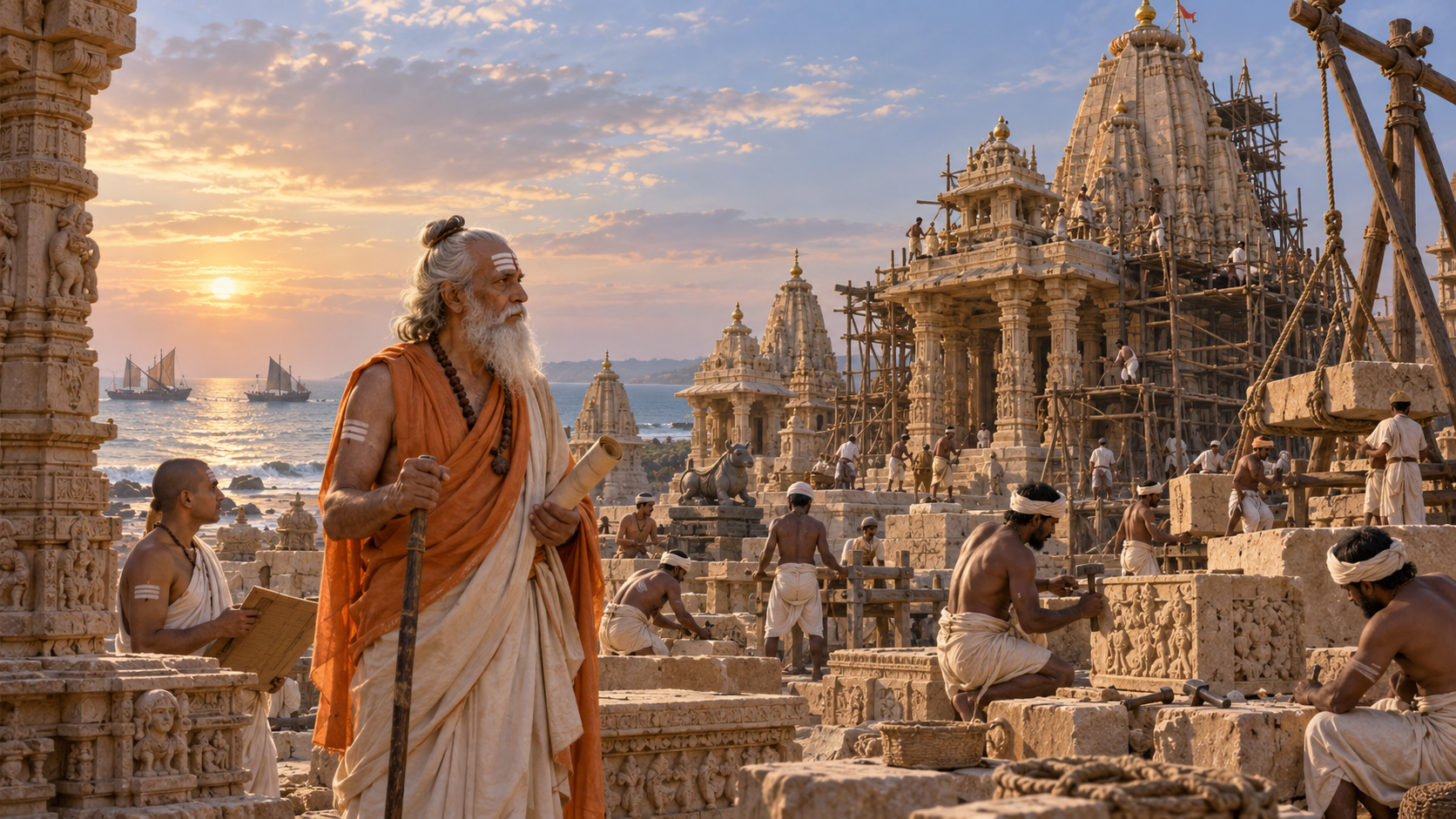
If you are trying to identify who rebuilt Somnath in the medieval period, the answer cannot stop with King Kumarapala. Royal patronage made the work possible, but Bhava Brihaspati was the Pashupata acharya who recognized the ruined condition of the shrine, appealed for its repair, directed its reconstruction and helped establish the arrangements needed to sustain it.
Recovering his role also changes what you see when you look at Somnath. This was not merely the replacement of damaged masonry. It was the renewal of a functioning sacred centre, complete with subsidiary temples, waterworks, food provision, fortifications, a royal assembly space and a succession plan for its religious leadership.
Who rebuilt medieval Somnath?
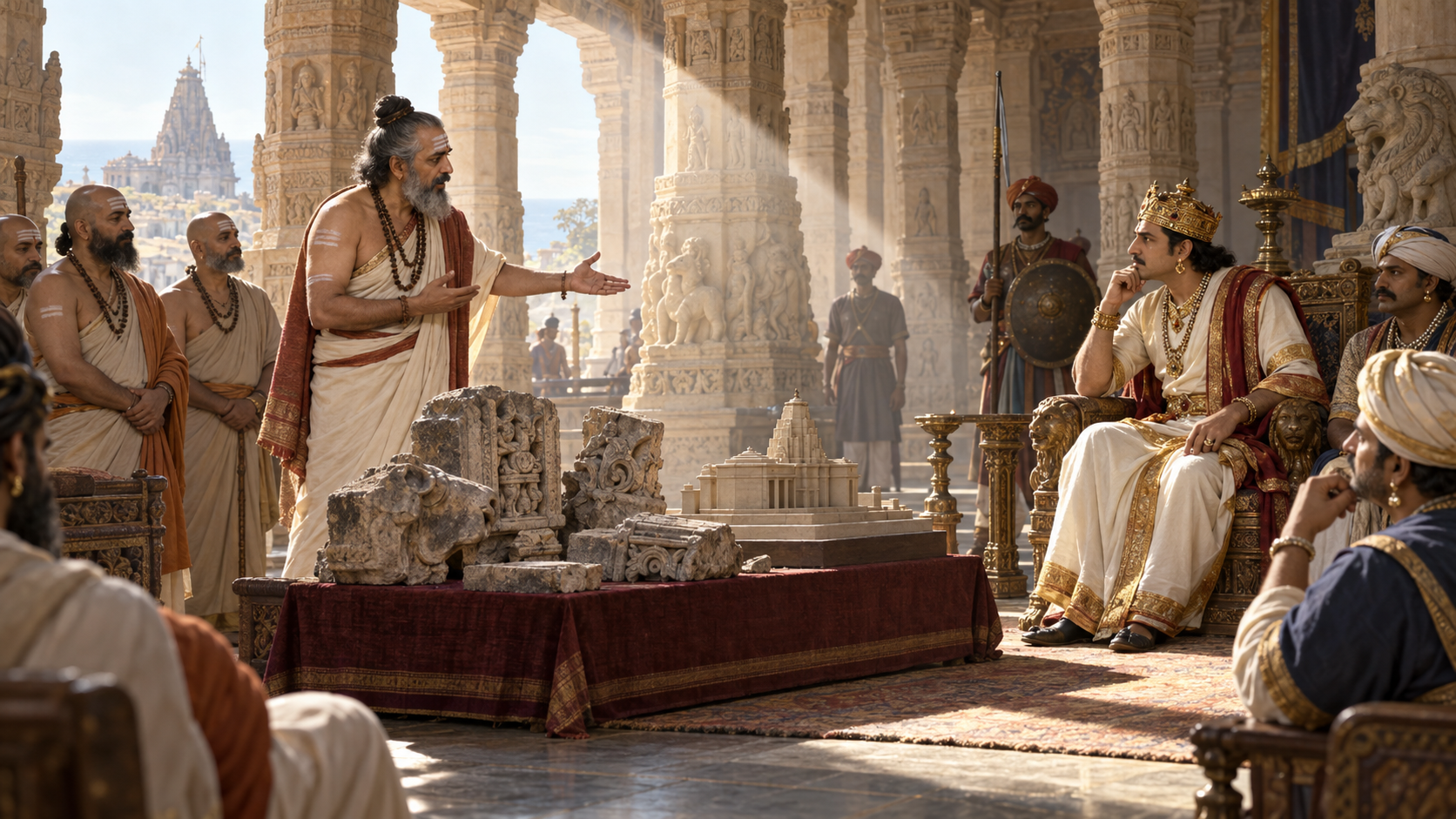
The most accurate short answer is this: Somnath’s major medieval reconstruction was undertaken under the royal authority of Kumarapala and led on the ground by Bhava Brihaspati.
We can place this episode securely in the 12th-century memory of the shrine because Bhava’s work was commemorated in the Bhadrakali stone inscription dated 1169. Bhava is remembered there as seeing the temple of Shiva in a ruined condition and asking Kumarapala to have Somnath repaired. With royal authorization in place, he caused the great temple to be built.
That division of responsibility matters. Kumarapala supplied sovereign approval, wealth, honours and property. Bhava supplied religious authority, institutional leadership and the sustained direction of the rebuilding programme. Calling Kumarapala the patron does not diminish his role. Calling Bhava merely a priest, however, badly understates his.
Nor should we casually give Bhava the modern professional title of architect. The evidence supports a stronger and more historically appropriate description: he was the acharya and temple head who initiated, organized and oversaw the renewal. The craftsmen, labourers and other officials required for such extensive work are not individually named in the surviving account.
You can understand the project through a five-stage sequence: Bhava identified the need, petitioned the king, obtained authorization, carried out the reconstruction and secured provisions for continuity. Remembering that sequence is more useful than attaching the entire achievement to either the throne or the religious office alone.
Why Bhava Brihaspati was prepared for the task
Bhava did not arrive at Somnath as an unknown local functionary. Born in Kashi, he received rigorous training in the Pashupata tradition while young and rose to the standing of Parama-Pashupatacharya. Devotional memory compared him with Nandishvara and praised the severity of his yogic discipline. Those honorifics express reverence, but they also tell you how his contemporaries understood his authority: he was regarded as an exemplary Shaiva teacher, not simply an administrator appointed for convenience.
Pilgrimage was central to his public life. He travelled through important religious and political centres, initiated rulers into the Pashupata tradition and encouraged the construction of temples to Shiva. He first moved to Kanyakubja and later to Ujjain, where he became associated with the Paramara rulers and the preservation of temples and mathas in Malwa.
A decisive change followed Jayasimha Siddharaja’s conquest of Malwa. The Gurjara Chalukya king invited Bhava, then about forty, to become his spiritual preceptor. Bhava subsequently received responsibility as the chief mahattara of Somnath, an office comparable to that of the shrine’s chief mahant or senior religious head. By the time Kumarapala supported the great reconstruction, Bhava already combined three kinds of authority: mastery of a Shaiva lineage, relationships with kings and experience caring for religious institutions.
This background explains why the project could grow beyond a repair order. A travelling acharya could connect a local shrine to a wider sacred geography. A royal preceptor could bring its needs before the court. A chief mahattara could translate authorization into ritual, administrative and physical arrangements at the site. The same person occupied all three roles.
For you as a reader of temple history, this is an important distinction. Medieval acharyas were not always confined to teaching doctrine or conducting worship. In Bhava’s case, spiritual leadership included diplomacy, construction, management, patronage and the preservation of an institution across generations.
What the Somnath reconstruction actually included
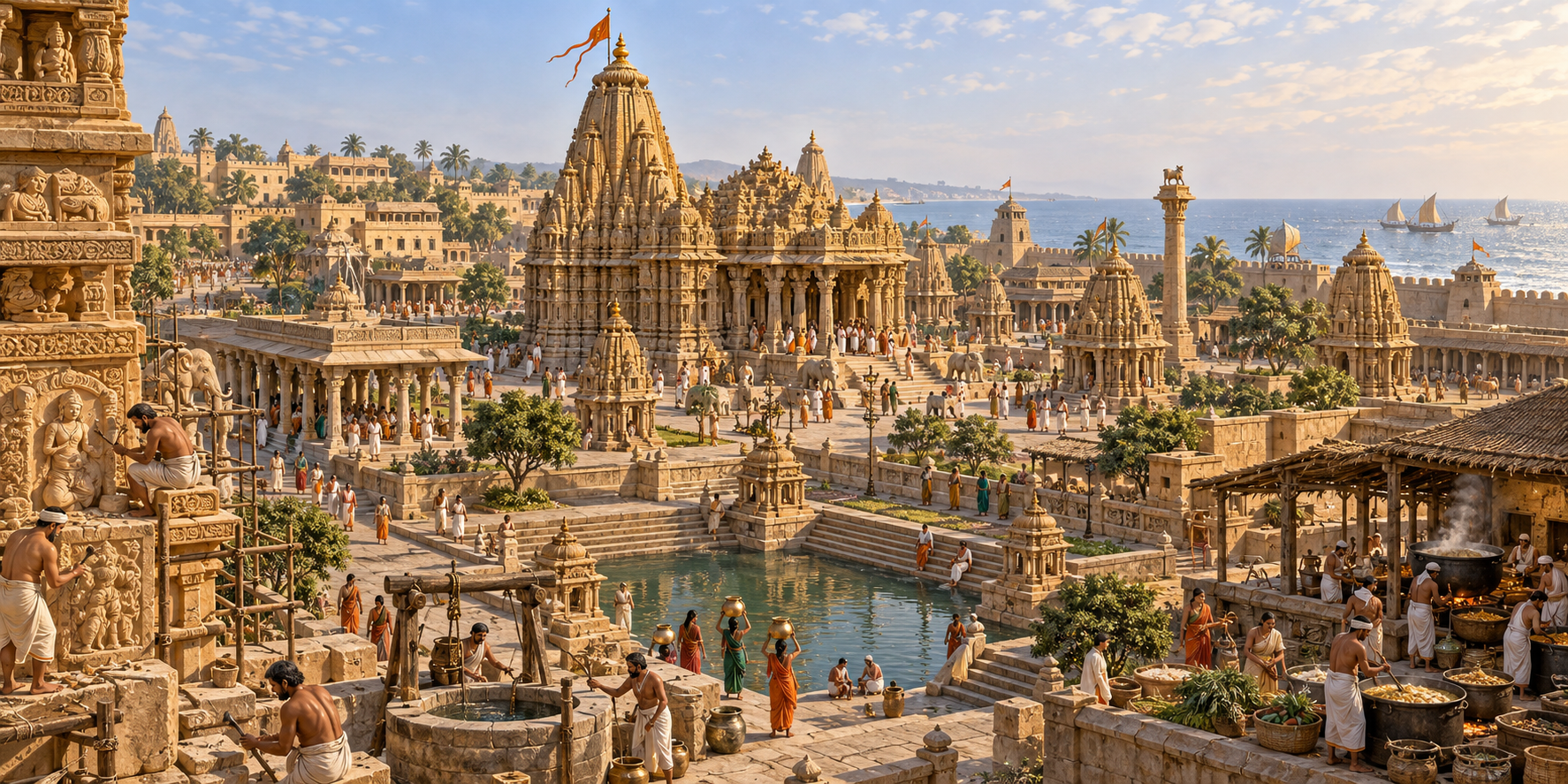
The first great milestone was the completion of Somnath’s Meru-prasada. Its ceremonial description compares the rebuilt temple with Mount Kailasa, Shiva’s divine abode. That is sacred and courtly praise rather than a measurable architectural specification, but it captures the ambition of the renewal: Somnath was to return as a monumental centre worthy of Bhagavan Somanatha.
Bhava did not stop when the principal temple was standing. The recorded programme of works extended across the temple complex and the surrounding settlement:
- The principal shrine: Bhava caused the great temple of Somnath to be rebuilt, with the Meru-prasada forming the central achievement.
- The sacred complex: Gold kalashas were placed on the temples of Gauri, Bhimeshvara, Kapardi, Siddheshvara and other deities.
- The mandapa: A spacious pillared hall was constructed in front of the main temple. Within it stood a prominent seat for Shiva, fashioned in the form of a frog and provided with a watercourse.
- The water supply: A vapi, or reservoir, described as holding the purifying waters of the Sarasvati-Nadi was dug to supply the temple kitchen and the water required for abhisheka.
- The town’s security: The settlement was extended and strengthened with fortifications to the north and south of the temple.
- Royal administration: A courtroom or assembly space was built for kings to gather.
- A Vaishnava shrine: The temple of Bhagavan Papamocana, identified with Vishnu, was repaired as part of the wider programme.
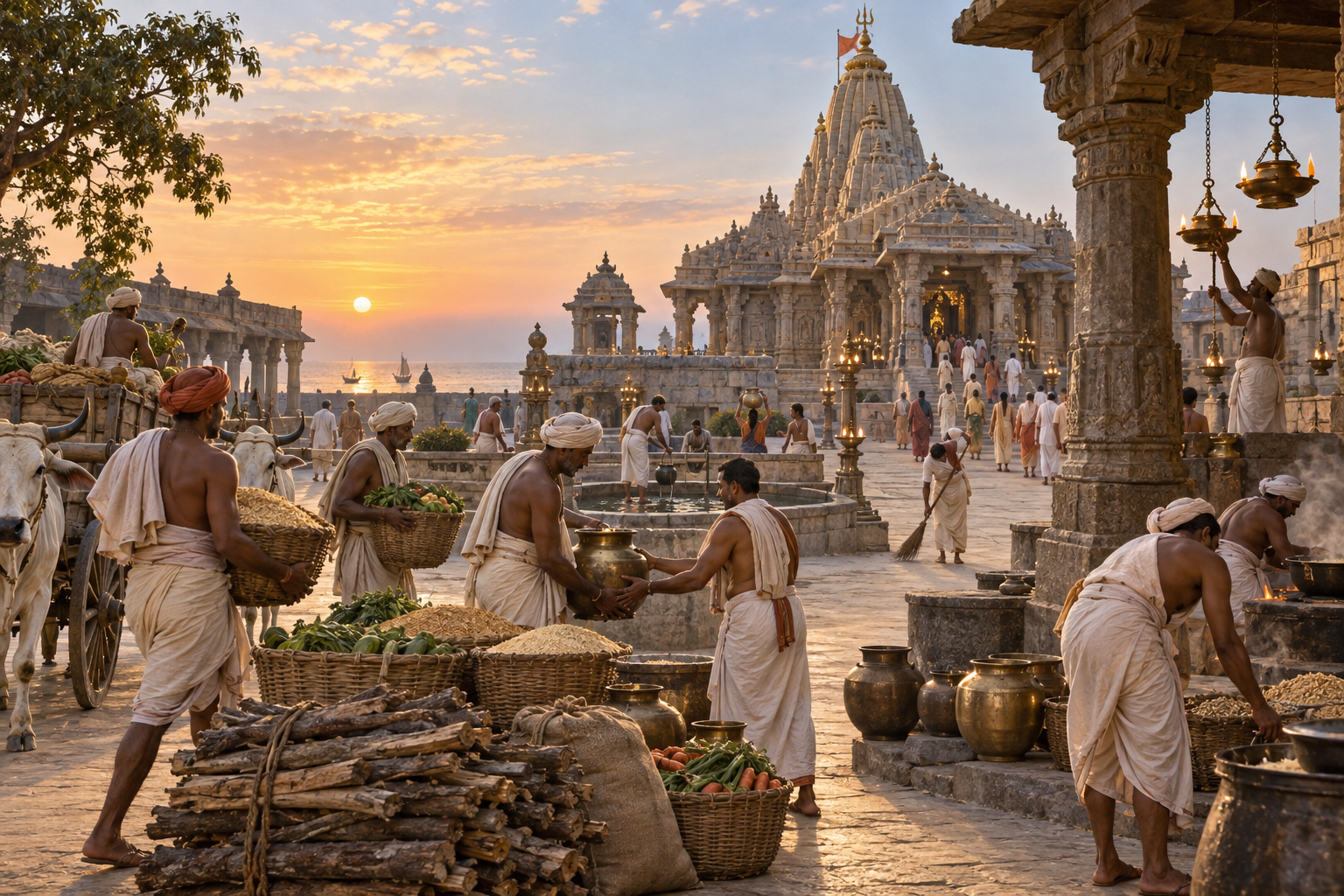
The waterworks deserve particular attention. A temple can be visually impressive and still fail as a living institution if its daily requirements are ignored. Abhisheka needs a dependable supply of water. A working kitchen needs water as well as provisions. By including the vapi in the rebuilding programme, Bhava addressed recurring ritual and practical needs rather than concentrating exclusively on the visible monument.
The associated shrines are equally revealing. Somnath was not treated as an isolated sanctum surrounded by incidental buildings. The kalashas on the temples of Gauri, Bhimeshvara, Kapardi and Siddheshvara restored the dignity of a larger Shaiva landscape. The repair of the Papamocana temple also prevents an overly narrow reading of Bhava’s Pashupata identity. His work served a sacred complex in which a shrine of Vishnu had a recognized place.
Fortifications and a royal assembly space show the other side of the project. A renowned pilgrimage centre had to exist in a settled, governed and defensible environment. Bhava’s programme connected worship to the town around it and brought the shrine into an enduring relationship with royal authority. The result was not simply a reconstructed building. It was sacred infrastructure.
How endowment turned reconstruction into continuity
Kumarapala’s response to the completed work was expressed through elaborate public honour. The king adorned Bhava, placed a pearl necklace around his neck, applied sandalwood to his feet, bowed before him and gave him his own ring. The symbolism reversed the ordinary visual hierarchy of court: royal greatness was deliberately set aside before the acharya responsible for restoring Somnath.
Those gestures mattered, but the durable provisions mattered more. Bhava received the appellation Ganda, with the distinction extended to his sons and grandsons. Kumarapala also granted the village of Brahmapuri, including its trees and water, for the enjoyment of Bhava’s descendants. The order was formalized on three copper plates before the assembled court. Another grant supported a place associated with the observance of Dharma and the daily distribution of food.
Bhava also performed puja for 505 saintly men in connection with the temple’s proper maintenance. The number points to the human scale of the religious network being gathered around Somnath. Buildings required people who could conduct worship, receive pilgrims, preserve a lineage and keep the institution operating after the founding generation had passed.
This is the part of the reconstruction that is easiest to overlook. Stone can survive for centuries, but an institution cannot rely on masonry alone. It needs income, land, water, food, recognized authority and a method of succession. By tying property and status to Bhava’s family line, the settlement attempted to make the temple’s leadership continuous rather than dependent on one exceptional acharya.
The hereditary arrangement should not be romanticized as the only possible model of temple governance. It was the solution preserved for this place and period. Its historical importance lies in the problem it was designed to solve: who would care for the renewed shrine after Bhava?
You can use the same question when assessing any claim about a historic temple reconstruction. Look for five things:
- Who recognized the need and initiated the work?
- Who supplied legal authority and material patronage?
- What was built beyond the central shrine?
- How were daily worship, water, food and maintenance supported?
- What arrangement allowed the institution to continue after its leading patron or acharya died?
Applied to Somnath, those questions keep you from making three common mistakes. The first is remembering only the king and losing the acharya. The second is treating devotional comparisons with Kailasa or Varaha as literal measurements of architectural scale. The third is reducing the whole episode to a cycle of damage and rebuilding while ignoring the institutional work that made revival possible.
Eulogistic Shaiva language is strongest as evidence for the roles, relationships, grants and works that Somnath’s custodians wanted remembered. Its cosmic comparisons reveal the sacred meaning assigned to the reconstruction, not a neutral engineering survey. A careful reading therefore preserves both dimensions: the practical programme is taken seriously, and the devotional metaphors are read as devotional metaphors.
Key takeaways for remembering Bhava Brihaspati
- Use a two-part attribution: Kumarapala was the royal patron; Bhava Brihaspati was the Pashupata acharya and temple head who initiated and directed the renewal.
- Do not reduce the work to one building: the programme encompassed the great temple, mandapa, water reservoir, subsidiary shrines, fortifications, royal assembly space and a repaired Vishnu temple.
- Count operating systems as part of reconstruction: water for abhisheka, a functioning kitchen, daily food distribution and arrangements for maintenance were as necessary as stone and kalashas.
- Recognize the institutional design: land, copper-plate authorization, hereditary distinction and succession provisions were intended to carry the shrine beyond Bhava’s lifetime.
- Read praise with precision: comparisons with Kailasa and Varaha communicate sacred stature, while the named works and grants show the practical scope of the project.
The next time you encounter the sentence that Kumarapala rebuilt Somnath, add the missing half: Bhava Brihaspati made the royal decision into a living Shaiva institution. Then ask what was provided for worship, maintenance and succession. That is where a reconstruction becomes a restoration of civilizational life.
References

Leave a Reply
You must be logged in to post a comment.