

You see a sweeping allegation about Kumbh or Sanatan Dharma. It mixes a real concern, a missing context and a contemptuous conclusion. If you respond only with anger, the allegation becomes the story. If you stay silent, an unsupported claim may harden into accepted wisdom.
The better response is neither passive nor defensive. It is precise, evidence-led and dharmic in conduct. That is the practical challenge behind the two-day Dnyankumbh 2026 Vidwat Sangoshthi in Nashik, where saints and scholars resolved to counter what they characterised as ideological attacks and conspiracies intended to defame Kumbh and Sanatan Dharma.
Defend the living institution, not a convenient slogan
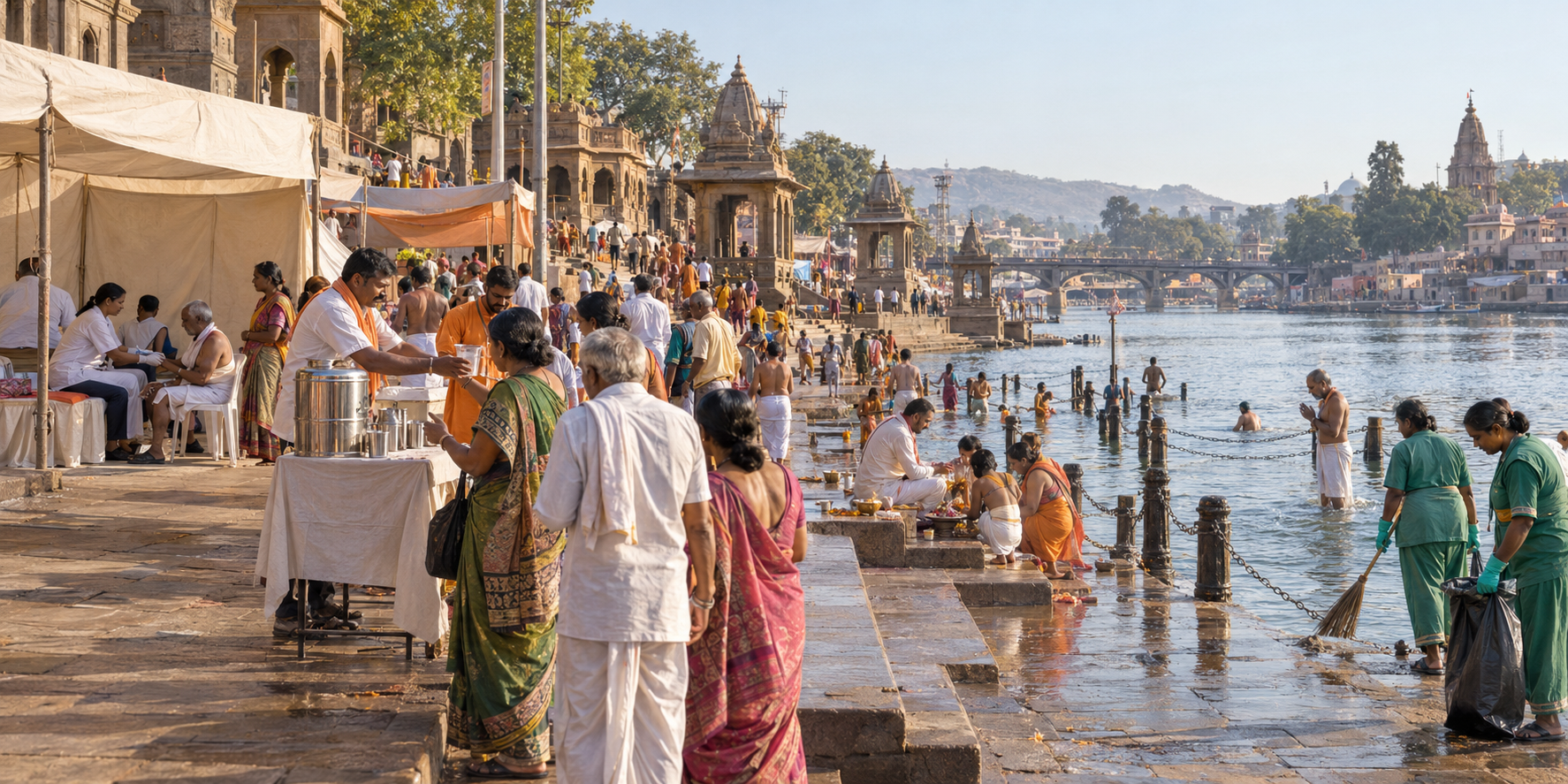
Kumbh is not merely a large crowd beside a river. It is a living religious institution expressed through pilgrimage, worship, renunciation, teaching, debate, service and encounters among different Hindu traditions. A photograph of congestion, a dispute over administration or a provocative television exchange cannot contain that whole reality.
Sanatan Dharma is broader still. It contains many sampradayas, teachers, disciplines and philosophical positions. Defending it does not mean pretending that every Hindu agrees on every doctrine or practice. It means refusing to let internal diversity be misrepresented as incoherence, or a failure by one person or institution be used to condemn an entire civilisation.
Before replying to an attack, identify what is actually being challenged:
- A factual claim: Did a named event occur, and is the available material complete enough to establish what happened?
- An administrative decision: Is the criticism about management, safety, access, expenditure or public communication?
- A religious practice: Does the critic understand the practice’s purpose and the tradition to which it belongs?
- The dignity of participants: Has criticism of conduct turned into contempt for pilgrims, sadhus or Hindus as a people?
- The legitimacy of Dharma itself: Is one disputed incident being used to deny an entire tradition the right to exist on its own terms?
These categories require different answers. Records can settle a narrow factual error. Administrative criticism should be answered on administrative grounds. A theological misunderstanding requires an explanation from within the relevant tradition. Open contempt may need to be exposed rather than rewarded with an endless argument.
Distinguish scrutiny, misrepresentation and hostility
Not every uncomfortable question is an attack on Dharma. Kumbh organisers, public authorities and Hindu institutions can make mistakes. Treating all criticism as malicious makes genuine correction harder and weakens the response when real hostility appears.
You can make the distinction by testing the claim rather than trying to read the critic’s mind:
- Can the claim be verified? Look for the exact statement, image, decision or incident. A vague assertion should not be answered as though it were a documented fact.
- Does the conclusion fit the evidence? Evidence of one error may justify criticism of that error. It does not automatically establish that Kumbh is fraudulent or that Sanatan Dharma is harmful.
- Is relevant context being withheld? A clipped recording, an undated photograph or a quotation without its preceding question may create a false impression even when the fragment itself is authentic.
- Are people being reduced to stereotypes? Language that treats pilgrims as dirty, irrational or less worthy of dignity is not neutral scrutiny.
- Can the claim be corrected? A person who updates a mistake deserves a different response from someone who repeats it after receiving clear contrary evidence.
The word conspiracy needs particular care. Dnyankumbh participants resolved to oppose what they described as conspiracies and ideological attacks. That records their stated position; it does not make every allegation of coordination self-proving. A conspiracy claim should identify the actors, the mechanism of coordination and the supporting evidence. Where those elements are absent, use narrower language such as misrepresentation, selective framing or an unsupported allegation.
This restraint is not timidity. It prevents a critic from escaping the original issue by pointing to exaggeration in the Hindu response.
Answer in a form that a fair reader can verify

Your real audience is often not the person making the allegation. It is the undecided reader watching the exchange. Give that reader a short path from claim to evidence.
- Restate the claim accurately. Remove insults and rhetoric. If you cannot describe the opposing claim fairly, you are not ready to answer it.
- Verify the narrow fact first. Prefer complete recordings, dated notices, original statements and identifiable records over screenshots whose origin cannot be checked.
- Add only the context that changes the meaning. Do not bury a valid correction beneath a general lecture on Hindu civilisation.
- Name the category error. Say plainly when criticism of management has been converted into condemnation of a religion, or when one individual’s conduct has been presented as universal Hindu doctrine.
- Request a specific remedy. Ask for a correction, restored context, a changed headline or removal of a demonstrably false assertion. A precise request is easier to assess than a demand for respect in the abstract.
A useful response can therefore be simple: The claim is X. The verifiable record establishes Y. The conclusion omits Z. Please correct the specific statement. This structure keeps you focused when an exchange becomes emotional.
Match the evidence to the question. Sacred significance does not, by itself, answer a claim about administration. An administrative lapse does not, by itself, invalidate sacred significance. Keeping those levels distinct protects both truth and Dharma.
Religious explanations require similar precision. Do not present a local custom, one teacher’s interpretation or one sampradaya’s discipline as the uncontested position of every Hindu. Name the tradition whose view you are explaining. Honest specificity makes Sanatan Dharma’s plurality intelligible; false uniformity makes it easy to caricature.
Turn recognition into durable cultural work

The Nashik gathering also honoured Hindu Janajagruti Samiti State Organiser Sunil Ghanwat with the Maharshi Award 2026. Recognition can acknowledge sustained service, but the defence of a tradition cannot depend on an award, a single speech or one gathering. It needs memory, trained judgement and repeatable work.
A temple group, cultural organisation or informal volunteer network can build that capacity without creating a large bureaucracy:
- Maintain a claim log. Record the exact allegation, its link or origin, the date encountered, the available evidence, the response made and whether a correction followed.
- Separate subject roles. Ask a practitioner or teacher to check religious meaning, a careful researcher to verify factual material and a calm editor to shape the public response. Spiritual authority and evidentiary competence are related, but they are not interchangeable.
- Create a basic Kumbh primer. Explain pilgrimage, ritual bathing, akharas, sadhus, discourse and seva in language an unfamiliar reader can understand. Mark practices that vary rather than forcing them into a single formula.
- Preserve primary material. Keep complete statements, full recordings and dated notices when they are lawfully available. A cropped image should never become the foundation of your own case.
- Correct your side as well. Withdraw an inaccurate counterclaim openly. Credibility grows when readers can see that truth, not victory, governs the response.
- Translate without inflaming. Make explanations accessible in the languages your community actually reads, while removing taunts and collective accusations that obscure the factual point.
There is also a boundary worth keeping. Defence of Dharma is not permission to harass an individual, expose private information or answer ridicule with threats. Such conduct violates the dignity being defended and gives an opponent a new, legitimate grievance. Document, correct and organise; do not imitate the behaviour you oppose.
Key takeaways
- Identify whether you are facing a factual error, an administrative criticism, a distorted religious claim or hostility toward Hindus.
- Do not call coordination a conspiracy unless you can identify actors, mechanism and evidence.
- Answer the narrow claim first; add only the context that materially changes its meaning.
- Distinguish an institutional failure from an attack on the legitimacy of Kumbh or Sanatan Dharma.
- Preserve verifiable material, request a specific correction and repair inaccuracies in your own response.
- Convert gatherings and honours into continuing education, documentation and disciplined cultural advocacy.
The next time a distorted claim appears, resist the pressure to answer instantly. Classify it, verify it and respond for the fair-minded reader who is still deciding what to believe. A defence conducted with satya, restraint and clarity does more than rebut an allegation: it demonstrates the civilisational discipline that Sanatan Dharma asks its defenders to preserve.
References

Leave a Reply
You must be logged in to post a comment.