
You may want to honor Lakshmi but feel unsure about what the practice should involve. Must you buy something on Dhanteras, recite an elaborate hymn, consult a horoscope, or perform a large puja? The better starting point is simpler: decide what kind of prosperity you are asking to receive, and what kind of person you will become if it arrives.
Auspicious practice is not a transaction in which an offering purchases a financial result. It joins devotion to conduct. You make the home receptive through order and reverence, then make your use of money receptive to dharma through honesty, restraint, gratitude, and responsibility.
Prosperity becomes sacred when it passes a dharmic test

Lakshmi is easily reduced to a symbol of cash. That reduction creates a contradiction: a person may ask for abundance while neglecting obligations, wasting existing resources, or pursuing gain through conduct that disturbs the household. More money does not resolve that contradiction. It gives the contradiction more room to operate.
A workable understanding of sacred prosperity includes enough material stability to meet your duties, the discernment to use resources well, and the inner steadiness not to make wealth your master. Before asking whether something is auspicious, pass it through four questions:
- Source: Is this income or opportunity obtained without deception, exploitation, or concealment?
- Duty: Are essential obligations being met before money is spent on display, status, or impulse?
- Stewardship: Are you caring for what you already possess, or asking for more while allowing waste and disorder to accumulate?
- Purpose: Will this prosperity strengthen your household and your capacity to serve, or merely enlarge comparison and craving?
This is not a demand for perfection before worship. It is a way to stop separating the shrine from the rest of life. If the audit exposes a neglected bill, an unfair transaction, or habitual waste, correcting that problem can become part of your Lakshmi practice.
Build a household practice you can sustain
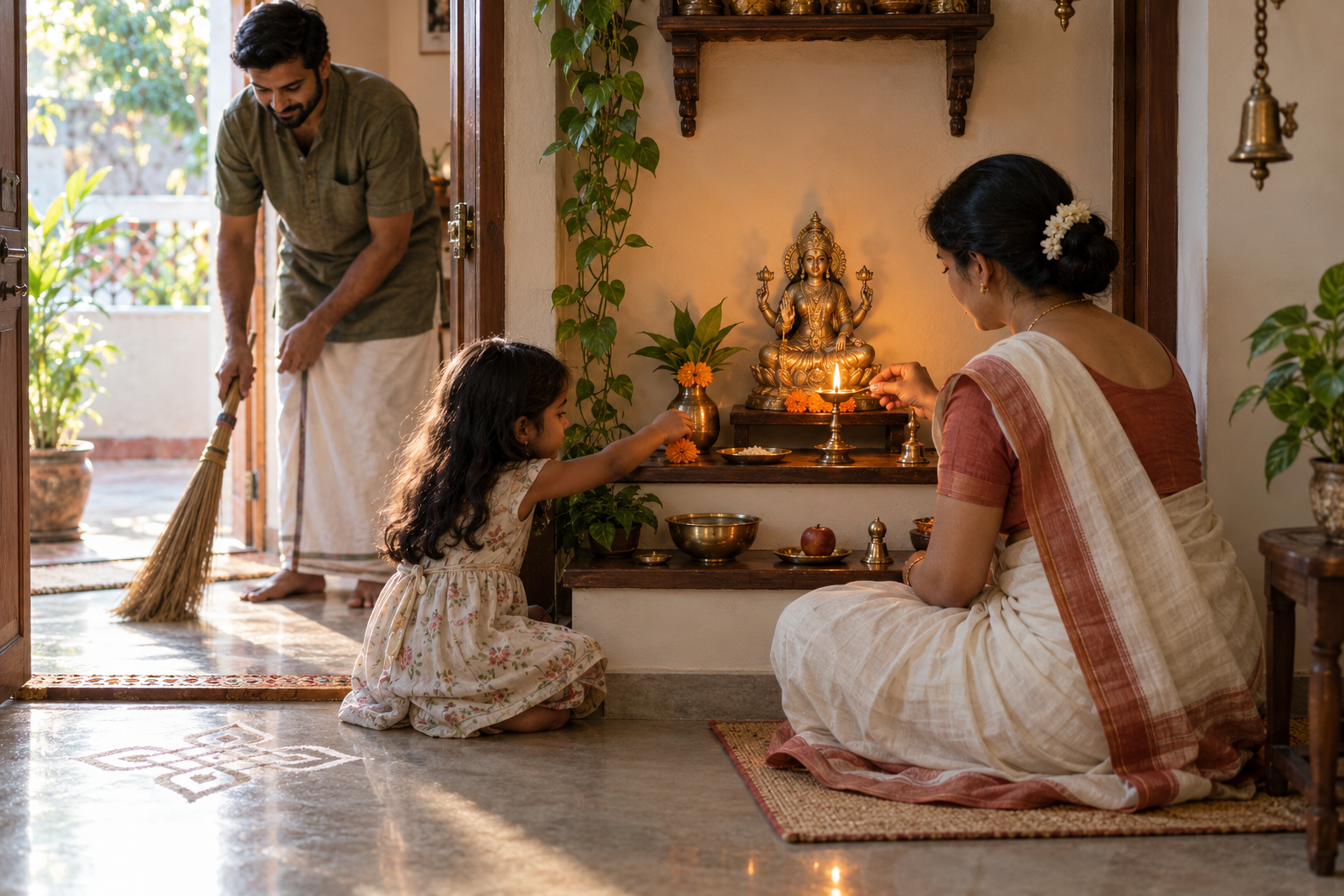
A modest observance performed attentively is more useful than an elaborate arrangement that leaves you anxious, indebted, or dependent on instructions you do not understand. Use the following sequence as a household framework, adapting its devotional details to your family tradition.
- Prepare the place. Wash, wear clean clothes, tidy the worship area, and remove unrelated clutter. Put the phone away. The practical purpose is to give undivided attention rather than conduct puja between distractions.
- Arrange only what you can handle safely. Place the murti or image respectfully. If your custom includes a lamp, keep it on a stable, heat-resistant surface and never leave the flame unattended.
- Offer within your means. Water, a flower, fruit, or food already suitable for your household is enough for a simple observance. Do not borrow money or strain the family budget to make the offering look impressive.
- Recite what you know with care. A familiar prayer, nama-japa, or a hymn learned correctly is preferable to hurriedly repeating unfamiliar syllables. Let attention govern the length of the recitation.
- Make one concrete correction. After the worship, choose an action you can complete promptly: record an ignored expense, pay an amount that is properly due, repair something useful, stop a wasteful purchase, or allocate help responsibly.
The last step protects the practice from becoming wishful thinking. Prayer directs the mind; conduct gives that direction a form. If you repeatedly ask for abundance but never examine how resources enter and leave your life, the missing discipline is not another ornament for the altar.
Let Dhanteras begin a correction, not a shopping deadline

Dhanteras begins the five-day Diwali celebration and falls on the thirteenth day of the dark fortnight of Ashwin, usually in October or November. It is also called Dhanatrayodashi or Dhanvantari Trayodashi. Because its observance follows the Hindu lunar calendar, use the appropriate calendar for the year and your location rather than assuming a fixed Gregorian date.
The commercial atmosphere around the festival can make purchase seem like the main ritual. Buying an object is not automatically wrong, but a purchase becomes a poor symbol of prosperity when it creates avoidable debt, displaces an essential expense, or exists only to satisfy social pressure.
You can turn Dhanteras into a practical annual checkpoint:
- Before the observance: clean the shrine and the place where financial papers are kept. Gather scattered bills, account notices, and records so that hidden disorder becomes visible.
- During the observance: offer gratitude for what already sustains the household. Name duties as well as desires; prosperity has to support both.
- Before a purchase: ask whether the object is useful, affordable without disturbing essentials, and likely to be maintained. If any answer is no, abstaining is the more disciplined choice.
- After the observance: complete one financial or household correction while the intention is still fresh. Devotion gains force when it changes the next decision.
This approach does not turn Dhanteras into a bookkeeping exercise. It prevents the sacred day from being captured by consumption. Cleaning, worship, gratitude, and responsible acquisition can then point in the same direction.
Keep advanced recitation and astrology in their proper places
Sri Suktam is a Vedic hymn dedicated to Lakshmi. A samputita form of Sri Suktam places bija mantras or additional verses around or within the core recitation. This is a structured ritual form, not simply a longer playlist for attracting wealth.
If you have received a method from a competent teacher or inherited one through a living family practice, follow that method rather than combining fragments from unrelated instructions. If you have not, begin with a prayer you understand and seek instruction before attempting samputikarana or homa. A fire ritual also brings an ordinary physical risk: use proper supervision, ventilation, a safe vessel and surroundings, and local fire precautions. When those conditions are absent, choose a non-fire observance.
Claims about multiplied spiritual efficacy belong to the theological and ritual understanding of the practice. They should not be converted into a guarantee of income, business success, debt relief, or investment performance. Sacred recitation may shape intention and discipline; it does not remove the need to examine contracts, costs, risks, and professional advice.
The same boundary matters in Jyotisha. Lakshmi Yoga is described as an auspicious planetary combination associated with wealth and success in Vedic astrology. Within that tradition, a chart may offer a framework for interpretation. It is not proof that riches must arrive, and the absence of such a yoga is not a verdict that you are barred from prosperity.
Keep three kinds of judgment distinct. Puja concerns devotion and the formation of attention. Jyotisha supplies a traditional interpretive framework. Financial decisions concern actual income, obligations, evidence, and risk. Allowing any one of these to impersonate the others invites confusion. Never take a loan, make an investment, abandon employment, or postpone necessary financial help solely because a ritual or horoscope appears favorable.
Key takeaways
- Honor Lakshmi through the way wealth is earned, managed, shared, and used—not through display alone.
- Keep household worship clean, attentive, affordable, and safe. Debt-funded ritual extravagance contradicts the stability being sought.
- Use Dhanteras to inspect obligations and correct one material habit, not merely as a deadline for buying something.
- Learn samputita Sri Suktam or homa through competent instruction rather than assembling an advanced rite from fragments.
- Treat astrological indications as traditional interpretation, never as a guarantee or a substitute for sound financial judgment.
Choose one neglected corner of your material life today: a disordered account, an unpaid duty, a wasteful habit, or an object that needs care. Put it right, then offer your prayer. That small union of reverence and responsibility is a sound place for auspicious practice to begin.
References
- Hindu Pad — Samputitha Sri Suktam Vidhi – Parayana, Samputa Mantra, Homa
- Hindu Pad — 8 Things to do on Dhanteras
- Hindu Pad — Lakshmi Yoga in Horoscope | Planetary Positions

Leave a Reply
You must be logged in to post a comment.