
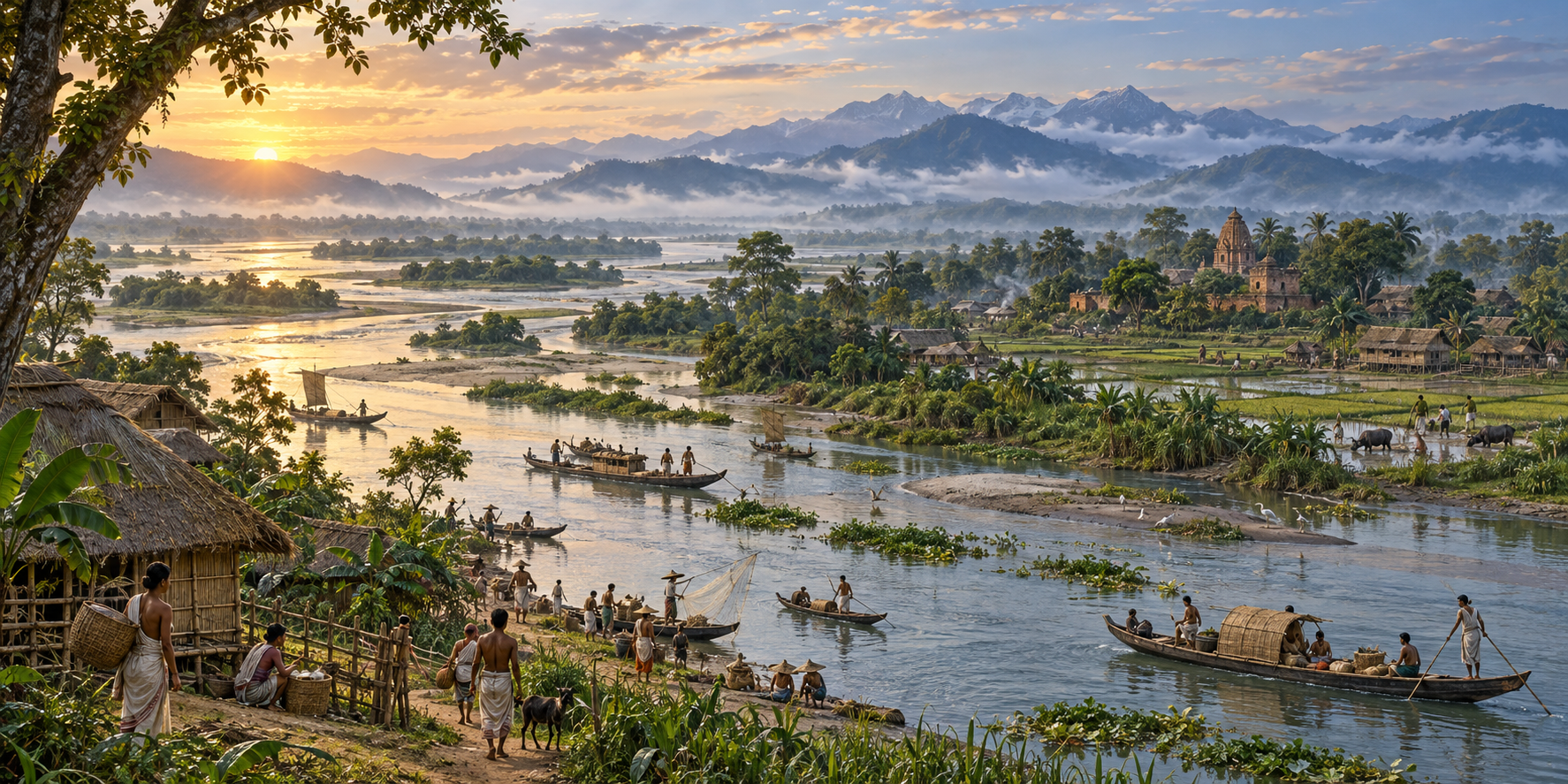
You open a history of Assam and the story seems to start with the Ahoms. That can leave you with a basic but important question: what was there before them?
The useful answer begins with a change of method. Do not treat a dynasty’s arrival as a civilization’s birth. Read the Ahom period as one major chapter in a longer regional history, then look behind the court chronicle for the land, communities, institutions and sacred life that made later political power possible.
Correct the starting point before building the timeline
A history may reasonably begin with the Ahoms when its subject is the Ahom state. It becomes misleading when that same starting point is presented as the beginning of Assam itself. The necessary correction is straightforward: Assam’s history did not begin with the arrival of the Ahoms.
This distinction matters because dynasties do not arrive in historical emptiness. The rise of a new ruling formation presupposes a human landscape with settlements, relationships, inherited practices, local authority and memories of the past. A dynasty can reorganize these things, adopt some of them, challenge others and eventually become inseparable from the region’s identity. It does not follow that it created the region from nothing.
When you encounter a timeline that jumps directly to Ahom rule, therefore, do not reject everything that follows. Mark the scope correctly. You are probably reading the history of a ruling house or a political era, not a complete account of Assam’s civilizational formation.
Define what “before the Ahoms” actually means
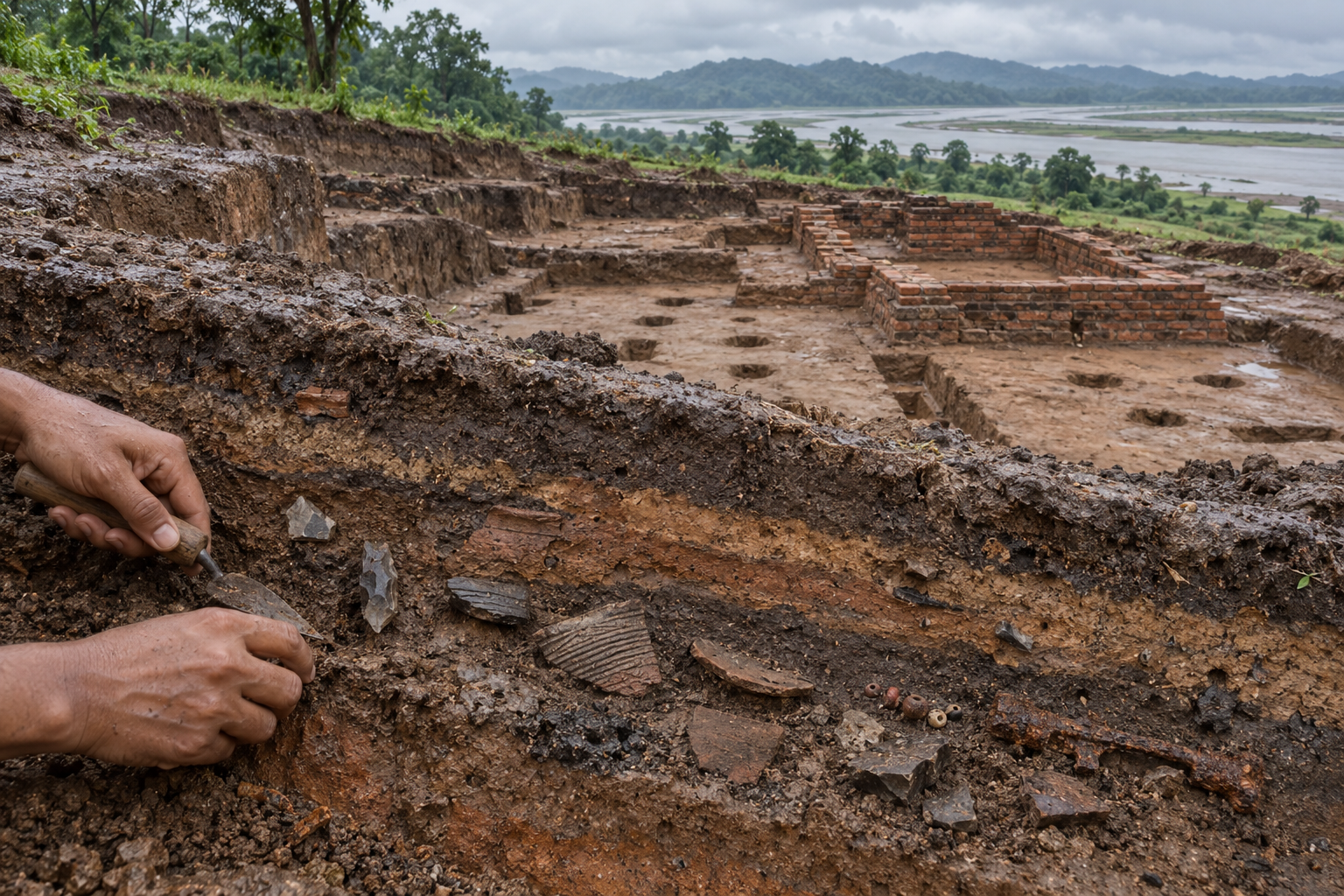
The phrase “before the Ahoms” can conceal two different thresholds: the period before their arrival and the period before their political rise. Those are not automatically the same thing. Arrival describes the presence of a people or leadership group. Political rise describes the development of durable authority. Compressing both into a single starting moment turns a historical process into a creation story.
Use three chronological questions whenever you read about this transition:
- What conditions existed before the arrival of the Ahoms?
- What changed between their arrival and their emergence as a ruling power?
- Which older communities, customs and institutions continued after Ahom authority expanded?
This prevents two opposite mistakes. The first is to imagine an empty land awaiting political organization. The second is to treat the Ahoms as merely incidental, denying the scale of the chapter that followed. A sound account should be capable of holding both truths: Assam had earlier histories, and the Ahom era became a major historical formation.
You should also resist projecting the borders and terminology of present-day Assam unchanged into the distant past. Modern political boundaries are useful for locating a subject, but they are not timeless containers. Historical regions are often shaped by routes, ecological zones, centres of authority, pilgrimage networks and shifting spheres of influence. Ask what territory a claim actually concerns instead of assuming that every use of “Assam” refers to one fixed map.
Read the earlier history through four connected layers
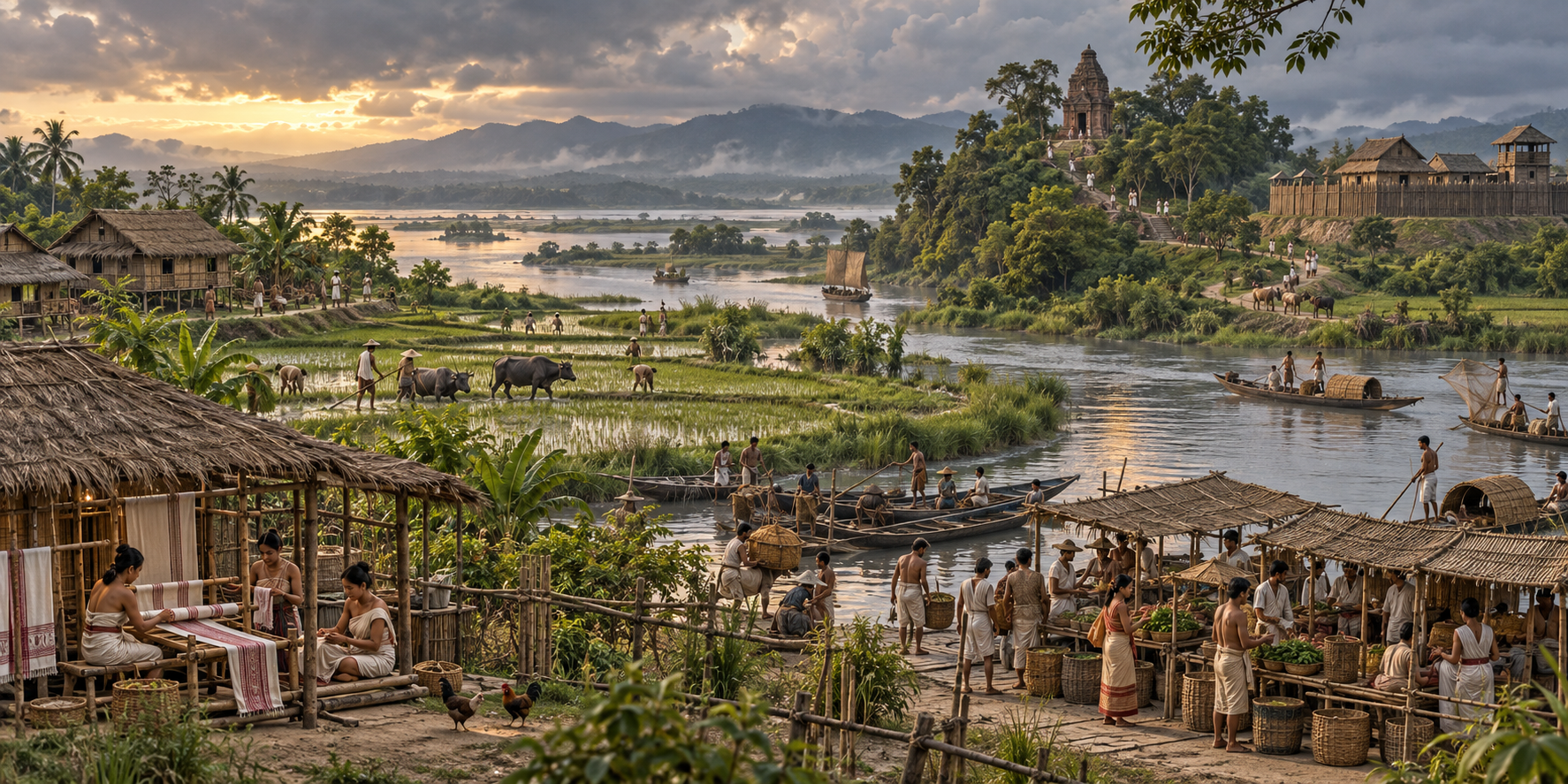
A list of rulers cannot answer what Assam was before Ahom rule. For a fuller picture, test every account against four connected layers. Missing one layer does not necessarily make an account false, but it tells you what kind of history you are receiving.
- Land: How did terrain, water systems, routes and settlement patterns shape contact and political authority? Geography is not background decoration. It affects how people travel, trade, defend territory and sustain institutions.
- People: Which communities inhabited the region, and what evidence identifies them? Be alert to changing names. A name in a later narrative may not correspond neatly to an earlier community or to a present-day identity.
- Power: How was authority exercised before the later dynasty became dominant? Look beyond royal titles to local leadership, alliances, obligations, control of routes and the ability to sustain institutions.
- Dharma and culture: What do sacred geography, ritual practice, religious institutions, memory and patronage reveal? Dharma cannot be reduced to the declared affiliation of a ruler. It also lives through communities, places, practices and inherited moral worlds.
These layers should be read together. A shrine without its surrounding community gives you an incomplete cultural history. A ruler without the routes and settlements that supported authority gives you an incomplete political history. A community name without attention to when and by whom it was recorded may produce a false continuity.
The same discipline applies to evidence. Inscriptions, material remains, coins, chronicles, genealogies, literary traditions and oral memory answer different questions. They are not interchangeable. Instead of asking whether one kind of evidence is simply “reliable,” ask when it was produced, what it was intended to record, whose interests it represented and whether independent evidence corroborates the claim.
A later genealogy may preserve an important memory while arranging the past to legitimize a ruling family. A court narrative may record political events while saying little about ordinary communities. Material evidence can establish presence or activity without explaining how people understood themselves. Historical method begins when these limits are stated rather than hidden.
Notice the shortcuts that erase pre-Ahom Assam
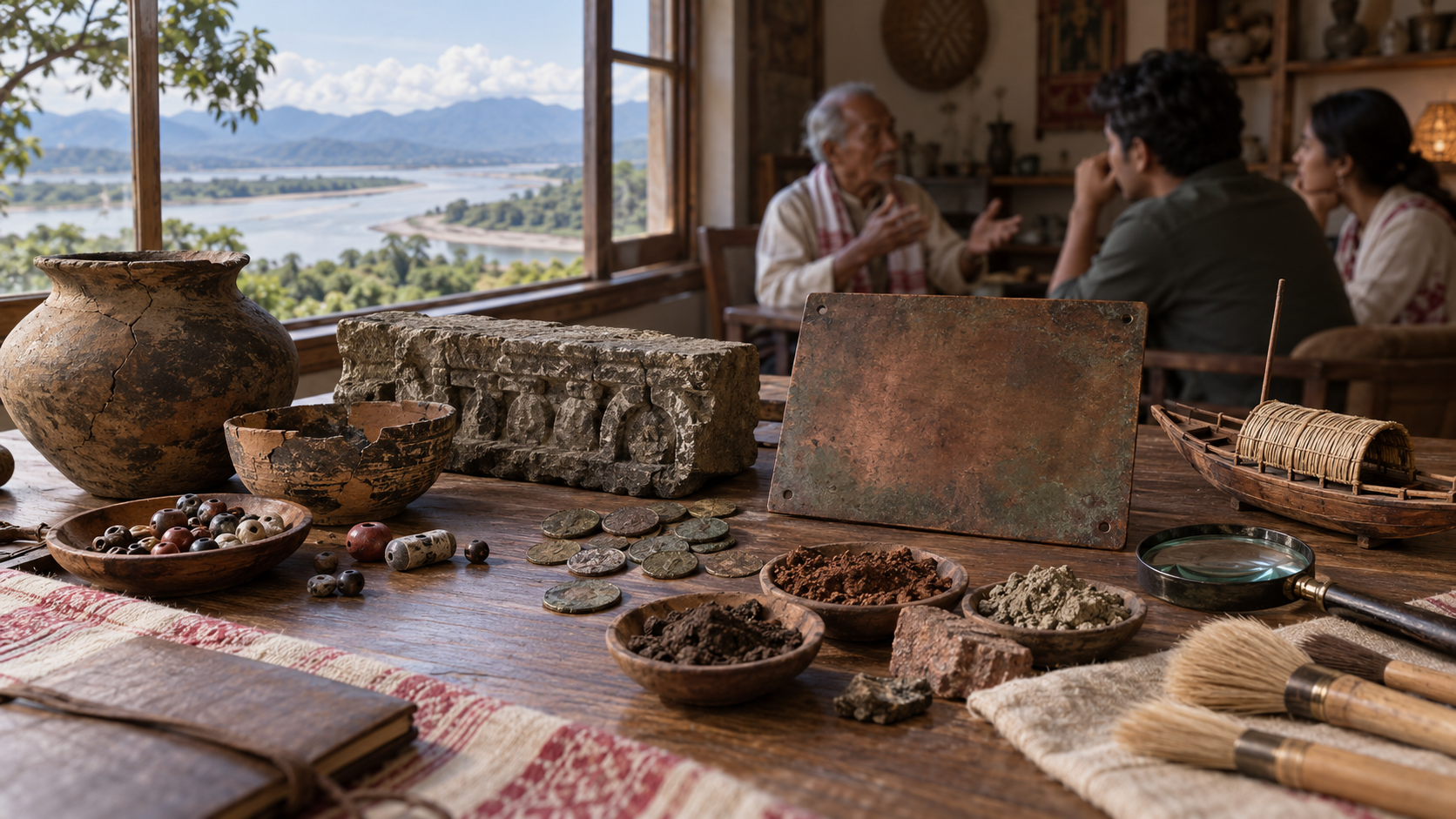
The erasure of an earlier past does not always come from an explicit denial. More often, it enters through the structure of the story. You can spot it by watching for four common shortcuts.
- The dynastic shortcut: The narrative changes rulers and assumes it has explained society. Ask what changed outside the court and what remained continuous.
- The empty-land shortcut: The arrival of a politically successful group is narrated as the beginning of organized life. Ask what population, authority and cultural practices the newcomers encountered.
- The fixed-border shortcut: A modern map is projected backwards without explanation. Ask how the historical region is being defined for the period under discussion.
- The single-identity shortcut: A complex regional past is forced into one modern ethnic, religious or political identity. Ask whether the evidence supports that continuity or whether a later identity is being read backwards.
There is also a subtler problem: treating continuity and change as opposites. A society can preserve sacred practices while changing political allegiance. A new ruling formation can adopt regional institutions while transforming administration. Communities can retain memory while acquiring new names and affiliations. The better question is not “Did everything continue or did everything change?” It is “What continued, what changed, and at what level?”
This is especially important in a Dharmic reading of history. Civilizational continuity need not mean that every institution remained unchanged. Nor does political change prove a total civilizational rupture. Look for transmission through practice, place, language, community memory and institutions rather than demanding an unbroken sequence of identical courts.
Key takeaways for your next reading
- Do not confuse the beginning of Ahom political history with the beginning of Assam.
- Separate arrival from political rise; they describe different stages of historical change.
- Read land, people, power and dharma together instead of relying on a list of rulers.
- Do not project present-day borders or identities backwards without evidence.
- Judge each claim by the date, purpose and limits of the evidence supporting it.
- Look for continuity and transformation at the same time; neither should be assumed in advance.
The next time a timeline begins with the Ahoms, write one question in the margin: “What had to exist for this chapter to begin?” Follow that question through the geography, communities, institutions and sacred life of the region. That is the practical doorway into Assam before the Ahom kingdom, and into a history of Bharat that does not mistake the best-known dynasty for the first page.
References

Leave a Reply
You must be logged in to post a comment.