

You probably recognise Panchajanya as the conch Krishna sounds at Kurukshetra. If your question is how he obtained it, however, the answer begins neither on a battlefield nor in a search for a divine weapon. It begins with a student’s obligation to his guru.
That origin changes how you read the symbol. Panchajanya is not merely an impressive object Krishna carries. It emerges during an act of guru-dakshina, is first sounded during a mission to restore a life, and only later becomes the unmistakable call associated with Krishna.
Key takeaways
- Krishna acquired Panchajanya while fulfilling guru-dakshina for his teacher, Sandipani.
- The conch came from the sea-dwelling daitya Panchajana; its name preserves that connection.
- Finding the conch did not complete Krishna’s mission. He continued to Yama’s city until Sandipani’s son was restored.
- The conch therefore carries a meaning deeper than martial power: duty, resolve and the public announcement of dharmic purpose.
- When you see Krishna holding a conch in sacred art, distinguish general Vishnu iconography from a scene depicting Panchajanya’s origin.
The story begins with a debt to the guru
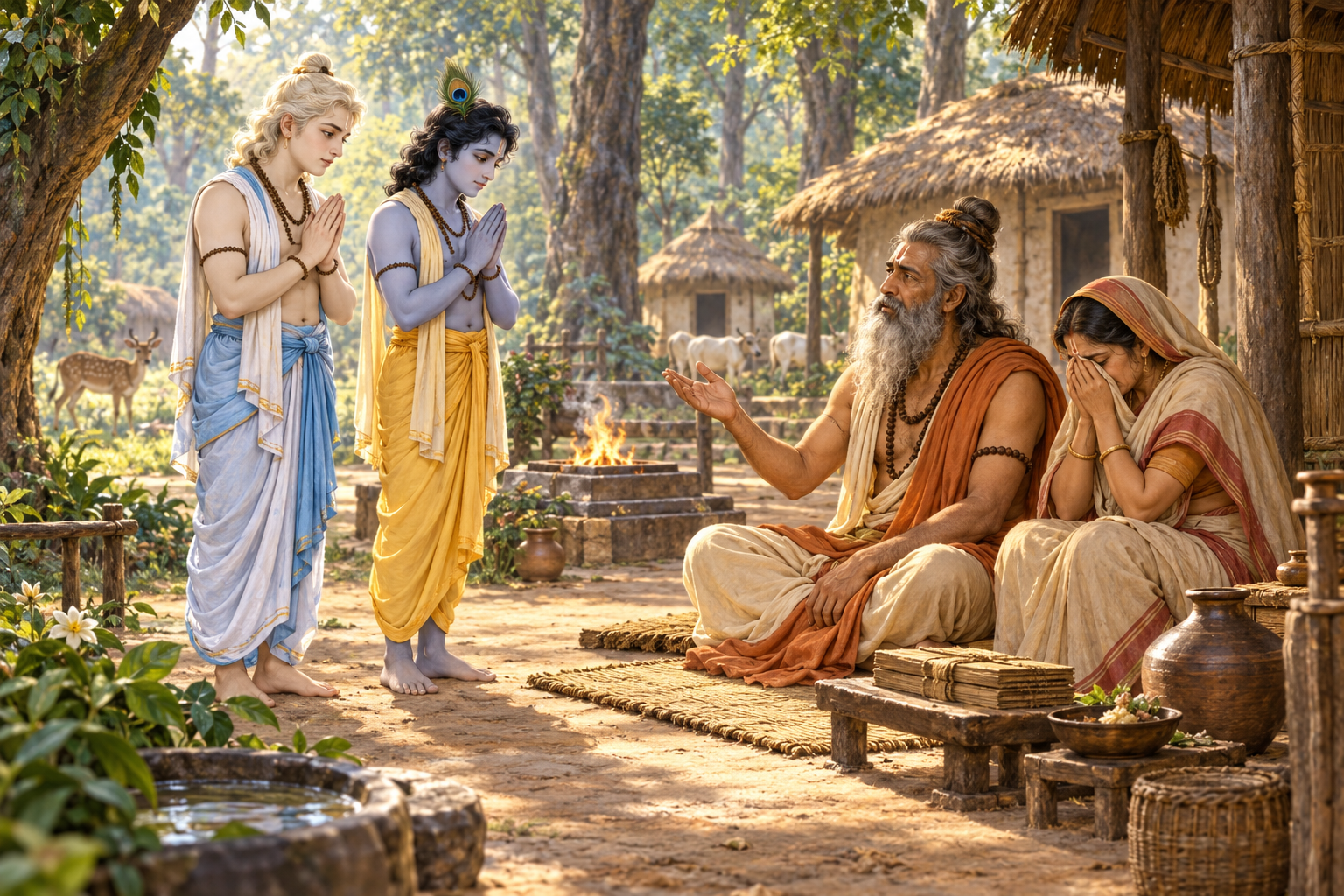
After completing their education under Sandipani, Krishna and Balarama asked what they could offer as guru-dakshina. Sandipani did not ask for cattle, wealth or public honour. He asked for the return of his son, who had been lost at the ocean near Prabhasa. The brothers accepted the request and went in search of him.
The ocean directed them toward a powerful daitya named Panchajana, who moved through the water in the form of a conch. Krishna entered the water and killed him. Yet the expected rescue did not follow: Sandipani’s son was not found within the daitya’s body.
This is the turning point readers often pass too quickly. Defeating Panchajana was not the purpose of the journey. Recovering the boy was. Krishna therefore did not mistake a dramatic victory for completion of his duty.
Krishna took the conch that had arisen from Panchajana’s body and returned to the chariot. He and Balarama then travelled to Samyamani, the city of Yama. At its entrance Krishna sounded the conch. Yama heard the call, received the brothers and returned Sandipani’s son. Krishna and Balarama brought the boy back to their guru, completing the guru-dakshina they had promised.
If you want to remember the account accurately, keep its order intact: the guru’s request, the journey to the ocean, the encounter with Panchajana, the unsuccessful search for the boy, the taking of the conch, the journey to Yama and the child’s restoration. Panchajanya enters Krishna’s hands in the middle of the mission, not at its end.
Why the name Panchajanya matters
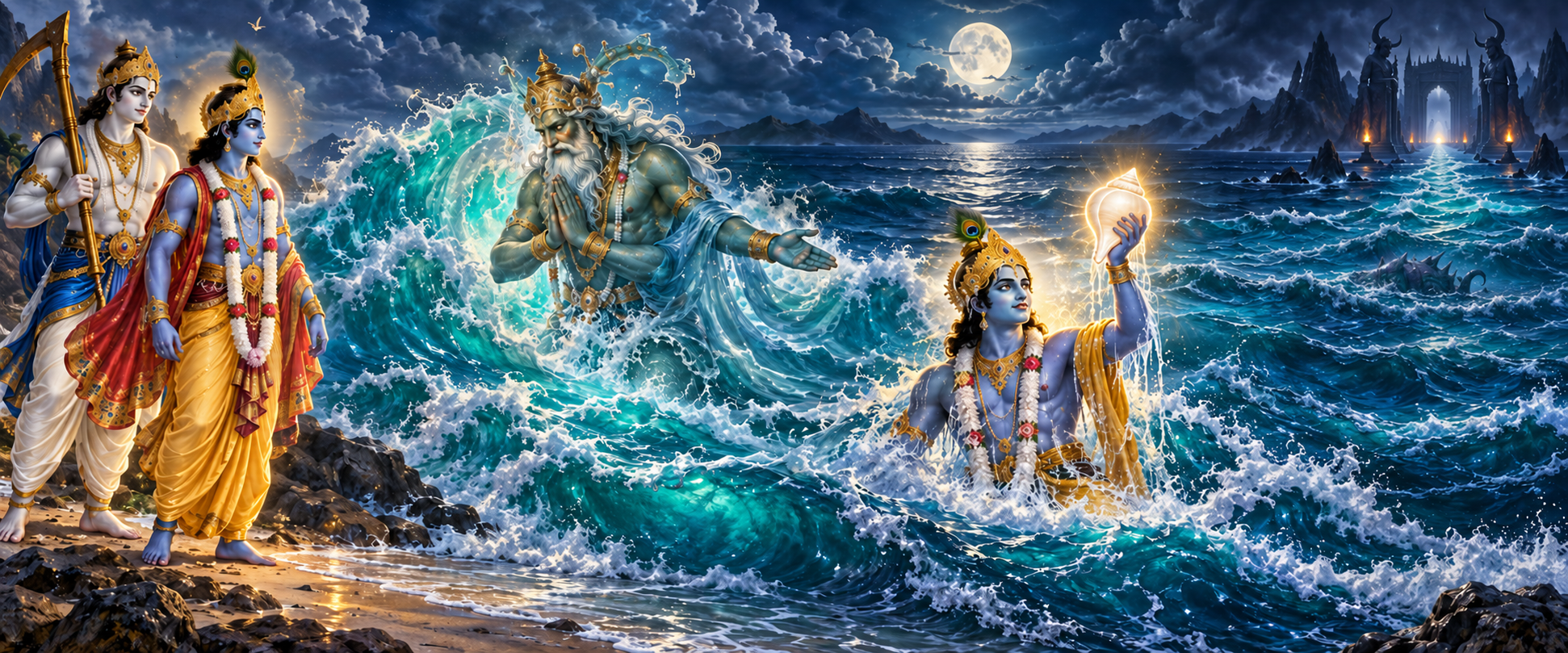
Panchajanya is a proper name, not simply another word for every shankha. Its connection to Panchajana identifies the conch by its origin. A careful retelling should therefore preserve the distinction between Panchajana, the being Krishna encounters, and Panchajanya, the conch Krishna carries away.
This also corrects two common misunderstandings. Krishna did not receive the conch from Sandipani as a reward, and he did not first acquire it at Kurukshetra. It entered his possession during the earlier search for Sandipani’s son. Kurukshetra is where many readers first hear its name, not where its story begins.
Retellings sometimes blur whether Panchajana possessed a conch, inhabited one or had a body that took its form. The narrative used here describes the daitya as moving through the water in conch form and the shell as arising from his body. You do not need to force those images into a modern biological explanation. The essential narrative claim is that Panchajanya came directly from Krishna’s encounter with Panchajana.
That distinction is useful whenever you encounter confident claims about the shell online. Ask whether the speaker is explaining the scriptural narrative, offering a later symbolic interpretation or describing an ordinary ritual conch made in imitation of the divine emblem. Those are three different kinds of claim and should not be treated as interchangeable.
The conch announces purpose rather than replacing action
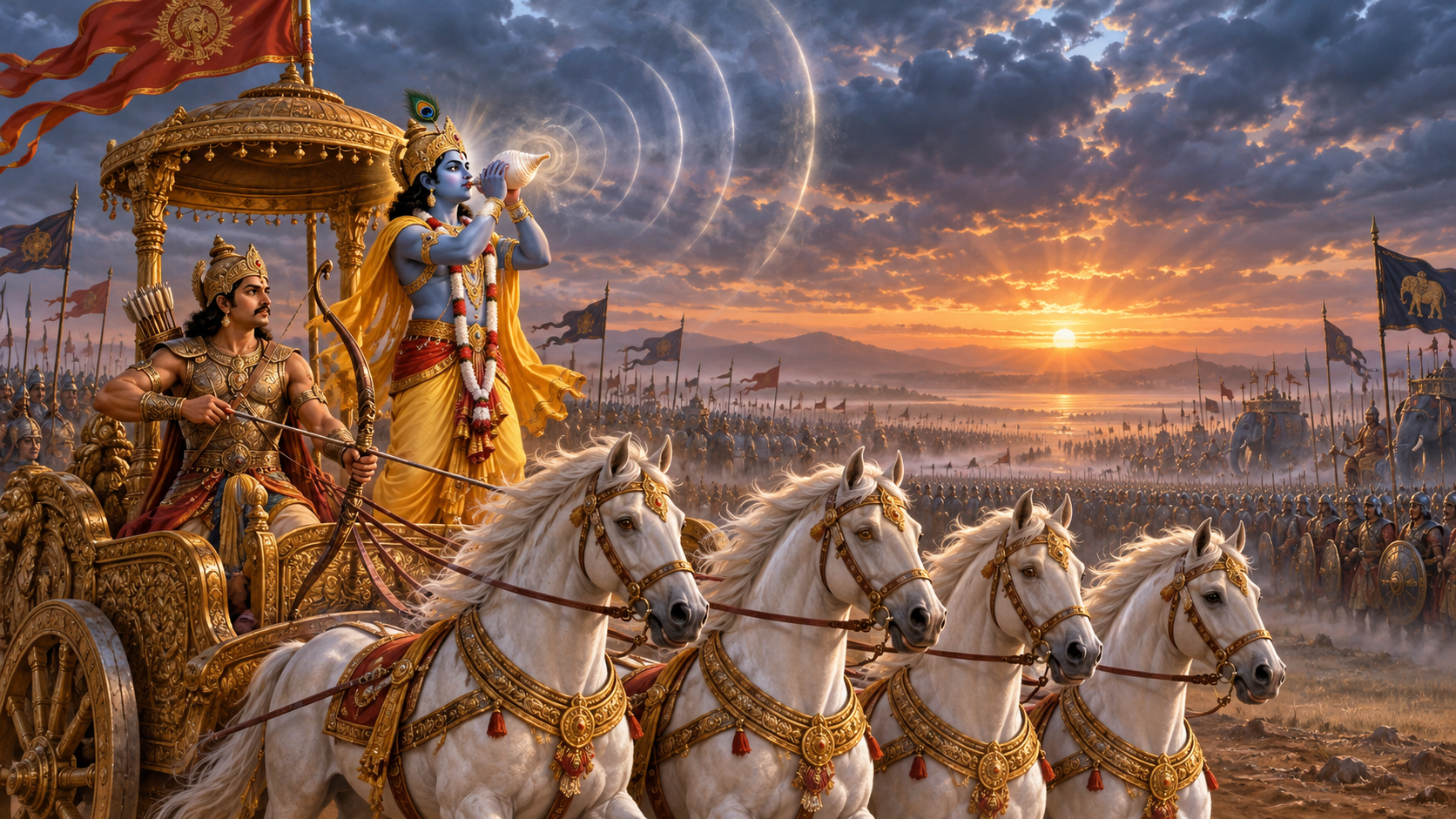
The best-known image of Panchajanya is martial: Krishna sounds it before the armies at Kurukshetra. Its origin gives that battlefield moment a fuller moral frame. The conch belongs to one who accepted a difficult obligation, pursued it past the first obstacle and used power in service of a promised duty.
Notice what the conch does at Samyamani. Its sound announces Krishna’s arrival, but the sound is not a substitute for the mission. Krishna had already entered the ocean, faced Panchajana and continued after discovering that the boy was absent. He then approached Yama for the life he had promised to restore. Panchajanya gives the purpose a voice; it does not perform the duty on Krishna’s behalf.
This keeps devotional symbolism disciplined. You can read the sound as an awakening, a summons or an announcement of dharma, but those meanings should remain anchored to what Krishna actually does. The call is joined to resolve. A grand declaration without faithful action would reverse the order of the story.
The same point helps when explaining why a conch appears in scenes of both sacred worship and war. Calling Panchajanya only a weapon is too narrow. Calling it merely decorative is narrower still. It is an identifying emblem and a heralding instrument whose meaning depends on the dharmic purpose it announces.
How to recognise and teach the Panchajanya story
A conch in Krishna’s hand does not automatically mean that an image depicts this particular episode. Vishnu and Krishna are commonly represented with the conch as a divine attribute. To identify an origin scene, look for narrative companions and settings rather than relying on the shell alone.
- The ocean and Panchajana: these indicate the encounter through which Krishna obtains the conch.
- Balarama beside Krishna: the brothers undertake the guru-dakshina together.
- Yama or the entrance to his city: this points to the stage at which Krishna sounds the newly acquired conch and seeks the boy.
- Sandipani receiving his son: this depicts completion of the original duty.
- Arjuna, a war chariot and assembled armies: these place Panchajanya at Kurukshetra, a later and different setting.
- A conch alongside the discus, mace and lotus: this is likely general Vishnu iconography rather than a sequential retelling of the guru-dakshina episode.
If you are teaching the account to children or discussing it in a study group, resist making the demon-slaying its climax. Use three questions instead: What promise began the journey? Why did Krishna continue after the boy was not found? What did the conch’s sound announce at Yama’s city? Those questions keep attention on duty, perseverance and restoration.
You can apply the same method in your own reading. When Panchajanya appears, pause and identify what comes before the blast and what follows it. Is the conch marking an arrival, declaring readiness or announcing a dharmic course of action? Context will tell you more than an isolated list of symbolic meanings.
Carry the sequence into your own practice

The practical lesson is not that every difficult task will end as miraculously as Sandipani’s request. It is that dharmic commitment is measured by the duty actually accepted, not by the most visible obstacle overcome along the way.
Before making a solemn commitment, name the real obligation. While carrying it out, check whether an impressive intermediate success has distracted you from the promised result. Speak publicly only when your declaration is supported by the work you are prepared to continue. That is a grounded way to let Panchajanya function as more than an admired emblem.
The next time you hear Krishna’s conch invoked, remember the complete movement: service to the guru, descent into difficulty, refusal to stop at a partial victory and the restoration of what had been lost. Then let the sound ask you one direct question: what duty must your words now be followed by?
References

Leave a Reply
You must be logged in to post a comment.