

You notice a thin, ladle-like object in the hand of a Hindu sacred figure. Is it an ordinary spoon, a weapon, or a ritual emblem? The safest way to answer is to look beyond the silhouette. A sruva becomes intelligible through its connection to yajna, the Vedic fire ritual.
Once you recognize that connection, a small sculpted implement can reveal the ritual world compressed into the image. It points to offering, disciplined action, and communication between the human and the divine. The task is to separate what the implement does, what it signals in sculpture, and what it can mean in spiritual reflection.
Key takeaways
- The sruva is a slender sacrificial ladle used in yajna.
- Its meaning begins with its ritual function: it conveys an offering rather than merely decorating the hand of a figure.
- In sculpture, it can evoke the wider sacrificial setting without depicting every part of the rite.
- A narrow object should not be identified from shape alone. The grip, orientation, surrounding attributes, and ritual context all matter.
- A spiritual interpretation may grow from the sruva’s function, but it should not replace the implement’s precise ritual identity.
Start with what the sruva does

The clearest definition is also the most useful: the sruva is a ritual ladle employed in yajna. It belongs to the movement of an offering toward the sacred fire. Its identity therefore rests on function, context, and action together, not on resemblance to an everyday utensil.
This gives you a practical rule for interpreting sacred implements: begin with ritual work before reaching for symbolism. The sruva is first an instrument by which an intended offering is conveyed. Only then does it become an emblem of offering, mediation, or disciplined surrender.
That order matters. Calling the sruva merely a symbol can make the actual rite disappear behind an attractive abstraction. Calling it merely a spoon has the opposite effect: it strips away the sacred action that gives the object its identity. A precise reading holds both facts together. It is a usable implement, and its use carries religious meaning.
The implement also clarifies why material actions matter in Hindu worship. An offering is not left as an inward intention. It is given a form, directed through an ordered act, and placed into a sacred relationship. The sruva stands at that point of transition. It is not the giver, the offering, the fire, or the recipient; it is the channel connecting parts of the rite.
Read the sruva at three distinct levels
The ritual level: an implement of yajna
At the most concrete level, the sruva belongs to sacrificial action. This is the level to state first when you are identifying it for a child, a visitor, or a reader unfamiliar with Hindu ritual. A reliable one-sentence explanation is: “The sruva is a slender ladle used to convey an offering in a Vedic fire ritual.”
That sentence gives the object a name, a function, and a setting. It also avoids claiming that every sculpted ladle records a complete ritual procedure. Exact practice belongs to the particular rite and the tradition conducting it; a stone image is not a substitute for ritual instruction.
The iconographic level: a compact ritual signal
A sculptor cannot always show an entire yajna within a single figure. Placing the sruva in a hand allows one implement to call the wider sacrificial world to mind. The attribute can therefore connect the figure with sacred fire, offering, ritual authority, or participation in yajna.
Notice the limit of that claim. The presence of a sruva establishes a sacrificial association; it does not, by itself, tell you every detail of the scene or prove that a complete yajna is unfolding at the represented moment. Sacred attributes identify relationships and capacities as well as immediate actions.
This is why the implement should not be treated as incidental decoration. Remove it, and the figure’s ritual character may become less specific. Read it correctly, and a seemingly static sculpture begins to imply action: something is prepared, conveyed, and offered.
The contemplative level: intention given a disciplined path
The sruva can also support a spiritual reading because its symbolism grows naturally from its work. It receives without becoming the final possessor. It carries without becoming the destination. It serves by directing something beyond itself.
For a practitioner, this can become an image of disciplined offering. A good intention alone remains private. Dharma asks that intention take an appropriate form and move into action. The sruva offers a compact analogy for that movement: receive carefully, carry steadily, and release what is to be offered.
This contemplative interpretation should be presented as interpretation, not as a replacement definition. The ritual fact comes first. The philosophical meaning is persuasive precisely because it remains anchored in what the implement actually does.
A five-step method for identifying it in sculpture
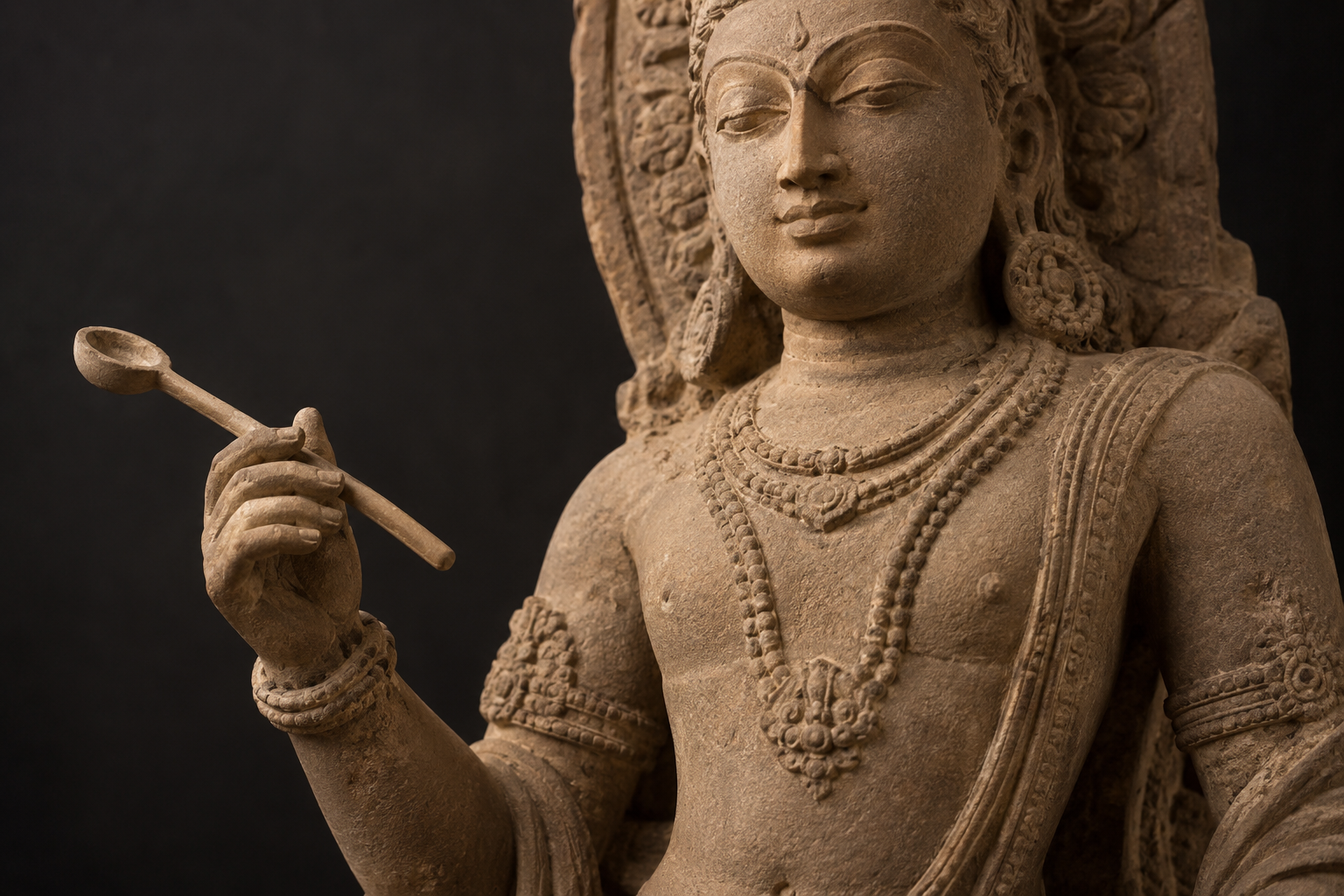
Weathering, scale, and stylization can make ritual objects difficult to distinguish. If you are standing before a temple sculpture or examining a photograph, use the following sequence instead of deciding from one visual clue.
- Inspect the profile. Look for an elongated, slender, ladle-like form. Ask whether the working end resembles something meant to receive or convey a substance rather than a blade, flower, book, or staff.
- Study the hand. A ritual implement is normally held for controlled use or presentation. The grip and angle may be more informative than the object’s outline, especially when the end has been damaged.
- Expand your view to the whole composition. Look for a ritual setting, fire imagery, vessels, offering gestures, or other signs that make a sacrificial reading coherent. Context can strengthen an identification that shape alone leaves uncertain.
- Ask what the identification explains. If reading the object as a sruva clarifies the figure’s relationship to yajna and offering, the interpretation has contextual value. If it explains nothing else in the image, remain cautious.
- Verify before stating certainty. Consult the temple’s traditional identification, a catalogue entry, or a knowledgeable guide when available. If the evidence remains incomplete, call the object “possibly a sruva” rather than turning a plausible reading into a fact.
This method guards against two common errors. The first is treating every long-handled object as the same implement. The second is assuming that one attribute, viewed in isolation, identifies the figure and exhausts the meaning of the sculpture. Hindu iconography works through combinations: posture, hands, companions, setting, and implements reinforce or correct one another.
There is another important boundary. A sculpture can preserve the cultural importance of yajna without functioning as a procedural diagram. Do not reconstruct a fire ritual from the pose of a stone figure. If you intend to participate in or conduct a rite, follow the relevant sampradaya and qualified ritual guidance.
Put the identification to useful work

If you are teaching, begin with the concrete object and then unfold its meanings. Let learners first understand “ladle, offering, yajna.” Add the iconographic idea next: one implement can evoke a larger sacred action. Introduce the philosophical reading last, so reflection remains connected to ritual knowledge.
If you are writing a caption, avoid both vagueness and overclaiming. A careful description might read: “The figure holds a sruva, a slender sacrificial ladle associated with yajna; the attribute places the image within the ritual world of sacred offering.” If the identification is uncertain, preserve that uncertainty explicitly.
If you are commissioning or drawing sacred art, recognizability depends on relationship, not just shape. Preserve the implement’s slender character, but also consider how the hand holds it and how the surrounding composition communicates ritual action. An oversized generic spoon or a rigid weapon-like object can obscure the intended meaning even when the label says “sruva.”
If you encounter the sruva during darshan, you need not stop at naming it. Follow the action implied by the image: intention becomes offering, offering is directed through discipline, and the act reaches beyond the one who gives. That movement is where ritual function and spiritual philosophy meet without becoming confused.
On your next temple or museum visit, take three deliberate steps: identify the form, verify it through the surrounding iconography, and then ask what the act of offering contributes to the image. The sruva is small, but reading it carefully can open the logic of an entire sacred scene.
References

Leave a Reply
You must be logged in to post a comment.