

You may honour Srila Prabhupada’s arrival in America every year and still find it difficult to explain why that moment matters. A date alone cannot carry the meaning. The better question is what his journey asks you to notice about faith, courage, Bharat, and the transmission of Dharma.
The answer begins with a striking contrast. In 1965, one mendicant reached the United States. What he represented was much larger than one traveller: a living devotional inheritance that could cross an ocean without treating its Bharatiya origin as something to hide.
Remember the event without enlarging the claim
Start with the firm historical core: Srila Prabhupada made his 1965 voyage to America. That is enough to establish the event’s significance. You do not need decorative details, doubtful anecdotes, or inflated language to make it impressive.
This discipline matters because devotional history is often weakened by careless retelling. A speaker combines the arrival, the later mission, and everything that followed into one seamless legend. A listener then cannot distinguish the documented event from its interpretation.
Keep three layers separate whenever you teach or discuss the anniversary:
- Event: Srila Prabhupada arrived in America in 1965.
- Meaning: a Bharatiya devotional teacher carried his spiritual calling beyond India’s geographic boundaries.
- Legacy: later developments belong to the continuing story and should not be compressed into the arrival itself.
This distinction does not diminish the achievement. It makes your account more trustworthy. When a detail cannot be verified, leave it out or identify it as tradition rather than presenting it as established history.
Read the “lone mendicant” image correctly
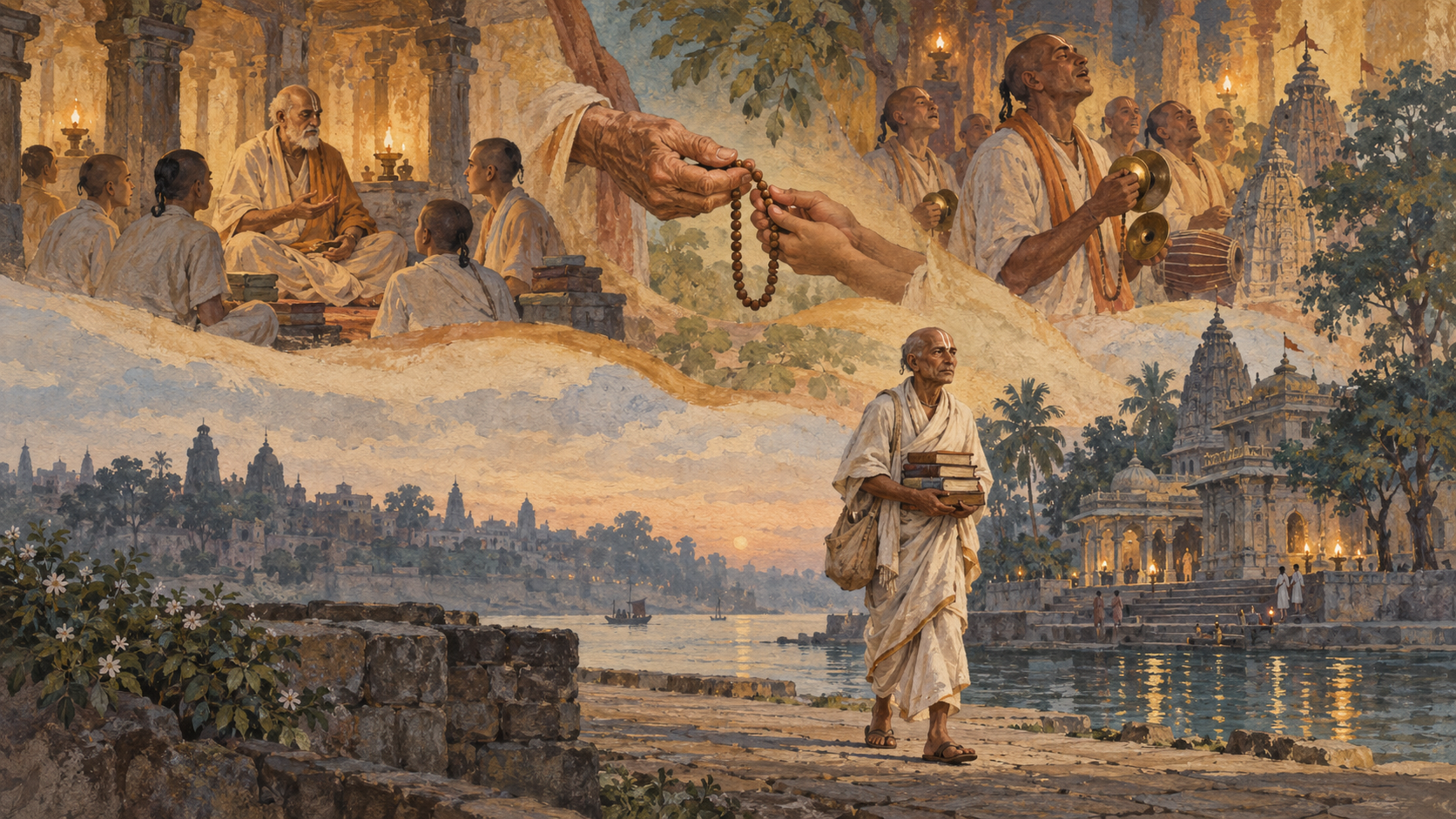
The phrase “lone mendicant” gives you a useful way to contemplate the arrival, but both words need care.
“Lone” describes the human vulnerability of the scene. It directs your attention away from numbers, institutional power, and social status. It does not mean that Srila Prabhupada was spiritually self-created or detached from an inherited tradition. A teacher may stand physically alone while carrying obligations, teachings, disciplines, and relationships received through a lineage.
“Mendicant” does not merely mean a traveller with few possessions. In a religious setting, the word points to a life in which ordinary material security has been subordinated to a spiritual vocation. That is why the arrival should not be retold as a conventional success story about an ambitious individual seeking a new market. Its moral centre is service, not self-invention.
This corrects a common misreading. Modern culture often turns every demanding journey into a celebration of personal branding, independence, or worldly achievement. Srila Prabhupada’s arrival asks you to look instead at fidelity: what does a person do when service must continue beyond familiarity, comfort, and recognition?
Use that question in your own observance. Do not ask only, “What did he accomplish?” Also ask, “What duty was he prepared to carry when visible success was not assured?” The second question moves the anniversary from admiration to self-examination.
Universal Dharma does not have to become rootless
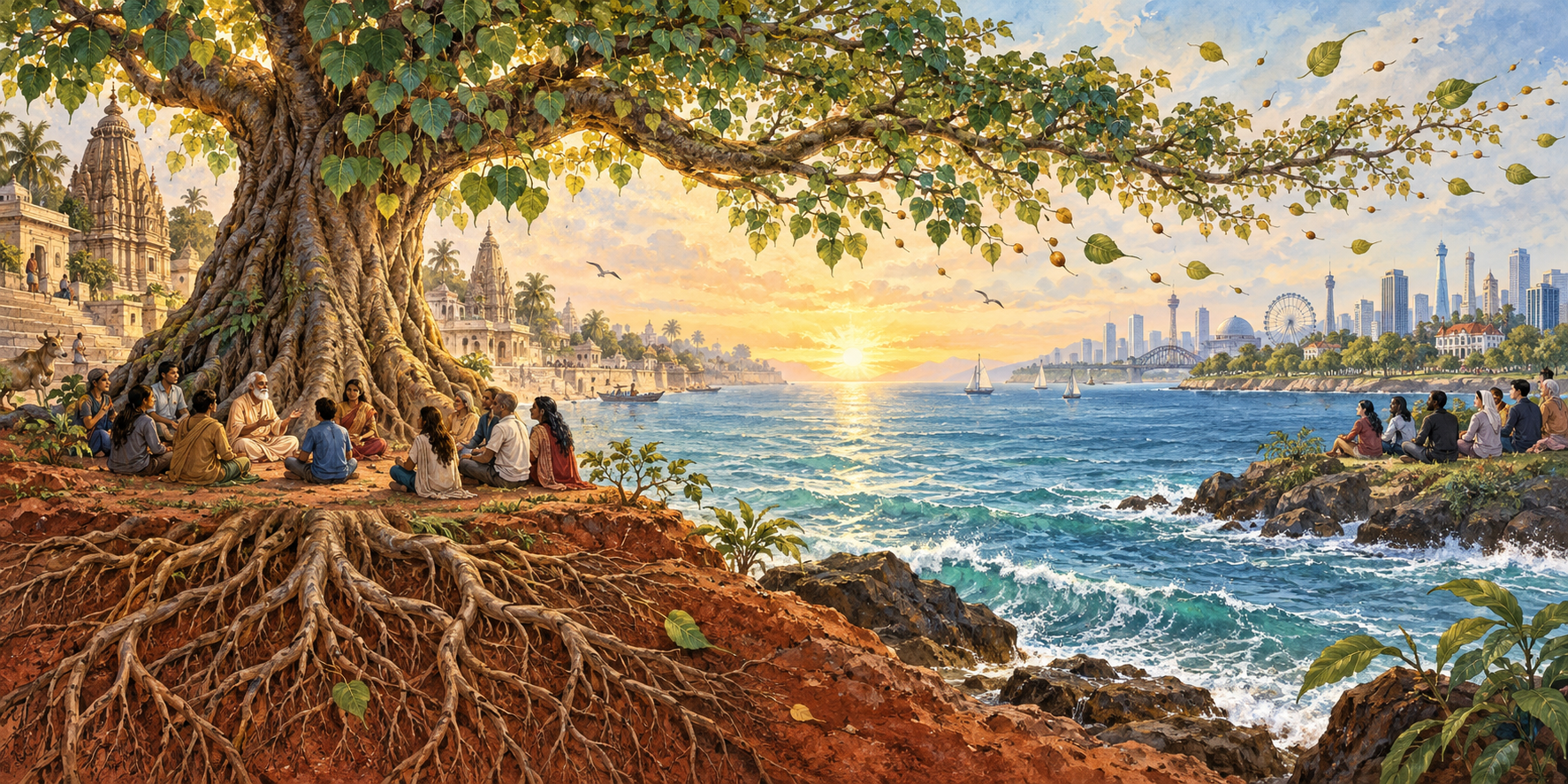
Srila Prabhupada’s arrival matters to readers concerned with Bharat’s influence on the world because it challenges two opposite errors.
- The first error is cultural enclosure: the assumption that a tradition born in Bharat can speak meaningfully only to people of Indian ancestry.
- The second error is cultural erasure: the assumption that a teaching becomes universal only after its Bharatiya roots are made invisible.
You do not need either position. A tradition can address human beings across borders while remaining honest about where it came from. Universality means that truth can be received beyond one ethnicity or nation. Rootlessness means hiding the history, vocabulary, disciplines, and civilizational setting through which that truth was preserved. They are not the same thing.
When you explain the arrival to a non-Hindu friend, say plainly that Srila Prabhupada carried a Bharatiya devotional inheritance to America. Then explain its purpose in accessible language. Translation should remove an unnecessary barrier to understanding; it should not remove the tradition’s identity.
Precision also prevents another mistake: flattening every Dharmic path into a single undifferentiated system. Srila Prabhupada’s journey belongs to a particular devotional inheritance, even as it forms part of the wider history of Bharat’s spiritual influence. Respect for the larger Dharmic family grows stronger when its distinct traditions are represented accurately.
A practical observance for a home, temple, or study circle

An anniversary becomes useful when remembrance changes attention and conduct. You can use the following sequence with adults, young people, or a mixed gathering. It requires no elaborate programme.
- State the verified core. Begin with Srila Prabhupada, the 1965 voyage, and the arrival in America. Keep later episodes separate so participants can see where this chapter actually begins and ends.
- Consider the two defining words. Ask each participant what “lone” reveals about vulnerability and what “mendicant” reveals about motive. Correct any interpretation that turns spiritual service into a story of personal fame.
- Place Bharat and America on a map. This simple act is especially effective with children. It turns “taking Dharma abroad” from a slogan into a visible movement between two civilizational settings.
- Separate fact from reflection. Write one historically verifiable statement and one statement about what the event means to you. Labelling them correctly teaches both reverence and intellectual honesty.
- Choose one act of transmission. Explain one Dharmic idea to a newcomer without jargon, share a reliable teaching, assist a devotional gathering, or strengthen one part of your own sadhana. Choose something concrete enough that you will know whether you did it.
If you are speaking to children, do not ask them merely to memorise the year. Ask them to explain why someone might carry a spiritual duty far from familiar surroundings. If you are leading adults, ask what must remain unchanged when Dharma enters a different culture, and what may be translated to make understanding possible.
End the observance with a commitment rather than a compliment. Admiration keeps the historical figure at a safe distance. A specific act of study, practice, service, or clear communication allows remembrance to shape your own life.
Key takeaways
- Srila Prabhupada’s arrival in America belongs to the history of 1965; keep that event distinct from everything that followed.
- “Lone” describes visible vulnerability, not separation from a spiritual inheritance.
- “Mendicant” places service and vocation at the centre of the journey, not personal ambition.
- A teaching can address the world without concealing its roots in Bharat.
- The strongest commemoration joins accurate history to one concrete act of study, sadhana, service, or transmission.
At the next anniversary, resist the temptation to add more spectacle. Tell the verified story clearly, preserve its Bharatiya and devotional character, and decide what part of its example you will carry forward. That is how an arrival in 1965 becomes a living question for you now.
References

Leave a Reply
You must be logged in to post a comment.