
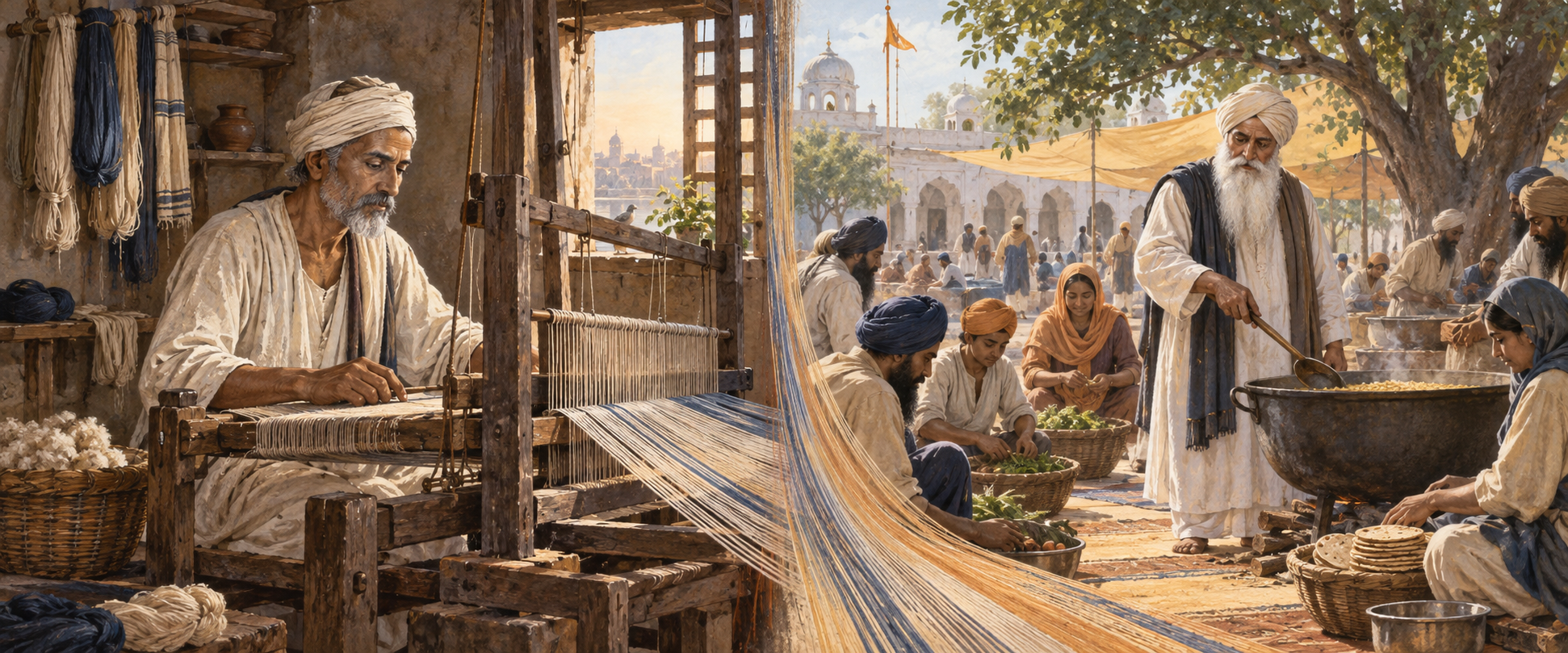
If you have wondered why Sikh spiritual memory makes room for both a weaver-poet and a community elder, you are asking a useful question. A tradition is formed not only by who speaks truth, but also by how people learn to receive, embody, and preserve it.
Bhagat Kabir Ji and Baba Budha Ji illuminate those different tasks. Kabir Ji helps you test religious speech for honesty. Baba Budha Ji helps you test service and leadership for steadiness. Read together, they offer a practical way to recognize Sikh spirituality in action: remembrance that exposes ego, and responsibility that survives changes in personality or circumstance.
Begin by respecting their different kinds of authority
The first mistake is to arrange every revered Sikh figure on a single ladder. Guru, Bhagat, and Baba are not interchangeable titles. They identify different relationships to revelation, teaching, service, and the Panth. Respect does not require collapsing those distinctions.
Bhagat Kabir Ji’s bani belongs to the scriptural life of Sikhs. Baba Budha Ji is remembered through a life associated with the Gurus, the sangat, spiritual maturity, and dependable service. One confronts the listener through utterance; the other demonstrates how spiritual commitments can be carried through communal responsibility.
This distinction gives you a sound reading rule: ask what kind of witness you are encountering before asking what lesson to draw from it. Is the figure giving voice to spiritual truth, embodying disciplined service, preserving communal continuity, or doing more than one of these? That question prevents reverence from becoming vagueness.
It also keeps the Guru at the center. A formative personality in Sikh history should not become a substitute object of personality worship. The proper test is where the person’s words and conduct direct your attention: toward the self, or toward the Guru, truthful living, and service to the sangat.
Kabir Ji turns devotion into a test of honesty

Bhagat Kabir Ji is remembered as an unlettered weaver whose spiritual legacy endured. That description matters because it separates wisdom from social prestige. Formal learning can refine understanding, but status, vocabulary, and institutional position cannot manufacture spiritual realization.
Do not misread this as contempt for study. Kabir Ji’s challenge is sharper: learning must answer to truth. A well-informed person can still be ruled by pride, while a person without scholarly credentials may see through a religious performance that has lost its inner purpose. The relevant question is not whether learning matters, but whether learning changes the learner.
Kabir Ji is especially valuable when religion starts protecting appearance. External observance, inherited identity, eloquent argument, and public piety can all become shelters for the ego. His searching voice asks whether remembrance has penetrated conduct. If anger, contempt, dishonesty, or superiority remain untouched, the religious image has outrun the inner work.
That does not make every form or observance empty. Discipline, recitation, congregational practice, and inherited forms can orient a person toward the Divine. The problem begins when the form is treated as proof of transformation. Use Kabir Ji’s bani to examine that gap, not to congratulate yourself for seeing hypocrisy in someone else.
When you read a shabad associated with Kabir Ji, resist the temptation to extract a dramatic line for an argument or a social-media image. Keep its ang reference, read the whole shabad, and notice both the error being exposed and the spiritual alternative being offered. A critique of pride is incomplete if you never identify the humility, remembrance, or truthful conduct demanded in its place.
Baba Budha Ji makes steadiness a spiritual discipline

A community needs more than piercing speech. It also needs people who can be trusted with continuity. Baba Budha Ji is remembered as a pillar of Sikh spirituality and leadership, joining inward maturity to sustained responsibility.
That pairing corrects a common misunderstanding of leadership. Spiritual leadership is not merely the ability to speak persuasively, win agreement, or occupy a visible position. It is the capacity to carry a duty without turning the duty into personal property. The leader’s role is custodial: receive responsibly, serve faithfully, and pass on what should not depend on one personality.
This is a useful standard for a gurdwara committee, volunteer group, family responsibility, or educational initiative. Before judging a leader by charisma, ask:
- Does the person’s influence direct people toward the Guru and the sangat, or make the group increasingly dependent on that individual?
- Are ordinary duties carried out reliably when there is no public recognition?
- Can responsibility pass to another sevadar without secrecy, resentment, or disorder?
- Are standards upheld without humiliation, factionalism, or self-exaltation?
- Does the work leave the community more capable of serving after the leader steps aside?
Humility here is not timidity. A passive person can avoid responsibility just as easily as a proud person can dominate it. Steadiness requires judgment, patience, and the willingness to protect a shared direction. Its spiritual character lies in refusing to treat power, access, or seniority as personal possession.
Read the prophetic voice and the serving life together

Kabir Ji’s searching challenge and Baba Budha Ji’s steady service correct the possible shadow in each other. Critique without service can become another performance of superiority. Continuity without self-examination can harden into lifeless routine. Sikh spiritual formation needs the courage to expose falsehood and the discipline to sustain what is true.
This balance also helps when you place Sikh tradition within the wider Dharmic world. Shared civilizational settings, ethical concerns, and spiritual vocabulary can illuminate genuine connections. They should not be used to dissolve every tradition into a generic mysticism. Begin with how Sikh scripture and Sikh memory receive a figure. Only then make comparisons, and state both the common ground and the difference.
Kabir Ji need not be forced into a later communal label before his bani can be heard within Sikh tradition. Nor should his inclusion be used to imply that doctrinal distinctions are meaningless. The more disciplined conclusion is that inherited status does not monopolize spiritual truth, while the Sikh scriptural setting gives that received voice a particular place and meaning.
Key takeaways
- Kabir Ji teaches you to test religious identity, learning, and observance by the transformation they produce.
- Baba Budha Ji teaches you to test leadership by service, continuity, and freedom from possessiveness.
- Different Sikh honorifics should be respected rather than flattened into a single rank or role.
- Spiritual criticism should result in humbler conduct, not a new reason to feel superior.
- Reliable seva gives inward devotion a durable form in the life of the sangat.
Put these voices to work in your next reading
You do not need to master an entire historical period before these formative voices can change your practice. Use the following method with one Kabir shabad and one responsibility you already hold:
- Anchor the reading. Record the ang reference and read the complete shabad rather than an isolated translated line. If you depend on translation, keep unfamiliar key terms visible instead of assuming that one English equivalent exhausts their meaning.
- Name the exposed refuge. Identify exactly where the shabad locates self-deception: pride, appearance, mechanical practice, hollow speech, or some other shelter of the ego. Apply the diagnosis to yourself before applying it to a group you dislike.
- Name the demanded alternative. Write down the positive movement of the shabad. A spiritual critique should point toward remembrance, humility, truthful conduct, or another concrete reorientation.
- Pair insight with seva. Choose an existing duty that benefits other people and perform it without seeking added visibility. Let Baba Budha Ji’s model of dependable responsibility test whether the reading has entered your conduct.
- Invite correction from the sangat. Discuss your interpretation with a knowledgeable Sikh reader or teacher. Keep three things separate in your notes: the actual words of the shabad, your interpretation of them, and the action you propose to take.
That final separation is important. It prevents a personal application from being presented as the only possible meaning of Gurbani. It also makes discussion more fruitful: another reader can question your interpretation without dismissing the text, or refine your proposed practice without weakening the principle behind it.
At your next reading or committee meeting, carry two questions with you: What ego is being exposed, and what service must become more reliable? Let the answer change one real duty before you collect another inspiring quotation.
References
- SikhNet – The Unlettered Weaver’s Lasting Legacy
- SikhNet – A Pillar of Sikh Spirituality and Leadership

Leave a Reply
You must be logged in to post a comment.