
You have probably encountered truti, lava, or kshana in a discussion of Hindu timekeeping and wondered whether they are poetic expressions or measurable units. In the reckoning examined here, they form a precise hierarchy, and all three can be converted into seconds.
The hierarchy is more useful than an isolated list of decimal values. Once you know its two ratios, you can convert a passage, check someone else’s calculation, and describe this part of Bharat’s intellectual heritage without making claims that the evidence cannot support.
The three units form one simple ladder
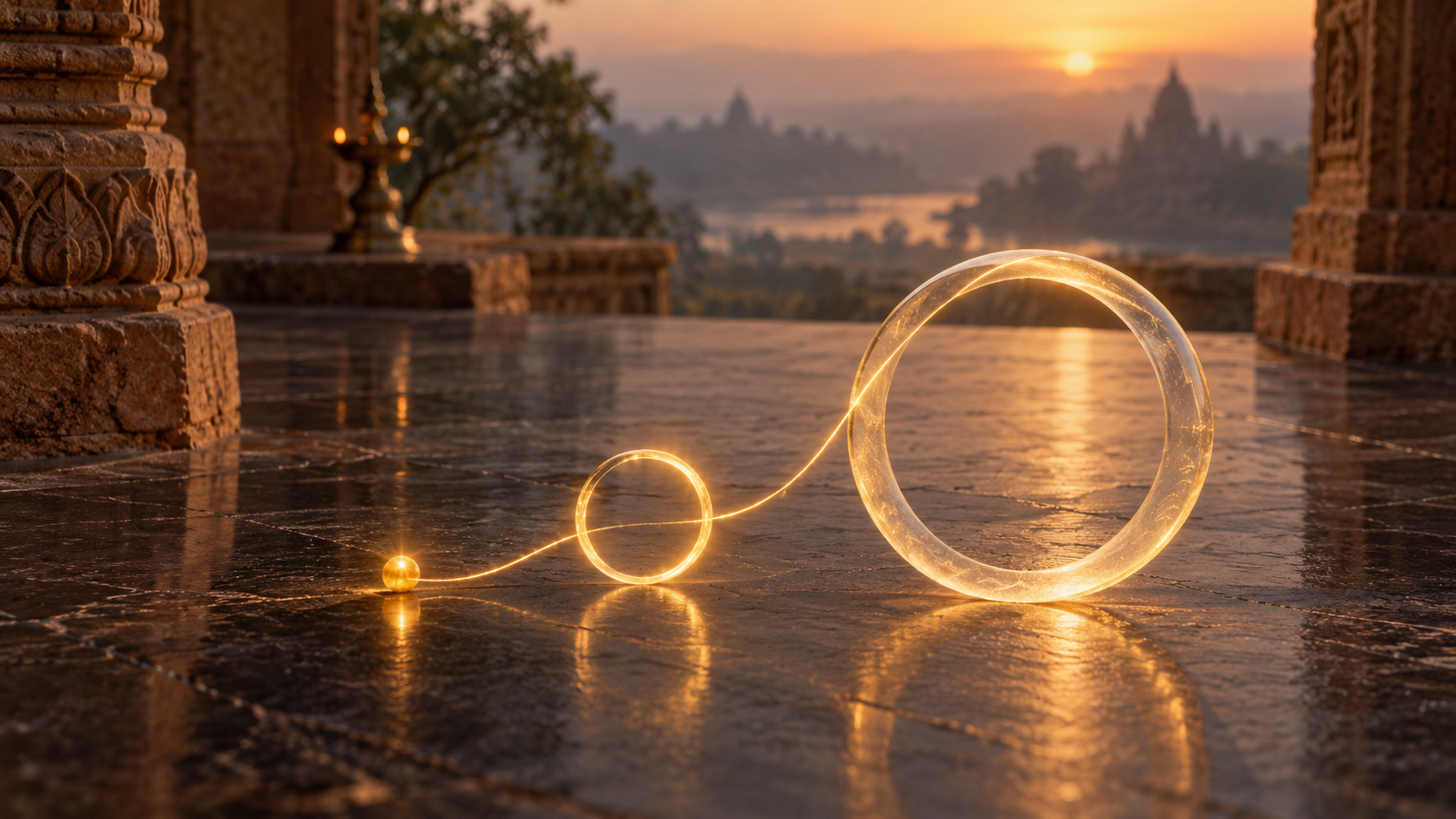
In this Mahabharata-linked reckoning, a kshana is associated with one twinkling of the eye and is taken as four-fifths of a second. A lava is one-sixth of a kshana, while a truti is half of a lava.
| Unit | Relationship | Equivalent within this reckoning | Decimal value |
|---|---|---|---|
| Kshana | 6 lava or 12 truti | 4/5 second | 0.8 second |
| Lava | 1/6 kshana or 2 truti | 2/15 second | About 0.1333 second |
| Truti | 1/2 lava or 1/12 kshana | 1/15 second | About 0.0667 second |
The complete relationship is therefore:
1 kshana = 6 lava = 12 truti.
If the unfamiliar names make the order difficult to remember, begin with the smallest unit. Two trutis make one lava, and six lavas make one kshana. Building upward this way also prevents the common mistake of reversing lava and truti.
How to convert the units without losing their meaning
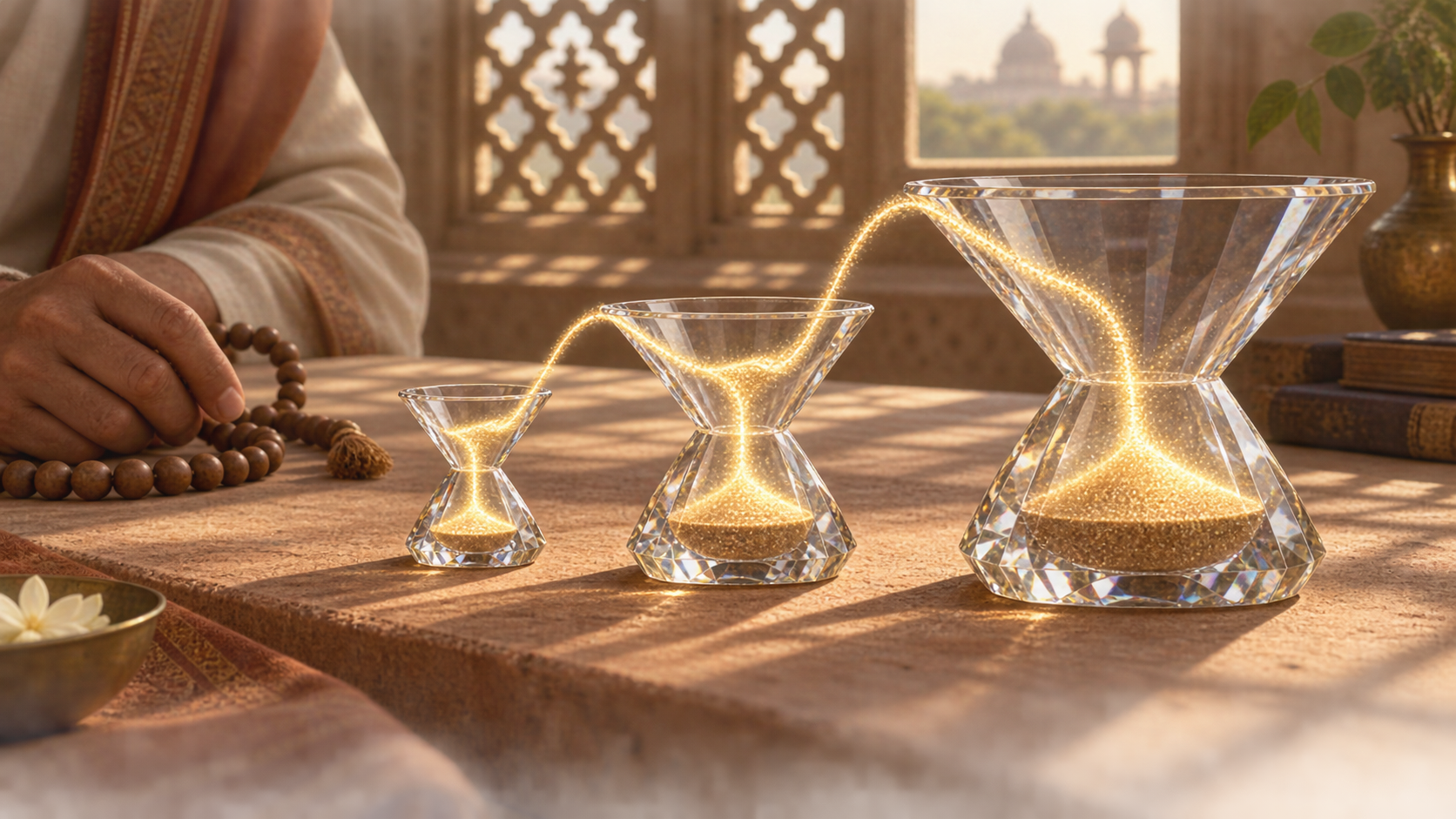
Use the traditional ratios first and convert to seconds only at the end. This keeps the internal structure visible and avoids unnecessary rounding.
- Identify the original unit. Do not replace the Sanskrit term immediately; it may matter to the passage you are reading.
- Normalize the quantity. Multiply kshanas by 12 to obtain trutis, or multiply lavas by 2.
- Convert only if needed. Because one truti equals 1/15 second in this reckoning, divide the number of trutis by 15.
- Label the result. Present the decimal as a conversion within this particular reckoning, not as the only possible meaning of the Sanskrit word in every context.
Three worked examples
Three kshanas: Multiply 3 by 4/5. The result is 12/5 seconds, or 2.4 seconds.
Nine lavas: Each lava is 2/15 second, so 9 lavas equal 18/15 seconds. Reduce the fraction to 6/5, which is 1.2 seconds.
Twenty-four trutis: Divide 24 by 15. The result is 8/5 seconds, or 1.6 seconds. You can verify it another way: 24 trutis make 2 kshanas, and 2 multiplied by 0.8 second also gives 1.6 seconds.
For a translation or annotation, the clearest form is usually the original quantity followed by the conversion in parentheses: “nine lavas (1.2 seconds in this reckoning).” The reader sees both the traditional vocabulary and the modern comparison, while your wording makes the scope of the conversion explicit.
An eye twinkle is a definition, not a stopwatch test
The description of a kshana as the time of an eye twinkle gives the unit an embodied point of reference. It connects an abstract interval to an action that a person can readily imagine. The assigned value of four-fifths of a second then allows the smaller units to be expressed mathematically.
You should not reverse that logic by timing a person’s literal blink and treating the result as a new canonical value. Human movements vary, whereas the calculation depends on the stated value of the kshana. Use the fixed ratio when doing arithmetic; use the eye-twinkle description to understand how the interval was conceived.
The distinction also keeps historical claims proportionate. These definitions support the conclusion that Hindu tradition named and related intervals shorter than a second. By themselves, they do not establish what timing instruments were used, how measurements were experimentally verified, or whether every Sanskrit text employed the words identically.
That restraint does not diminish the achievement. The important feature is the relational thinking: a perceivable moment was divided into successively smaller parts, and those parts were given names. If you are discussing Bharat’s intellectual heritage, that defensible observation is stronger than attaching an undocumented technological claim to it.
Quick questions about truti, lava and kshana
Which is the smallest of the three units?
Truti is the smallest. Two trutis equal one lava, while twelve trutis equal one kshana.
How many of these units equal one second?
Within this reckoning, one second equals 15 trutis, 7.5 lavas, or 1.25 kshanas. The truti provides the cleanest whole-number conversion, so it is normally the easiest unit to use as the basis for calculations.
Can these values be applied to every Hindu text?
Do not assume so without checking the context. When you cite the values, say that you are using this Mahabharata-linked reckoning and state the defining relationship: one kshana equals six lavas or twelve trutis. That single line lets another reader verify every conversion you make.
When you next meet one of these terms, write “1 kshana = 6 lava = 12 truti” beside the passage before reaching for a decimal. You will preserve the traditional structure, calculate accurately, and give the reader a modern comparison without mistaking the comparison for the tradition itself.
References

Leave a Reply
You must be logged in to post a comment.