
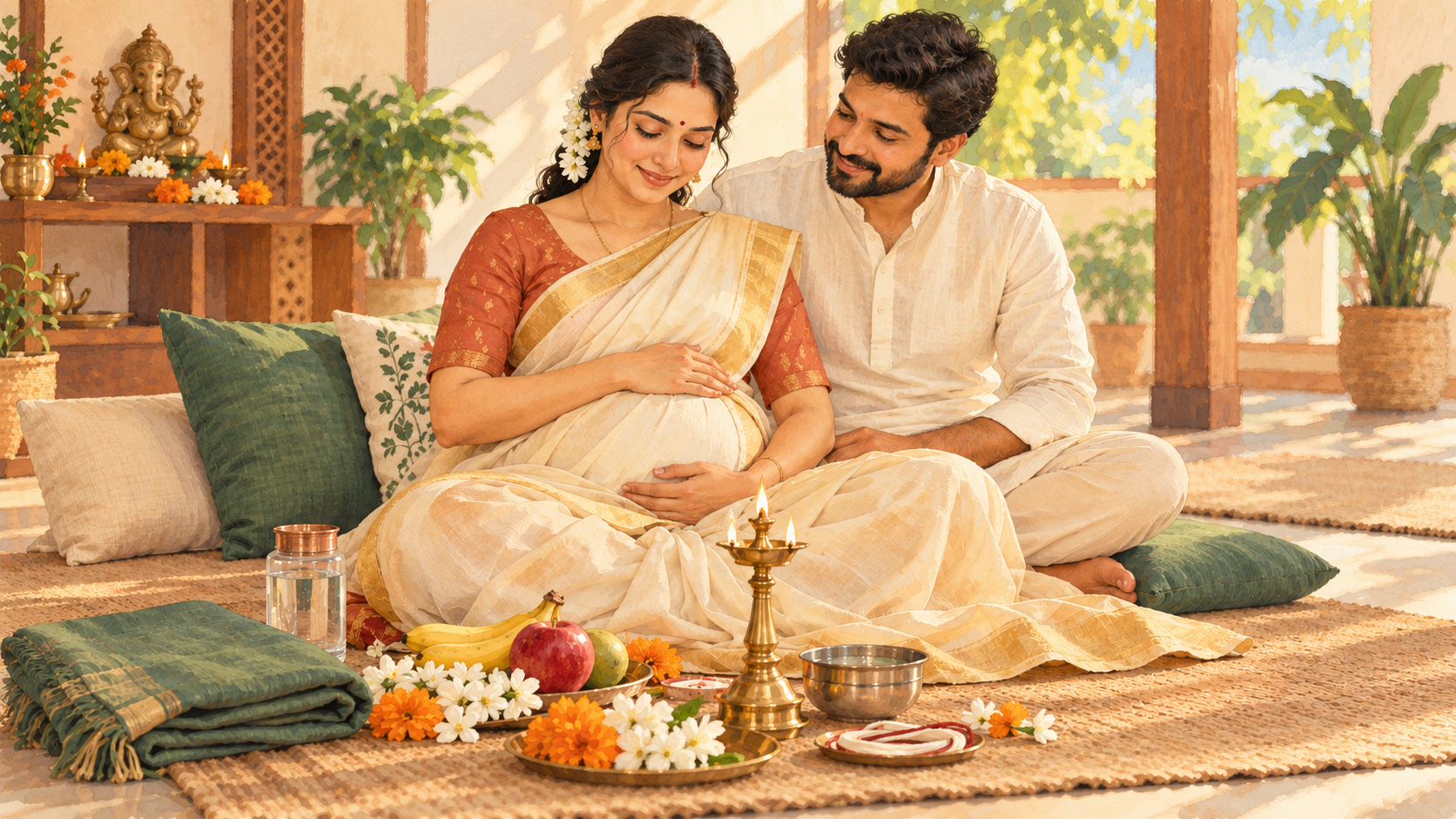
If you are expecting a child, the difficult question is rarely whether Hindu tradition has a protective rite. It is what your family should actually do, which form fits your intention, and how to keep devotion from becoming another burden on the pregnant mother.
A sound approach separates spiritual protection from medical promises. Prayer, puja, and yajna can place pregnancy within a sacred relationship of gratitude and responsibility. They cannot predict an outcome, replace antenatal care, or make the mother responsible for preventing every complication.
Begin with the protection you are actually seeking
Families do not all observe pregnancy in an identical way. Region, sect, family custom, chosen deity, and access to a temple or priest can shape the practice. Before arranging anything, identify the need in one sentence.
- Is the immediate concern an existing pregnancy? A devotional practice centred on the protection of the pregnant mother may be the clearest fit.
- Does the prayer include both pregnancy and the child’s continuing well-being? A Santana Gopala observance may express that wider intention.
- Does your family want a formal fire ceremony? Ask for a yajna or homam whose deity and purpose are stated clearly.
- Would a quiet home prayer serve better? A meaningful observance need not be the most elaborate one available.
This distinction prevents a common mistake: collecting several ceremonies as though each added ritual increases a guaranteed level of protection. Devotional value is not a dose. Choose one form your family understands, can perform respectfully, and can accommodate without exhausting or frightening the mother.
If your family already has a trusted acharya, priest, temple, or inherited custom, begin there. Ask what the rite means within that tradition instead of relying on an unfamiliar procedure copied from a short online video. If no such relationship exists, a simple prayer in words you understand is more honest than pretending to possess a prescribed mantra or initiation that you have not received.
Choose between Garbharakshambika, Santana Gopala, and a homam
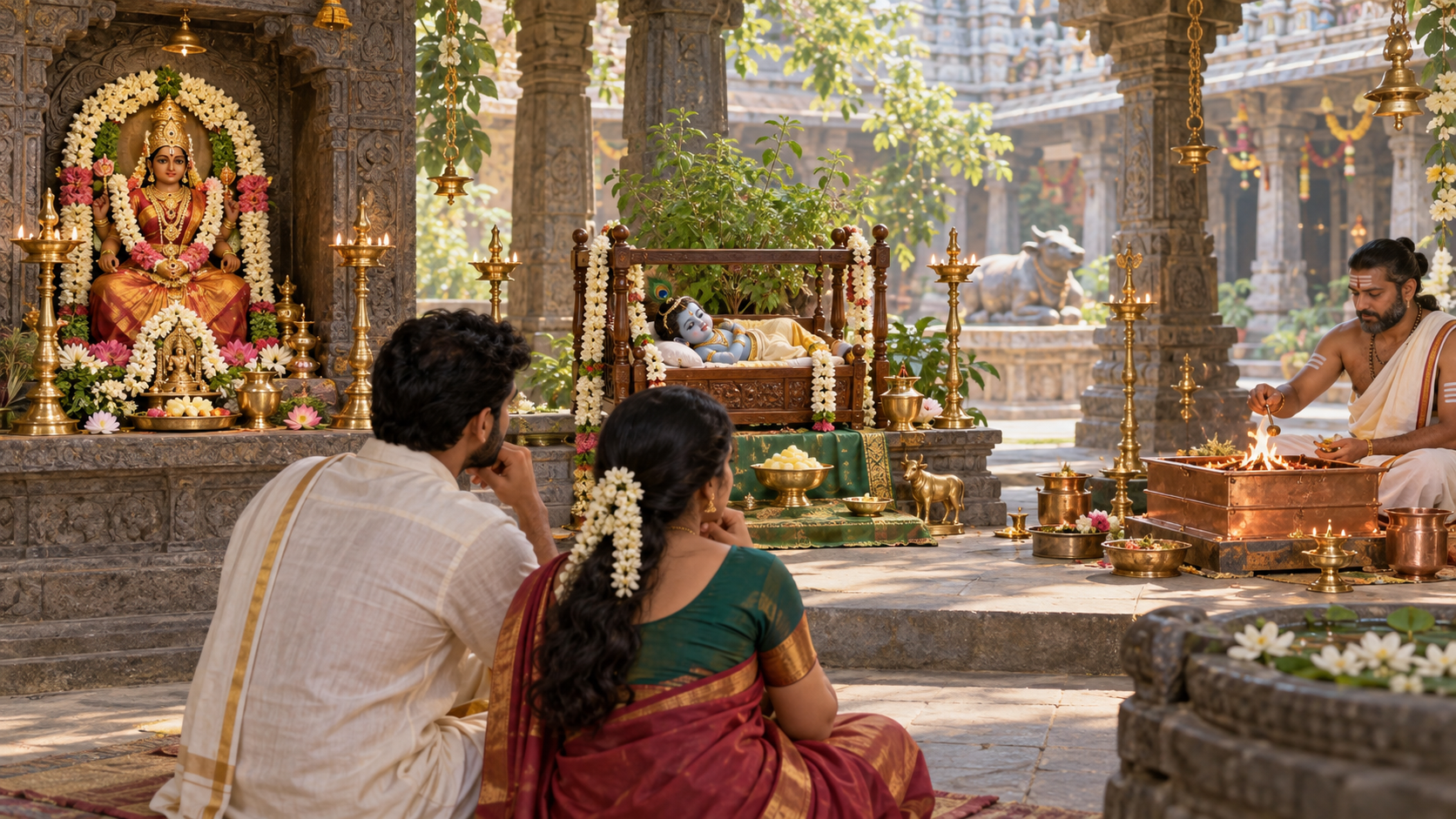
These names are related to pregnancy and children, but they do not describe the same thing. Garbharakshambika identifies a protective divine focus. Santana Gopala identifies Krishna in a form associated with children and family well-being. Yajna or homam describes a ritual form involving sacred fire. Knowing that difference makes it much easier to ask a temple for what you actually want.
Garbharakshambika devotion for the pregnant mother
Garbharakshambika is revered as a protector of pregnant women and invoked for safe delivery. This is the most direct devotional focus when the family is praying for a woman who is already pregnant.
The belief associated with the Goddess does not, by itself, establish one compulsory procedure for every household. Follow the form recognized by your own temple or family tradition. At home, you can use the ordinary puja practice your household already knows, address the Goddess respectfully, and state the intention plainly. There is no need to invent secret instructions or promise the mother that completing a particular act will control the medical outcome.
A suitable plain-language intention might be: “May mother and child be protected, and may our family care for them with steadiness and wisdom.” This is not presented as a traditional mantra. It is a transparent prayer for a family that does not have an authorized mantra or established liturgy.
Santana Gopala Yagna for pregnancy and a child’s well-being
Santana Gopala Yagna seeks the blessings of Lord Krishna as Santana Gopala for a healthy pregnancy and the well-being of children. “Santana” refers to children, while “Gopala” is a name of Krishna. This makes the observance especially coherent for a Krishna-centred household or for a family whose prayer extends from pregnancy into the child’s life.
When contacting a priest, do not ask only for “a child-protection puja.” Say whether the prayer concerns an existing pregnancy, a safe delivery, the well-being of a child, or more than one of these intentions. Ask exactly what will be performed, which deity will be invoked, what the mother is expected to do, and whether the ceremony includes fire, travel, fasting, prolonged sitting, or a large gathering. The title of a rite is not enough information for safe planning.
Yajna or homam as the ritual form
A yajna, also called a homam, is conducted before sacred fire with mantra recitation and offerings. The practice has Vedic and Puranic roots and is used in the worship of deities. In this context, a Santana Gopala Yagna is a purpose-specific use of that broader fire-ritual form.
This matters because “homam” alone does not tell you the intended blessing. Before agreeing to one, ask for the full name of the ceremony and its purpose. Also ask who will lead it, what will be offered into the fire, where it will take place, how long the mother is expected to participate, and what accommodations are possible. A trustworthy practitioner should be willing to answer without using fear or guaranteeing a result.
Plan the ceremony around the pregnant mother’s well-being
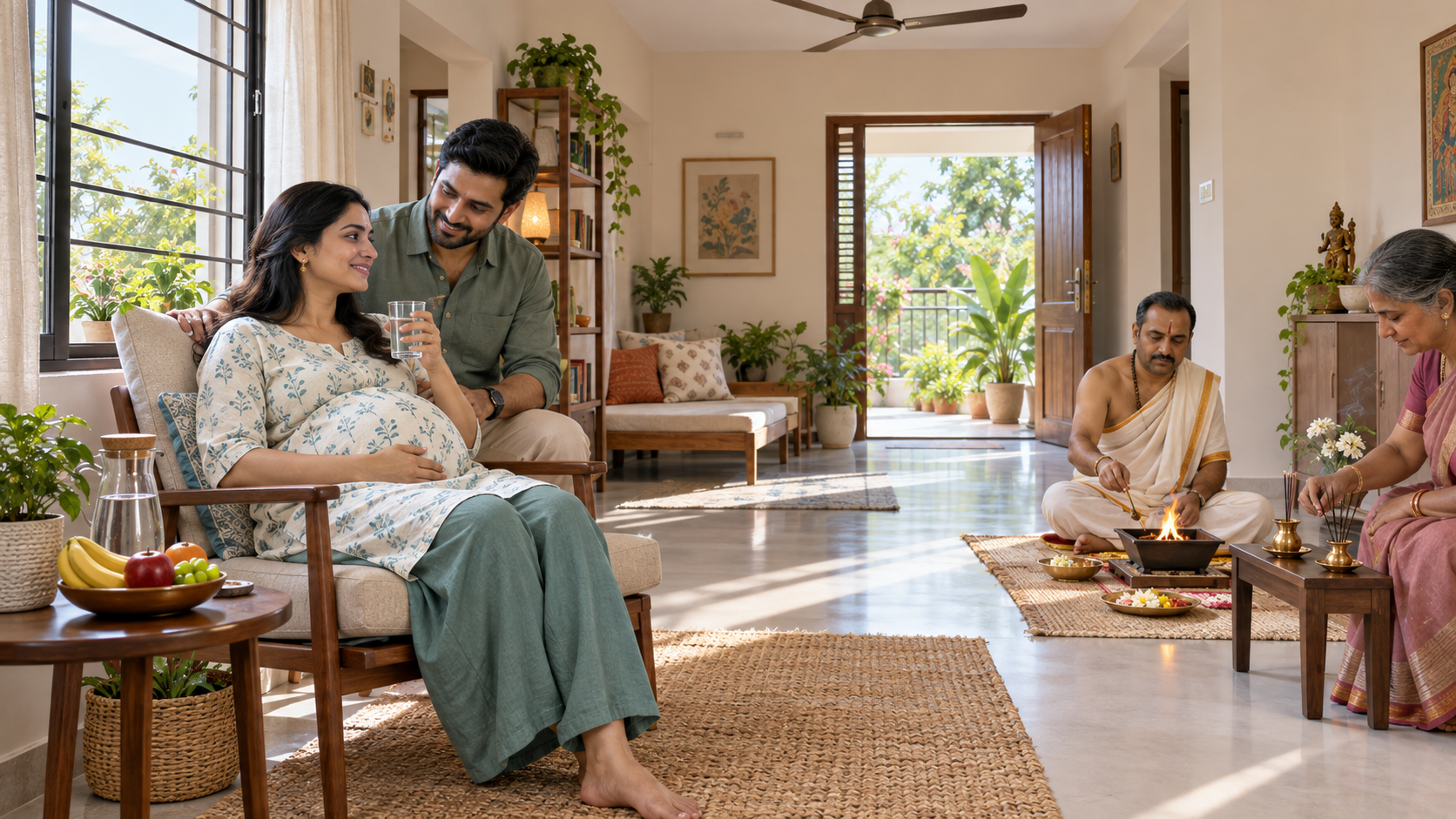
The person carrying the pregnancy is not a ceremonial object. Her consent, medical needs, energy, and comfort determine what is reasonable. A rite intended to bless her should not require her to ignore her own body.
- Check medical constraints first. If her maternity professional has restricted fasting, travel, smoke exposure, heat, crowds, or particular postures, that instruction governs the plan. A priest can adapt a ceremony; a priest does not replace the maternity team.
- Describe the actual setting. Tell the practitioner whether the homam would be indoors or outdoors, what ventilation is available, and whether chairs can be used. Do not assume the mother must sit on the floor or remain beside the fire throughout.
- Remove unnecessary austerity. Do not add fasting, sleep loss, or a difficult journey merely to make the observance feel more serious. If a customary discipline conflicts with medical advice, ask for an accepted alternative or choose a simpler prayer.
- Ask the mother privately. She should be able to decline a public event, a crowded gathering, physical contact, photographs, or prolonged participation without being told she is rejecting the blessing.
- Assign practical roles. One family member can communicate with the priest, another can arrange food and transport, and another can keep the space quiet. The mother should not have to manage the event being performed for her.
- Keep an exit plan. Make it easy for her to rest, leave the ritual space, or stop participating. If a medical concern arises, end her participation and follow the instructions of her maternity professional or emergency-care plan immediately.
- Use ordinary fire precautions. Keep the ritual area clear, supervise the flame, protect children from the fire, and make sure responsibility for fire safety belongs to an attentive adult rather than the pregnant participant.
If the mother cannot comfortably attend, ask the priest whether the family can offer the prayer while she rests elsewhere. Traditions may handle representation differently, so confirm the practice rather than assuming. The governing principle is straightforward: participation should support her, not expose her to avoidable strain.
Keep child protection from turning into pressure or blame
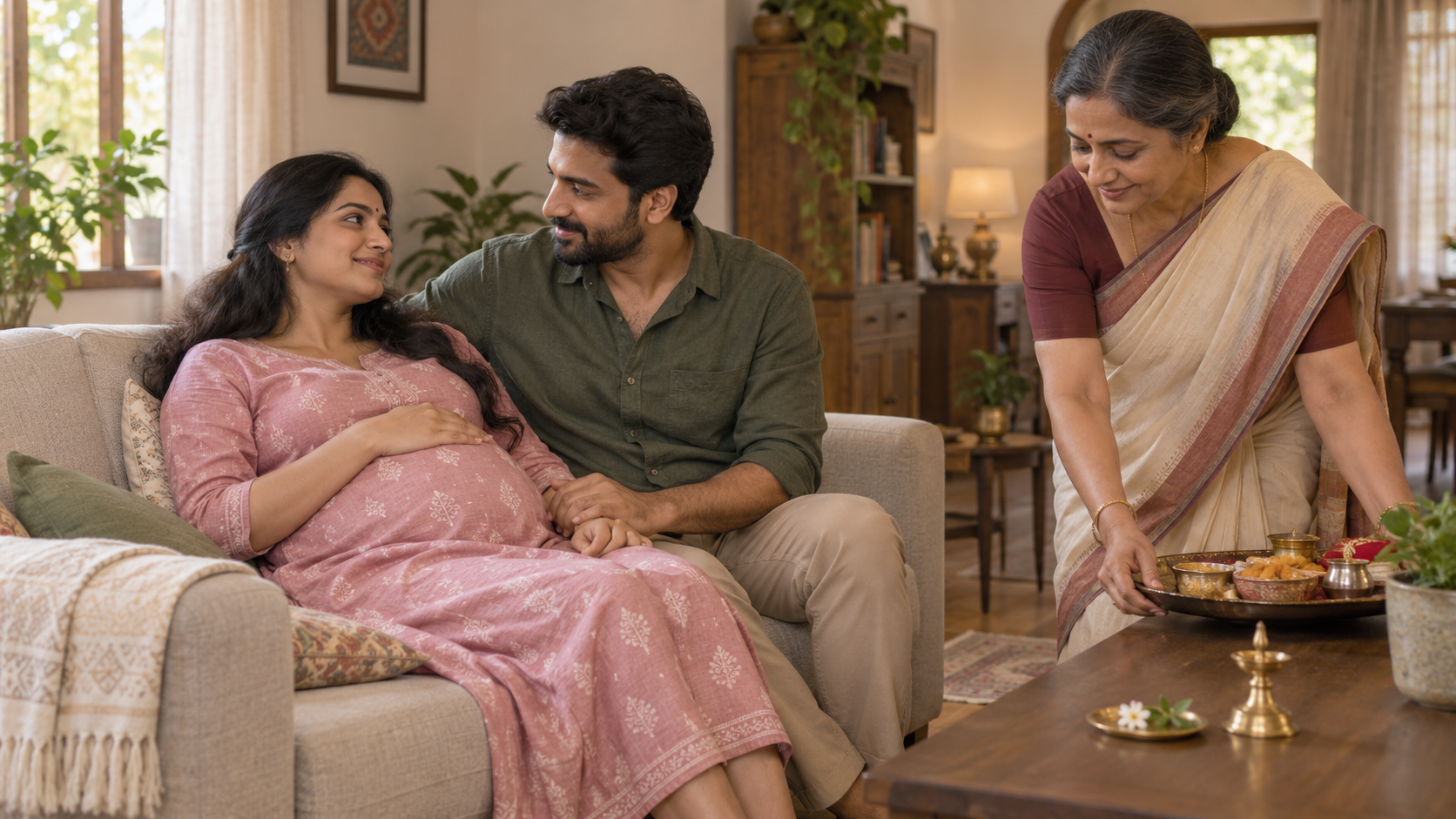
Protective devotion can become harmful when a blessing is described as a guarantee. No family should be told that a complication proves inadequate faith, an incorrectly performed rite, impure conduct, or a failure by the mother. Those claims cannot be established by the ceremony and can deepen suffering at precisely the moment a family needs care.
Keep the roles clear. The ritual expresses surrender, reverence, hope, and family responsibility. Qualified health professionals manage pregnancy and paediatric care. If symptoms or concerns arise, do not delay contacting the appropriate professional because a puja is underway, because an auspicious time has not arrived, or because someone expects prayer alone to resolve the problem.
After the ceremony, translate the prayer into duties that can be seen. Arrange meals and transport. Protect time for rest. Help with appointments and household work. After birth, continue with appropriate paediatric care and make the home physically and emotionally safe for the child. A family that invokes protection should also organize itself to provide care.
This is also where Santana Gopala devotion can retain meaning beyond the day of a yagna. The family’s prayer for the child’s well-being can become a continuing reminder that protection is not possession or control. It is a commitment to nourish, guide, and seek competent help when help is needed.
Key takeaways
- Garbharakshambika is the more direct devotional focus when the prayer centres on protecting a pregnant mother and seeking a safe delivery.
- Santana Gopala Yagna invokes Krishna for a healthy pregnancy and the continuing well-being of children.
- Yajna or homam names the sacred-fire form of worship, not a guaranteed outcome; always ask which deity and intention define the ceremony.
- Medical care and ritual have different responsibilities. Never replace, postpone, or contradict professional maternity or paediatric care in the name of an observance.
- Choose the smallest meaningful rite that respects the mother’s consent, comfort, medical needs, and family tradition.
- Judge the family’s sincerity by the care it provides after the prayer, not by the cost or complexity of the ceremony.
Your next step is simple: ask the mother what form of prayer would bring steadiness rather than pressure, tell a trusted priest exactly what the family is seeking, and check every practical demand against her care plan. The right observance is one she can receive without fear and the family can honour through sustained care afterward.
References
- Hindu Pad – Significance of Yagnas, Homams
- Hindu Pad – Story of Garbharakshambika Devi (Garbharakshambigai Mata)
- Hindu Pad – Santana Gopala Yagna: Benefits, Purpose, Significance

Leave a Reply
You must be logged in to post a comment.