
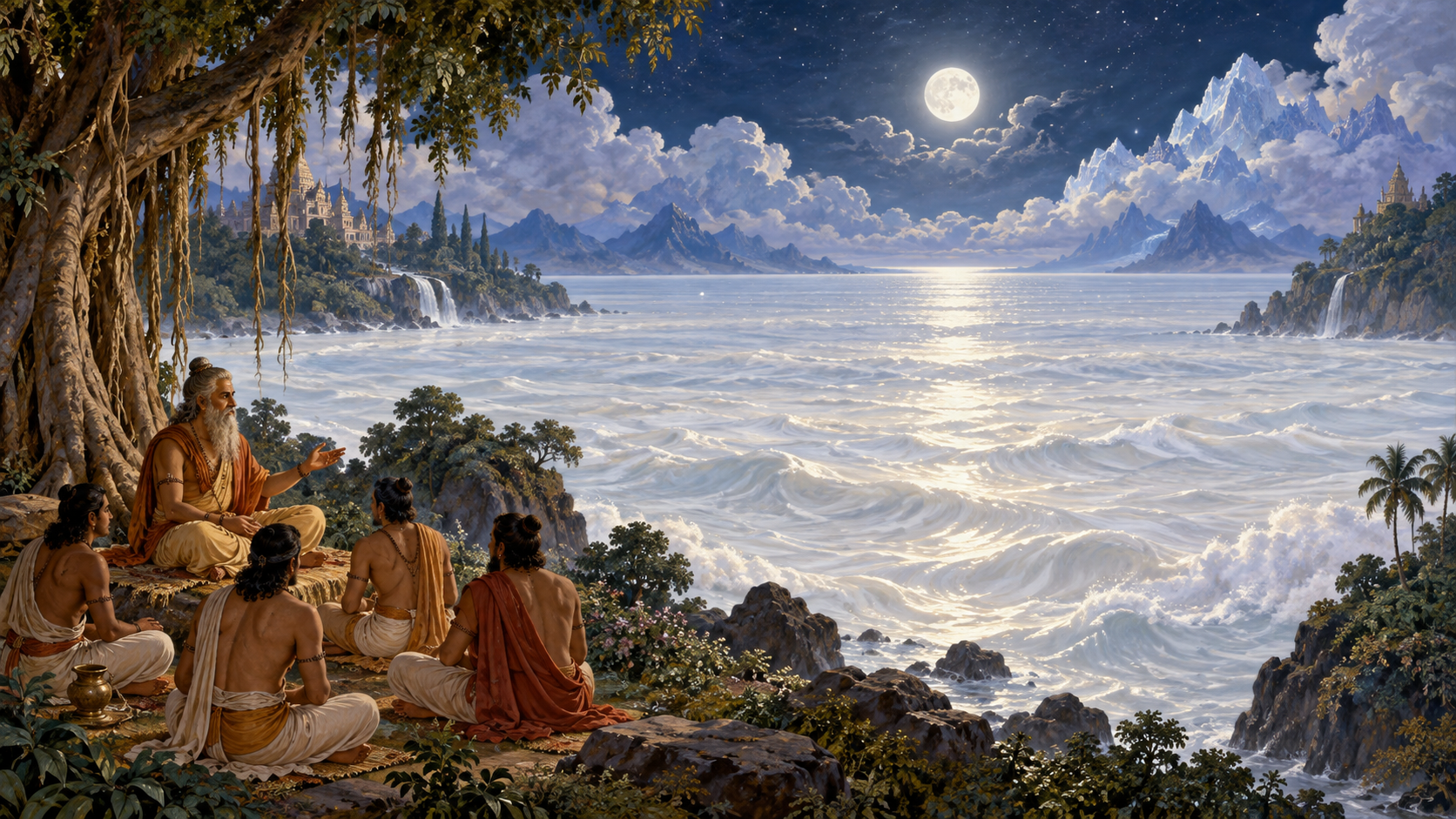
You may know Kshira Sagara from temple imagery or from Samudra Manthana, the churning of the ocean. Then you encounter the name in the Mahabharata and wonder what it means there: Is it a place, part of a narrative, or a symbol for spiritual life?
The soundest answer begins with context. In the relevant passage, Kshira Sagara belongs first to the epic’s sacred geography. Its value as an image of inner churning comes afterward. Keeping those two levels distinct lets you draw spiritual meaning from the image without attributing words or teachings to the Mahabharata that the passage itself does not state.
Place Kshira Sagara in the epic before interpreting it
Kshira means milk, while sagara means ocean or sea. The relevant Mahabharata setting is the Astika Parva within the Adi Parva. Its cosmological arrangement describes seven seas associated with seven island-regions. Kshira Sagara surrounds Saka Dwipa, which is presented in this arrangement as the second island.
If you want to find the passage in an edition or translation, use this textual path: Mahabharata, then Adi Parva, then Astika Parva, and finally the description involving Saka Dwipa and Kshira Sagara. Searching by these names is more dependable than approaching the epic through an isolated image or a retelling detached from its section.
The placement also prevents a common confusion. A passage that locates an ocean within a sequence of islands and seas is performing a cosmographical function. That is not automatically the same thing as narrating Samudra Manthana. The two may share a sacred image and evoke related associations, but you should not collapse every reference to an ocean of milk into the churning narrative.
A simple reading rule helps: when the surrounding verses enumerate regions, boundaries, or seas, read Kshira Sagara first as part of the epic cosmos. When a narrative describes participants, actions, and consequences, attend to the event. When a teacher or devotee draws a lesson about the mind, recognise that as a contemplative interpretation. Context decides which meaning should stand in the foreground.
Read the ocean as sacred geography, not an ordinary map

A modern reader may immediately ask where Kshira Sagara belongs on a physical globe. That question is understandable, but it is too narrow for the passage. The epic presents an ordered sacred cosmos in which islands and encircling seas form a meaningful pattern. You do not need to force that pattern into a modern atlas, and you do not need to dismiss it merely because it does not function like one.
Use four questions when reading this kind of cosmography:
- What does the passage actually locate? Here, the direct relationship is between Kshira Sagara and Saka Dwipa.
- What order does the description establish? Notice the repeated pattern of island-regions and surrounding seas rather than extracting one spectacular image from the sequence.
- What does the unusual substance invite you to contemplate? Milk can evoke nourishment, purity, abundance, and latent richness. Treat these as interpretive possibilities, not as a single definition imposed by the passage.
- Which statements belong to the text, and which belong to your reflection? Write them separately. This preserves both devotional openness and textual honesty.
This approach avoids two unhelpful extremes. Kshira Sagara need not be reduced to a material claim competing with modern geography. Nor should its cosmological location be erased so that it becomes nothing more than a psychological metaphor. The image can retain its place in the Mahabharata’s world while also giving you a vocabulary for contemplation.
Use inner churning without turning interpretation into quotation

Kshira Sagara lends itself to inward reflection because churning is repeated, patient work. It does not create value from nothing; it brings something latent into a form that can be recognised and used. Applied to spiritual life, the image asks whether clarity is already obscured within a mixture of knowledge, desire, fear, memory, and attachment.
That is a contemplative use of the image, not a claim that every Mahabharata mention of Kshira Sagara explicitly teaches a method of meditation. The distinction matters. If you present an interpretation as though it were a direct scriptural statement, you weaken both the interpretation and your reading of the scripture.
You can turn the image into a disciplined examination of one difficult decision:
- Name one question. Make it actionable: “What is mine to do in this situation?” is more useful than “Why is everything unsettled?”
- Separate what is mixed together. On a page, create three headings: “Known,” “Assumed,” and “Desired.” Place every relevant thought under one of them.
- Identify what is agitating the mind. Look specifically for haste, wounded pride, fear of disapproval, attachment to one outcome, or the wish to appear virtuous.
- Apply a dharmic test. Ask which course is truthful, fulfils a real responsibility, and avoids preventable harm without using comfort as an excuse for inaction.
- Take the smallest honest next step. Prefer an action whose consequences you can observe before making a larger commitment. Then examine what the action revealed about your motives.
This exercise is not a ritual prescribed in the Astika Parva. It is a contemporary practice shaped by the image of churning. Its purpose is to stop you from calling the first strong feeling “intuition” or the most convenient option “dharma.” Patient reflection is useful only when it eventually produces truthful action.
Three mistakes that obscure the meaning
- Making every milk-ocean reference identical: Kshira Sagara can appear within cosmography, narrative, iconography, or spiritual teaching. Shared imagery does not eliminate the function of each context.
- Treating symbolism as a replacement for the text: An inward reading may be spiritually fruitful, but it should begin after you have identified what the passage actually describes. Otherwise, the epic becomes a screen onto which you project whatever lesson you already wanted.
- Forcing a choice between devotion and modern cartography: You can take sacred cosmography seriously without pretending that it is written as a contemporary geographical survey. First ask how the ordered cosmos works within the epic and what kind of attention that order demands from the reader.
A careful reader therefore uses modest language: “The passage places Kshira Sagara around Saka Dwipa” is a textual claim; “the ocean can represent the depth of consciousness” is an interpretation. Both statements may belong in a Dharmic conversation, but they do not have the same status.
Key takeaways
- Kshira Sagara means the Ocean of Milk and appears in the Astika Parva of the Mahabharata’s Adi Parva.
- Within the relevant cosmological arrangement, it surrounds Saka Dwipa, presented there as the second island-region.
- A cosmographical mention should not automatically be treated as a complete retelling of Samudra Manthana.
- Sacred geography, narrative action, and contemplative symbolism are related levels of reading, not interchangeable claims.
- Inner churning is most useful as a disciplined application of the image, provided you do not misrepresent it as a direct quotation or explicit instruction from the passage.
The next time you encounter Kshira Sagara, write two sentences before reaching for a grand explanation: “What does this passage state?” and “What does this image ask me to examine?” That small separation will make your scriptural reading more precise and your spiritual reflection more honest.
References

Leave a Reply
You must be logged in to post a comment.