
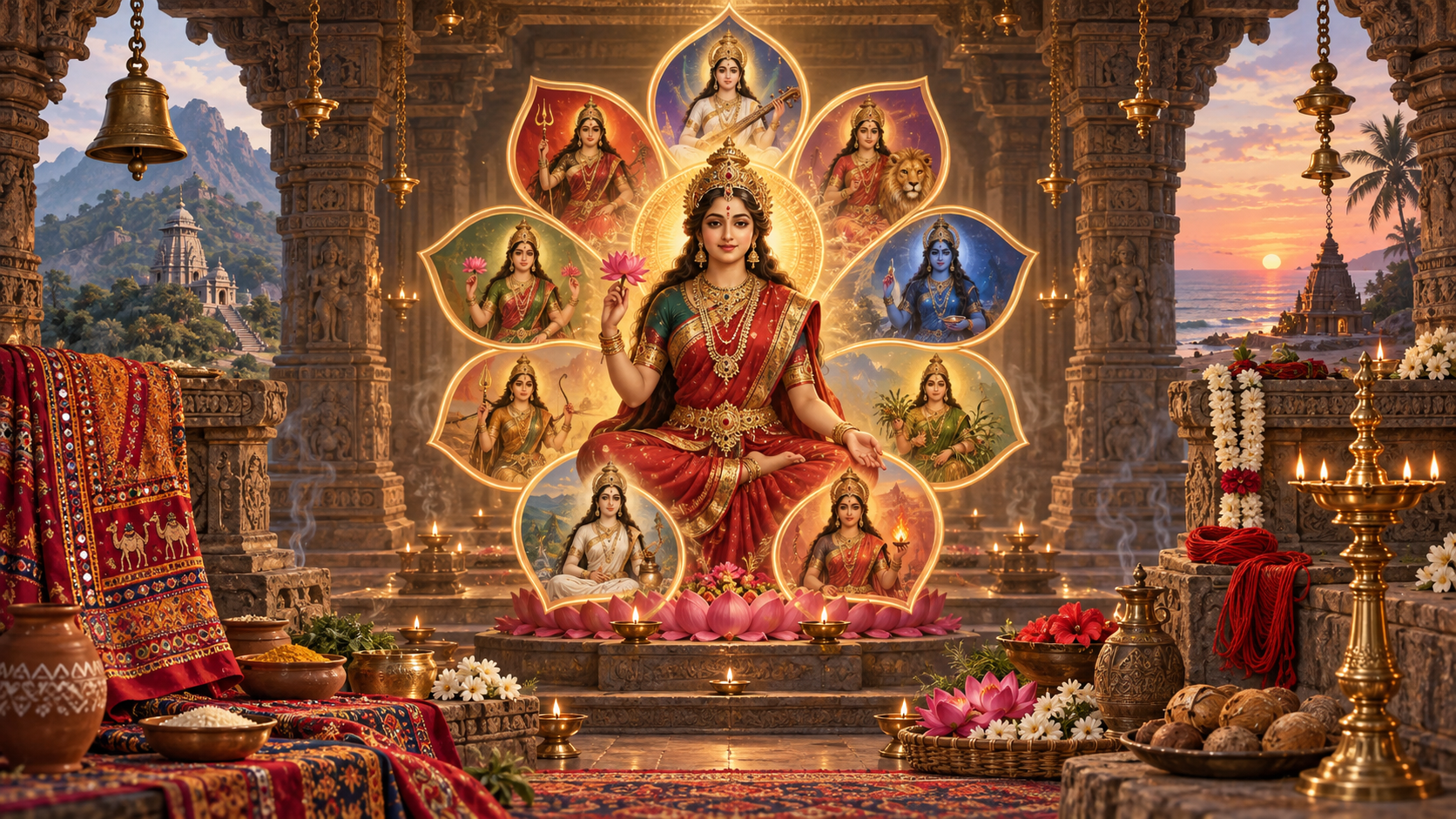
You may know Durga through the nine nights of Navaratri, then encounter names such as Momai Maa or Shoolini Mata and wonder whether these are separate goddesses, local names for Durga, or different manifestations of one Shakti. The most useful answer is not a forced choice between “same” and “different.”
Navadurga and regional Devi traditions are two ways of approaching divine power. One arranges worship through a sacred sequence. The other roots worship in a community, place, inherited name, icon and body of practice. Understanding both lets you recognise unity without flattening the distinctions that devotees preserve.
Navadurga and regional Devi traditions answer different questions
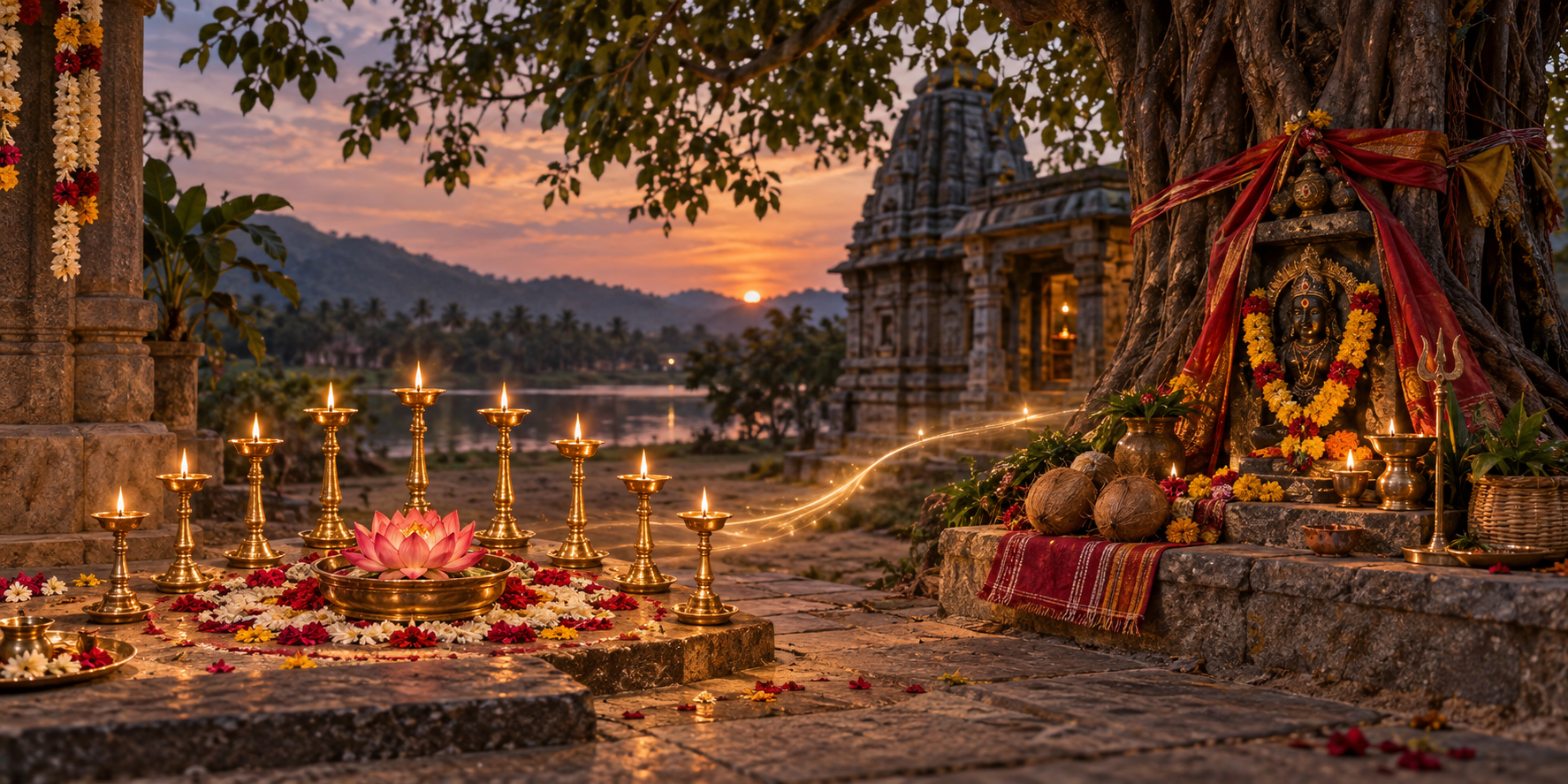
Navadurga gives you a ritual map. During Navaratri, the worshipper approaches Durga through nine forms in an ordered progression. A form’s place in that progression matters: it connects the day, name, iconography and devotional contemplation. The sequence teaches you to remain with a particular manifestation rather than treating every image of Devi as interchangeable.
A regional goddess gives you a relationship map. Her identity may be carried through a local name, a temple, a family tradition, a community memory or a distinctive representation. Folk divinity can be represented through human form, animal form or a sacred object such as a holy stone. That range is not theological confusion. It shows that presence can be recognised through more than one visual language.
This distinction gives you a simple rule: ask what the name is doing in its setting. If it identifies a day within Navadurga worship, read it through the festival sequence. If it identifies the Devi of a community or shrine, begin with that tradition’s own name and practice. Only after that should you ask how the form relates to Durga, Parvati or Shakti more broadly.
Unity does not make every form interchangeable
Shakti is divine power: the active reality through which creation, preservation, transformation, knowledge and wisdom become intelligible. A named goddess can therefore be understood as a manifestation of Shakti without becoming a disposable label for an abstract idea.
Shoolini illustrates this layered identity. She is revered as a principal form of Durga or Parvati, the power of Shiva, and both form and formless reality. Those descriptions do not cancel one another. “Durga,” “Parvati,” “Shakti” and “Shoolini” place the devotee at different levels of recognition: divine personality, theological relationship, universal power and a particular sacred identity.
Momai Maa, Dashama and Momai Mata show another kind of layering. Multiple names may gather around one devotional presence. You should not assume that a change of name creates a different goddess, but neither should you assume that every name can be substituted without consequence. Names carry pronunciation, affection, memory and inherited ways of addressing the Devi.
For a newcomer, the respectful approach is straightforward. Use the name devotees use in that setting. Observe the established image or sacred object without ranking it against more familiar iconography. Ask how worship is conducted before importing a mantra, offering or explanation from another tradition. Shared Shakti establishes kinship; it does not erase ritual boundaries.
Chandraghanta shows how a Navadurga form should be read
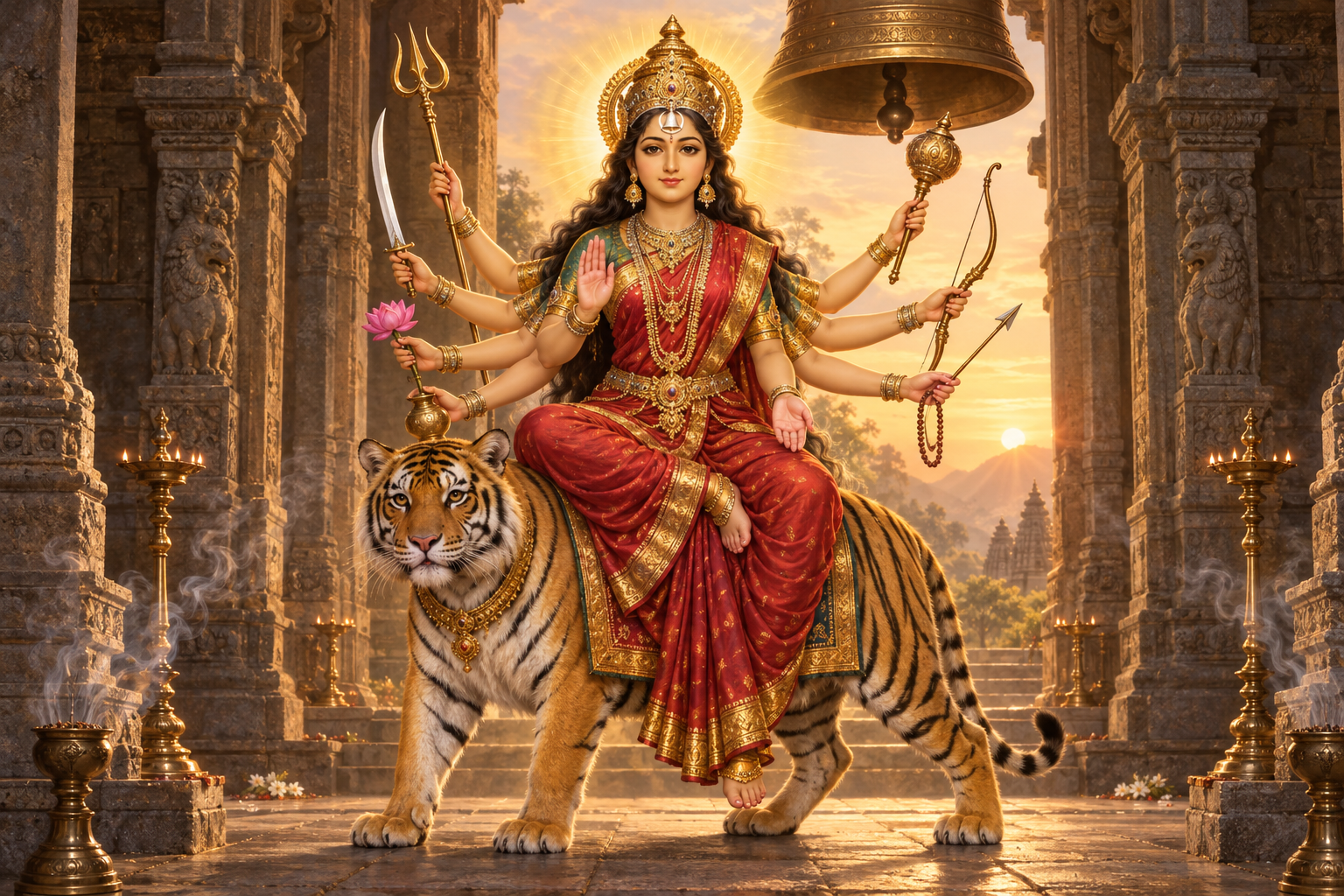
Chandraghanta is the third form of Durga and is honoured on the third day of Navaratri. That placement is part of her identity within the Navadurga cycle. If you are following the festival, the day tells you when to direct attention specifically toward her form.
Her name joins “Chandra,” the moon, with “Ghanta,” the bell. She is commonly depicted with a crescent or half-moon on her forehead and with ten arms. Read those features together rather than as disconnected decorations. The name gives you the verbal key; the crescent makes that key visible; the multiple arms express a power that exceeds ordinary human capacity.
You do not need to memorise every attribute before worshipping. Begin with three observations: this is the third Navadurga form, the lunar-bell name identifies her, and the image presents divine power through a many-armed form. That is enough to keep your attention specific. Further meanings can then be learned within the tradition you follow, without pretending that one brief interpretation exhausts the form.
This method also prevents a common mistake: reducing iconography to a code in which every object has one fixed translation. Sacred images support contemplation, ritual memory and recognition. They are not merely diagrams. When different depictions vary, identify the stable features first and then learn how a particular temple or lineage understands the variation.
A four-step way to approach an unfamiliar form of Shakti
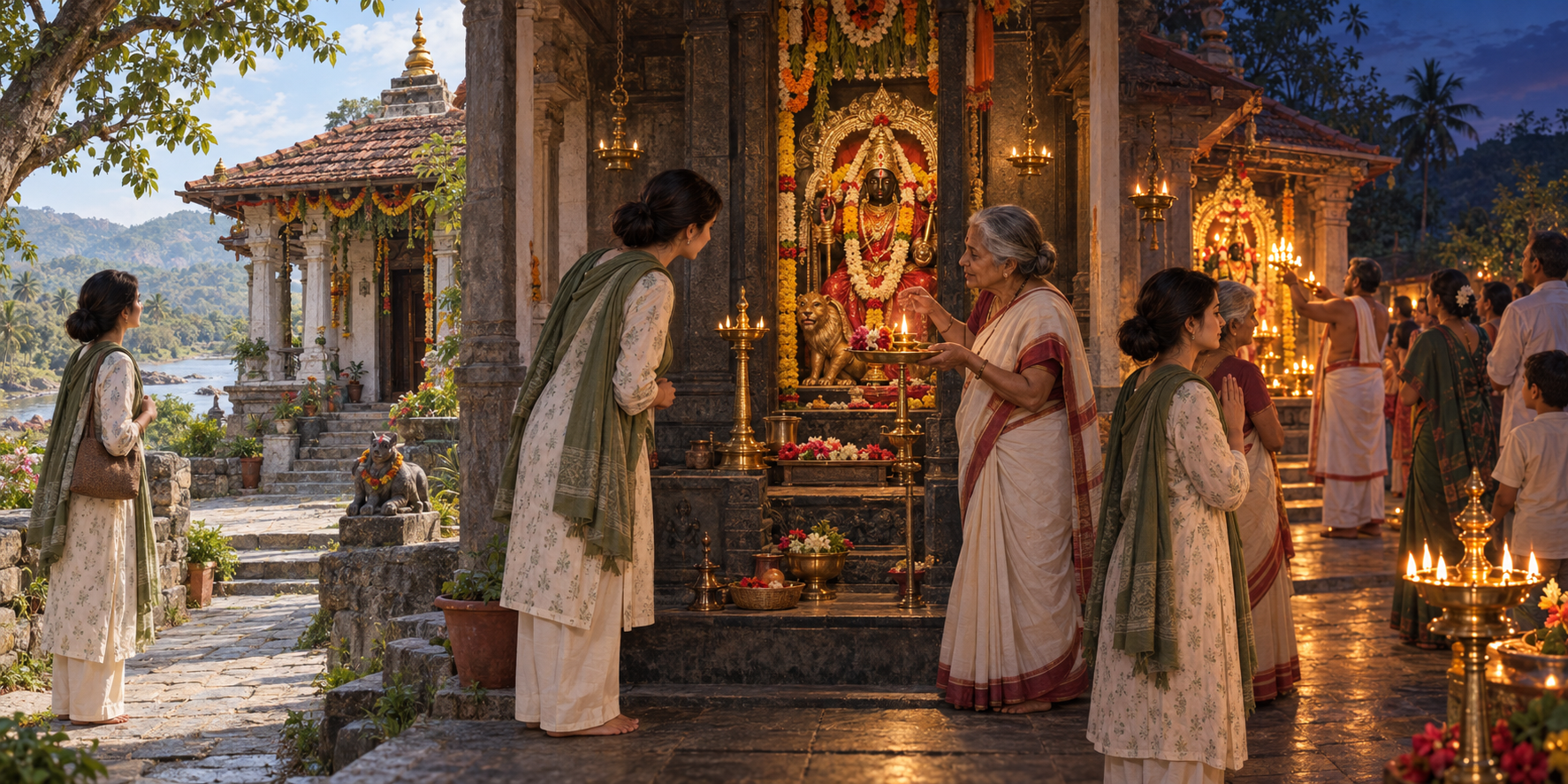
- Identify the setting. Is the name being used in a Navadurga sequence, a regional temple, a household tradition or a community observance? The setting tells you which interpretive frame belongs first.
- Keep the local name intact. Record alternate names, but do not immediately replace them with “Durga” or “Parvati.” Momai Maa, Dashama and Momai Mata can point toward a connected devotional identity while still carrying their own local force.
- Read the visible form carefully. Note the face, posture, number of arms, emblems and form of representation. A sacred stone and a many-armed image may both mediate Devi worship, but they invite different forms of attention.
- Follow the practice before supplying an explanation. Use the calendar, worship procedure and form of address recognised by the tradition in front of you. A broad theology of Shakti should deepen your respect for the particular practice, not overrule it.
This framework is especially useful during Navaratri, when public celebrations, family observances and regional customs may appear side by side. You can recognise all of them as Shakta expressions while still asking the precise question: which form is being invoked here, by what name, at what point in the observance, and according to whose living practice?
Key takeaways
- Navadurga is an ordered ritual approach to nine forms of Durga; a regional Devi tradition is rooted in a particular devotional setting.
- Calling several goddesses manifestations of Shakti expresses theological unity, not ritual interchangeability.
- A local name deserves to be learned and used rather than immediately replaced with a broader Sanskrit name.
- Chandraghanta is the third Navadurga form; her name, crescent and many-armed image should be read together.
- When you encounter an unfamiliar goddess, identify the setting, preserve the name, observe the form and follow the established practice.
The next time you meet a form of Devi you do not recognise, resist the urge to classify her too quickly. Learn her name as it is spoken there, notice how she is represented, and find her place in the community’s worship. That small discipline lets you encounter the many forms of Shakti as a living sacred world rather than a list of equivalents.
References
- Hindu Pad — Momai Maa | Dashama | Momai Mata
- Hindu Pad — Shoolini Mata | Shooli Mahashakti
- Hindu Pad — Aspects of Chandraghanta Navadurga

Leave a Reply
You must be logged in to post a comment.