
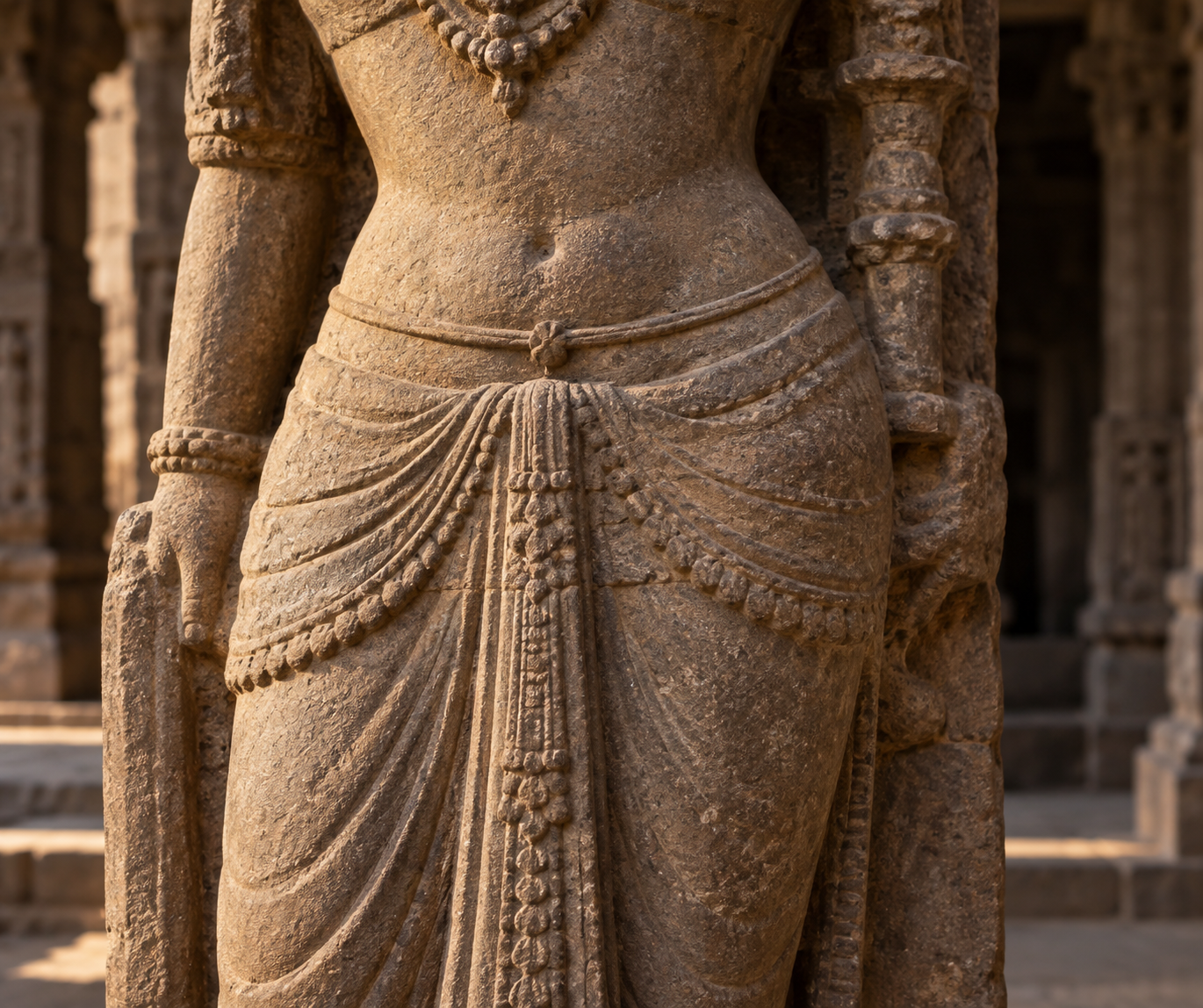
You are looking at a temple image rich with crowns, necklaces, armlets and carefully arranged garments. Near the waist, however, there may be only a thin carved line. It is easy to dismiss that line as a minor detail. It may be the kati sutra, and noticing it can change how you read the entire figure.
The kati sutra does not offer a secret code for identifying a deity. Its value is subtler. It draws your attention to the sacred body as a form that is adorned yet ordered, powerful yet contained. To interpret it well, you need to distinguish what the sculptor actually carved from the meaning you bring to it.
Begin with what the sculptor actually carved
At the literal level, the kati sutra is a cord at the waist. In Hindu sculpture it can appear as a simple cord tied around the waist, far less conspicuous than a crown, necklace or armlet. That contrast matters. The object belongs to the figure’s ornamented presentation, but its basic visual action is binding rather than dazzling.
Before assigning symbolism, look closely at four things:
- Placement: Confirm that the line actually encircles or marks the waist. A nearby fold, damaged edge or garment border can be mistaken for a cord.
- Form: Ask whether it looks like a narrow cord, a broad band or part of a more elaborate waist arrangement. Do not force every feature at the waist into the same category.
- Function: Notice whether the line seems to secure clothing, organize hanging elements or simply articulate the body’s centre.
- Relationship: Compare its simplicity with the rest of the figure. A plain cord amid abundant ornament produces a different emphasis from an elaborate waist treatment.
This first pass protects you from a common mistake in iconographic interpretation: leaping from an indistinct shape to an elaborate theological claim. Description comes first. Meaning comes after.
Its central symbolism is disciplined containment
A cord gathers, fastens and holds. That visible action provides the most reliable basis for interpreting the kati sutra. Symbolically, it can evoke restraint, integration and the ordering of embodied power. The figure is not shown as shapeless energy or uncontrolled abundance. The body, clothing and ornaments have been brought into a coherent sacred form.
This is why the kati sutra should not be reduced to jewellery. Jewellery primarily draws attention through beauty, intricacy or splendour. A simple waist cord may be beautiful, but its deeper visual grammar is different: it defines, gathers and secures. Its meaning lies as much in what it does as in how it looks.
Three related symbolic readings become possible:
- Restraint without rejection: The sacred body is not denied or treated as an obstacle. It is presented as ordered. The cord therefore supports a Dharmic reading of discipline as right arrangement rather than hostility toward embodied life.
- Power under direction: A divine figure may possess immense power, yet its form remains composed. The cord can participate in that larger image of potency governed by purpose.
- Unity at the body’s centre: By gathering the visual composition at the waist, the cord helps the upper and lower portions of the figure read as one integrated whole.
These are interpretive layers, not rigid dictionary definitions. The kati sutra does not mean exactly one abstract idea in every image, region or sculptural setting. Its meaning emerges from the visible form and the company it keeps.
Read the waist cord in relation to the whole figure
A small iconographic feature rarely speaks alone. Once you have identified the cord, widen your attention instead of staring only at it. The surrounding figure tells you which interpretation deserves the most weight.
Compare restraint with splendour
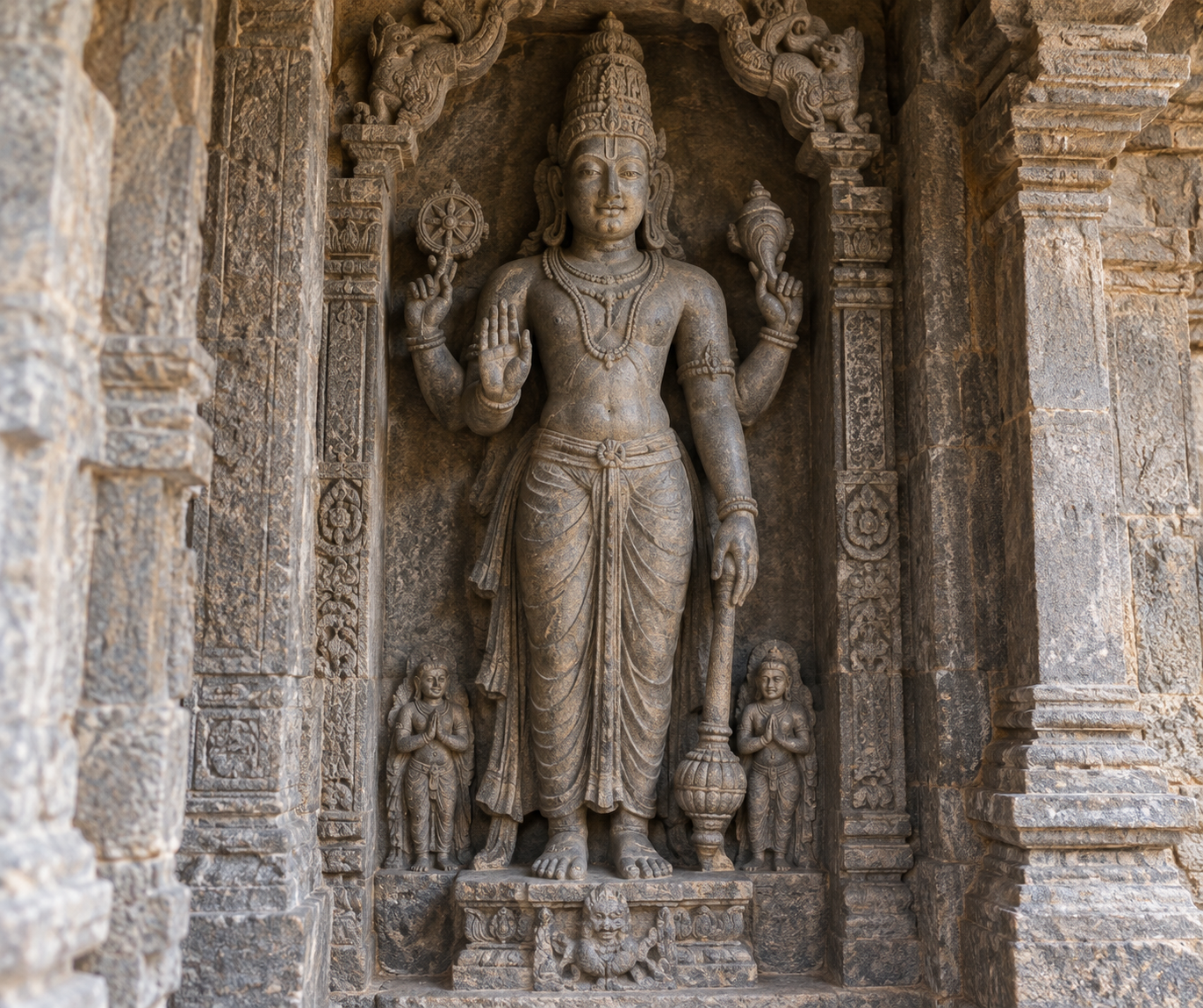
If the figure bears an imposing crown and abundant ornaments while the kati sutra remains plain, notice the deliberate contrast. Splendour communicates manifest presence; the cord communicates order. Read together, they suggest that sacred majesty and self-command are not opposites. Power becomes meaningful when it is held within form and directed toward purpose.
Follow the visual lines
Look at what descends from or converges upon the waist. Garment folds, hanging ornaments and the contours of the torso may all meet there. The kati sutra can act as a visual hinge, helping the eye move from the upper body to the lower body without losing the unity of the image.
This compositional role is not separate from symbolism. Hindu iconography often communicates through the ordered presentation of the whole figure. A line that stabilizes the composition can also strengthen the impression of inward steadiness.
Notice what is quiet but indispensable
The kati sutra may receive less attention than a prominent headdress or necklace precisely because it does not demand attention. Yet it helps organize the figure. Its quietness offers a useful symbolic insight: not everything essential announces itself through grandeur.
That insight has a practical Dharmic resonance. Discipline often works like a cord rather than a crown. It is not necessarily the most visible part of a life, but it holds conduct, intention and responsibility together. This is an application of the image’s visual logic, not a claim that every sculptor encoded a single moral lesson.
Avoid the four most common interpretive errors
You can learn more from a sculpture by making fewer assumptions. Four errors are especially worth avoiding.
<!– wp:list {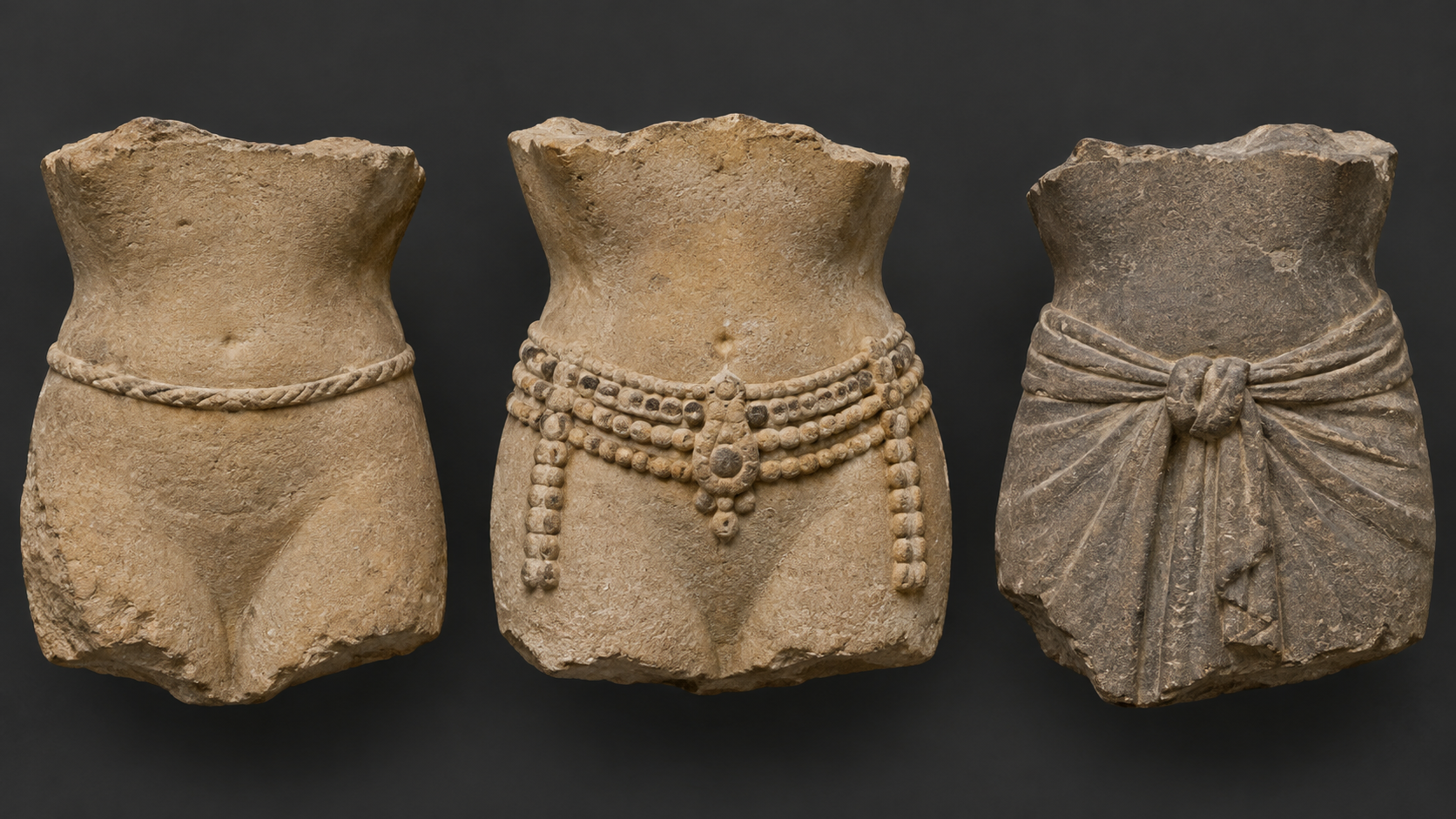


Leave a Reply
You must be logged in to post a comment.