
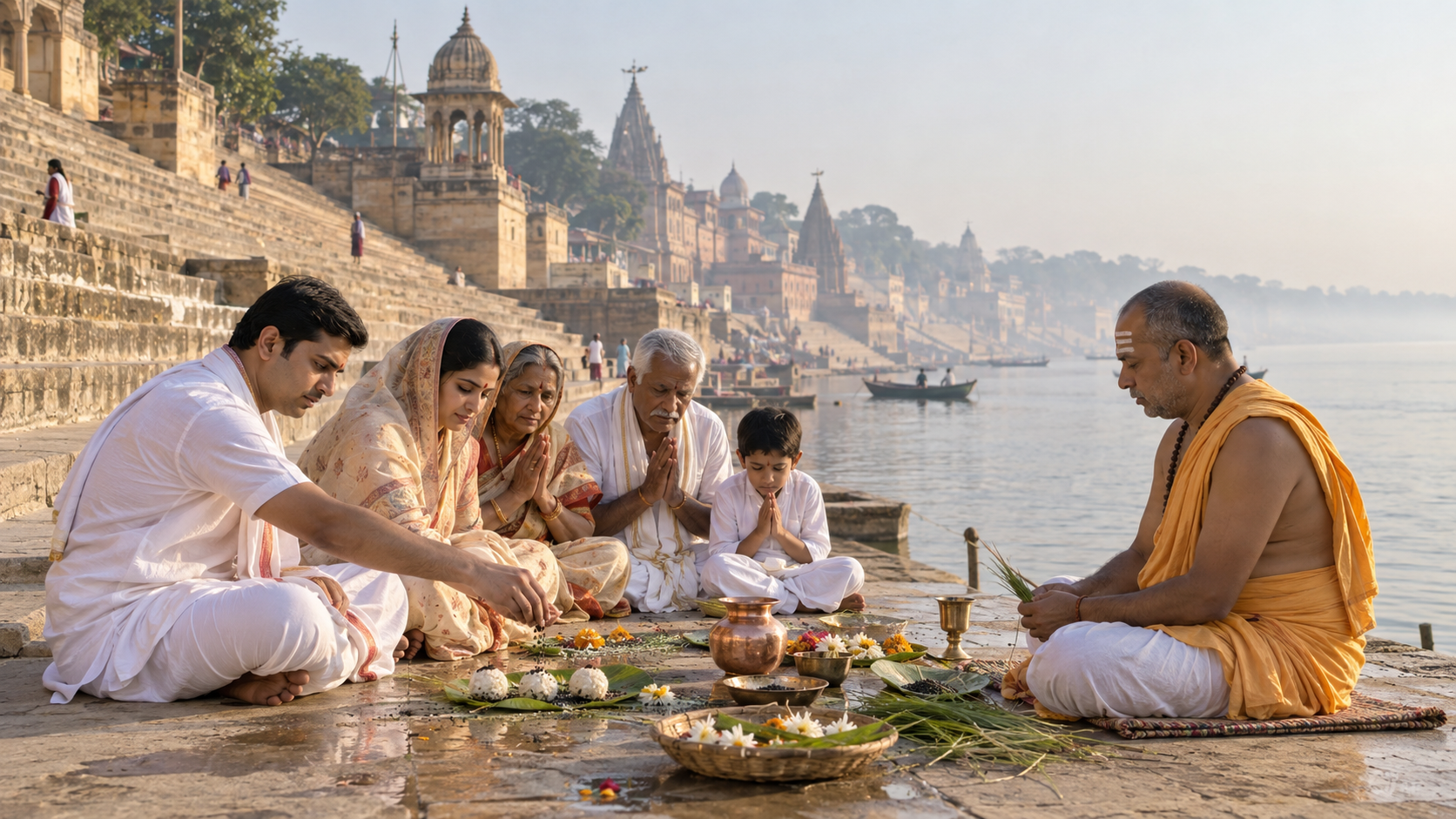
If you are arranging Shraddha away from home, settle four things before you reserve the journey: the correct tithi, the pilgrimage place, the officiating purohit, and the local performance window. A famous destination cannot compensate for arriving on the wrong day or discovering that the ritualist expected you several hours earlier.
In 2026, Pitru Paksha begins on September 27 and concludes with Mahalaya Amavasya on October 10. Treat those dates as the boundary of the fortnight, not as a complete appointment. Your family’s applicable tithi and the destination’s local muhurta still have to be confirmed.
Fix the observance day before you reserve the journey
The civil date answers only one part of the question. Shraddha is organized through the lunar calendar, so the day appropriate to your family may not be obvious from a September or October date on a travel website. The practical mistake is to book transport first and ask about the tithi later.
| Planning layer | What it answers | What you need to confirm |
|---|---|---|
| Pitru Paksha fortnight | When the annual observance period falls | September 27 through October 10 in 2026 |
| Family tithi | Which lunar day applies to the ancestor being remembered | The appropriate tithi under your family or sampradaya practice |
| Local muhurta | When the rite should be performed on that day | The destination-specific clock time supplied by the officiant or local panchanga |
| Reporting time | When you must be physically present | How early to arrive for preparation and sankalpa details |
Ask the officiant these questions before paying for non-refundable travel:
- Which lunar tithi should our family observe?
- If the death tithi is unknown or uncertain, which day does our tradition prescribe?
- On which civil date does that tithi apply at the pilgrimage destination?
- Which auspicious period will be used, and what are its exact local start and end times?
- What is the reporting time, as distinct from the time when the rite begins?
Mahalaya Amavasya is the concluding day of the 2026 fortnight, but do not automatically substitute it for a known family tithi. Practices differ. If you are uncertain, let the family purohit or the ritualist at the destination resolve the question before you travel.
Choose a tirtha by the rite you need, not by fame alone
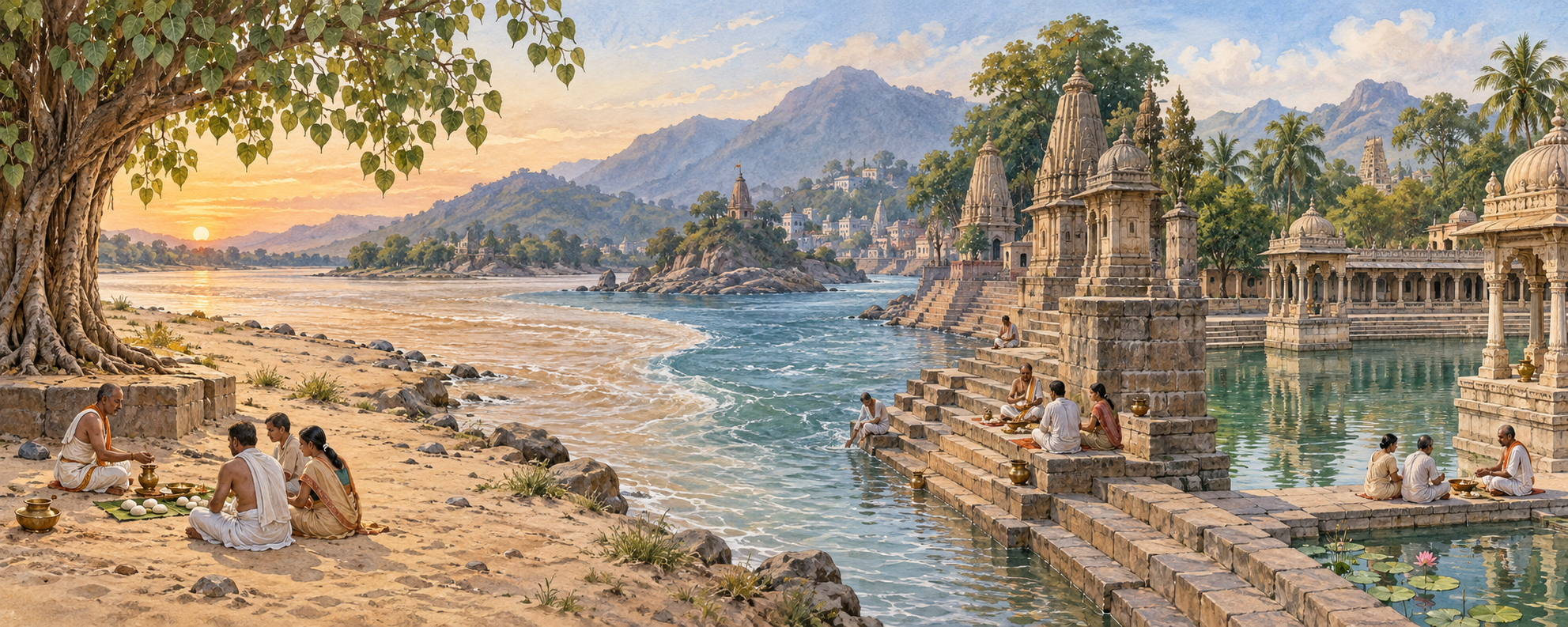
Traditional pilgrimage lists describe 1008 sacred places in India associated with Pitru Paksha observances. That breadth matters because it corrects a common assumption: there is not one destination that every Hindu family must choose in every circumstance.
The right place is one where your family’s intended rite can actually be completed under competent guidance. A longer journey is not automatically a more appropriate one. Begin with family custom, then test the destination against the practical requirements of the ceremony.
- Family connection: Ask whether your family has an established tirtha, temple, priestly relationship, or regional custom for ancestral rites.
- Ritual availability: Confirm whether the officiant will conduct the Shraddha, tarpana, pinda daan, or combination your family expects. Do not assume that every location offers every form.
- Calendar agreement: Give the ritualist your intended tithi and ask for the corresponding 2026 civil date at that destination.
- Language and procedure: Make sure you can understand the instructions or arrange help. You should know what information and participation will be expected from you.
- Materials: Request a written list of what the officiant supplies and what you must bring. Local customs can change the requirements.
- Site logistics: Ask where you will report, how far it is from your lodging, and whether any physical access needs must be planned for in advance.
- Cost clarity: Establish the officiant’s charges, material costs, and any site-specific fees before arrival. A vague quotation creates pressure at the moment when your attention should be on the rite.
Do not rely on a hotel, driver, or general tour organizer to answer ritual questions. They can solve transport and accommodation. The tithi, procedure, and muhurta should be confirmed by the person responsible for conducting the ceremony.
Build the day around Kutup, Rohina, and Aparahna

The recognized auspicious periods for Pitru Paksha performance include Kutup Muhurta, Rohina Muhurta, and Aparahna Kaal. These names identify ritual portions of the day; they are not fixed nationwide clock appointments.
Exact clock times depend on the date and location used for the calculation. A timetable prepared for your home city may therefore be unsuitable at a distant tirtha. Ask for the local start and end of the period the officiant intends to use, and ask whether the ritual must begin, substantially occur, or finish within that interval according to the procedure being followed.
- Kutup Muhurta: Obtain its exact local start and end times for your selected date.
- Rohina Muhurta: Ask whether it is being used as the planned performance period or as an alternative window.
- Aparahna Kaal: Confirm the locally calculated interval rather than interpreting it as a casual instruction to arrive sometime in the afternoon.
Also distinguish the reporting time from the muhurta. The priest may need you present beforehand to check family information, arrange materials, explain the sequence, and prepare for the sankalpa. If the stated ritual window begins at a particular time, arriving at that time may already be late.
Avoid planning a tight same-day arrival. A delayed train, flight, or road journey can cost you the intended window even when the tithi itself continues. Where practical, reach the destination the previous evening and keep the period after the rite free from an inflexible departure. This is a scheduling safeguard, not a ritual rule.
Use one confirmation call to close every planning gap
Before booking, send the officiant a single written request: “We intend to perform our family’s Pitru Paksha rite in 2026. Please confirm the applicable tithi and civil date, the local Kutup, Rohina, or Aparahna timing you will use, our reporting time, the rite you will conduct, the materials we must bring, and the full expected cost.”
Keep the reply with your travel details. A written confirmation prevents four different assumptions from developing between the family, the organizer, the driver, and the priest. Reconfirm shortly before departure because your working schedule must reflect the local panchanga and the officiant’s actual arrangements.
Prepare a compact pilgrimage file containing the confirmed date, destination address, priest’s contact details, reporting point, local ritual window, required family information, material list, charges, transport plan, and one backup contact. If an elder or several relatives are participating, give everyone the same version rather than relaying details through separate conversations.
Key takeaways for Pitru Paksha 2026
- The 2026 observance runs from September 27 through Mahalaya Amavasya on October 10.
- Do not turn the fortnight’s opening and closing dates into an assumed appointment; first identify the family tithi.
- A sacred destination should be chosen for family custom, ritual suitability, and competent guidance rather than fame alone.
- Kutup Muhurta, Rohina Muhurta, and Aparahna Kaal are the timing windows to discuss with the officiant.
- Use clock times calculated for the pilgrimage location, not a schedule copied from another city.
- Confirm both the muhurta and the earlier reporting time before booking travel.
Your next step is simple: contact the family purohit or the intended destination priest with the ancestor’s relevant details and ask for one written confirmation covering tithi, civil date, local timing, procedure, materials, and cost. Once those points agree, the journey can be arranged around the rite instead of forcing the rite into a journey already booked.
References
- Hindu Pad – Places to do Pitru Paksha Shraddh | Where to perform Mahalaya Shraddh rituals
- Hindu Pad – Pitru Paksha 2026 Time | Shraddh Timings

Leave a Reply
You must be logged in to post a comment.