
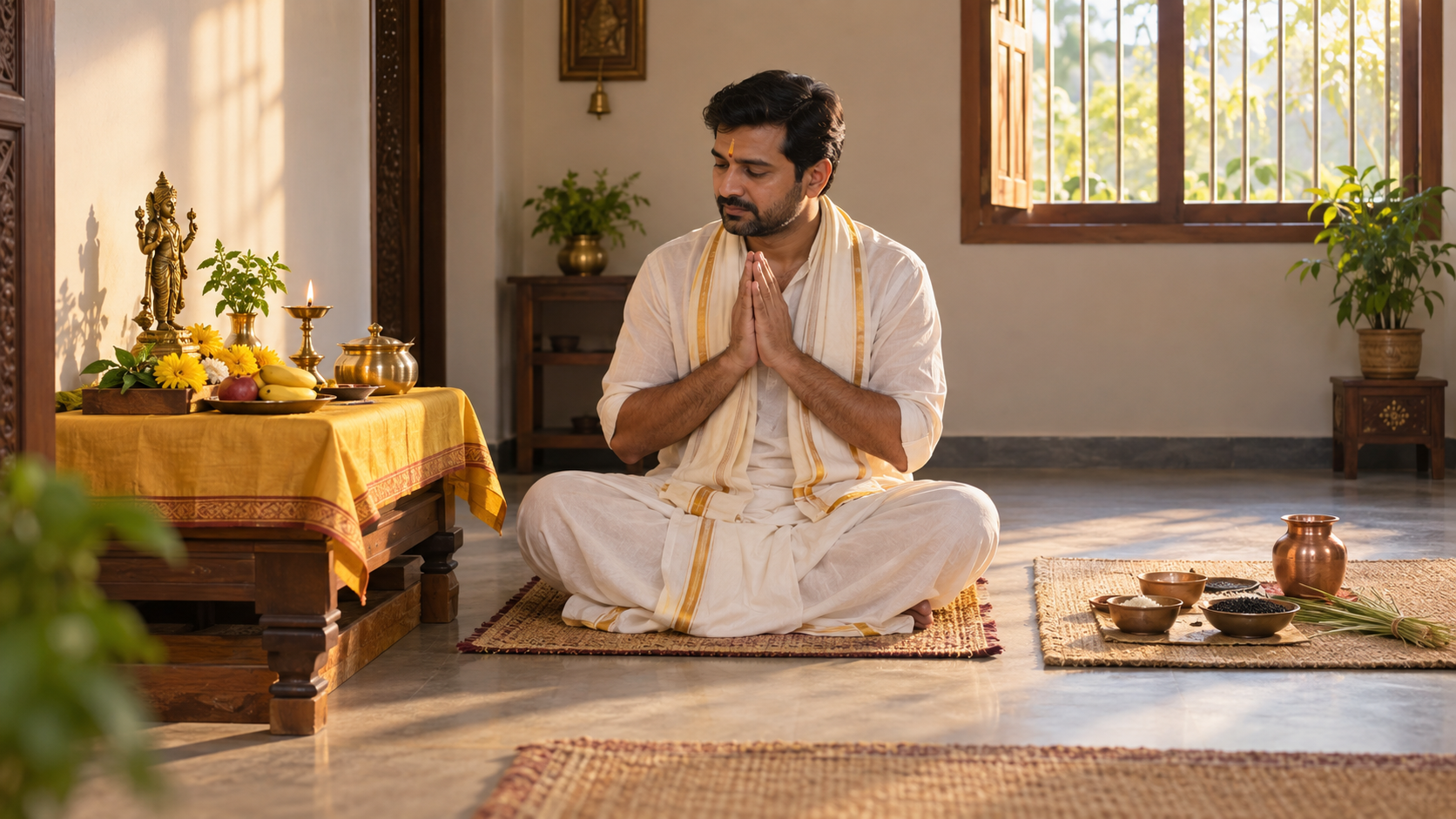
You have found Indira Ekadashi on the Pitru Paksha calendar, but the practical question remains: are you meant to keep an Ekadashi vrat, perform Shraddha, or do both? The answer begins by separating two related observances that share a tithi but are not interchangeable.
Indira Ekadashi gives the Ekadashi discipline an explicitly ancestral direction. Ekadashi Shraddha belongs to the sequence of Pitru Paksha rites. Once you know which duty applies in your family, you can plan the day without reducing it to either a food restriction or a generic remembrance ceremony.
Start with the distinction most calendars do not explain
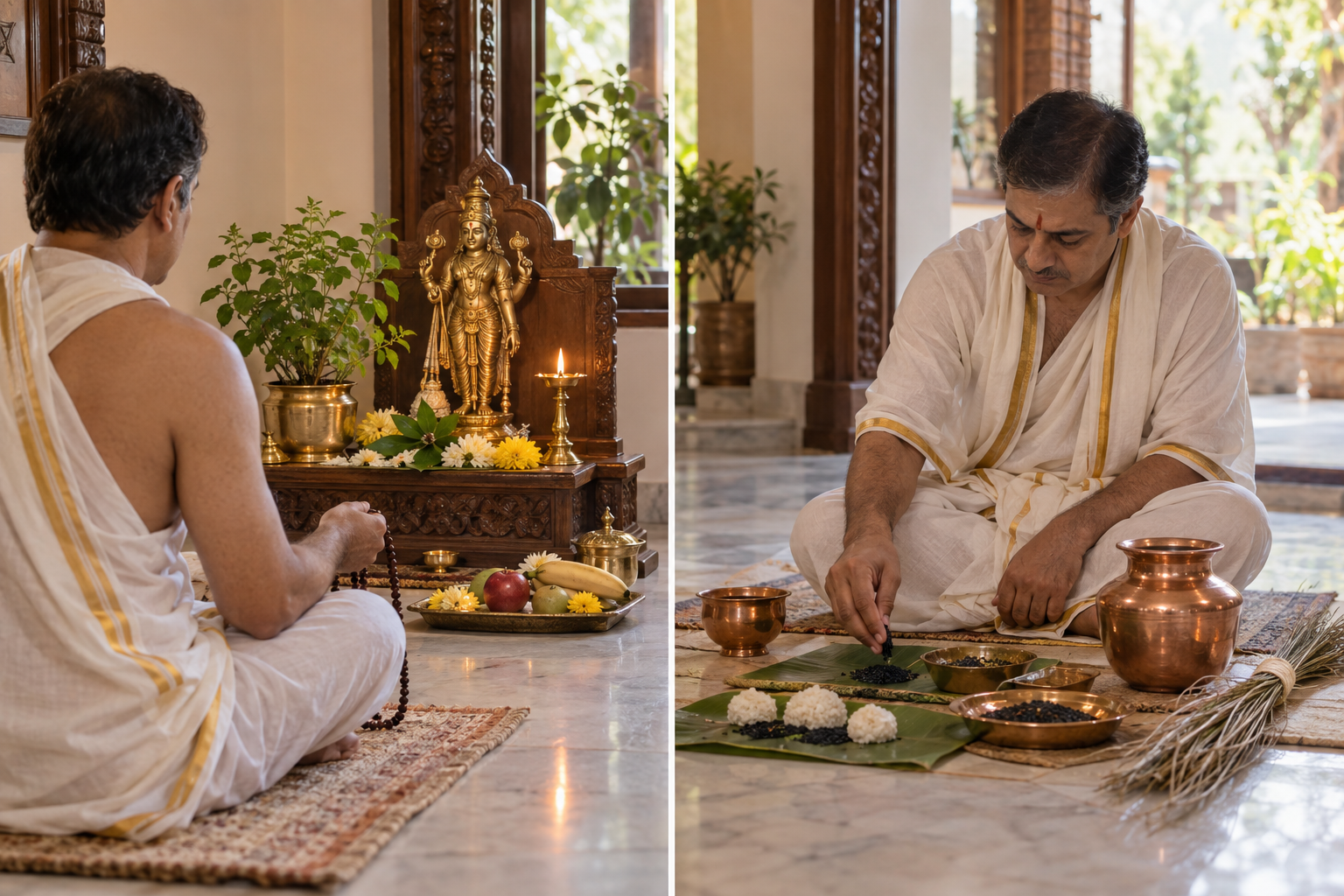
Ekadashi Shraddha is the eleventh day of Pitru Paksha. Because Indira Ekadashi occurs on that same Krishna Paksha Ekadashi, a calendar may use the names “Indira Ekadashi,” “Ekadashi Shraddha,” or both. The shared date does not make the two expressions of dharma identical.
The Indira Ekadashi vrat is an Ekadashi observance whose merit and intention are directed especially toward one’s forefathers. Its vrata-katha is associated with King Indrasena and is identified with the Brahmavaivarta Purana. Its distinguishing emphasis is not merely the seeker’s own spiritual liberation, but spiritual benefit offered for the forefathers.
Ekadashi Shraddha, by contrast, is the Pitru Paksha observance assigned to the eleventh lunar tithi. In many family traditions, the daily Shraddha within Pitru Paksha is connected with the ancestor’s death tithi. If your family follows that system, first determine whether Ekadashi is the relevant Shraddha tithi for your ancestor. Do not assume that every formal family Shraddha moves to Indira Ekadashi merely because this vrat has an ancestral purpose.
This distinction gives you a clean decision:
- If Ekadashi is the applicable ancestral tithi in your family, ask how the prescribed Shraddha and the Indira Ekadashi vrat are combined.
- If another tithi is used for your formal Shraddha, you may still observe Indira Ekadashi for your forefathers according to your sampradaya or household practice.
- If you do not know the death tithi or family rule, do not invent one from an online calendar. Ask a knowledgeable family elder, purohit, or acharya who understands your tradition.
Confirm the tithi before arranging the day
Indira Ekadashi falls in Krishna Paksha during Pitru Paksha. It is placed in Ashwin in North Indian Hindi calendars, while Marathi, Gujarati, Telugu, and Kannada panchangams place it in Bhadrapada. These different month names reflect regional calendar systems; they do not create two separate Indira Ekadashis.
For 2026, Indira Ekadashi and Ekadashi Shraddha fall on October 6. Treat that as the civil date for planning, not as a substitute for local ritual timings. A lunar tithi can begin and end within a civil day, and the correct fasting and parana schedule depends on the panchang for your location.
Before buying materials, arranging leave, or calling relatives, verify four items:
- Set the panchang to the city where you will actually observe the vrat. An India-based festival date alone is insufficient if you live in another time zone.
- Locate Krishna Paksha Ekadashi within Pitru Paksha, regardless of whether your regional calendar labels the month Ashwin or Bhadrapada.
- Check the locally prescribed fasting day and the parana window rather than guessing when the vrat ends.
- Confirm separately when your family performs any formal Shraddha, tarpana, or associated rite. The ritual schedule should come from the tradition guiding that rite.
A festival image showing only “October 6” cannot answer all four questions. Record the city, tithi, observance date, and parana timing together so that nobody in the household has to reconstruct the decision on the morning of the vrat.
Build one observance without erasing either duty
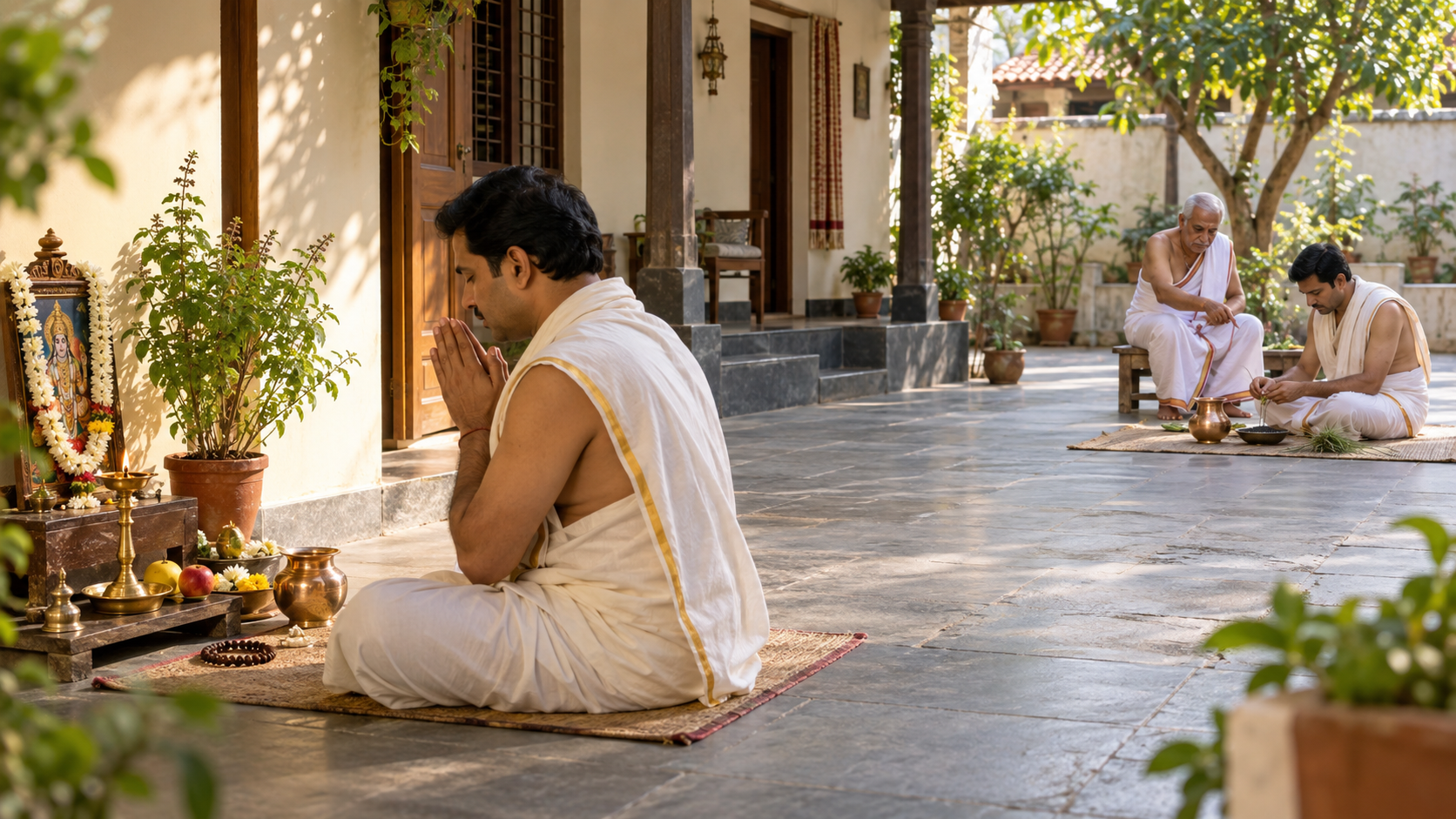
The common mistake is to let one part of the day swallow the other. Focusing only on permitted foods can turn the vrat into a diet. Treating Indira Ekadashi as a generic ancestors’ day can erase the discipline of Ekadashi. Performing a formal rite mechanically while ignoring its ancestral intention misses the connection that makes this tithi distinctive.
Use this planning sequence instead:
- Identify the formal obligation. Establish whether Ekadashi Shraddha applies to an ancestor under your family’s tithi rule. If it does, obtain the correct procedure from the person who guides your family rites.
- Choose the vrata discipline separately. Ask what your sampradaya permits and expects on Ekadashi. Food rules, water restrictions, worship, and recitation practices are not uniform across all Hindu households.
- Fix the ritual order before the day begins. Let the family purohit or established household practice determine the timing of Shraddha and tarpana. Arrange personal prayer, vrata-katha, and remembrance around that schedule rather than creating a supposedly universal order.
- Prepare only what your practice requires. Make one written list covering ritual materials, permitted food, the local parana time, and the names of people responsible for each task. This prevents a late search for supplies from displacing the observance itself.
- State the intention clearly. Keep the welfare of the forefathers central when undertaking the vrat. Indira Ekadashi is not simply an ordinary fast that happens to occur during Pitru Paksha.
- Complete the vrat according to the same authority used to begin it. Do not combine a fasting rule from one tradition, a ritual sequence from another, and a parana time copied from a third location.
Fasting capacity also deserves an honest decision. Strictness is not something to improvise when you are pregnant, unwell, taking medication, managing a condition affected by food or fluids, or responsible for a child or frail elder. Seek medical guidance where fasting could affect health, then ask a competent acharya how to adapt the vrata discipline. Personal prayer or a moderated observance may still be meaningful, but you should not declare an adaptation ritually identical to a prescribed fast without guidance from your tradition.
If you cannot perform a full formal observance
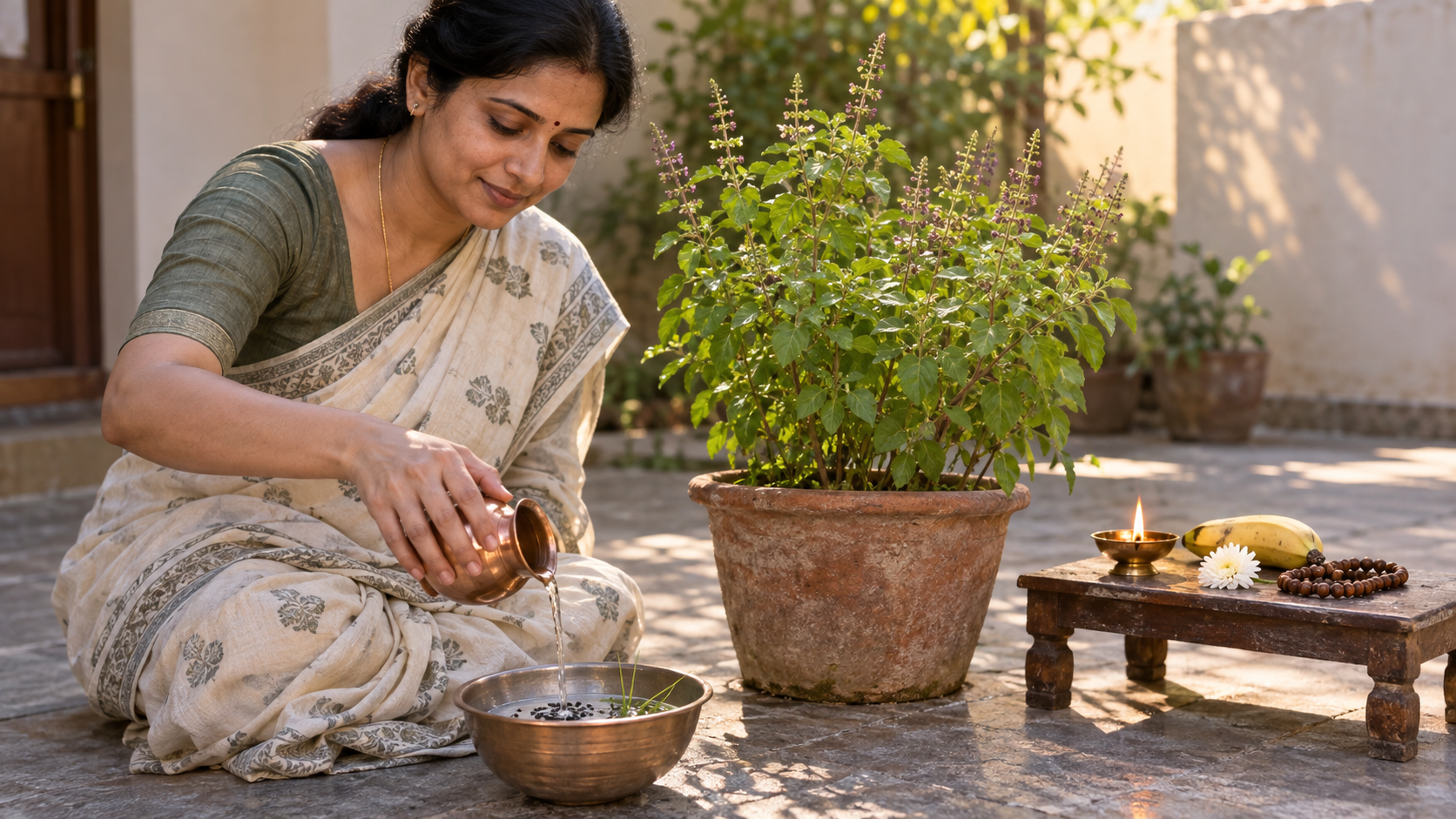
Distance, migration, missing family records, lack of a purohit, work obligations, or uncertainty about lineage practice can make Pitru Paksha observance difficult. The responsible response is to preserve the distinction between sincere remembrance and a formal rite. Do what you can truthfully, but do not rename a self-designed ceremony as Shraddha if you do not know that it meets your family’s requirements.
Start with one precise question to a trusted elder or priest: “What is the appropriate Indira Ekadashi observance for our family if I cannot perform the full Shraddha?” Include your location, family tradition if known, whether Ekadashi is the ancestor’s death tithi, and any health limit affecting the fast. Those details produce a more useful answer than asking generally what everyone should do.
If formal guidance is unavailable in time, you can still keep the day from passing unnoticed through prayer, remembrance, study of the vrata-katha, or an act of charity undertaken with ancestral gratitude. Treat these as honest devotional acts, not as automatic replacements for rites whose procedure you have not established. Preserve the question and resolve it before the next Pitru Paksha rather than repeating the uncertainty each year.
Let King Indrasena’s katha correct the intention
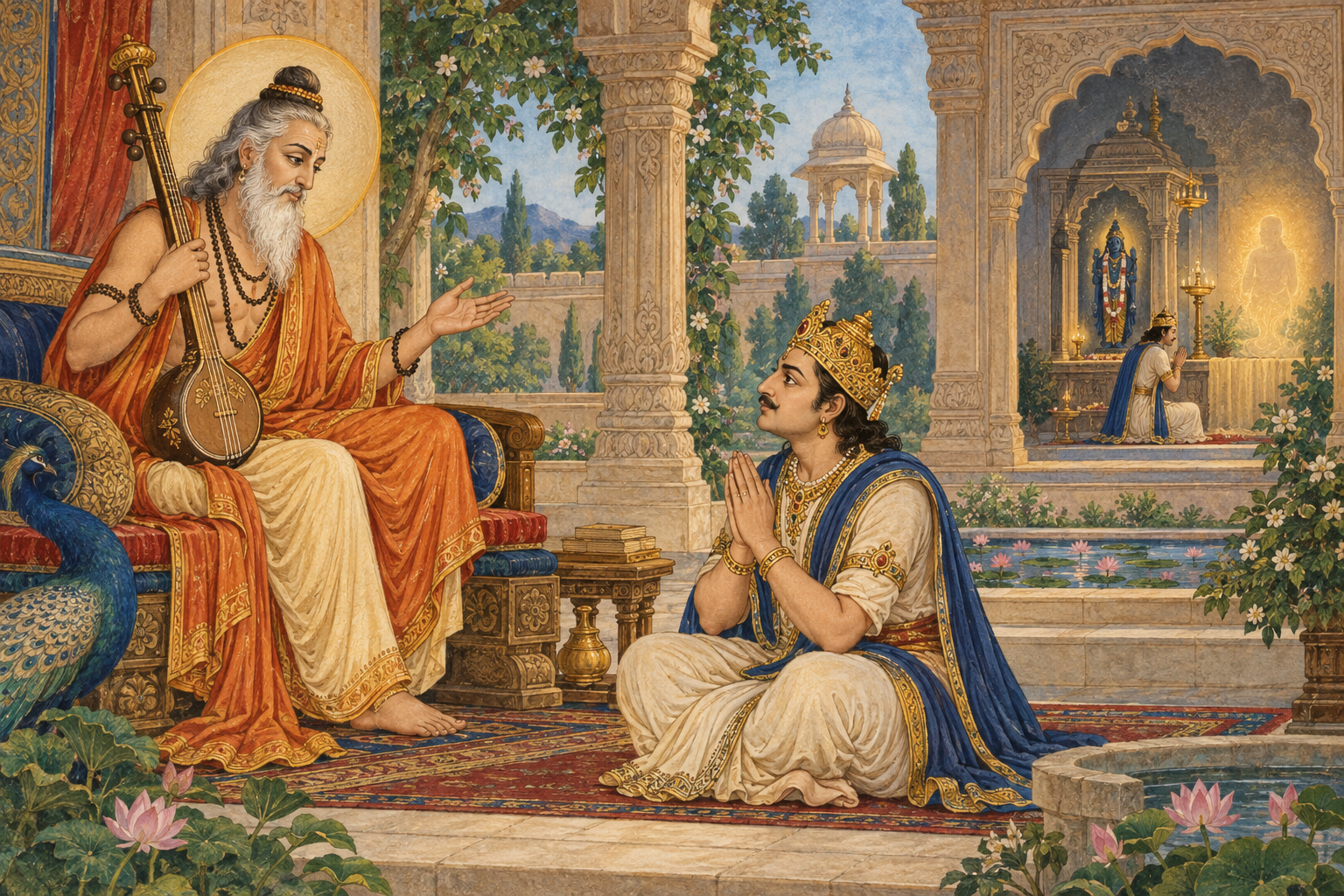
The vrata-katha matters because rules alone can make the day feel transactional: abstain from certain foods, complete a rite, and expect a result. The traditional account connected with King Indrasena places responsibility toward a forefather at the center of Indira Ekadashi. That focus changes what you should notice in your own observance.
Ask whether your preparations express gratitude or merely anxiety about procedural perfection. Ask whether younger family members know whose memory is being honored. Ask whether fasting is making attention steadier or only making the household irritable. These questions do not replace ritual rules; they keep the rules joined to their purpose.
If you read or hear the katha, do not treat it as decorative material to be rushed through after the “real” observance. Give it enough attention to recover the day’s governing principle: spiritual effort need not end with the individual. Within the Dharmic understanding of relationship and obligation, remembrance of the pitrs is also an acknowledgment that a life is inherited, not self-created.
Key takeaways
- Indira Ekadashi is the Krishna Paksha Ekadashi that occurs during Pitru Paksha and has a particular orientation toward the forefathers.
- Ekadashi Shraddha is the eleventh-tithi observance within Pitru Paksha; it should not automatically be treated as identical to the Indira Ekadashi vrat.
- In 2026, the observance falls on October 6, but local panchang timings remain necessary for the fast, parana, and ritual schedule.
- Ashwin in a North Indian calendar and Bhadrapada in several western and southern calendars are regional labels for the relevant lunar period, not conflicting festival dates.
- Family practice, sampradaya, location, and the applicable ancestral tithi determine how you combine fasting with formal Shraddha or tarpana.
- When health limits strict fasting, protect health and obtain both medical and spiritual guidance rather than improvising a hazardous rule.
Before October 6, settle three matters in writing: the local panchang timing, the family Shraddha requirement, and the vrata discipline you can responsibly keep. Then the day can be directed toward remembrance and dharma instead of last-minute uncertainty.
References
- Hindu Pad – Ekadashi Shraddh 2026 | Indira Ekadasi during Pitru Paksha
- Hindu Pad – Indira Ekadashi Vrat Katha, Story
- Hindu Pad – Indira Ekadashi – Significance, Merits

Leave a Reply
You must be logged in to post a comment.