
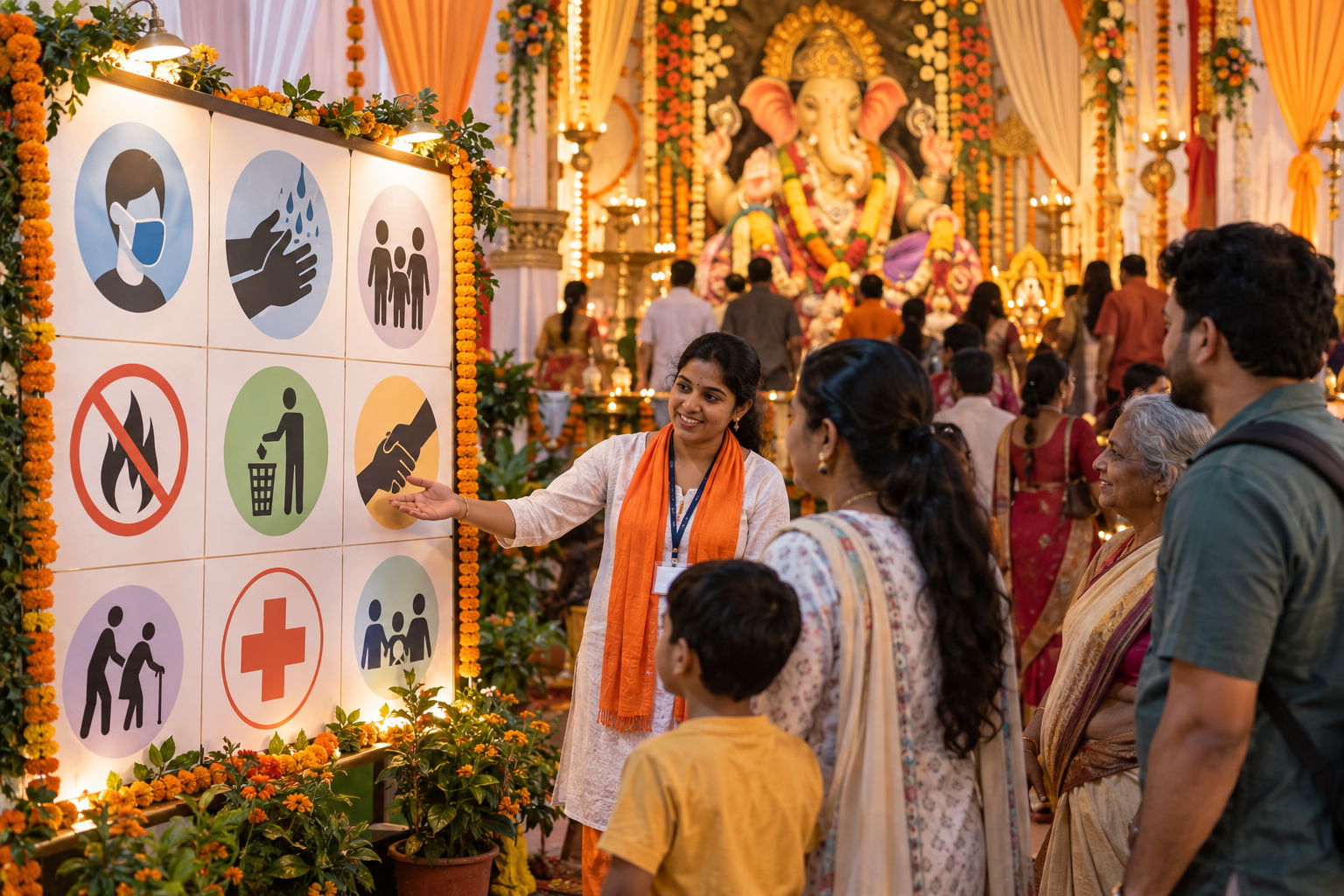
If your Ganeshotsav mandal wants to warn Hindu families about coercion, radicalisation, violence, or organised hostility, the difficult part is not attracting attention. It is making the warning accurate enough to trust, specific enough to use, and disciplined enough to belong in a sacred public celebration.
An anti-jihad display can serve that purpose, but only when it identifies conduct rather than treating religious identity as evidence. The standard should be simple: a visitor must leave knowing what to notice, how to verify it, and what lawful step to take next.
Name the conduct instead of casting suspicion on a community

Hindu Jagruti Sarvajanik Shri Ganeshotsav Mandal in Thane, Maharashtra, used festival displays to raise awareness about what it called various forms of jihad, alongside social and national issues. That example shows how a Ganeshotsav platform can be used for civic messaging. The existence of a campaign, however, does not prove every claim made under its chosen label.
The word jihad carries more than one meaning in Islamic thought and public debate. If a display leaves the term undefined, visitors may interpret it as referring to Muslims generally. That is both unjust and strategically weak. Muslim identity is not evidence of coercion, criminality, or violent intent, just as Hindu identity does not make every Hindu organisation answerable for every Hindu individual.
Use anti-jihad as an umbrella label only if every panel immediately identifies the behaviour at issue. If the concern is recruitment to violent extremism, say so. If it is an alleged threat, deception, assault, or coercive act, name that conduct and give its evidentiary status. Do not make a charged word carry a claim that the display itself has not established.
Before approving a panel, require clear answers to four questions:
- What exact act, method, or pattern is the panel asking visitors to notice?
- What verifiable material supports the claim?
- Is the matter an allegation, a documented incident, an official finding, a judicial outcome, or the mandal’s interpretation?
- What safe and lawful action should a visitor take after reading it?
If the panel cannot answer all four, it is not ready. Urgency should raise the standard of evidence, not lower it.
Turn a warning into a display visitors can verify
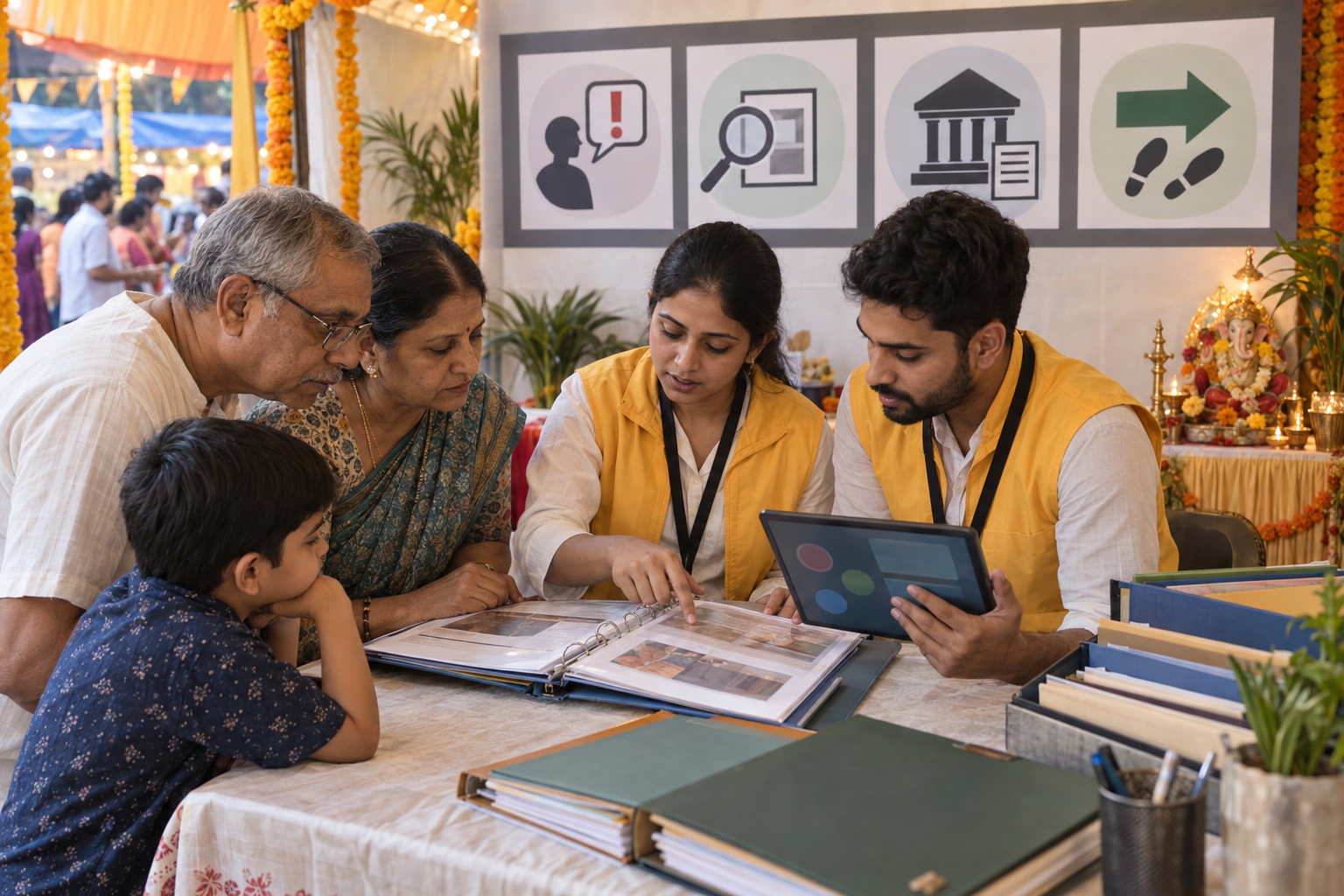
A wall of alarming slogans may produce attention, but it does not produce awareness. Awareness requires a visible chain from claim to evidence to action. Build that chain before deciding on colours, photographs, or dramatic headlines.
- Write the objective in one sentence. A workable objective would be: help visitors recognise and lawfully report specified coercive or violent conduct without blaming a religious community.
- Make an inventory of every factual claim. Record the original reference, the date and place where relevant, and the claim’s current status.
- Separate confirmed facts, allegations, interpretations, and appeals. Do not blend them into a single declarative caption.
- Give each panel one principal claim, the evidence supporting it, a precise source line, and one appropriate next action.
- Ask a reviewer who did not draft the display to check names, translations, image captions, links, and whether the cited material actually supports the headline.
- Prepare a correction process before opening. If a factual error is identified, amend the panel and any online version visibly instead of silently changing it.
Anonymous forwards, cropped screenshots, unattributed quotations, and images detached from their original context are not adequate evidence. They may be emotionally persuasive precisely because visitors cannot test them. Exclude them unless their origin and context can be independently established.
Be equally careful with personal information. Publishing a private individual’s name, face, telephone number, address, or unproven accusation can expose that person to harassment and can create legal risk for the mandal. Redact identifying details where they are unnecessary. Obtain suitable legal review before publicly naming an accused person or organisation, especially when proceedings are unresolved.
A good panel makes uncertainty visible. Phrases such as alleged, under inquiry, disputed, or confirmed are not signs of weakness when accurate. They tell the visitor what is known, what remains contested, and how much confidence to place in the claim.
Keep the campaign recognisably dharmic
Ganeshotsav is not a generic advertising opportunity. Shri Ganesha is associated with wisdom, discernment, auspicious beginnings, and the removal of obstacles. A civic display placed beside worship should therefore cultivate viveka rather than reflexive suspicion.
Test the display against the values of the setting. Does it encourage courage without vigilantism? Does it protect potential victims without turning their suffering into spectacle? Does it distinguish hostile acts and ideologies from ordinary neighbours? Does it ask Hindus to become better informed and more responsible, or merely more afraid?
The physical sequence matters. Begin with the mandal’s devotional and civic purpose. Define the issue before presenting examples. Follow every warning with verification guidance and a lawful response. End with help, reporting, and community-support options. This sequence moves the visitor from attention to understanding and then to action.
Keep the devotional space proportionate. Make the awareness material readable without forcing every worshipper through graphic or distressing imagery. Children, elders, and families may encounter the display unexpectedly. Images of injury, private grief, or humiliation should never be used merely to intensify emotion.
Language is another design choice. Vague warnings about an approaching storm may heighten alarm, but they do not tell a family what to recognise or do. Replace theatrical language with observable indicators and defined actions. Precision is more protective than volume.
Prepare a safe response before inviting disclosures
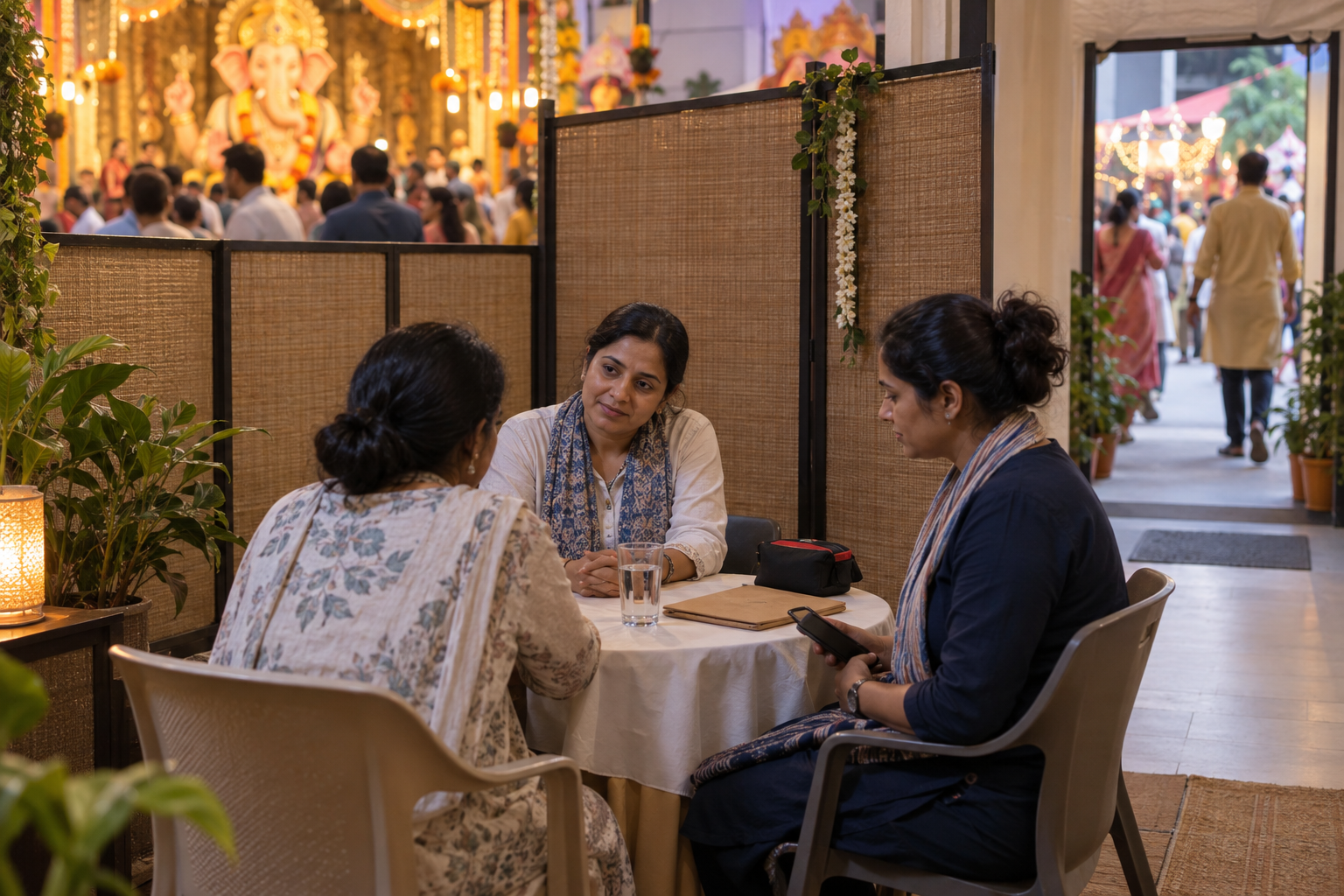
A public campaign may prompt someone to disclose a threat, coercive relationship, suspected recruitment effort, or other sensitive experience. Do not invite such reports unless the mandal has decided who will receive them and how privacy will be protected.
- If there appears to be immediate danger, direct the person to local emergency services or police. Volunteers should not attempt a confrontation or improvised rescue.
- For a non-immediate allegation, move the conversation away from the crowd, listen without promising an outcome, and refer the person to appropriate legal, safeguarding, or support services.
- Preserve original messages, files, links, and dates when evidence may matter. Do not repeatedly forward sensitive material through volunteer groups.
- Do not display a visitor’s account, photograph, or identifying details without informed permission and a clear protective reason.
- Designate one trained spokesperson for questions from visitors or media. Other volunteers should know where to direct a dispute rather than debating it in a queue.
- Record factual objections to the display and examine them promptly. A correction supported by evidence strengthens the campaign’s credibility.
Volunteers also need a short, consistent explanation of the campaign’s scope: the display addresses specified conduct and claims; it does not assign guilt to a religion or an entire community; factual corrections are welcome. That sentence sets a boundary without retreating from legitimate concern.
Do not permit the display to become a pretext for threats, harassment, collective blame, or unofficial policing. Such conduct endangers innocent people, exposes the mandal to avoidable risk, and destroys the moral distinction between awareness and intimidation.
Key takeaways
- Define the precise conduct behind the anti-jihad label; never use religious identity as a substitute for evidence.
- Show visitors which statements are verified facts, allegations, interpretations, or calls to action.
- Make every panel traceable through an original reference, accurate context, and a source line that supports the actual claim.
- Protect private information and obtain locally qualified legal review before publishing unresolved accusations or identifying details.
- Give visitors a safe reporting route, and expressly reject confrontation, vigilantism, harassment, and collective blame.
- Judge the campaign by a dharmic standard: more discernment, more responsible courage, and less indiscriminate fear.
Before printing the first panel, put the complete display before three people: a careful fact-checker, a locally qualified legal reviewer, and an ordinary festival visitor who did not help create it. Ask each person to identify the exact conduct, the evidence, and the requested action. If they cannot, revise it. If they come away suspecting an entire religious community, rewrite it. A Ganeshotsav awareness campaign should leave your community more capable of protecting itself, not merely more agitated.
References

Leave a Reply
You must be logged in to post a comment.