
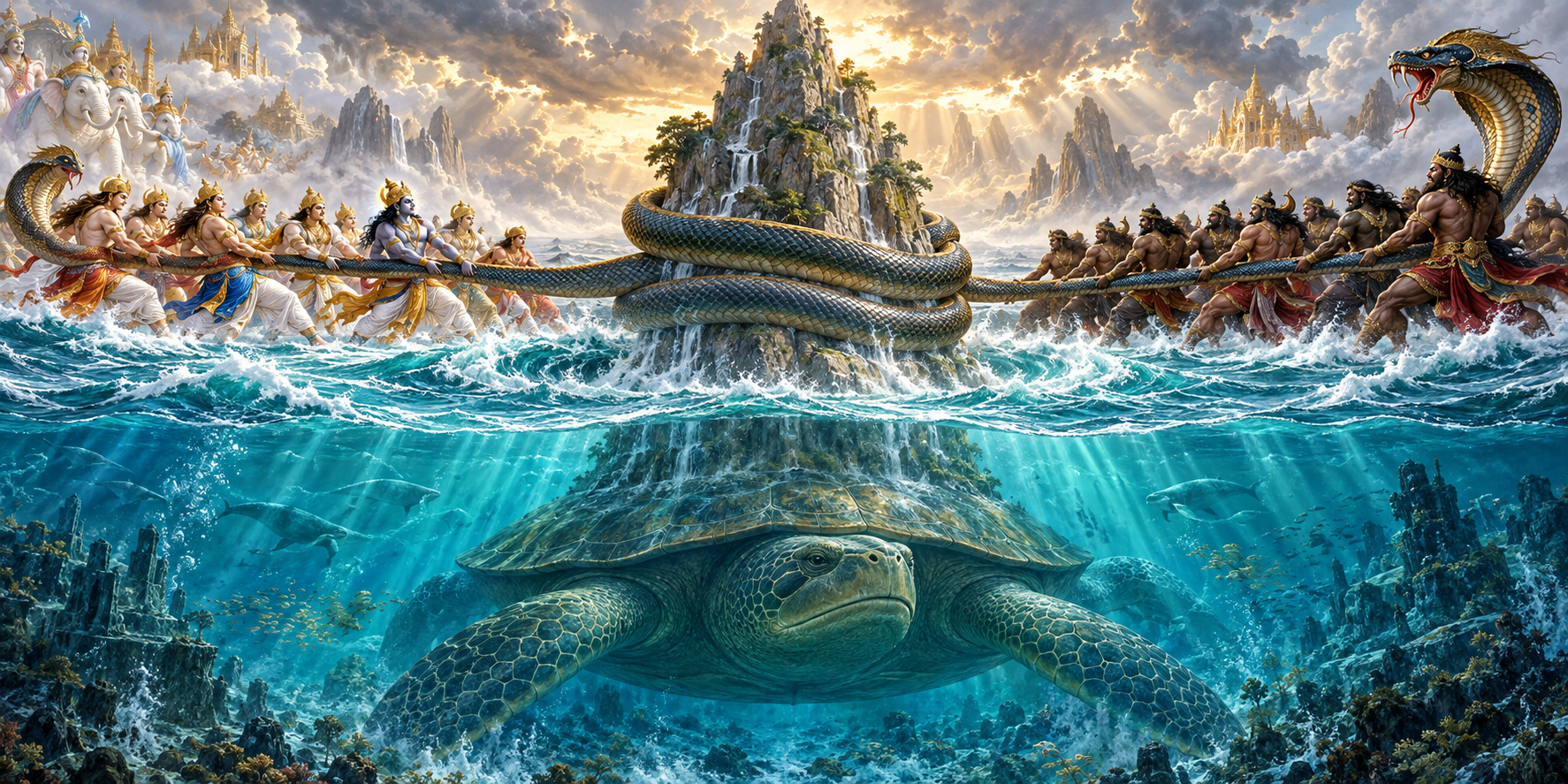
If you came looking for the identity of Akupara, the short answer is precise: Akupara is the king of tortoises who bears Mount Mandara during the churning of the milky ocean in the Mahabharata.
That answer is easy to lose inside the scale of the episode. Devas, asuras, a mountain, the ocean and amrita all command attention. Yet the name Akupara points you toward the element on which the entire operation depends: the support beneath the churning rod.
Who Akupara is and where he appears

Akupara appears in Chapter 16 of the Astika Parva, within the Adi Parva of the Mahabharata. The Adi Parva is the opening book of the epic, while the Astika Parva is one of its constituent sections. Keeping both names in your notes will help you locate the passage even when an edition organizes or numbers its chapters differently.
His identification has two parts. He is the king of tortoises, which tells you who he is, and he bears Mandara, which tells you what he does. Those parts should remain together. Calling him merely “a tortoise” drops the personal name and status given to him; calling him a churner confuses his function with that of the devas and asuras.
The narrow wording also prevents an unnecessary exaggeration. In this episode, Akupara bears Mandara. That does not by itself establish that every cosmic-tortoise reference in every Hindu narrative names the same being. When you explain the passage, begin with its actual claim before moving to comparisons or theological interpretation.
How Akupara fits into the churning of the ocean
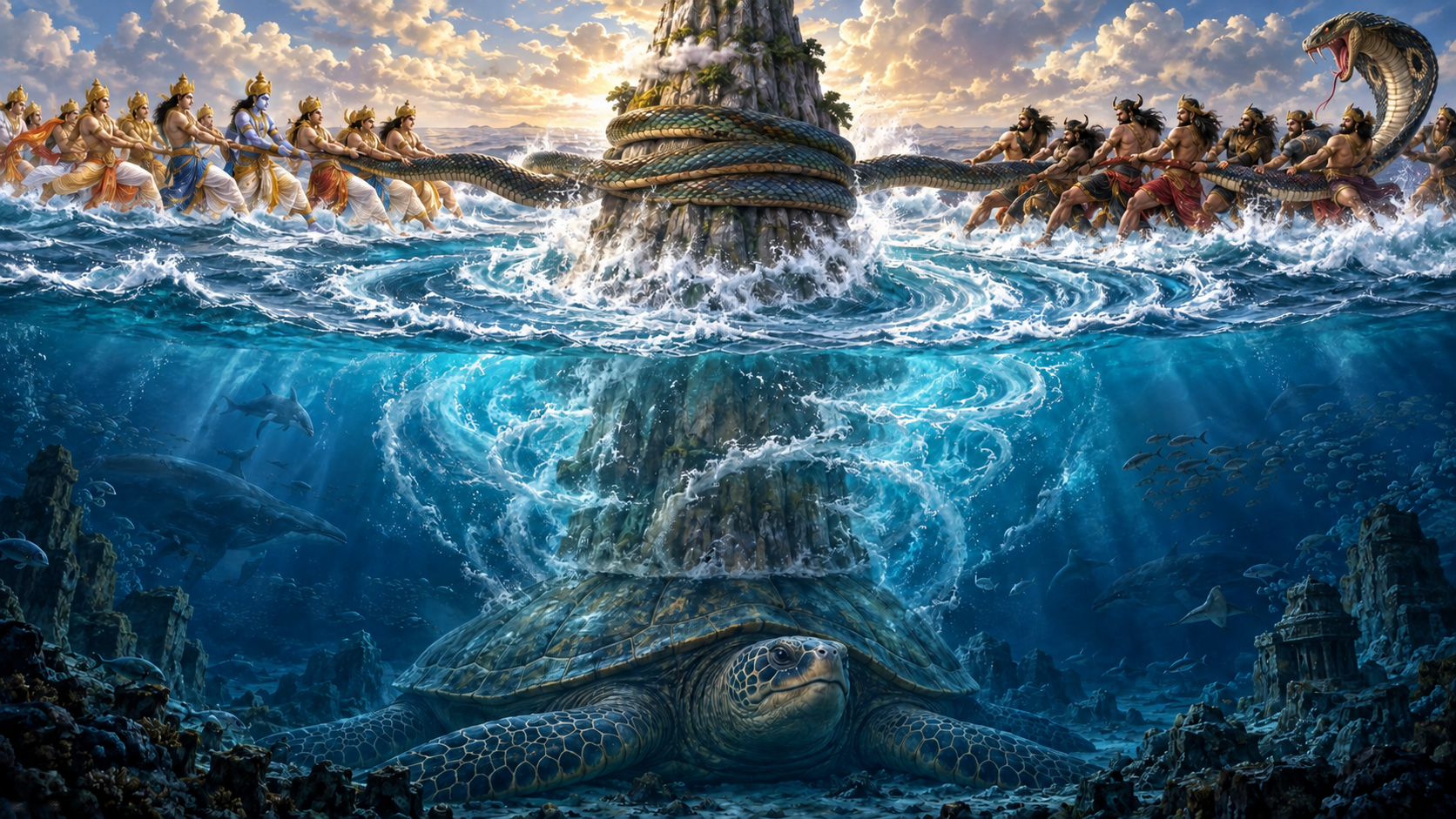
The episode is easier to understand when you assign each participant one clear function. The devas and asuras seek amrita, the nectar of immortality. Mandara is uprooted for use as the churning rod. The milky ocean agrees to be churned. Akupara provides the support that allows the mountain to serve its purpose.
- Devas and asuras: the two parties undertaking the churning.
- Amrita: the object they hope to obtain.
- The milky ocean: the vast field of the operation and a participating presence, not merely scenery.
- Mount Mandara: the mountain converted into the churning rod.
- Akupara: the supporting being beneath Mandara.
This role map corrects a common reading error. Akupara does not compete with the most visible actors. His importance comes from making their movement possible. A mountain may be an impressive rod, but force applied to an unsupported rod cannot produce ordered churning. The bearing point is part of the mechanism.
You can therefore summarize Akupara’s narrative function in one sentence: he supplies stability beneath the instrument through which the devas and asuras pursue amrita. That formulation is more accurate than saying only that he “helped,” because it identifies the exact kind of help he provided.
Should Akupara be identified with Kurma?
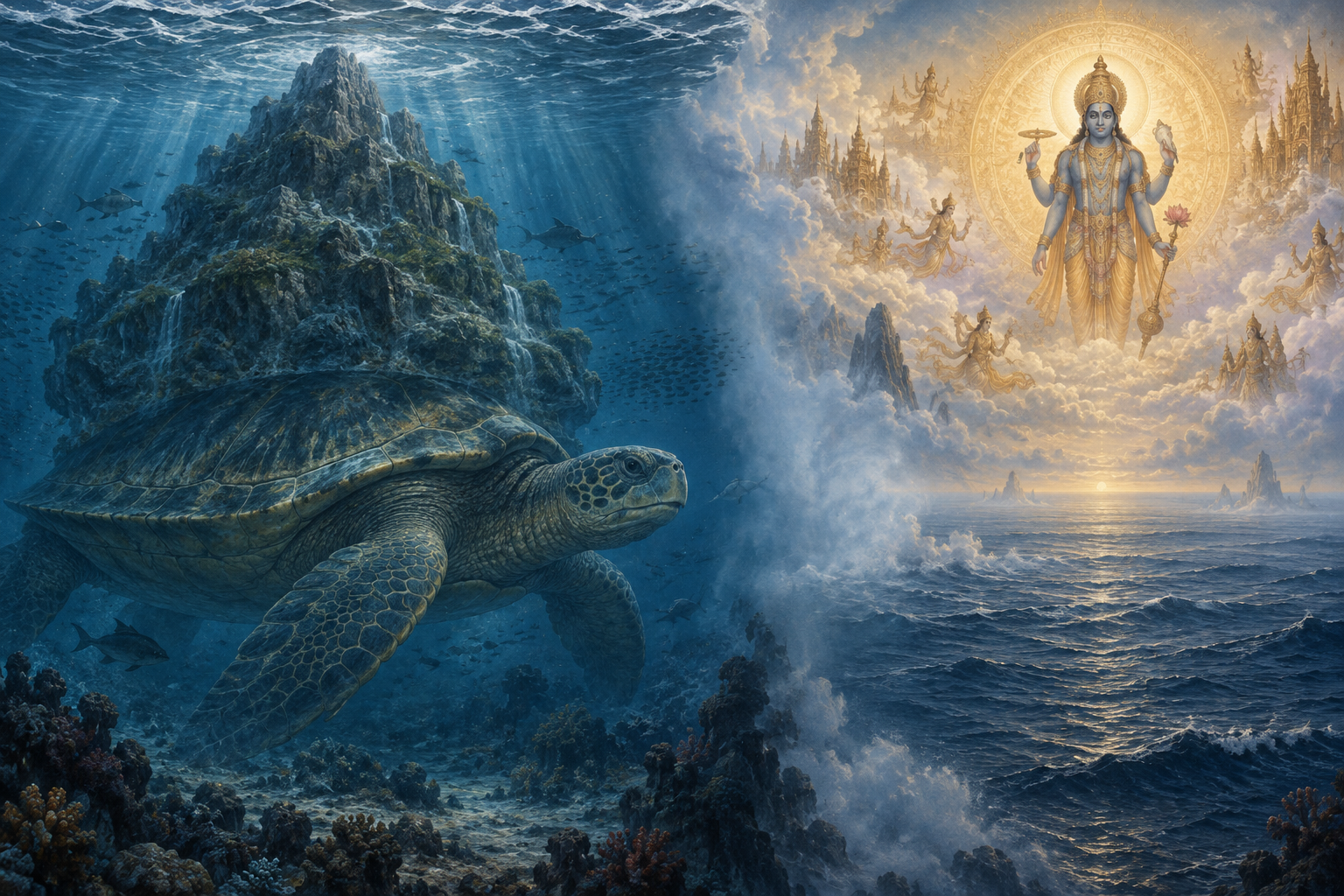
Many readers approach the ocean-churning story already remembering Kurma, the tortoise form of Vishnu. That familiar association can cause the proper name Akupara to disappear from the retelling. The careful response is neither to ignore Kurma nor to declare an identity that the name alone cannot settle.
Keep three kinds of statement separate:
- Passage-level statement: in this Mahabharata episode, Akupara, king of tortoises, bears Mandara.
- Comparative statement: other tellings or theological presentations may describe the supporting tortoise through the Kurma tradition.
- Identity claim: deciding whether Akupara is a distinct being, a name or title connected with Kurma, or a form of Vishnu requires support from the particular Sanskrit reading, translation or commentary being used.
This distinction matters whenever you teach, write or answer a question about Hindu scripture. Similar roles across tellings do not give you permission to erase a name found in a particular passage. At the same time, different names do not automatically prove that the traditions describe unrelated beings.
A dependable sentence for a class or discussion is: “The Mahabharata passage names Akupara, the king of tortoises, as the bearer of Mandara; Kurma belongs to the wider theological frame through which many Hindus know the episode.” It states what is secure and marks where interpretation begins.
What Akupara’s supporting role lets you notice
First read the mechanics
Before treating the churning as an allegory, reconstruct the event. There is a desired result, an enormous instrument, coordinated effort and a base capable of bearing the instrument. Akupara belongs to that last category. Reading the mechanics first keeps a later spiritual interpretation anchored to the narrative rather than replacing it.
Then distinguish meaning from plot
A disciplined symbolic reading can see Mandara as concentrated effort, the churning as sustained transformation and Akupara as the steadiness without which effort becomes disorder. But that is an interpretation, not a substitute translation of the episode. Use language such as “Akupara can represent” rather than “Akupara always means.”
The distinction gives you a practical question for sadhana: what bears the weight of your practice when enthusiasm begins to move? A demanding discipline needs a dependable base—regularity, restraint, attention and a life arranged so that practice can continue. The analogy is useful precisely because Akupara’s work is structural. He does not become the goal, the mountain or the churning force.
Use a four-step method when reading the passage
- Locate the episode: note Adi Parva, Astika Parva and Chapter 16 in the arrangement cited here.
- Map each proper noun to a function: do not let the grandeur of the whole scene blur who does what.
- State the smallest secure claim: Akupara is king of tortoises and bears Mandara during the churning.
- Add comparisons and symbolism afterward: label them as comparative or interpretive claims instead of blending them into the plot.
This method works especially well when names differ among retellings. It lets you respect the wording before you harmonize traditions, and it makes your explanation clearer to someone encountering the Mahabharata for the first time.
Key takeaways
- Akupara is the king of tortoises who supports Mount Mandara during the churning of the milky ocean.
- The episode appears in Chapter 16 of the Astika Parva within the Mahabharata’s Adi Parva.
- Akupara is the bearer beneath the churning rod, not one of the parties doing the churning and not the amrita they seek.
- The safest way to discuss Akupara and Kurma is to preserve the name used in this passage while identifying broader comparisons as such.
- Stability as a spiritual lesson is a reasonable interpretation of Akupara’s role, but it should not be presented as though it were the literal wording of the narrative.
When you next read the ocean-churning episode, pause before following the struggle for amrita. Write down what supports Mandara. That small act of attention restores Akupara to his proper place and reveals a characteristic Dharmic insight: transformative effort depends on a foundation capable of bearing it.
References

Leave a Reply
You must be logged in to post a comment.