
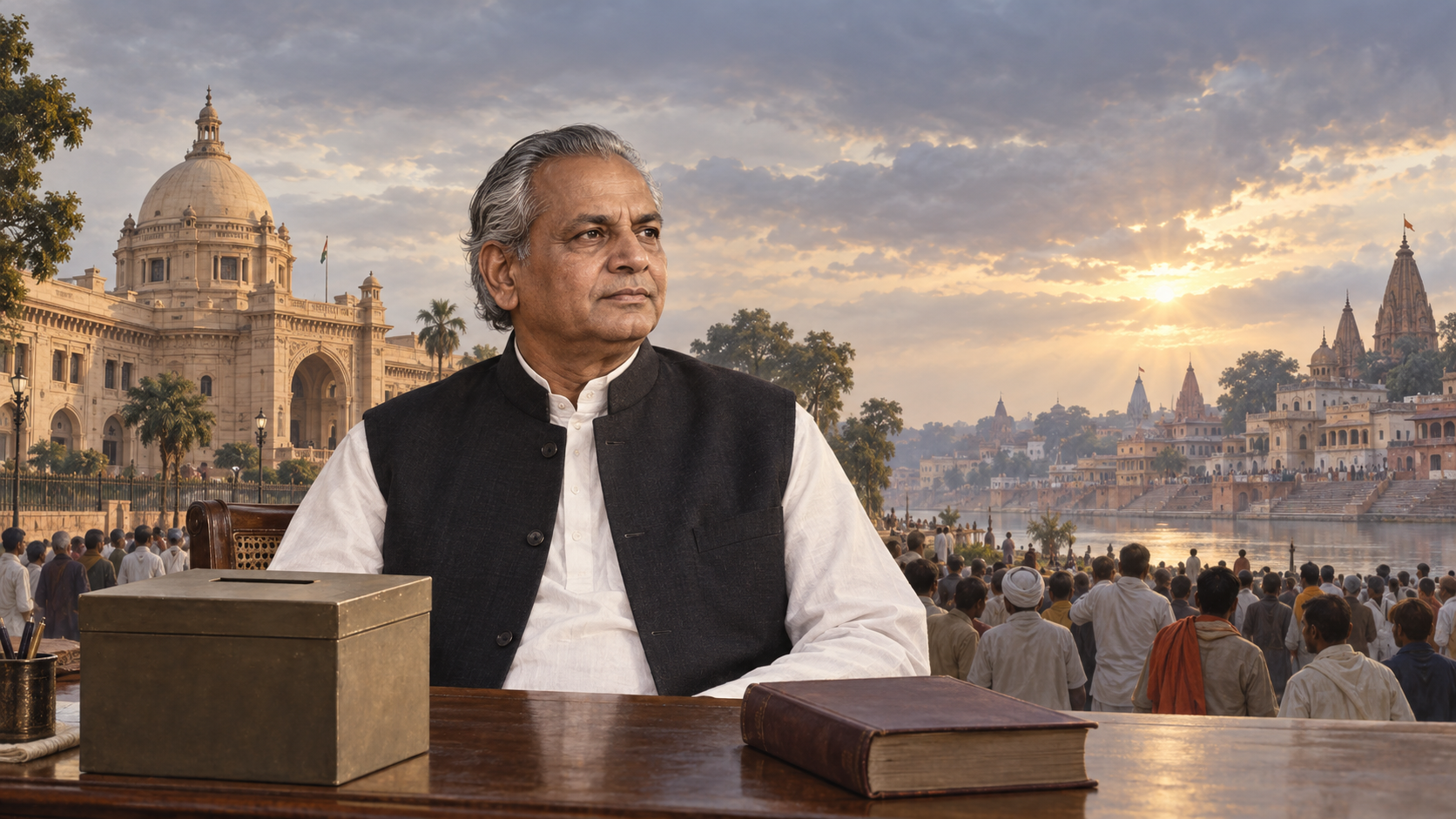
If your question is what Kalyan Singh actually did in the Ram Janmabhoomi movement, the shortest answer is this: he turned a mass civilisational demand into a test of government power. He was Uttar Pradesh’s chief minister when the Babri Masjid was demolished on December 6, 1992, and he chose not to deploy force against the assembled Hindus. That executive choice, more than any speech or slogan, fixed his place in the movement’s history.
But December 6 is only the endpoint of the explanation. Singh had spent decades building political strength in western Uttar Pradesh, emerged from the Lodh community, helped the BJP reach beyond its earlier social base, and became chief minister after the party’s 1991 landslide. If you understand those parts together, you can judge his legacy without reducing him either to a devotional icon or to a one-day failure of administration.
His importance came from three roles at once
Kalyan Singh was not merely a prominent supporter who happened to hold office in 1992. His importance came from the convergence of three distinct roles:
- Organiser: He spent decades developing his political presence in the Aligarh-Hathras belt, speaking in an idiom that connected with ordinary rural voters.
- Social bridge: As a Lodh leader from an historically subordinated Other Backward Class community, he demonstrated that the BJP’s cultural nationalism could acquire leadership beyond its older urban and upper-caste networks.
- Chief minister: After the BJP’s 1991 victory in Uttar Pradesh, he occupied the office responsible for the state’s response when the Ram Janmabhoomi mobilisation reached its decisive confrontation.
The sequence matters. An organiser without state authority can mobilise but cannot decide how a government will respond. An office-holder without a social base may issue orders but cannot embody a movement. A symbolic leader without either organisation or authority can inspire, yet remains removed from consequences. Singh combined organisation, representation and executive authority. That is why his role cannot be understood as ceremonial.
The Lodh connection was political substance, not biography
It is easy to mention Singh’s Lodh identity as a line in his biography and then move on. Doing so misses a central change in Uttar Pradesh politics. The Jana Sangh and the BJP’s earlier formation in the state had been associated primarily with Banias, Brahmins, Kayasthas and urban organisational networks. Elevating a leader rooted in a numerous rural OBC community showed that Hindu political consolidation could cross an established caste boundary.
This does not prove that caste ceased to matter. It proves something narrower and more useful: caste identity and a wider Hindu political identity did not have to be mutually exclusive. Singh could represent a particular social community while leading a movement presented as a civilisational cause shared across communities.
That distinction helps you test two common but inadequate accounts. Describing the Ram Janmabhoomi movement as nothing more than an upper-caste project overlooks the significance of Singh’s ascent. Claiming that Hindu unity had already dissolved caste hierarchy goes too far in the other direction. His selection as chief minister carried an explicit message about broadening the BJP’s social base; it did not abolish every division within Hindu society.
When you study any mass movement, therefore, do not look only at its declared ideology. Ask who built its local organisation, which communities supplied its leaders, and who was ultimately entrusted with government. In Singh’s case, those questions explain why his caste background belongs inside the political analysis rather than in a biographical footnote.
December 6, 1992 made restraint an executive decision
On December 6, 1992, the Babri Masjid was demolished at the site claimed by the Ram Janmabhoomi movement. Singh’s defining decision was not to use force against the assembled Hindus. To understand that choice clearly, you have to separate three layers that are often collapsed into one argument.
- The sacred claim: Devotees regarded the location as Bhagwan Ram’s janmabhoomi and the campaign as the recovery of a place carrying civilisational meaning.
- The democratic claim: Singh governed after the BJP’s major electoral victory in Uttar Pradesh, so the movement was no longer operating only outside the institutions of power.
- The constitutional question: A chief minister remained responsible for the conduct of the state when a disputed structure was demolished, regardless of the depth of the religious conviction surrounding it.
Supporters remember the event as the fulfilment of a long-denied Hindu aspiration. Its critics regard it as a breach of constitutional order. These positions do not answer exactly the same question. The first judges the civilisational end; the second judges the means and the government’s duty. You should identify that difference before deciding how much weight to give either argument.
It is also important to distinguish non-use of force from absence of agency. Singh did not need to demolish the structure personally for his role to be consequential. A chief minister’s decision not to employ state coercion is itself an exercise of authority. Calling him a passive spectator hides that choice. Treating him as the movement’s sole actor hides the years of social and religious mobilisation that put the government in that position.
Within the BJP’s political memory, his willingness to bear the political consequences rather than order force against the gathering became evidence of courage and fidelity. That explains his stature among supporters. It does not, by itself, settle every constitutional objection. Historical understanding requires you to recognise both the conviction behind a decision and the responsibility attached to the office from which it was made.
Key takeaways: five tests for claims about his legacy
- Check the timeline. An account beginning on December 6 leaves out the organisational work and social coalition that made Singh chief minister.
- Name his role precisely. He was simultaneously a party organiser, an OBC leader and the head of the Uttar Pradesh government. A claim that considers only one of those roles will be incomplete.
- Separate action from intention. His stated civilisational commitment explains why he chose as he did; the consequences of that choice remain part of the judgment.
- Label the viewpoint. Reclamation and constitutional breach are rival interpretations of the same event, not neutral substitutes for its factual description.
- Distinguish causal importance from total responsibility. Singh’s executive decision was central, but the Ram Janmabhoomi movement was larger than one politician and older than one day.
What his career asks of pro-Dharma politics
Kalyan Singh’s career carries a demanding lesson for anyone who wants civilisational causes to influence democratic government. Cultural conviction alone does not create political power. It must be translated into patient organisation, a coalition broad enough to cross social boundaries, electoral authority and finally decisions for which an office-holder can be held responsible.
Each stage adds an obligation. A movement can speak in the language of faith and historical memory. A governing party must also decide what the state will do, what it will refuse to do, and which consequences it is prepared to own. Singh’s importance comes from reaching that final stage and choosing in a way consistent with the cause he represented, despite the constitutional controversy that followed the event.
A pro-Dharma reading need not erase the difficult question of state power. Nor should constitutional analysis erase the sacred attachment that made Ram Janmabhoomi a mass cause. The stronger reading keeps the categories clear: devotion explains the objective, organisation explains the movement’s reach, electoral success explains access to authority, and executive choice explains Singh’s personal place in the outcome.
The next time you encounter either unqualified praise or unqualified condemnation of Kalyan Singh, make three columns: social coalition, formal authority and decisive choice. If an account cannot fill all three, it is giving you a verdict before giving you the history.

References

Leave a Reply
You must be logged in to post a comment.