
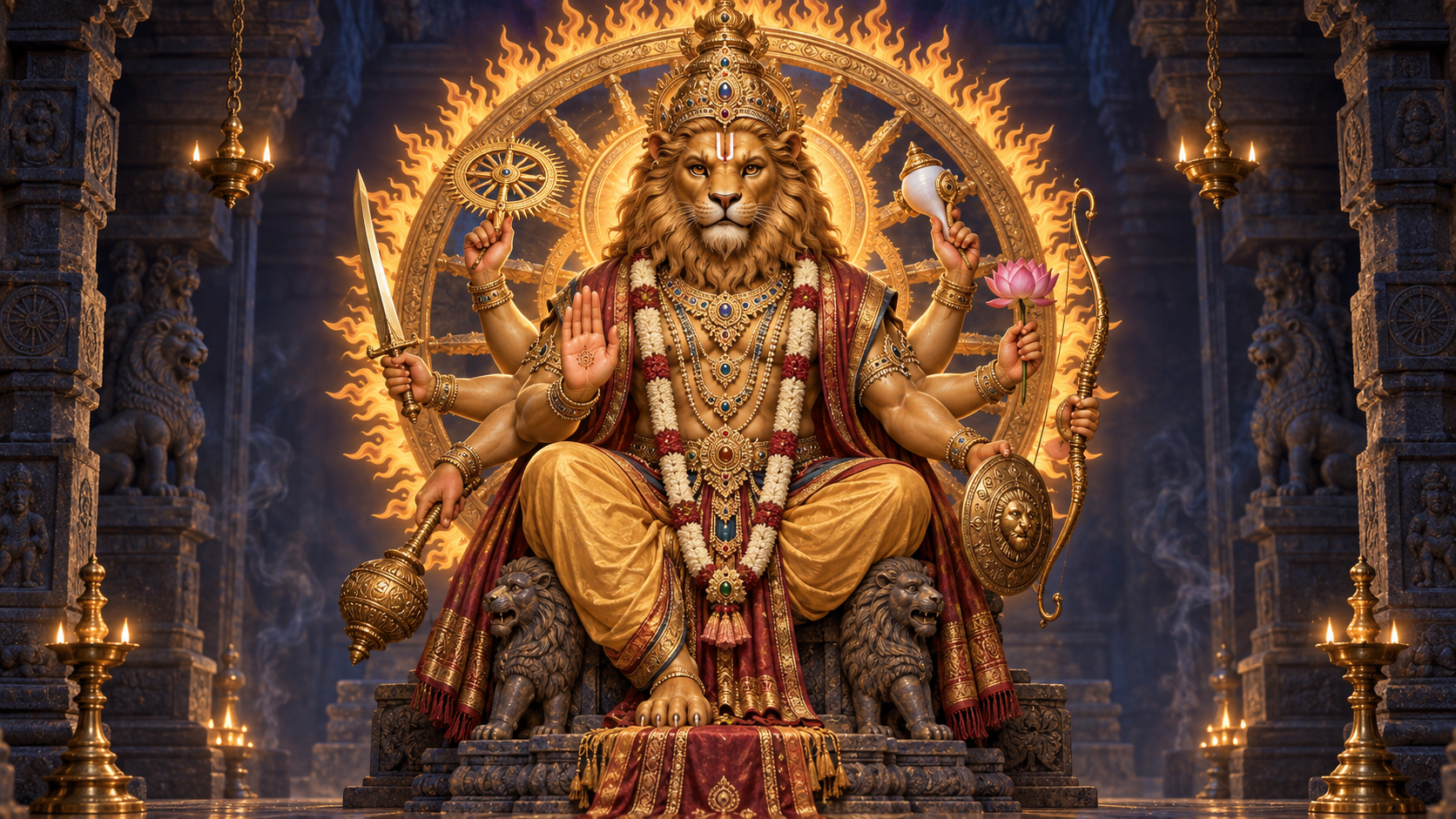
You have stopped before an image that seems to be Narasimha, yet its label calls it Sudarshana Narasimha. Is that simply another name for the man-lion avatara, a second deity added to the image, or a distinct theological form?
The clearest way to read it is to look beyond individual weapons, faces, and poses. Sudarshana Narasimha joins protective action to disciplined spiritual power. Once you see that relationship, the image stops looking like an assortment of divine attributes and begins to read as a coherent statement about how dharmic power should operate.
First establish which two identities are present

The name brings together Sudarshana, the personified divine discus of Bhagavan Vishnu, and Narasimha, Vishnu’s man-lion form. Both belong to Vishnu, but they do not contribute exactly the same visual and spiritual emphasis.
This distinction matters because a chakra appearing in a Vishnu image is not automatically the same thing as Sudarshana being presented as a divine identity. The discus can function as an attribute held by Vishnu. In Sudarshana Narasimha, however, Sudarshana participates in the identity and meaning of the composite form. The chakra is therefore not merely an accessory to the figure.
Narasimha is equally essential. A man-lion form identifies Vishnu’s capacity to intervene when ordinary boundaries and ordinary responses no longer suffice. Yet a leonine face by itself establishes only the Narasimha dimension. To identify Sudarshana Narasimha responsibly, you still need evidence that Sudarshana has been intentionally incorporated into the image or its established shrine identity.
When you encounter an unfamiliar sculpture, ask three questions before assigning a name:
- What clearly identifies the form as Narasimha rather than another manifestation of Vishnu?
- Is the chakra merely one attribute, or does the composition, label, inscription, or temple tradition identify Sudarshana as part of the form itself?
- Does the complete image present the two identities as one devotional statement?
This is a guardrail, not a mechanical formula. Temple traditions and sculptural programs can preserve meanings that are not obvious from a cropped photograph. If the name is uncertain, record what is actually visible before moving to interpretation.
The composite form is a theological sentence

Sudarshana Narasimha should not be imagined as an alliance between unrelated gods. Both dimensions arise from Vishnu. Their union brings two modes of divine power into a single field: power that acts to protect and power governed by spiritual discipline.
That pairing corrects two common misreadings. The first is to treat divine fierceness as uncontrolled anger. Narasimha’s force belongs within the work of protection; it is not violence displayed for its own sake. The second is to treat yoga as withdrawal or helpless passivity. In this context, discipline does not cancel action. It gives action direction, concentration, and restraint.
The image therefore holds an important dharmic tension. Protection sometimes demands decisive intervention, but force that is not governed from within can become another source of disorder. Spiritual discipline is not an escape from that responsibility. It is what prevents protective power from collapsing into impulse, pride, or retaliation.
This is why the form should not be reduced to a visual curiosity or an unusually fierce image of Vishnu. Its compositeness is the message. Sudarshana and Narasimha make visible a power that is simultaneously alert, capable of action, and inwardly ordered.
For the viewer, that changes the central question. Instead of asking only which being or weapon each feature represents, ask why protection and discipline have been made inseparable. That question moves you from recognition to interpretation without requiring speculative claims about every sculptural detail.
Use a three-layer method when examining an image
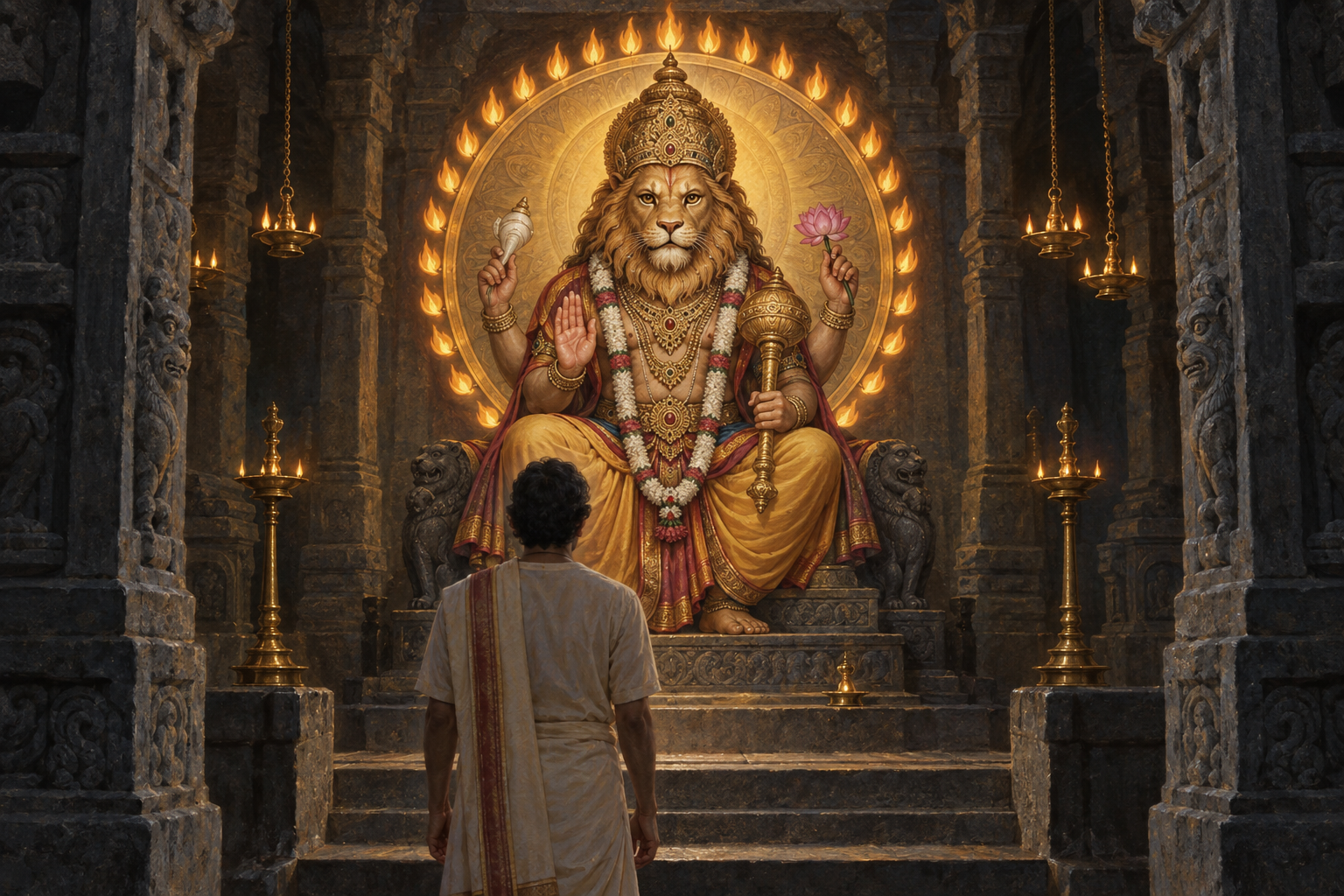
A reliable reading separates observation, interpretation, and local tradition. Problems begin when those layers are collapsed and a viewer treats an inference as though it were a visible fact.
- Observe before naming. Note the face, body, hands, weapons, posture, pedestal, aureole, and any other figures. If the object has more than one visible side, include each side in your notes. Do not begin by forcing every feature into an expected template.
- Identify the two principal dimensions. Locate the Narasimha identity and then determine how Sudarshana is represented or named. If only one dimension is evident, keep the identification provisional.
- Read the relationship. Ask how the composition connects active protection with disciplined spiritual power. This is more useful than merely producing a catalogue of attributes.
- Check contextual evidence. Read the full label, provenance, shrine name, or inscription when available. In a temple, ask a precise question such as, How are Sudarshana and Narasimha joined in this form? A focused question is more likely to reveal the local understanding than a general request to explain the image.
- Mark the limits of the evidence. A temple explanation may preserve a place-specific tradition; a museum label may emphasize identification and history; an online photograph may omit another side of the object. Do not turn one partial view into a universal rule for every Sudarshana Narasimha image.
Context also determines how you should approach the object. In a temple, the murti belongs to worship before it belongs to analysis. Follow the shrine’s rules about movement, photography, and proximity. Do not handle a sacred object or enter a restricted area to inspect a feature. In a museum, look for alternate views and provenance information. Online, check whether the photograph has cropped the pedestal, reverse, surrounding panels, or identifying caption.
Arm counts and individual weapons may help with a particular sculpture, but they should not become your only test unless the relevant temple or iconographic tradition supplies that test. The most important evidence is the complete visual program together with the identity preserved by its setting.
Key takeaways
- Sudarshana Narasimha combines Sudarshana, Vishnu’s personified discus, with Narasimha, Vishnu’s man-lion form.
- The image unites active protection with disciplined spiritual or yogic power.
- A lion-like face alone identifies the Narasimha dimension, not necessarily the complete composite form.
- A chakra should not automatically be treated as a personified Sudarshana; composition and context matter.
- Read the whole object, then distinguish what you can see from what you infer and what the local tradition teaches.
- The form presents divine fierceness as purposeful and governed, not as uncontrolled rage.
Let recognition become a disciplined form of darshana
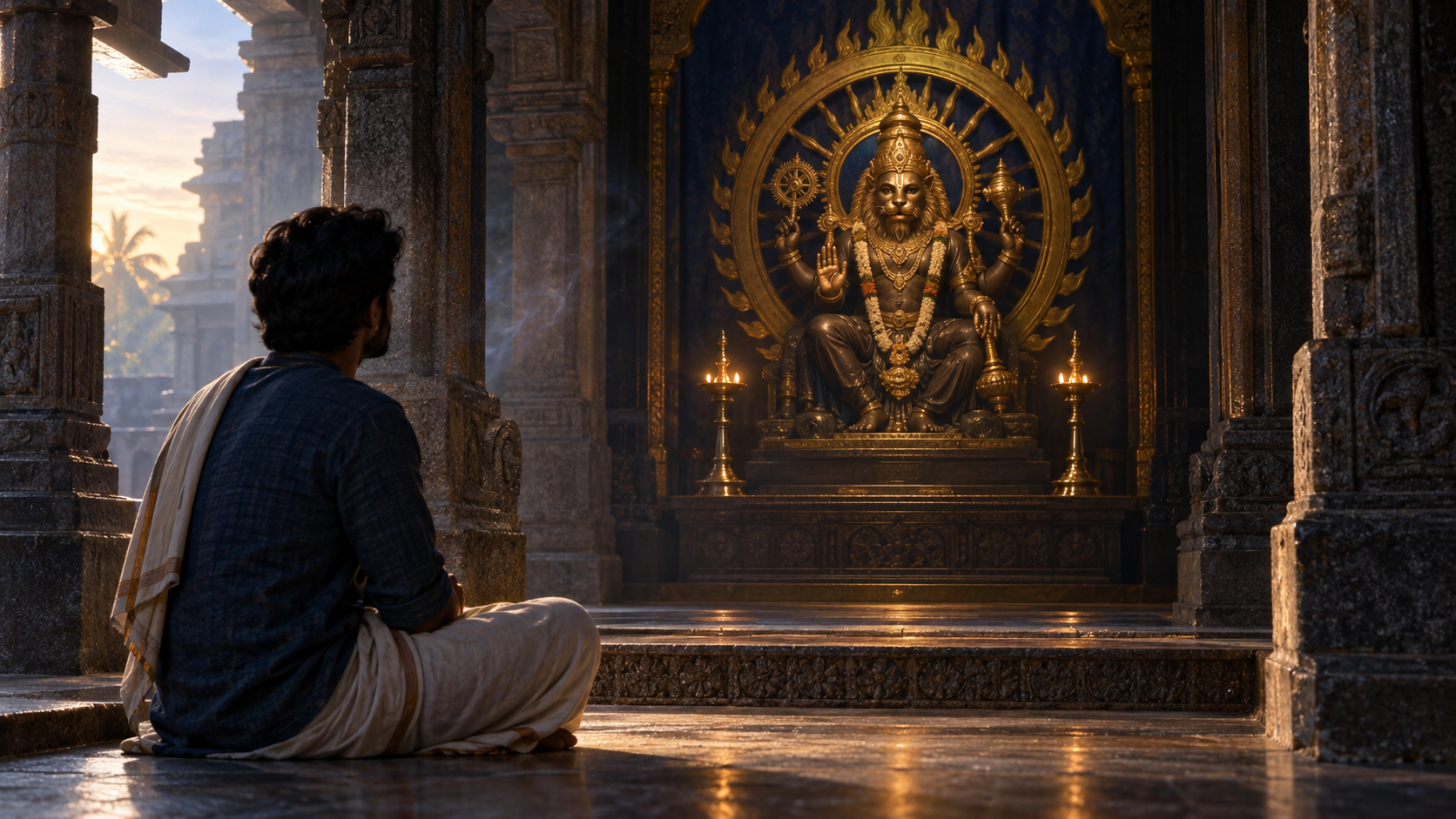
Iconographic recognition is useful, but it is not the end of the encounter. Sudarshana Narasimha asks you to consider the relationship between the power to confront a threat and the discipline required to use that power without becoming ruled by it.
On your next encounter with the form, make three passes. First, name the two identities without rushing into symbolism. Second, notice how the image holds protection and spiritual control together. Third, turn the relationship toward your own conduct: what genuinely requires protection, and what discipline would keep your response aligned with dharma rather than personal anger?
You do not need to decode every attribute before the image can teach you something. Begin with the union at its center. See the protective force, see the discipline that governs it, and let neither be separated from the other.
References

Leave a Reply
You must be logged in to post a comment.