
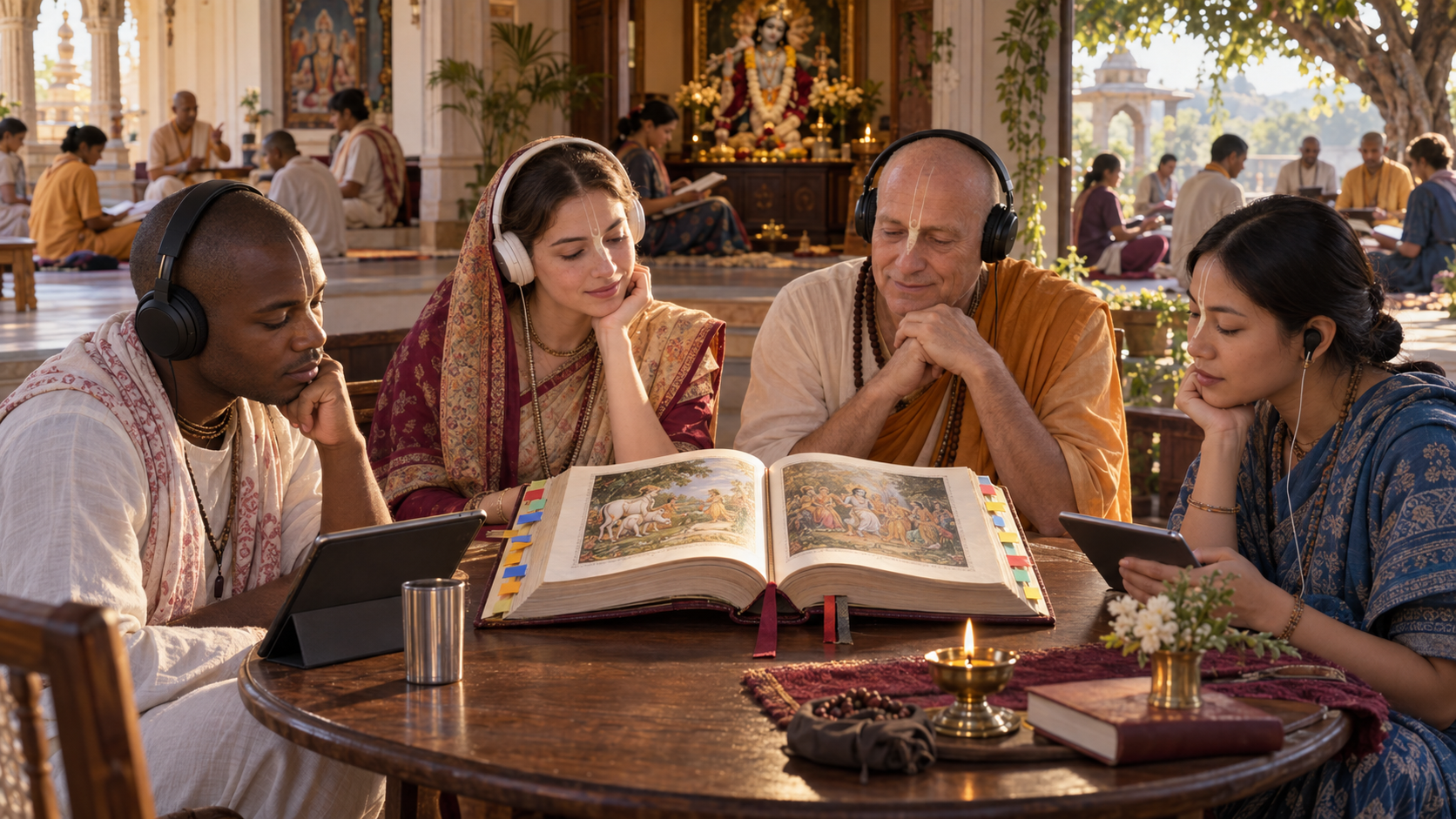
You open an ISKCON media feed and find one class on 1.8.18, another on 3.6.8-9 and another on 4.9.42. Some speakers are familiar, some are not, and some recordings identify a temple or special occasion rather than the passage. If you choose only by speaker name or headline, you can collect many talks without developing a steady relationship with the Srimad Bhagavatam itself.
A better approach is to let the textual reference organize your listening. You can then receive teaching from different ISKCON communities while remaining anchored in the verse, Srila Prabhupada’s presentation and a practical question: what should change in your understanding or conduct after this class?
Let the verse reference organize your listening

A Bhagavatam reference normally follows the pattern canto, chapter and verse. Thus 1.8.18 identifies Canto 1, Chapter 8, Verse 18. A reference such as 3.6.8-9 identifies two consecutive verses in Canto 3, Chapter 6. Learning this simple notation turns a scattered media archive into a map of the scripture.
The range is visible in recorded teaching on 1.8.18 by Srila Prabhupada, a class on 3.6.8-9 with Candramauli Swami, 4.9.42 with Chakravarti Prabhu and 4.28.9 in Durban. These are not interchangeable talks on a generic spiritual theme. Each begins from a particular place in the Bhagavatam.
Before pressing play, copy the reference exactly. Locate the translation and purport in the edition used by your community. Read them once and note the sentence or idea you find hardest to understand. That small act changes your role from a passive listener into a student arriving with a real question.
- If you are already reading a canto sequentially, choose the class that matches your current passage.
- If a theological or practical question brought you to the archive, identify which verse the speaker uses to answer it.
- If a session is presented by occasion rather than verse, listen for the textual reference near the beginning and add it to your notes.
- If you cannot identify the passage at all, treat the session as general inspiration rather than as a close explanation of a specific verse.
A Sunday Special class at ISKCON Indore, for example, identifies its community and occasion without placing a verse number in the public wording. That does not diminish the class, but it gives you a reason to establish the scriptural passage before filing or applying what you hear.
Use foundational recordings and community classes together
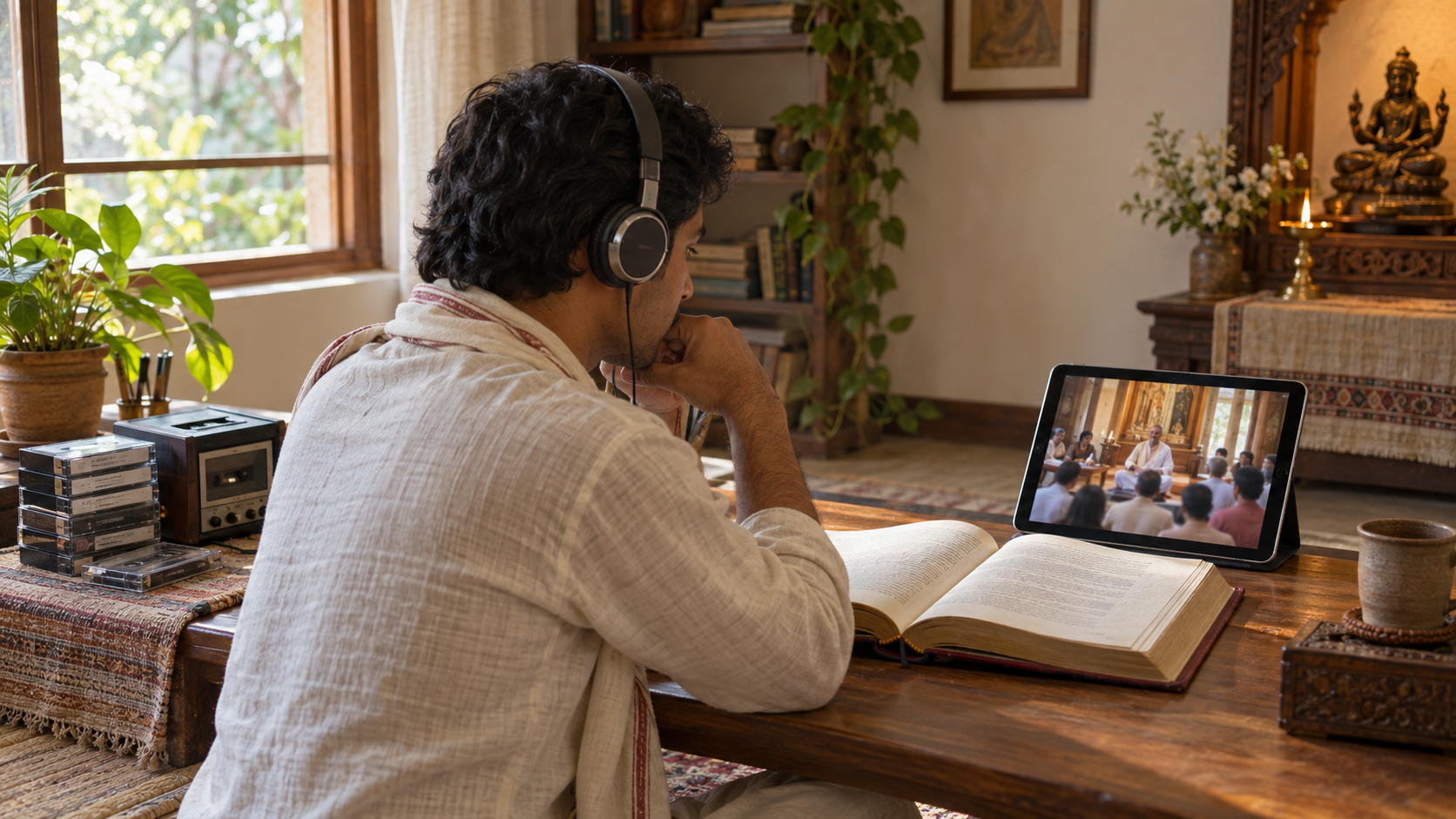
You do not need to choose between recorded teaching by Srila Prabhupada and classes from present-day ISKCON speakers and temples. They serve related but distinct purposes. Keeping both in your study practice prevents two common mistakes: treating every new lecture as self-contained, or treating inherited teaching as something to archive rather than hear and apply.
Use Srila Prabhupada’s recorded teaching as an anchor
When a recording by Srila Prabhupada addresses the passage you are studying, give it deliberate attention. Listen for how he moves from the verse to doctrine and from doctrine to practice. Capture the full line of reasoning rather than extracting an isolated sentence. A memorable quotation can support study, but it cannot replace the argument in which it appears.
Return to the recording after hearing another class on the same passage. The second hearing often reveals whether a later explanation develops the same principle, applies it to a different circumstance or makes a claim that needs closer examination.
Use community classes to encounter living application
Classes associated with speakers such as Candramauli Swami and Chakravarti Prabhu, and with communities such as Durban and Indore, show the distributed character of Bhagavatam teaching in ISKCON. The same scripture is heard through different voices, local settings and teaching occasions.
Variation in emphasis is not automatically a contradiction. A speaker may clarify a term, develop one implication, answer an audience’s likely difficulty or stress an application suited to the occasion. Your task is to ask whether that emphasis remains connected to the cited text and its established exposition.
- For close study, prefer a class that names the exact passage you are reading.
- For orientation, a special or thematic class can help you see why a passage matters to communal life.
- For continuity, keep sequential reading primary and allow recommended talks to supplement it.
- For difficult claims, return to the verse, translation and purport before deciding what the class means.
Turn every class into a usable study record

Listening becomes cumulative when every class leaves behind a compact record. You do not need a transcript. You need enough structure to distinguish the Bhagavatam’s words, the speaker’s explanation and your own response.
- Record the citation. Write the canto, chapter and verse before taking thematic notes.
- State the central claim. Express in your own words what the speaker appears to be establishing. If you cannot do this briefly, revisit the transition from the verse to the explanation.
- Identify the textual support. Note which word, translation, purport or narrative context carries the claim. Do not let an engaging illustration become a substitute for scriptural support.
- Separate explanation from application. The explanation tells you what the passage means in the class. The application tells you what attitude, choice or practice should follow.
- Preserve an unresolved question. Write the precise point that still needs clarification and take it to a qualified teacher rather than filling the gap with guesswork.
Test the quality of your application by asking whether it can be traced back to this passage. Be more attentive in spiritual life is too broad to guide conduct. Revisit this verse before responding in the kind of situation discussed in the class is observable and connected to what you heard. If the class calls mainly for contemplation, the appropriate action may simply be to reread the passage without rushing to manufacture a dramatic resolution.
Compare like with like
A class on 4.9.42 and a class on 4.28.9 begin from different chapters. Different themes or applications between them do not establish a disagreement. When you want to compare teaching, begin with classes on the same verse or closely connected passage.
For classes on the same passage, sort differences into wording, illustration, practical emphasis and doctrine. The first three can vary considerably without creating a theological conflict. A genuine doctrinal tension deserves slower treatment: check the complete statement, consult the translation and purport, compare it with Srila Prabhupada’s teaching where available, and bring the exact citation and recording position to a trusted teacher. A clipped phrase circulating without its verse or context is a poor basis for judgment.
Make community archives easier to study
If you help publish temple classes, metadata is part of the teaching service. Preserve the full Bhagavatam reference, speaker’s name, date, community or location, language, and whether the item is an original session or an older recording. Add the passage to the description when the public headline emphasizes a festival, Sunday programme or guest speaker.
A listener can identify both passage and location immediately for the Durban class, while the Srila Prabhupada item explicitly signals that it is recorded. The Indore Sunday Special supplies its community and date but not a verse in the public wording. Complete metadata helps future students find the right class by scripture rather than depending on memory, popularity or an algorithm.
Key takeaways
- Choose Bhagavatam classes by textual reference before choosing them by speaker, location or popularity.
- Read the translation and purport first so that you can hear how the explanation arises from the passage.
- Use Srila Prabhupada’s recorded teaching as an anchor and community classes as opportunities for contextual explanation and application.
- Keep the verse, the speaker’s explanation and your personal application separate in your notes.
- Treat differences in emphasis as questions to examine, not instant proof of contradiction.
- When publishing a class, preserve enough metadata for another devotee to find and study it later.
For your next class, begin before the audio starts. Write down the verse reference, read the passage, and bring one honest question. When the class ends, keep one text-grounded insight and one application you can actually recognize in your conduct. That is how a stream of recordings becomes sustained Bhagavatam study.
References
- Dandavats – Chakravarti Prabhu – SB 4-9-42 – 9-21-26
- Dandavats – SB 3.6.8-9 – H.H. Candramauli Swami – 21th Sept 2026
- Dandavats – 17.09.26, SB class 4.28.9, SSRRT, Durban
- Dandavats – Sunday Special Srimad Bhagwatam Class | ISKCON INDORE 20-Sep-2026
- Dandavats – Srimad Bhagavatam Text 01.08.18 Speaker – Srila Prabhupada Recorded

Leave a Reply
You must be logged in to post a comment.