
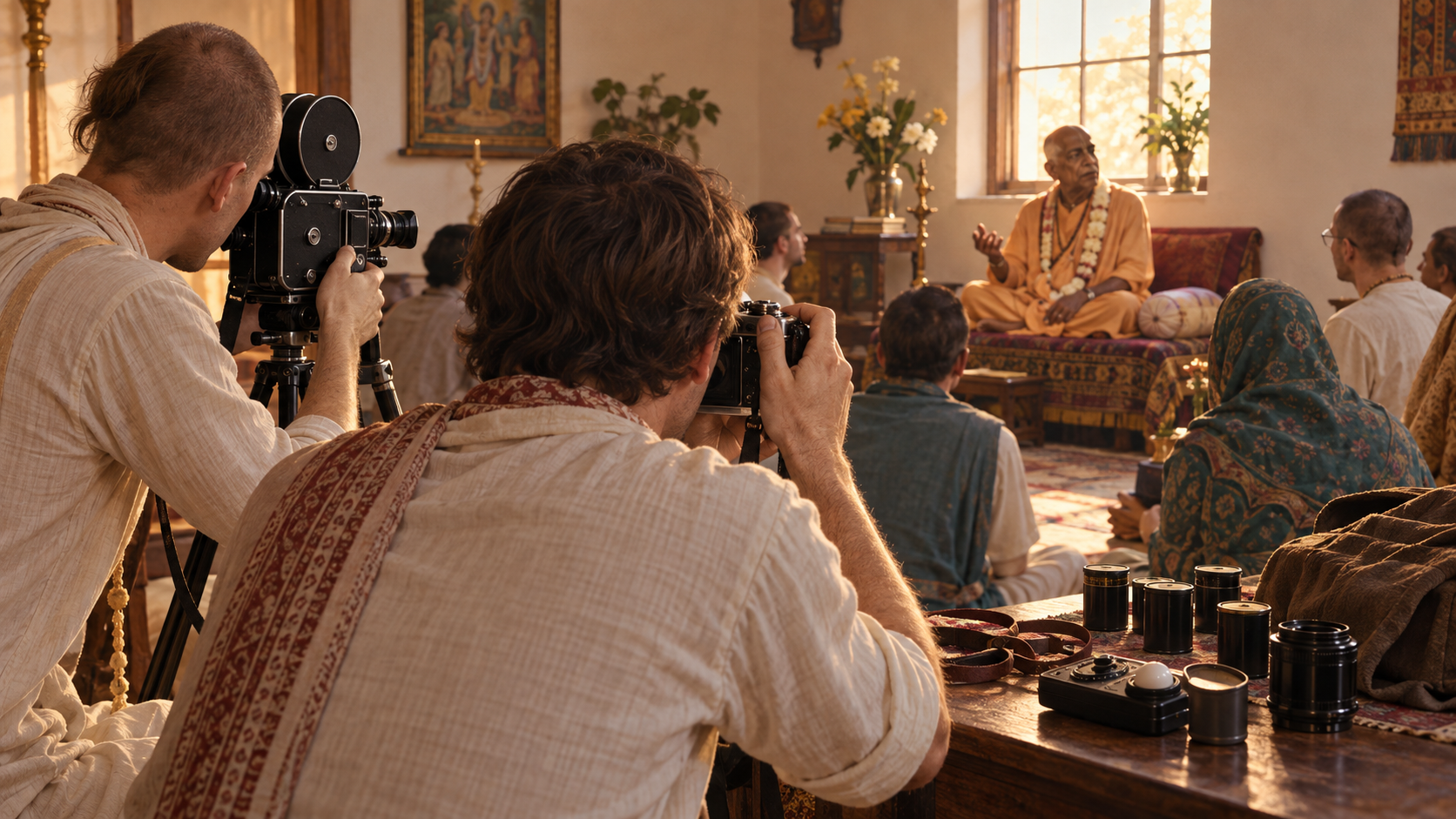
You may recognize Srila Prabhupada at once yet know nothing about the person who chose the frame, held the camera, protected the film, or wrote the caption. If you are trying to understand that visual record—or preparing to publish part of it—the missing person behind the camera matters.
Photographs and films of Prabhupada are devotional witnesses, historical evidence, and deliberately made objects at the same time. You will understand them more clearly when you respect all three dimensions instead of treating the camera as an invisible machine.
The person behind the camera belongs in the history
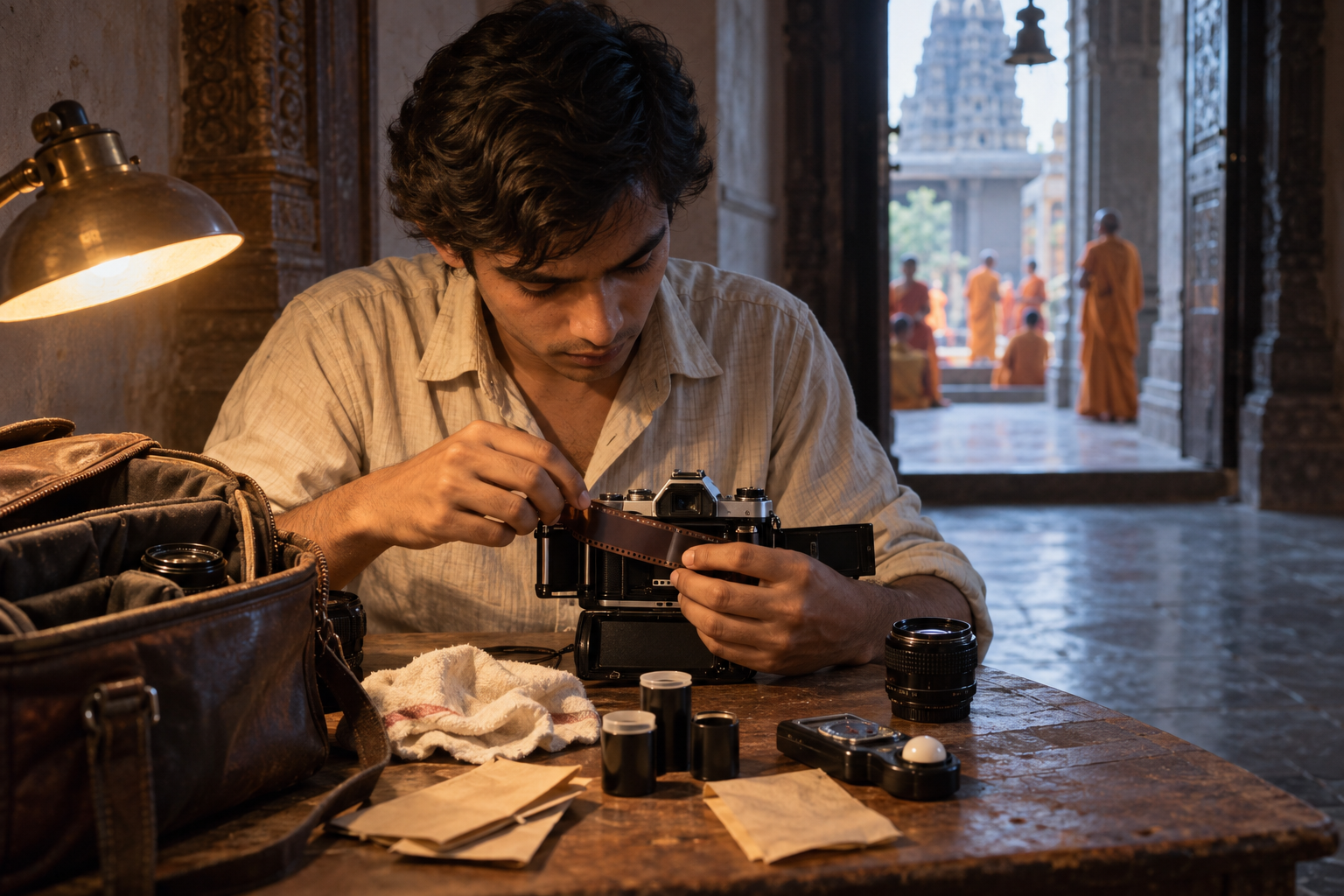
For Yadubara das, coming to Krishna consciousness was connected with photographing and filming Prabhupada. That connection gives us a useful way to understand devotional image-making. Technical ability did not have to remain separate from spiritual life; the work could be offered as seva.
Seva, however, does not make a camera transparent. A photographer chooses where to stand, what to include, when to release the shutter, and which moment to miss. A filmmaker decides when a shot begins and ends. Editors, cataloguers, printers, and later digital restorers make further choices. None of this diminishes the spiritual value of the record. It explains how that record reached you.
This is why attribution matters. When a photographer or filmmaker is known, name that person. When the maker is not known, record photographer unidentified or camera operator unidentified. Do not convert uncertainty into a confident organizational credit merely because an image circulated through an institution. An honest gap preserves the possibility of a later identification; a false credit can travel for years.
You should therefore ask two questions whenever you encounter an image of A.C. Bhaktivedanta Swami Prabhupada: What does this image actually let me observe, and what do I know about the circumstances in which it was made? The first question concerns visible evidence. The second concerns provenance.
What the visual record can—and cannot—establish
A photograph can preserve remarkable detail, but it captures only what entered one frame at one moment. Film adds movement, duration, and sometimes sound, yet the camera position and editing still set boundaries around what you receive. The safest reading begins with a disciplined distinction between observation and interpretation.
| Question | What the image can support | What still needs corroboration |
|---|---|---|
| What is visible? | Clothing, posture, objects, gestures, and the relative positions of people within the frame. | Names, relationships, intentions, and events outside the frame. |
| What happened? | A continuous shot can show one recorded action following another. | The complete sequence, what preceded the shot, and what happened after it ended. |
| What does an expression mean? | You may accurately note a visible smile or another observable expression. | Claims about approval, inner feeling, or the cause of the expression require context. |
| Who made it? | A reliable credit on an original container, catalogue record, or documented transfer may identify the maker. | Authorship cannot safely be inferred from visual style or from who usually covered similar occasions. |
| Is this the original version? | A comparison may reveal cropping, added colour, altered contrast, subtitles, or other changes. | Authenticity and completeness require a traceable history of the particular copy. |
You do not have to choose between devotional seeing and historical care. An image may carry profound sacred significance for a devotee while still requiring an accurate date, credit, version description, and statement of uncertainty. Those are different kinds of attention, and each protects something valuable.
A devotional reflection may speak about the mercy, gravity, or spiritual presence a viewer encounters. A catalogue description has a narrower job: identify visible facts and documented context without claiming access to anyone’s inner state. Problems begin when the language of devotion is silently presented as metadata, or when archival caution is used to dismiss devotional meaning.
Use a five-pass method before accepting a caption
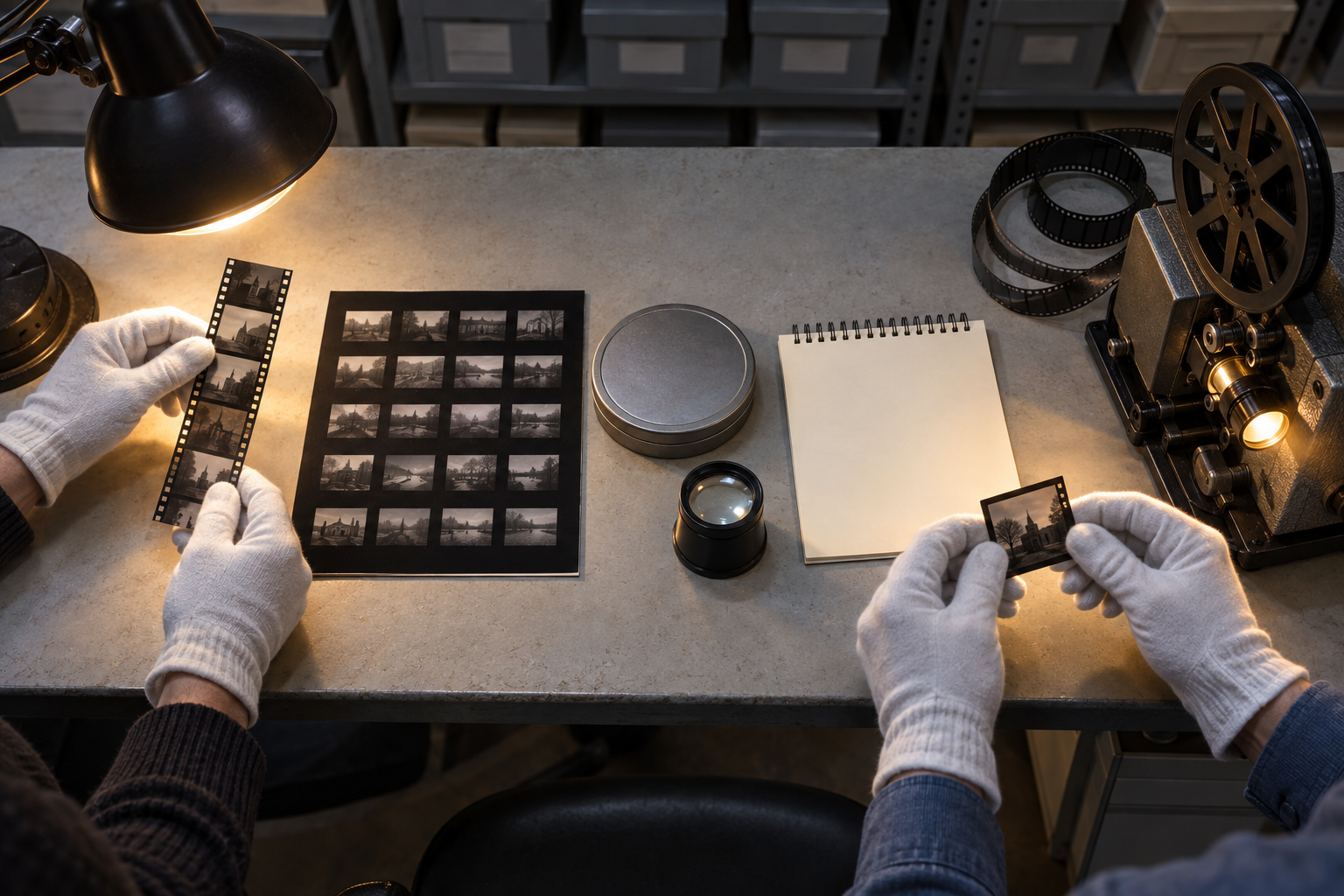
If you are researching, cataloguing, or reposting Prabhupada’s visual record, examine each item in five passes. This takes longer than copying an existing caption, but it stops unsupported details from becoming permanent.
- Identify the object in front of you. Is it a negative, print, reel, videotape, scan, compressed web file, screenshot, or restored derivative? A downloaded image is not the camera original merely because it is the earliest copy you have seen.
- Preserve inherited information exactly. Record the filename, existing caption, credit, catalogue number, physical markings, embedded metadata, and the person or collection from which the item came. Do not silently correct old wording; place your correction in a separate field.
- Sort every claim into observed, recorded, inferred, or unknown. A person visible in the frame is observed. A date written on a film container is recorded but may still need verification. A location guessed from architecture is inferred. A missing photographer’s name remains unknown.
- Test names and circumstances against other records. Compare catalogue entries, original notes, adjacent frames, continuous footage, and clearly attributed recollections. A recollection can be valuable, but preserve who supplied it and how certain that person was instead of turning it into anonymous fact.
- Write a caption that carries its own limits. A cautious form might read: A.C. Bhaktivedanta Swami Prabhupada; location and date not yet confirmed; photographer unidentified; reproduced from a cropped scan. That wording is more useful than a polished but unsupported story.
The fourth category—unknown—is especially important. An archive does not become weaker when it admits what has not been established. It becomes easier to improve. A future researcher can investigate a clearly marked gap; that person may never notice a guess that has been disguised as certainty.
Preserve the evidence before enhancing the experience
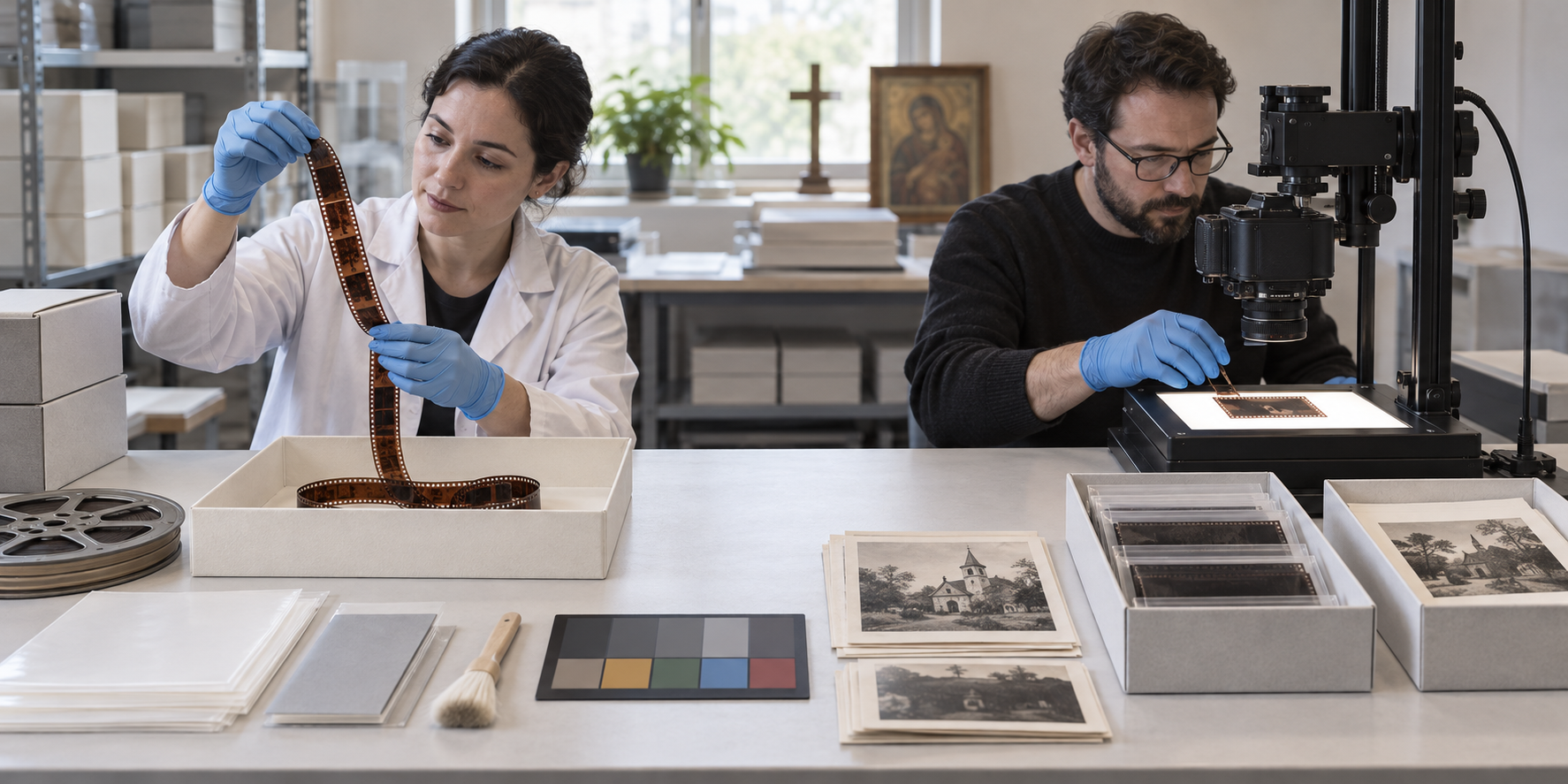
Restoration can make old material easier to see and hear, but preservation and presentation are not the same task. Keep an untouched preservation master and create separate working copies for publication. Never crop, denoise, sharpen, colourise, stabilise, or overwrite the only copy you possess.
If the item is a physical negative, reel, or tape, improvised cleaning, projection, splicing, or rehousing can cause permanent damage. Consult an archive or audiovisual conservator before intervening. Edge markings, film grain, splices, frame boundaries, leaders, and ambient sound may appear expendable while actually helping to establish the history of the item.
- Designate one file as the preservation master. Do not use it for routine editing or web publishing.
- Create a derivative for access. Keep the original aspect ratio, frame rate, and soundtrack available even if the viewing copy is reformatted for a modern platform.
- Maintain an edit log. Record crops, contrast adjustments, noise reduction, stabilisation, subtitles, repairs, and every other material change.
- Label synthetic alterations at the point of viewing. Colourisation, artificial frame generation, reconstructed audio, and machine-generated detail must never be allowed to masquerade as original evidence.
- Keep context with the file. The credit, item identifier, version description, known date and place, uncertainty notes, and rights information should remain connected even when the image is copied.
- Verify permission before republishing. Possessing a file does not automatically establish the right to reproduce it. When permission is unclear, link to an authorised location while you seek guidance from the relevant rights holder or custodian.
The same discipline applies to transcription. Write what can actually be heard. Mark an uncertain or inaudible word instead of filling it with the phrase you expect Prabhupada to have used. Preserve the unprocessed audio so that another listener can evaluate the passage later.
Key takeaways: check these before you publish
- Have you credited the actual photographer, filmmaker, or camera operator when that identity is documented?
- Have you clearly labelled an unidentified maker instead of assigning a convenient but unverified credit?
- Can a reader distinguish visible fact, inherited metadata, later recollection, and your own interpretation?
- Have you identified the file as original, scanned, cropped, restored, colourised, subtitled, or synthetically altered where applicable?
- Does an untouched preservation master exist apart from the copy prepared for viewing?
- Will the caption, item identifier, provenance, credit, and rights information remain attached if the image leaves its present page?
Begin with one photograph or one stretch of footage that matters to your community. Establish its maker if you can, describe the version honestly, preserve the master, and replace assumptions with marked uncertainties. That small act honours both Prabhupada and the devotees whose camera service made the encounter available to you.
References

Leave a Reply
You must be logged in to post a comment.