
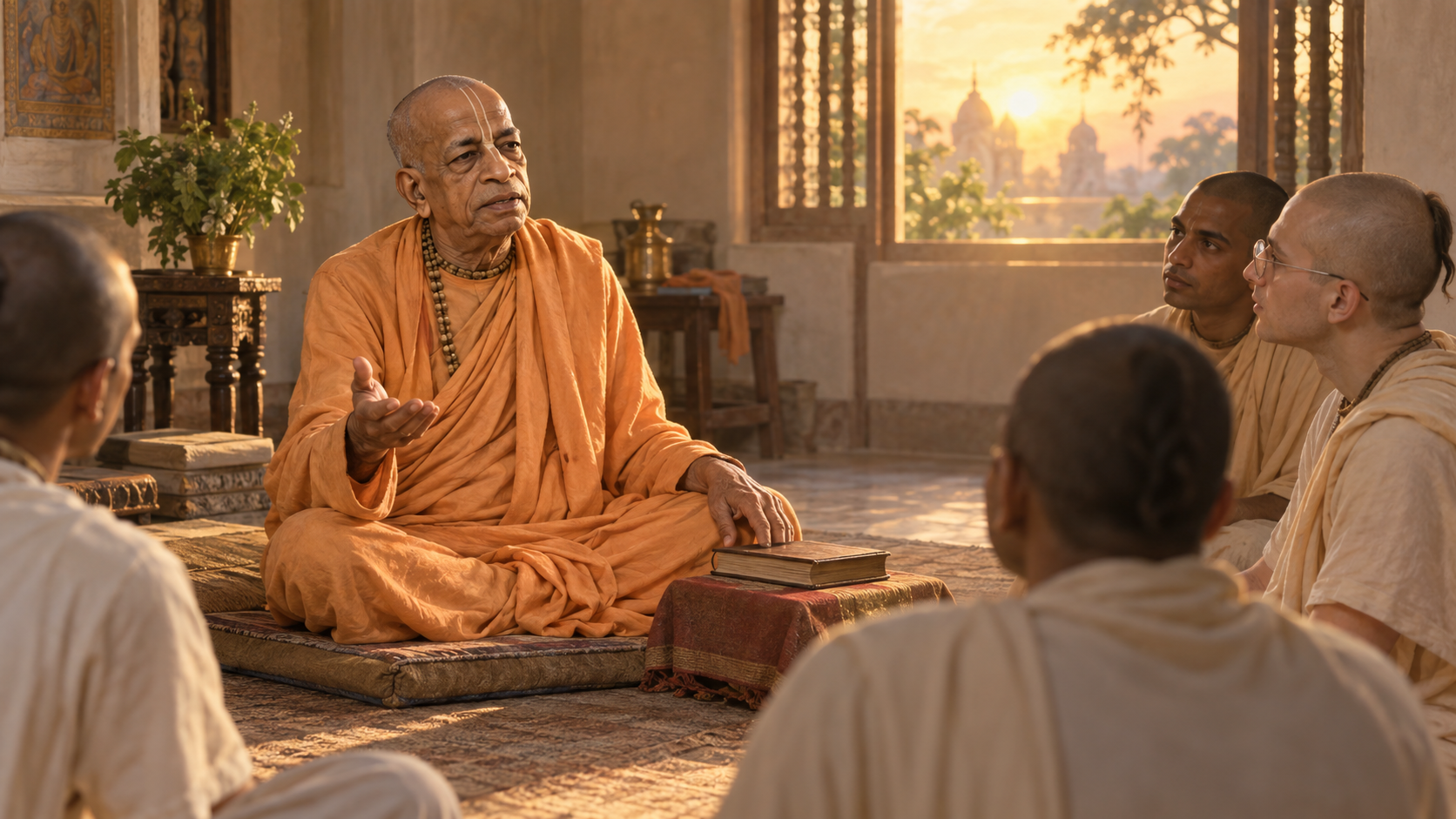
If Srila Prabhupada’s humility seems difficult to reconcile with his forceful teaching and decisive leadership, you may be using the wrong test. Humility is not the absence of conviction, authority, or achievement.
His example gives you a more demanding standard: carry the full weight of your duty while giving up the claim that the work exists for your prestige. That distinction can change how you serve, lead, accept correction, and respond when your contribution is overlooked.
Why humility did not make Srila Prabhupada passive

We often judge humility by manner. A quiet person appears humble; a commanding person appears proud. That shortcut is unreliable. Temperament tells you how someone expresses himself. Humility tells you where he places himself in relation to Krishna, guru, the teaching, and the service entrusted to him.
Within bhakti, humility is accurate spiritual placement. The servant is not the independent proprietor of the service, but neither is the servant excused from performing it. Ability can be acknowledged without being worshipped. Authority can be exercised without being privately owned. Success can be accepted without being converted into a demand for personal honour.
This is the key to understanding Srila Prabhupada. His confidence in the message did not require confidence in an independent self. His sense of duty could therefore be firm without making his own status the purpose of the duty. What has been called his extreme humility was not an ornamental softness added to leadership. It was the inner orientation that made strong leadership an act of service.
The useful question is not, “Did he look unassertive?” Ask instead, “What did he believe his authority was for?” If authority exists to transmit what one has received and to carry out a sacred responsibility, using it need not contradict humility. Refusing to use it merely to preserve an image of meekness can itself become a subtle form of self-concern.
Follow the direction of ownership, credit, and sacrifice

You can recognise humility more reliably by following three things: ownership, credit, and sacrifice. Where do they move when the work succeeds?
- Ownership: Does the person treat the service as a personal possession, or as a responsibility held on behalf of guru and Krishna?
- Credit: Does success end in self-display, or does it deepen gratitude toward the divine, the tradition, teachers, and fellow servants?
- Sacrifice: When comfort, reputation, and duty pull in different directions, which one is surrendered?
These questions make Srila Prabhupada’s humility easier to see. A large responsibility does not necessarily enlarge the ego. It can enlarge accountability. The more consequential the service becomes, the less room there is to treat personal preference as sacred.
This also explains why genuine humility may sound uncompromising. If you believe a teaching belongs to you, disagreement easily becomes a personal contest. If you understand yourself as its servant, you can defend the principle without making your wounded image the hidden subject of the dispute. Firmness answers the matter at hand; pride keeps redirecting the matter toward one’s own importance.
Use that distinction in your own disagreements. Before replying, ask: “Am I protecting a principle, protecting the people affected by this decision, or protecting the way I want to be seen?” The first two may require a clear answer. The third usually requires restraint.
Do not imitate the surface of humility
The safest way to learn from an acharya is to understand the principle beneath his conduct. Copying devotional vocabulary or an outward manner can produce a convincing performance while leaving self-importance untouched. Four counterfeits deserve particular attention.
- Self-contempt: Calling yourself worthless is not automatically humility. It can keep your attention fixed on yourself as completely as boasting does. Honest humility names a fault precisely, makes the needed repair, and returns to service.
- Timidity: Avoiding a necessary conversation may feel modest, but silence can leave another person carrying the cost. Humility removes the desire to dominate; it does not remove the duty to speak truthfully.
- Refusal of responsibility: Declining every visible role can be another way of managing your image. If a service is genuinely yours, accept it without turning either acceptance or refusal into a performance.
- Unquestioning compliance: Humility does not require you to abandon conscience or discernment. A person who invokes humility to suppress legitimate questions, conceal misconduct, or demand loyalty to himself is protecting power, not teaching service.
False modesty often reveals itself after praise. It rejects a compliment dramatically but continues fishing for reassurance. A cleaner response is simple: acknowledge the kindness, identify the help you received, and keep the focus on the work. You do not need to deny that something went well in order to deny yourself proprietorship over it.
The same precision is needed after failure. “I am terrible” sounds self-effacing, but it does not tell anyone what will change. “I interrupted you, misunderstood the instruction, and will confirm it before acting next time” is humbler because it accepts reality without making personal drama the centre of the repair.
Practise strength without proprietorship in your next service

You do not need a public role to practise the principle visible in Srila Prabhupada’s humility. Use the next definite service in front of you – at a temple, in your family, at work, or in a community project – and apply this four-part discipline.
- Name the duty without naming the desired image. Write one sentence beginning, “My responsibility here is…” Do not include “to appear spiritual,” “to prove I was right,” or “to be appreciated.” State the actual good you are responsible for delivering.
- Separate principle from preference. When someone proposes a different method, ask whether it violates the purpose of the service or merely differs from your way. Explain a genuine concern once and clearly. If the difference is only personal preference, yield without resentment.
- Receive correction before defending intention. First identify the observable problem. Ask what effect your action had. Good intentions may explain a mistake, but they do not erase its consequence. Correct the action before trying to restore your reputation.
- Close the service with gratitude and repair. Name the help that made the result possible. If something failed, name the next corrective action. In either case, resist turning the closing moment into a verdict on your worth.
Suppose you are helping organise a temple programme and another volunteer changes an arrangement you prepared. Pride has two common reactions: seize control or withdraw resentfully. False humility chooses the second and calls it surrender. A service-centred response is different. Clarify the programme’s need, offer relevant information, listen to the other person’s reason, and support the sound decision. Escalate only if a real ethical, safety, or doctrinal issue remains – not because your preference lost.
This discipline retains responsibility while relinquishing possession. That is harder than either domination or passivity. It asks you to bring your judgement, labour, and courage fully into the task, then refuse to make yourself its ultimate owner.
Key takeaways
- Srila Prabhupada’s humility is best understood as right relationship, not a timid temperament.
- Conviction and authority remain humble when they serve a received duty rather than personal prestige.
- Track where ownership, credit, and sacrifice move; they reveal more than devotional language does.
- Self-contempt, silence, neglected responsibility, and coerced obedience are not reliable signs of humility.
- Practise humility by naming the duty, yielding preferences, receiving correction, sharing credit, and repairing specific mistakes.
The next time your service is corrected, overlooked, or changed, do not ask first whether you received the place you deserved. Ask what the duty now requires. Then do that clearly and wholeheartedly. This is where admiration for Srila Prabhupada’s humility begins to become practice.
References

Leave a Reply
You must be logged in to post a comment.