
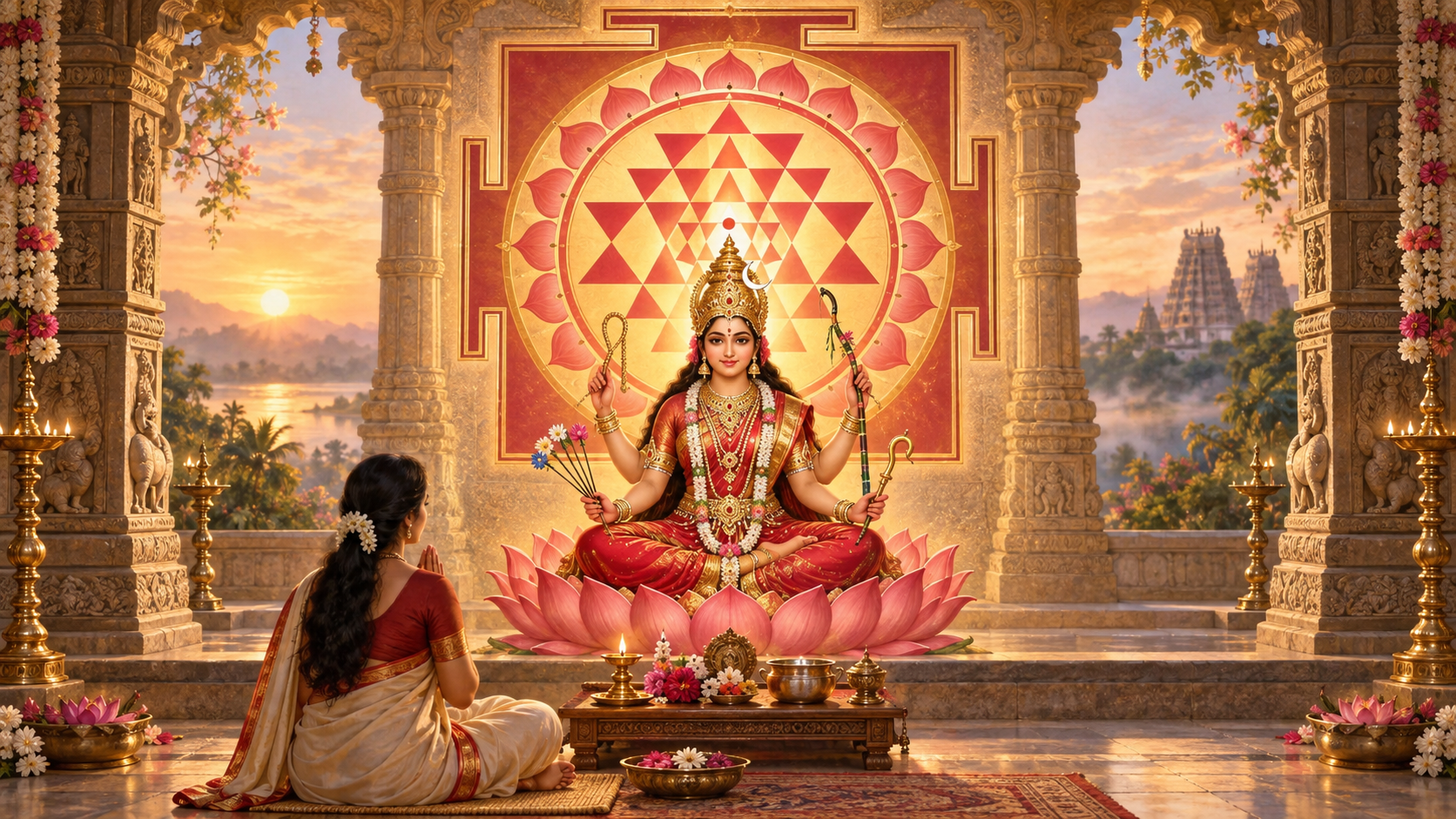
You may feel drawn to Lalita Tripura Sundari, have a Sri Yantra in front of you, and still be unsure what you are actually meant to do. Should you meditate on the diagram, begin a mantra, perform puja, or first seek initiation?
Your first decision is not which advanced practice to attempt. It is whether you want to begin with open devotion, simple contemplation, or formal Sri Vidya sadhana. All three can turn toward the same Devi, but they are not interchangeable.
Keep the Devi, the yantra and the path connected
Lalita Tripura Sundari is the divine presence to whom the practice is directed. The Sri Yantra, also called the Sri Chakra, gives that presence a sacred geometric form. Sri Vidya is the larger discipline through which devotion, contemplation, mantra and ritual are brought together.
- Lalita Tripura Sundari is the object of devotion: not an impersonal technique, but a manifestation of Shakti approached as Devi.
- The Sri Chakra is a form for attention: it is regarded as a geometric embodiment of Lalita’s presence and power, as well as a map of the cosmos and the movement toward union with her.
- Sri Vidya is the disciplined path: it joins worship of Tripura Sundari, Sri Yantra puja, mantra, meditation and guru-diksha within a spiritual orientation toward awakening and liberation.
This distinction prevents three common mistakes. A Sri Yantra is not merely an attractive pattern. A mantra is not a sound formula detached from responsibility and lineage. Lalita is not a mechanism for obtaining whatever the ego happens to desire.
If you are new, begin by holding these elements together: reverence for Devi, careful attention to the yantra, and humility about practices you have not been taught. That is already a more faithful beginning than collecting advanced-looking instructions from unrelated places.
Let the myth and geometry examine your inner life

Lalita’s appearance is associated with the defeat of Bhandasura, a being formed from the ashes of Manmadha, or Kama. You do not have to reduce this account to either literal history or private psychology. In practice, the narrative can also become a demanding question: what remains when desire is merely burned down, rejected or denied?
Ashes are not the same as transformation. Resentment, pride and compulsive craving can survive beneath an appearance of restraint. Read in that practical way, Lalita’s victory calls you to bring awareness and divine order to the residue, not simply to force desire out of sight. This is a contemplative application of the story, not a replacement for its sacred meaning.
The Sri Chakra offers a corresponding discipline of vision. Its nine interlocking triangles form an ordered whole that the ordinary glance cannot absorb all at once. That makes the yantra useful as more than an object to possess. It asks whether your attention can remain steady in the presence of complexity.
For a simple, non-initiatory contemplation, first take in the complete design. Then allow your gaze to notice its interwoven structure without trying to label every line. Let attention settle toward the centre, and finally return to the whole form. Do not claim that this is formal Sri Chakra puja. It is a modest way to train attention while approaching the sacred form respectfully.
You do not need to manufacture visions, sensations or mystical signs. If the design exposes impatience, mental noise or your urge to achieve something dramatic, that observation is already useful. Return to the form without turning an ordinary mental event into proof of spiritual attainment.
Begin with a practice that does not imitate initiation
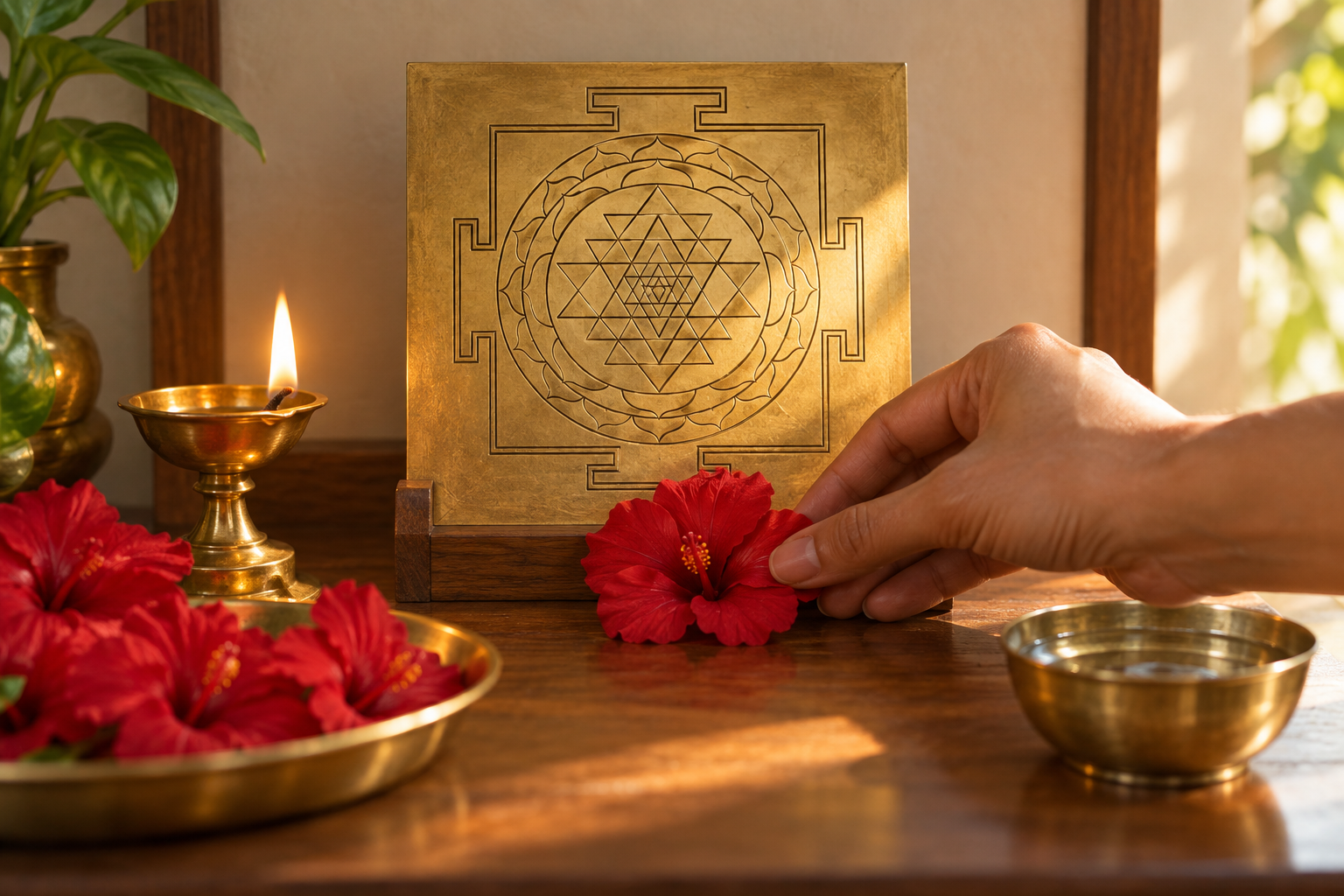
You can establish a sincere relationship with Lalita before receiving a specialised mantra. The boundary is simple: use open acts of devotion and contemplation, but do not reconstruct restricted procedures from fragments found online.
- Prepare a clean, stable place. Use a respectful image of Lalita or a clear Sri Chakra for this limited devotional practice. If you light a lamp, do so only where it can be tended safely.
- State an honest intention. Ask for clearer understanding, steadier conduct and the capacity to recognise what must change. Avoid treating worship as a bargain in which an offering obliges Devi to deliver a result.
- Offer a simple salutation. Bow, join your hands, or use a public prayer already established in your family or temple tradition. You do not need a secret bija mantra to express reverence.
- Contemplate the sacred form. Look at the Sri Chakra as a whole, let attention move gently toward its centre, and return to the whole. When the mind wanders, bring it back without aggression.
- Turn devotion into one concrete restraint or duty. Choose an action that makes your day more truthful, disciplined or compassionate. A practice that never reaches speech and conduct remains incomplete.
- Close deliberately. Offer gratitude, bow, and leave the space in order. Do not carry the session into the day as a claim of spiritual superiority.
Keep this beginning modest enough to repeat. Adding more objects, longer recitations or several unrelated methods does not automatically deepen it. Consistency reveals your actual tendencies; constant novelty can hide them.
If you already belong to a family, temple or initiated tradition, its instructions take priority over a general routine. Do not splice its practice together with techniques drawn from different teachers merely because all of them use the name Sri Vidya.
Know when Sri Vidya requires a guru and diksha
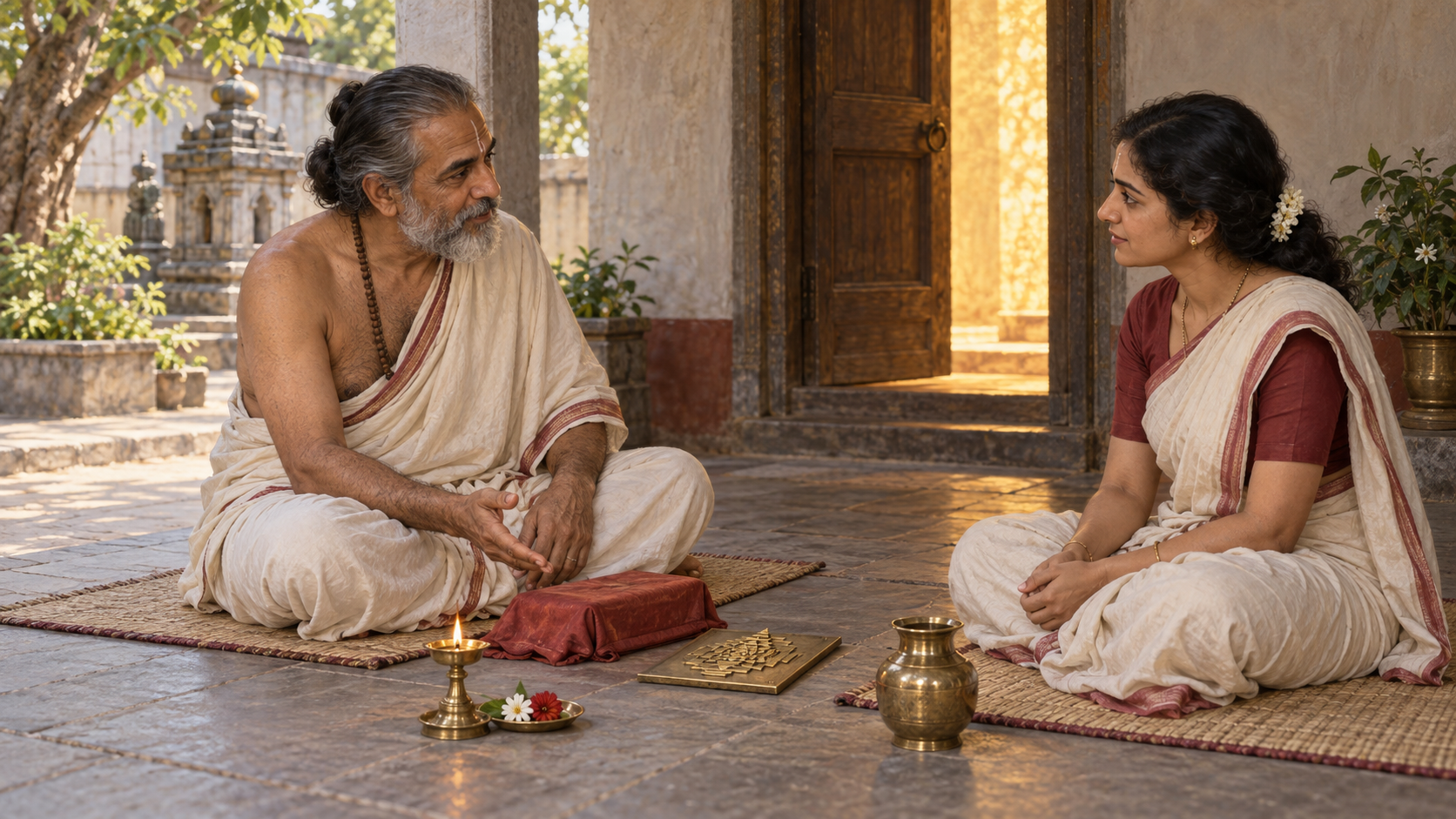
Formal Sri Vidya is not simply private experimentation with sacred syllables. Guru-diksha has particular importance within the path because specialised mantra and ritual belong to a transmitted discipline. Details can vary by lineage, including what is taught, when it is taught and what preparation is expected.
Initiation should therefore be understood as responsibility, not spiritual status. A teacher does more than disclose words. The teacher clarifies the method, establishes its boundaries, corrects errors and places the practice within a living framework. A copied mantra cannot perform those functions.
Before accepting instruction, ask direct questions:
- What lineage or teaching tradition is this practice transmitted through?
- Which practices are open to everyone, and which require diksha?
- What daily commitment will be expected after initiation?
- How will pronunciation, procedure and mistakes be corrected?
- What conduct is expected of the teacher and the student?
- Can you take time to understand the commitment before agreeing?
Be cautious when someone guarantees rapid powers, uses secrecy to prevent reasonable questions, pressures you for money or sexual access, tries to isolate you from family, or presents ordinary disagreement as an offence against Devi. Sacred confidentiality can protect a teaching; it must not protect manipulation.
Likewise, do not assume that every public recitation, temple observance or devotional name requires the same qualification as a lineage-specific mantra practice. Ask the competent teacher responsible for that practice. The useful distinction is not between devotion and prohibition, but between what has been offered publicly and what is transmitted with explicit preparation and obligations.
Key takeaways and your next step

- Lalita is the Devi being approached, the Sri Chakra is her sacred geometric embodiment, and Sri Vidya is the wider path of practice.
- The Sri Yantra is not merely decor or a device for obtaining desires; use it to cultivate reverent, steady attention.
- You can begin with salutation, prayer, contemplation and ethical resolve without pretending to perform an initiated ritual.
- Do not copy bija mantras or assemble advanced procedures from disconnected online instructions.
- Seek a qualified teacher when you are ready for formal mantra, Sri Chakra worship and the obligations of lineage practice.
Choose your next step plainly. If you want devotion, establish a clean place and begin with respectful prayer. If you want contemplative discipline, work patiently with the Sri Chakra without inventing secret meanings. If you want formal Sri Vidya sadhana, put your effort into finding trustworthy guidance rather than accumulating techniques.
Then judge the beginning by its fruit in conduct. Let worship make your attention less scattered, your desires more transparent and your dealings with other people more responsible. That is a sound foundation on which deeper instruction can rest.
References
- Hindu Pad – Lalita | Goddess Lalitha Tripura Sundari Devi
- Hindu Pad – ‘Sri Yantra’ and ‘Sri Lalita Tripura Sundari’
- Hindu Pad – Sri Vidya Sadhana: Major Methods and Main Mantras

Leave a Reply
You must be logged in to post a comment.